
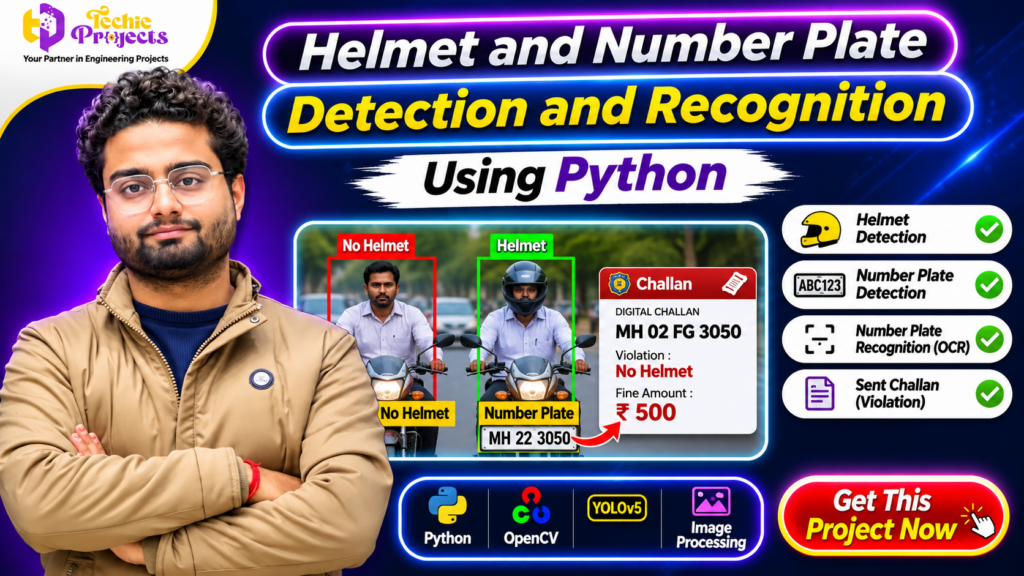
🚀 Looking for a practical AI and computer vision project for your final-year engineering submission? Get the Helmet and Number Plate Detection and Recognition Using Python project from Techie Projects and explore how artificial intelligence can be applied to traffic monitoring and road-safety applications. This project demonstrates helmet detection, number plate identification, and violation-related processing using Python, YOLO, OpenCV, and image processing techniques.
Instead of spending weeks building an entire project from scratch, you can enquire about the available project package, source code, documentation, demonstration, and technical support options. Whether you are a Computer Science, Information Technology, AI and Data Science, or Electronics student, this project offers an opportunity to understand how computer vision models can analyse traffic images and videos.
The Helmet and Number Plate Detection and Recognition Using Python project is designed as an educational implementation of an intelligent traffic-monitoring system. Contact Techie Projects to discuss the available package and confirm the features included before purchasing.
📞 Contact Techie Projects for Project Enquiries
Interested in purchasing the Helmet and Number Plate Detection and Recognition Using Python project? Contact us to enquire about package availability, pricing, source code, documentation, installation guidance, and technical support options.
💬 WhatsApp Enquiry: Chat with Techie Projects
📱 Contact Number: +91 94600 60699
🌐 Official Website: www.techieprojects.com
📸 Instagram: Follow Techie Projects
🎓 Project Categories: Artificial Intelligence, Machine Learning, Python, YOLO, OpenCV, Computer Vision, and Image Processing.
✅ Request Project Details: Share your engineering branch, project requirements, and preferred features to enquire about the most suitable available package.
🚀 Ready to get started? Click here to enquire on WhatsApp and mention Helmet and Number Plate Detection and Recognition Using Python.
Package contents, prices, hardware requirements, and support options should be confirmed before purchase.
🎬 Watch the Helmet and Number Plate Detection Project Demo
Explore the project demonstration to understand how the system processes traffic images or videos, detects helmet-related objects, identifies number plates, and displays the results.
The demonstration can help you understand the project workflow, graphical interface, detection output, and practical implementation concept before making a purchase decision.
🧠 What Is Helmet and Number Plate Detection and Recognition Using Python?
The Helmet and Number Plate Detection and Recognition Using Python project is an AI-based computer vision application that demonstrates how traffic-related objects can be identified from images and video frames.
The system combines object detection and image-processing techniques to identify motorcyclists, classify helmet-related conditions, locate vehicle number plates, and process the detected plate regions for recognition.
Road safety is an important concern in modern cities. Monitoring traffic manually can be time-consuming, particularly when a large number of vehicles pass through busy roads. Computer vision provides an opportunity to automate selected monitoring tasks by analysing visual information.
This project demonstrates how Python-based technologies can be combined to create an educational traffic-monitoring solution.
🎯 Objectives of the Project
The primary objective is to demonstrate an intelligent traffic-monitoring workflow using artificial intelligence and computer vision.
The main objectives include:
- Detecting motorcycles and riders from supported image or video inputs.
- Identifying helmet and no-helmet categories when supported by the trained model.
- Detecting vehicle number plates.
- Extracting number plate regions for further processing.
- Applying OCR techniques to recognise characters from detected plates.
- Displaying detection results through a graphical user interface.
- Demonstrating a traffic-violation workflow for academic purposes.
The project also helps students understand how object detection models and image-processing techniques can work together in a practical application.
⚙️ How Does the System Work?
The Helmet and Number Plate Detection and Recognition Using Python project follows a sequence of processing steps. Each step contributes to analysing the input and presenting the detection results.
1. 📂 Input Image or Video
The system receives an image or video as input. Depending on the implementation, users can select a stored traffic image or video file for processing.
The selected input is passed to the computer vision pipeline for analysis.
2. 🏍️ Vehicle and Rider Detection
The object detection model analyses the input frame and identifies relevant objects. These may include motorcycles, riders, and other trained detection classes.
Bounding boxes and class labels can be displayed around the detected objects to make the results easier to understand.
3. 🪖 Helmet Detection
Helmet detection is one of the important components of this application.
The trained model analyses the rider region and predicts whether the detected class corresponds to a helmet or no-helmet category. The output depends on the model architecture, training dataset, and detection threshold.
This functionality demonstrates how AI can support road-safety monitoring applications.
4. 🔢 Number Plate Detection
After analysing the vehicle, the system identifies the number plate region using an object detection or image-processing method.
The detected region can be cropped and prepared for character recognition. Proper image quality, lighting, plate visibility, and camera angle can influence the output.
5. 🔍 Number Plate Recognition Using OCR
Optical Character Recognition (OCR) is used to extract text from the detected number plate image.
The cropped plate region may undergo preprocessing operations such as resizing, grayscale conversion, thresholding, or noise reduction before recognition.
The OCR output represents the characters detected by the recognition component. Accuracy can vary depending on image quality, plate condition, and OCR configuration.
6. 🚨 Traffic Violation Result
The system can display a result based on the detected helmet category and the recognised number plate.
For demonstration purposes, a challan-related screen or record can be used to illustrate how a violation workflow might operate.
Important: A simulated challan in an academic project is not an official traffic fine. Actual challan generation or submission requires authorised government integration, valid verification procedures, and applicable permissions.
⭐ Key Features of the Project
The Helmet and Number Plate Detection and Recognition Using Python project brings together multiple computer vision concepts in one application.
Depending on the selected implementation package, the features may include:
- Helmet Detection: Identifies helmet-related classes using a trained object detection model.
- No-Helmet Identification: Demonstrates detection of riders classified without helmets.
- Number Plate Detection: Locates vehicle number plate regions in supported images or videos.
- OCR Recognition: Extracts readable characters from detected number plate regions.
- Image Processing: Uses preprocessing techniques to prepare images for analysis.
- Video Processing: Analyses video frames to demonstrate traffic monitoring.
- Graphical User Interface: Provides a user interface for selecting inputs and viewing results.
- Detection Output: Displays labels, bounding boxes, and processing results.
- Violation Demonstration: Shows how helmet-related detection results can be used in a simulated challan workflow.
Please confirm the exact features, model version, and integrations included in the package before purchase.
🛠️ Technologies Used
The project combines Python programming with computer vision and machine learning technologies.
🐍 Python
Python is the main programming language used to develop the application. It provides libraries and frameworks for image processing, model execution, data handling, and application development.
👁️ OpenCV
OpenCV is a computer vision library used for image and video processing. It can perform operations such as reading images, extracting video frames, resizing, colour conversion, and displaying detection results.
🤖 YOLO
YOLO (You Only Look Once) is an object detection approach used to locate and classify objects in images and video frames. A suitable trained model can be used for detecting helmet-related classes, riders, and number plates.
🔤 OCR
OCR technology converts text present in an image into machine-readable characters. In this project, OCR can be applied to cropped number plate images to demonstrate character recognition.
🖥️ Tkinter
Tkinter can be used to create the graphical user interface. It allows users to interact with the application through windows, buttons, labels, and file-selection controls.
💡 Advantages of the Project
The Helmet and Number Plate Detection and Recognition Using Python project provides several learning opportunities for engineering students.
1. Practical Computer Vision Experience
Students can understand how image and video inputs are processed using computer vision techniques.
2. Understanding Object Detection
The project demonstrates object detection concepts, bounding boxes, class labels, and model predictions.
3. Learning OCR Integration
Students can explore how text is extracted from images and how preprocessing can affect recognition results.
4. Real-World Application Concept
Traffic monitoring is a practical application area for AI. This project helps students understand how computer vision can be applied to road-safety-related use cases.
5. Suitable for Academic Demonstrations
The project combines multiple technical concepts that can be discussed during project demonstrations, presentations, and viva examinations.
6. Opportunity for Customisation
Students can explore additional features such as vehicle classification, improved plate preprocessing, dashboard reporting, or a database for storing demonstration results.
🏗️ Project Modules
The application can be organised into separate modules to make the workflow easier to understand and maintain.
| Module | Description |
|---|---|
| Login Module | Provides access to the application where authentication is implemented. |
| Input Module | Selects image or video files for processing. |
| Object Detection Module | Detects trained object classes in input frames. |
| Helmet Detection Module | Classifies helmet-related categories. |
| Number Plate Module | Locates and extracts number plate regions. |
| OCR Module | Processes plate images to recognise characters. |
| Result Module | Displays detection and recognition output. |
| Challan Demonstration Module | Illustrates a simulated violation-related workflow. |
The final module structure depends on the selected project version and its actual implementation.
📚 Applications of Helmet and Number Plate Detection
The concepts demonstrated in this project can be explored in several application areas:
- Smart Traffic Monitoring: Analysing traffic images and video streams.
- Road Safety Research: Studying helmet-use detection techniques.
- Intelligent Transportation Systems: Understanding how AI can assist traffic-related applications.
- Vehicle Identification Research: Exploring number plate detection and OCR.
- Computer Vision Learning: Practising object detection and image-processing methods.
- Academic Research: Testing model performance under different lighting and image conditions.
These are potential application areas. A student implementation should not be treated as a certified traffic enforcement system.
💻 Software and Hardware Requirements
The following is a general development environment for a Python-based computer vision project. Exact requirements depend on the model and libraries included in the package.
Software Requirements
- Programming Language: Python
- Computer Vision Library: OpenCV
- Object Detection: YOLO-based model
- OCR: Compatible OCR library
- Operating System: Windows 10 or Windows 11
- GUI Framework: Tkinter, where included
- Development Environment: Compatible Python IDE or code editor
Hardware Requirements
- Processor: Modern Intel or AMD processor
- RAM: 4 GB minimum recommended for basic experimentation; more may be useful
- Storage: Sufficient space for Python libraries, model weights, and input videos
- Camera: Optional, if live camera input is supported
- GPU: Optional for compatible accelerated model execution
🎓 Why Choose This Project for Your Final Year?
Choosing a final-year project is an important decision for engineering students. A good project should provide technical learning, demonstrate a practical concept, and offer enough scope for explanation and improvement.
The Helmet and Number Plate Detection and Recognition Using Python project brings together artificial intelligence, computer vision, object detection, and OCR. This combination gives students an opportunity to explore different areas of software development within one application.
During a project presentation, students can explain the input-processing workflow, detection model, number plate extraction, OCR operation, and output generation.
It can be relevant to students from:
- Computer Science Engineering
- Information Technology
- Artificial Intelligence and Machine Learning
- Data Science
- Electronics and Communication Engineering
Students should review the project requirements and confirm that the implementation matches their academic guidelines before purchasing.
🚀 Future Scope and Enhancement Ideas
There are several ways to extend the project for further learning and experimentation.
1. Live Camera Integration
A compatible camera input can be added to process frames in real time, subject to the system’s hardware and model performance.
2. Improved Number Plate Recognition
Students can experiment with image enhancement, noise removal, character segmentation, and OCR configurations to improve recognition under different conditions.
3. Database Integration
A database can be introduced to store demonstration records, timestamps, detected plate text, and model outputs.
4. Web-Based Dashboard
A web dashboard can display stored detection records, summary statistics, and project results.
5. Vehicle Classification
Additional trained classes can be used to explore vehicle categories such as cars, motorcycles, buses, and trucks.
6. Model Performance Evaluation
Students can compare detection results using suitable evaluation measures such as precision, recall, and mean average precision, depending on the available dataset and annotations.
These enhancements are optional development ideas and may require additional coding, datasets, hardware, or integrations.
🛒 Purchase Helmet and Number Plate Detection and Recognition Using Python Project from Techie Projects
Are you searching for a ready-to-explore AI and computer vision project for your engineering submission?
Techie Projects provides project solutions across Python, machine learning, artificial intelligence, computer vision, IoT, web development, and other technical domains.
You can enquire about the Helmet and Number Plate Detection and Recognition Using Python project to understand the available package and what is included.
📦 What Can You Enquire About?
Before purchasing, ask our team about the availability of:
- Python project source code.
- Required model files and dependencies.
- Project documentation.
- Installation and execution instructions.
- Demonstration video.
- Explanation of the project workflow.
- Technical assistance options.
- Customisation possibilities, where available.
The exact package contents and support terms should be confirmed with our team.
🎯 Who Can Purchase This Project?
This project may be suitable for:
- B.Tech and B.E. students.
- Computer Science engineering students.
- AI and Machine Learning students.
- IT and Data Science students.
- Diploma engineering students.
- Students exploring computer vision and Python applications.
If you want to understand how object detection and OCR can work together, this project offers a practical academic learning opportunity.
❓ Frequently Asked Questions
1. What is Helmet and Number Plate Detection and Recognition Using Python?
It is an educational computer vision project that demonstrates helmet-related object detection, vehicle number plate detection, and OCR-based text recognition using Python technologies.
2. Which programming language is used?
Python is the primary programming language used in the project.
3. Which technologies are used?
The implementation may use Python, OpenCV, YOLO, OCR, and Tkinter, depending on the selected package.
4. Can the project process videos?
Video processing can be supported when the selected implementation includes video input and frame-processing functionality.
5. Does the project generate real traffic challans?
A project demonstration may show a simulated challan workflow. Actual government challan generation requires authorised integration and approval; it should not be assumed to be included.
6. Can students customise the project?
Yes, students can explore enhancements such as database integration, dashboard development, improved OCR, and additional object detection classes. Additional work may be required.
7. How can I purchase this project?
Contact Techie Projects through WhatsApp at +91 94600 60699. Share your project name and requirements to enquire about pricing, package availability, and support.
💡 Recommended Projects
Explore more AI, Python, and computer vision projects from Techie Projects:
- Helmet Detection Using Machine Learning
- Number Plate Recognition Using Python
- Vehicle Detection and Counting Using YOLO
- Automatic Traffic Management System
- Face Recognition Attendance System
- Object Detection Using Deep Learning
- Accident Detection Using Machine Learning
These related topics can help students explore additional engineering project ideas.
🌐 Explore More Engineering Projects at Techie Projects
Looking for more final-year engineering projects? Explore the Techie Projects website for project ideas and solutions across multiple technical domains.
You can discover projects related to:
- Artificial Intelligence Projects
- Machine Learning Projects
- Python Projects
- Computer Vision Projects
- Image Processing Projects
- Deep Learning Projects
- IoT and Embedded Systems Projects
- Data Science Projects
- Web Development Projects
Visit www.techieprojects.com to explore available projects and contact our team for enquiries.
📞 Get Your Helmet and Number Plate Detection Project Today!
Build your understanding of artificial intelligence, YOLO-based object detection, OpenCV, and OCR with the Helmet and Number Plate Detection and Recognition Using Python project.
If you are planning your final-year engineering project and want to explore this implementation, contact Techie Projects today. Our team can help you check package availability, pricing, project details, and the support options available for your requirements.
💬 WhatsApp: Enquire Now – +91 94600 60699
🌐 Website: www.techieprojects.com
📸 Instagram: @pythonprojects_
🎓 Techie Projects – Your Partner in Engineering Projects.

