
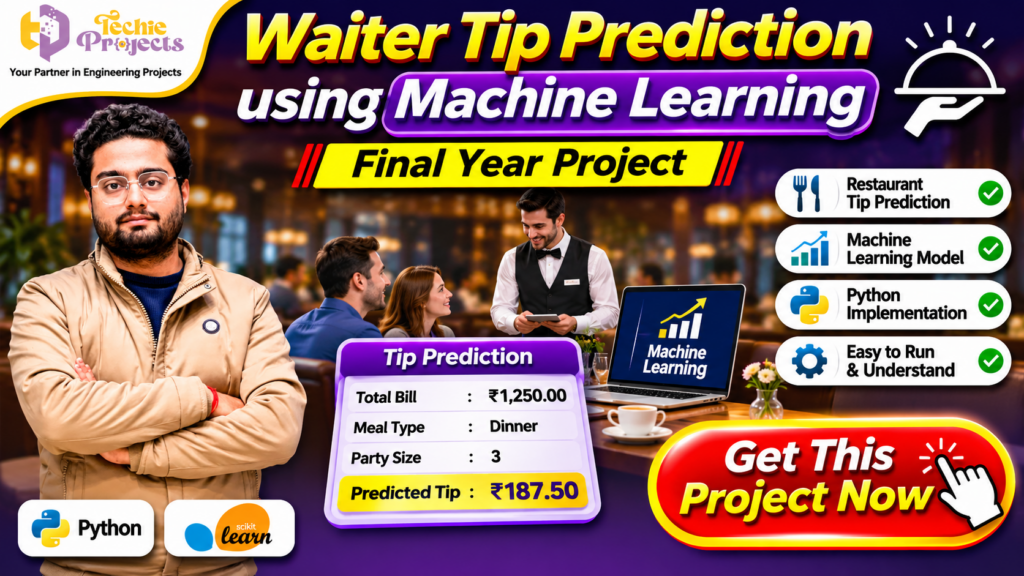
Looking for a practical Machine Learning project that combines Python programming, data analysis, and real-world business applications? Waiter Tip Prediction Using Machine Learning is an excellent project choice for engineering students, computer science students, and final-year project demonstrations.
Get this project from Techie Projects and explore how machine learning techniques can be used to estimate restaurant tips based on relevant information such as the total bill, meal type, party size, and other available dataset features. Instead of developing everything from scratch, you can get a ready project package with source code, project details, and implementation guidance to support your academic work.
Whether you need a Python machine learning project for your final-year submission, a practical demonstration, or an opportunity to understand predictive analytics, this project offers an interesting way to explore how data can support everyday business decisions.
📞 Contact Techie Projects for Project Enquiries
Want to purchase the Waiter Tip Prediction project? Contact Techie Projects to discuss project availability, source code, documentation, and implementation support.
- 📞 Call/WhatsApp: +91-9460060699
- 🌎 Website: www.techieprojects.com
- 📺 Instagram: @pythonprojects_
Contact us today to enquire about purchasing this project for your academic requirements.
🎬 Watch the Waiter Tip Prediction Using Machine Learning Project Demo
Explore the project demonstration to understand its interface, workflow, input details, and prediction process. The demo can help you become familiar with how the application works before purchasing the project.
📌 What Is Waiter Tip Prediction Using Machine Learning?
Waiter Tip Prediction Using Machine Learning is a Python-based predictive analytics project designed to estimate the tip amount using relevant restaurant billing and customer-related information.
In restaurants, tips may depend on several factors, including the total bill, number of customers, meal timing, and other available information. Machine learning provides a way to study historical data and identify patterns that can help estimate a possible tip amount.
The project uses a dataset to train a machine learning model. After training, the model can process suitable input values and generate a predicted tip.
For example, a restaurant bill may include details such as:
- Total bill amount
- Number of people at the table
- Meal category, such as lunch or dinner
- Other relevant dataset attributes
The model uses the features supported by its training dataset to estimate the expected tip. The exact prediction depends on the dataset, preprocessing, selected algorithm, and model performance.
This makes the project useful for understanding regression, data preprocessing, model training, and prediction in a practical business scenario.
🎯 Main Objectives of the Project
The main objective is to demonstrate how machine learning can be applied to restaurant-related data to estimate tip amounts.
Key objectives include:
- Understand restaurant data: Explore the relationship between billing information and tip values.
- Prepare the dataset: Clean and organize the available data for model training.
- Apply machine learning: Train a suitable predictive model using relevant input features.
- Generate predictions: Estimate tip values for new inputs supported by the model.
- Understand model performance: Evaluate the prediction results using suitable regression metrics.
- Build practical experience: Learn how a machine learning workflow can be implemented using Python.
⚙️ Technologies Used in the Project
The project can help students understand several important technologies used in data science and machine learning.
🐍 Python Programming
Python is the primary programming language for implementing the project. Its simple syntax and extensive library ecosystem make it suitable for data analysis, machine learning, and application development.
📊 Pandas
Pandas is useful for loading, organizing, cleaning, and exploring structured datasets. Students can use it to examine restaurant records and prepare the data for model training.
🔢 NumPy
NumPy supports numerical operations and array-based calculations. It can be used as part of the data processing and machine learning workflow.
🤖 Scikit-learn
Scikit-learn provides machine learning algorithms and utilities for data preprocessing, model training, and evaluation. A regression algorithm can be selected according to the dataset and project implementation.
📈 Matplotlib and Seaborn
These visualization libraries can help display relationships between variables, explore data distributions, and understand patterns in the dataset.
The exact libraries and algorithms included depend on the delivered project implementation.
🔍 How Does the Prediction System Work?
The project follows a typical machine learning workflow. Understanding these stages will help students explain the system during project presentations and viva examinations.
1. Dataset Collection
The first step is obtaining a suitable dataset containing restaurant billing information and corresponding tip values. The dataset provides examples from which the model can learn patterns.
2. Data Preprocessing
Raw data may contain missing values, inconsistent formats, or unnecessary columns. Data preprocessing prepares the information for machine learning.
Typical activities may include:
- Checking missing values
- Removing or handling duplicate records
- Selecting relevant columns
- Converting categorical values into numerical representations
- Separating input features and target values
3. Exploratory Data Analysis
Exploratory data analysis helps students understand the dataset before training the model.
Graphs and statistical summaries can help identify relationships between bill amounts, party sizes, and tip values.
4. Model Training
The prepared dataset is used to train a suitable regression model. The algorithm learns patterns between the selected input features and the recorded tip amounts.
5. Model Evaluation
The trained model should be evaluated using suitable metrics, such as:
- Mean Absolute Error (MAE)
- Mean Squared Error (MSE)
- Root Mean Squared Error (RMSE)
- R-squared score
These metrics help assess how closely predictions match actual values in the evaluation data.
6. Tip Prediction
Once training is complete, the model can accept supported input values and estimate a tip amount. The output is a prediction, not a guaranteed amount that a customer will pay.
⭐ Key Features of the Waiter Tip Prediction Project
The project provides an academic example of applying machine learning to a restaurant business problem.
Depending on the implementation, its features may include:
- Restaurant tip estimation: Predict a possible tip value using supported input variables.
- Python implementation: Explore a machine learning workflow using Python.
- Dataset analysis: Understand relationships between restaurant data attributes.
- Data preprocessing: Learn how raw data is prepared for model training.
- Regression modelling: Apply predictive modelling to a numerical target.
- Prediction workflow: Enter supported values and view the estimated result.
- Model evaluation: Examine prediction performance using regression metrics.
- Academic demonstration: Use the project to explain practical machine learning concepts.
💡 Real-World Applications of Tip Prediction
Predictive analytics is increasingly used to understand customer behaviour and business trends. A restaurant tip estimation model provides a simple academic example of how historical data can be used to generate predictions.
🍽️ Restaurant Business Analysis
Restaurants can study historical billing and tipping patterns to understand customer behaviour. A predictive model can serve as an educational demonstration of this type of analysis.
📊 Customer Behaviour Research
Students can examine how different variables relate to tipping patterns. This can help develop an understanding of data-driven decision-making.
📈 Predictive Analytics Learning
The project demonstrates how historical records can be used to train a model that estimates numerical values for new inputs.
🎓 Academic Machine Learning Demonstrations
Students can use the project to explain regression, data preprocessing, model evaluation, and prediction during academic presentations.
Important: This project is an educational demonstration. Its predictions should not be treated as guaranteed customer behaviour or used as the sole basis for restaurant business decisions.
🎓 Why Choose This Project for Your Final Year?
Choosing an appropriate final-year project is important for students who want to demonstrate practical technical knowledge.
Waiter Tip Prediction Using Machine Learning offers a focused problem statement and a clear workflow that students can explain during project demonstrations.
Some reasons to consider this project include:
- It introduces a practical application of machine learning.
- It demonstrates numerical prediction using regression.
- It provides experience with structured datasets.
- It combines Python programming and data analysis.
- It offers opportunities to understand model evaluation.
- It can be extended with additional features as part of academic learning.
Students who are interested in Python, data science, artificial intelligence, and predictive analytics can use this project to strengthen their understanding of machine learning concepts.
🛠️ Possible Project Enhancements
Students may extend the basic project with additional functionality, depending on their technical requirements and available data.
1. Interactive Prediction Interface
An improved interface can allow users to enter supported restaurant information and view the predicted tip.
2. Data Visualization Dashboard
Charts can display the relationship between bill amount, party size, and tip values.
3. Model Comparison
Students can experiment with multiple regression algorithms and compare their performance using consistent evaluation metrics.
4. Improved Dataset
A larger and more representative dataset may help students investigate whether model performance improves across different restaurant scenarios.
5. Prediction History
A history feature could store previous inputs and predictions for later review, if supported by the application architecture.
These enhancements can help students explore additional development concepts beyond the basic machine learning workflow.
🧑💻 What Can You Learn from This Project?
Working with this project can provide practical exposure to several technical topics.
| Learning Area | What You Can Explore |
|---|---|
| Python | Programming and application development |
| Data Analysis | Dataset exploration and preparation |
| Pandas | Handling structured data |
| NumPy | Numerical calculations |
| Machine Learning | Training predictive models |
| Regression | Predicting numerical values |
| Visualization | Displaying data patterns |
| Model Evaluation | Measuring prediction performance |
The project can also help students understand how to explain a technical problem, describe a solution, and present model outputs during an academic demonstration.
🚀 Benefits of Waiter Tip Prediction Using Machine Learning
Waiter Tip Prediction Using Machine Learning offers students an opportunity to understand how predictive analytics can solve a practical business-related problem. By analysing restaurant data, the system demonstrates how historical information can be used to estimate possible tip amounts.
Some important benefits include:
- Practical machine learning: Understand how regression models generate numerical predictions.
- Restaurant data analysis: Explore relationships between billing amounts, party sizes, and tip values.
- Python programming experience: Work with popular data science libraries and machine learning techniques.
- Prediction-based learning: Understand how a trained model processes new input values.
- Academic project development: Explore a real-world-inspired problem for a final-year engineering demonstration.
📊 Why Is Waiter Tip Prediction Using Machine Learning Useful for Students?
Students studying computer science, artificial intelligence, and data science can use this project to explore the complete machine learning development process.
Waiter Tip Prediction Using Machine Learning connects theoretical concepts with a practical application. It helps learners understand dataset preparation, feature selection, model training, regression analysis, and performance evaluation.
The project also provides scope for experimentation. Students can compare different regression algorithms, examine prediction errors, and investigate how input features influence model results.
🛠️ Development Scope of Waiter Tip Prediction Using Machine Learning
The development process can be expanded with additional features depending on academic requirements.
Possible improvements include:
- Adding an interactive interface for entering restaurant information.
- Displaying predicted tip amounts with clear output labels.
- Creating graphs to compare actual and predicted values.
- Comparing multiple regression algorithms.
- Improving data preprocessing and model evaluation.
- Adding a prediction history feature.
These enhancements can make Waiter Tip Prediction Using Machine Learning a more detailed academic demonstration while helping students gain practical development experience.
📦 Why Purchase Your Project from Techie Projects?
If you are searching for a machine learning project for your academic requirements, Techie Projects can help you explore a suitable project package.
Instead of spending unnecessary time searching for unrelated code examples, you can enquire about the project directly and confirm what is included before placing an order.
Benefits of Enquiring with Techie Projects
- Project-focused assistance: Discuss your selected project and academic requirements.
- Python-based implementation: Explore the available implementation and technologies.
- Source code availability: Confirm the source code package before purchase.
- Documentation details: Ask about the available project documentation.
- Demonstration support: Review the project demonstration to understand its workflow.
- Technical guidance: Discuss available implementation and setup assistance.
The exact package contents, documentation, and support arrangements should be confirmed with our team before purchase.
💰 Who Should Purchase This Project?
This project may be suitable for:
- B.Tech Computer Science Engineering students
- BCA and MCA students
- Data Science students
- Artificial Intelligence and Machine Learning students
- Students learning Python programming
- Students looking for a regression-based academic project
- Learners interested in predictive analytics
If you need a practical example of machine learning applied to restaurant data, this project is worth exploring.
🛒 How to Purchase Waiter Tip Prediction Using Machine Learning from Techie Projects
Getting started is simple. Follow these steps to enquire about the project.
Step 1: Contact Our Team
Visit Techie Projects or contact us through WhatsApp.
Step 2: Share Your Requirements
Tell us that you are interested in the Waiter Tip Prediction project. Mention your course, academic requirements, and preferred technology details.
Step 3: Confirm Project Package Details
Ask our team about source code, documentation, software requirements, demonstration, and available technical assistance.
Step 4: Confirm Pricing and Delivery
Confirm the project price, package contents, and delivery arrangements before making payment.
Step 5: Get Started
After confirming your order, follow the provided instructions to set up and explore the project.
📞 Purchase Your Python Machine Learning Project Today!
Are you looking for a practical machine learning project for your final-year submission? Waiter Tip Prediction Using Machine Learning is an interesting academic project that demonstrates how Python and predictive modelling can be applied to restaurant data.
Get in touch with Techie Projects to enquire about the project package, source code, documentation, and technical assistance.
📞 Call/WhatsApp: +91-9460060699
🌎 Website: www.techieprojects.com
📺 Instagram: @pythonprojects_
Don’t wait until your project submission deadline approaches. Contact Techie Projects today and discuss your requirements!
🚀 Explore Related Python and Machine Learning Projects
Interested in exploring more academic projects? Check out related categories and discover other project ideas.
- Python Projects
- Machine Learning Projects
- Artificial Intelligence Projects
- Data Science Projects
- Data Analytics Projects
- Final Year Engineering Projects
- Deep Learning Projects
Visit Techie Projects to explore more project options.
❓ Frequently Asked Questions (FAQs)
1. What is Waiter Tip Prediction Using Machine Learning?
It is a Python-based machine learning project that estimates restaurant tip amounts using relevant input features and a trained predictive model.
2. Which programming language is used?
Python is the primary programming language used for the machine learning workflow.
3. Is this project suitable for final-year engineering students?
Yes. It can be considered for academic demonstrations involving Python, data analysis, regression, and machine learning.
4. Which machine learning technique is used?
The task is a numerical prediction problem and can be implemented using regression algorithms. The exact algorithm depends on the project implementation.
5. Can I get the source code?
Contact Techie Projects to confirm source code availability and the contents of the project package.
6. Does the system predict the exact tip amount?
No. The system generates an estimated value based on patterns learned from its training data. Actual tips may vary depending on customer behaviour and other factors.
7. How can I purchase this project?
Contact Techie Projects through WhatsApp at +91 94600 60699 or visit https://techieprojects.com/ to discuss pricing and project availability.
🎯 Conclusion
Waiter Tip Prediction Using Machine Learning is a practical academic project for students interested in Python programming, data analysis, and predictive modelling. It demonstrates how restaurant-related data can be processed and used to estimate numerical outcomes through a machine learning workflow.
From dataset preparation and exploratory analysis to regression model training and evaluation, the project provides an opportunity to understand important concepts in applied machine learning.
If you want to explore this project for your final-year academic requirements, contact Techie Projects today. Discuss your requirements, confirm the available package details, and take the next step towards your project demonstration.