
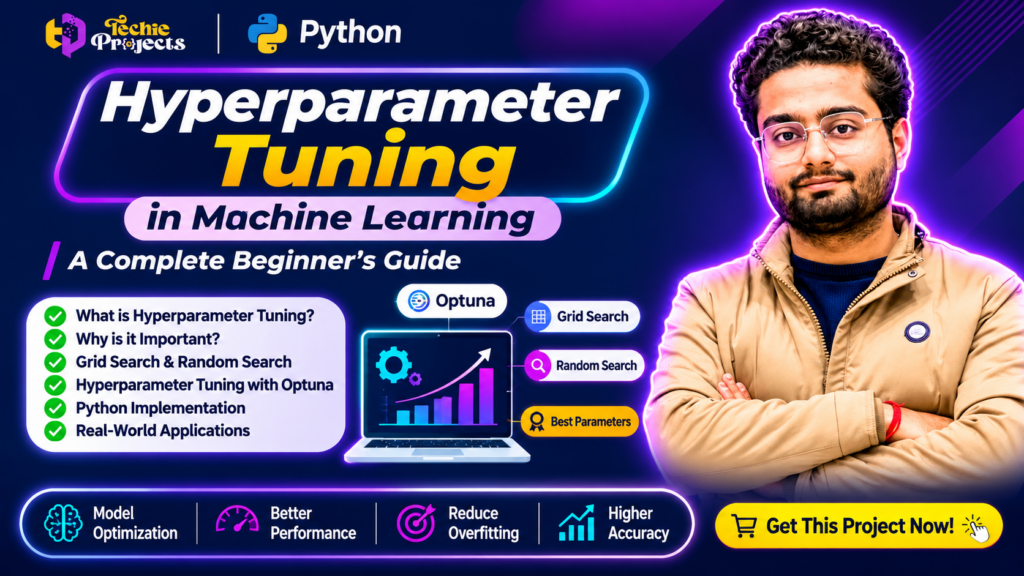
🚀 Looking to purchase a Hyperparameter Tuning in Machine Learning Project for your final-year engineering project, B.Tech submission, M.Tech research, or machine learning portfolio? Get a practical Python-based project from Techie Projects and explore how intelligent parameter optimization can improve machine learning model performance.
Don’t spend weeks struggling to build a machine learning optimization project from scratch. Our Hyperparameter Tuning in Machine Learning Project helps students and developers understand how different model configurations affect prediction accuracy, training performance, and generalization.
Whether you are preparing a final-year project, developing a machine learning application, or learning advanced Python techniques, this project offers a practical way to explore model optimization using popular techniques such as Grid Search, Random Search, and Optuna.
🎯 Get your Hyperparameter Tuning in Machine Learning Project from Techie Projects! Contact our team to discuss project availability, source code, implementation details, documentation, and customization options.
📞 Contact Techie Projects for Project Enquiries
Interested in purchasing this machine learning project? Connect with our team to discuss pricing, project requirements, and available support.
- 📞 Contact / WhatsApp: +91 94600 60699
- 🌐 Website: www.techieprojects.com
- 📸 Instagram: Techie Projects
🎬 Watch the Hyperparameter Tuning in Machine Learning Project Demo
Explore the practical implementation, workflow, and functionality of the project through our demonstration video.
📌 What Is Hyperparameter Tuning in Machine Learning?
Hyperparameter Tuning in Machine Learning is the process of finding the best configuration of parameters that control how a machine learning algorithm learns from training data.
Machine learning algorithms contain parameters that are learned automatically during training. However, hyperparameters are selected before or during the model training process and influence the learning procedure.
For example, consider a Random Forest classifier. Its performance can depend on several hyperparameters:
- Number of decision trees.
- Maximum depth of each tree.
- Minimum samples required for splitting.
- Minimum samples required at a leaf node.
- Number of features considered during splitting.
Choosing appropriate values can improve prediction performance and help prevent overfitting.
The main objective of Hyperparameter Tuning in Machine Learning is to identify a configuration that performs effectively on unseen data rather than simply achieving high accuracy on training data.
🎯 Why Is Hyperparameter Tuning Important?
Selecting appropriate hyperparameters is an important step in developing reliable machine learning applications.
A model trained with default settings may not provide the best possible results for a particular dataset.
Here are some important reasons to perform optimization:
1. Improve Model Accuracy
Different hyperparameter combinations can produce different prediction results. Optimization helps identify configurations that improve performance on validation data.
2. Reduce Overfitting
A highly complex model may memorize training examples instead of learning general patterns. Proper parameter selection and validation techniques help control model complexity.
3. Improve Generalization
A good machine learning model should perform well on new datasets. Parameter optimization helps identify configurations that generalize effectively.
4. Optimize Training Performance
Some configurations require more computational resources than others. Efficient search techniques can help balance model performance and computational cost.
5. Support Better Decision-Making
Businesses use optimized machine learning models for forecasting, classification, fraud detection, customer analysis, and other predictive applications.
🛠️ Technologies Used in This Python Project
The Hyperparameter Tuning in Machine Learning Project can be implemented using popular Python libraries and machine learning tools.
Important technologies include:
Python: The primary programming language used for data processing, model development, and optimization.
NumPy: Used for numerical calculations and array operations.
Pandas: Helps load, clean, organize, and analyze datasets.
Matplotlib: Used to create graphs and visualize model performance.
Seaborn: Provides statistical visualization tools.
Scikit-learn: Provides machine learning algorithms, model evaluation techniques, and parameter search utilities.
Optuna: An optimization framework used for efficient hyperparameter search.
Jupyter Notebook: Provides an interactive environment for developing and testing machine learning code.
💻 Installation and Project Requirements
Before implementing Hyperparameter Tuning in Machine Learning using Python, install Python and the required libraries.
Step 1: Install Python
Download Python from the official website:
https://www.python.org/downloads
Install a compatible Python version and configure the environment variables.
Step 2: Install Required Libraries
Open Command Prompt or Terminal and execute:
pip install numpy pandas matplotlib seaborn
pip install scikit-learn optuna
pip install jupyter
Step 3: Import Required Libraries
Import the required modules into your Python program:
import numpy as np
import pandas as pd

import matplotlib.pyplot as plt
import seaborn as sns

from sklearn.model_selection import (
    train_test_split,
    GridSearchCV,
    RandomizedSearchCV
)

from sklearn.ensemble import RandomForestClassifier
from sklearn.metrics import accuracy_score, classification_report

import optuna
These libraries provide the essential functionality required to develop and evaluate machine learning models.
⚙️ How Does Hyperparameter Tuning Work?
The optimization process generally follows a systematic workflow.
- Load the dataset.
- Perform data cleaning and preprocessing.
- Divide the dataset into training and testing sets.
- Select a machine learning algorithm.
- Define the hyperparameter search space.
- Apply an optimization technique.
- Train models using different configurations.
- Evaluate model performance.
- Select the best configuration.
- Test the optimized model using unseen data.
This workflow helps developers understand how model configuration influences prediction performance.
🔍 Different Hyperparameter Tuning Techniques
There are several techniques available for finding suitable machine learning configurations.
1. Grid Search
Grid Search is a systematic optimization technique that evaluates every combination of hyperparameter values defined in a search grid.
For example:
param_grid = {
    'n_estimators': [50, 100, 200],
    'max_depth': [5, 10, 20],
    'min_samples_split': [2, 5, 10]
}

model = RandomForestClassifier(random_state=42)

grid_search = GridSearchCV(
    estimator=model,
    param_grid=param_grid,
    cv=5,
    scoring='accuracy',
    n_jobs=-1
)

grid_search.fit(X_train, y_train)

print("Best Parameters:")
print(grid_search.best_params_)

print("Best Score:")
print(grid_search.best_score_)
Grid Search is useful when the number of parameters and possible combinations is relatively small.
2. Random Search
Random Search evaluates randomly selected combinations from a predefined parameter distribution.
Unlike Grid Search, it does not need to evaluate every possible combination.
from sklearn.model_selection import RandomizedSearchCV

param_dist = {
    'n_estimators': [50, 100, 150, 200],
    'max_depth': [5, 10, 15, 20, None],
    'min_samples_split': [2, 4, 6, 8]
}

random_search = RandomizedSearchCV(
    estimator=RandomForestClassifier(random_state=42),
    param_distributions=param_dist,
    n_iter=20,
    cv=5,
    scoring='accuracy',
    random_state=42,
    n_jobs=-1
)

random_search.fit(X_train, y_train)

print(random_search.best_params_)
Random Search is useful when the search space is large and computational resources are limited.
3. Hyperparameter Optimization Using Optuna
Optuna is a popular Python framework designed to automate hyperparameter optimization.
It supports intelligent search strategies and helps developers explore parameter combinations efficiently.
Example:
def objective(trial):

    n_estimators = trial.suggest_int(
        "n_estimators", 50, 200
    )

    max_depth = trial.suggest_int(
        "max_depth", 3, 20
    )

    model = RandomForestClassifier(
        n_estimators=n_estimators,
        max_depth=max_depth,
        random_state=42
    )

    model.fit(X_train, y_train)

    predictions = model.predict(X_test)

    accuracy = accuracy_score(
        y_test, predictions
    )

    return accuracy


study = optuna.create_study(
    direction="maximize"
)

study.optimize(objective, n_trials=30)

print("Best Parameters:")
print(study.best_params)
This example demonstrates how Optuna can search for model configurations based on a selected evaluation metric.
For production-quality experiments, use a separate validation set or cross-validation within the optimization process and reserve the test set for final evaluation.
📊 Model Evaluation and Performance Analysis
Model evaluation is an essential part of Hyperparameter Tuning in Machine Learning.
A model should not be selected only because it achieves high training accuracy.
Different evaluation metrics can help measure performance depending on the problem.
Accuracy
Accuracy measures the proportion of correctly predicted observations.
Precision
Precision measures how many positive predictions are actually positive.
Recall
Recall measures how many actual positive observations are correctly identified.
F1-Score
F1-score combines precision and recall using their harmonic mean.
Confusion Matrix
A confusion matrix provides a detailed comparison between actual and predicted classifications.
Example:
from sklearn.metrics import (
    accuracy_score,
    precision_score,
    recall_score,
    f1_score,
    confusion_matrix
)

predictions = model.predict(X_test)

print("Accuracy:", accuracy_score(y_test, predictions))
print("Precision:", precision_score(
    y_test, predictions, average='weighted'
))
print("Recall:", recall_score(
    y_test, predictions, average='weighted'
))
print("F1 Score:", f1_score(
    y_test, predictions, average='weighted'
))

print(confusion_matrix(y_test, predictions))
These metrics help developers understand model strengths and identify areas that require improvement.
📈 Applications of Hyperparameter Tuning in Machine Learning
Hyperparameter optimization is used across several industries and research domains.
1. Healthcare Prediction
Machine learning models can support disease prediction, medical image classification, and patient risk analysis. Proper optimization can help improve predictive performance.
2. Financial Fraud Detection
Financial institutions use classification algorithms to identify suspicious transactions and unusual financial activities.
3. Stock Market Prediction
Machine learning algorithms can analyze historical market information and identify patterns for predictive modelling.
4. Customer Churn Prediction
Businesses use predictive models to identify customers who may stop using their products or services.
5. Weather Forecasting
Optimized machine learning models can help analyze historical weather information and predict environmental conditions.
6. Image Classification
Computer vision applications use machine learning and deep learning models to classify images and recognize objects.
7. Recommendation Systems
E-commerce platforms and digital services use predictive algorithms to recommend relevant products and content.
🎓 Why Choose This Hyperparameter Tuning in Machine Learning Project?
If you are looking for a practical machine learning project for academic learning or portfolio development, this implementation can provide a useful starting point.
At Techie Projects, we focus on practical technology solutions across Python, Artificial Intelligence, Machine Learning, Data Science, Deep Learning, and Computer Vision.
By choosing this project, you can explore:
- Practical Python Implementation: Understand how machine learning algorithms work with real datasets.
- Optimization Techniques: Explore Grid Search, Random Search, and Optuna.
- Model Evaluation: Learn how to compare different configurations using suitable evaluation metrics.
- Technical Understanding: Study the complete workflow from preprocessing to model evaluation.
- Learning Support: Discuss implementation-related questions and available support options with our team.
- Customization Opportunities: Discuss modifications based on your academic or project requirements.
- Portfolio Development: Use the project as a learning reference when building your machine learning portfolio.
🛒 Get This Hyperparameter Tuning in Machine Learning Project Now!
Ready to explore machine learning optimization through a practical Python implementation?
Purchase your Hyperparameter Tuning in Machine Learning Project from Techie Projects and get started with an implementation designed to help you understand parameter optimization, model training, and performance evaluation.
Our team can discuss the available project package, including:
- Python source code availability.
- Dataset and preprocessing details.
- Project implementation workflow.
- Technical documentation availability.
- Installation and execution guidance.
- Customization possibilities.
- Project demonstration and support options.
The exact deliverables and support included will be confirmed before purchase.
🎯 Why wait? Contact Techie Projects today and take the next step in your machine learning learning journey!
📲 WhatsApp: +91-9460060699
🌐 Explore: www.techieprojects.com
💡 Recommended Python and Machine Learning Projects
Explore more practical project opportunities from Techie Projects:
- Machine Learning Prediction System: Develop predictive models using historical datasets.
- Weather Forecasting Using Machine Learning: Analyze weather information and predict future conditions.
- Fake News Detection Using Machine Learning: Identify potentially misleading news articles.
- Stock Price Prediction: Analyze historical stock market data using machine learning.
- Air Quality Prediction System: Analyze environmental measurements and predict air pollution levels.
- Satellite Image Analysis Using Python: Process and analyze satellite imagery.
- Data Visualization Using Python: Create interactive visualizations from complex datasets.
- Customer Churn Prediction: Identify customers who may discontinue a service.
Visit www.techieprojects.com to explore additional engineering projects and technical solutions.
❓ Frequently Asked Questions About Hyperparameter Tuning in Machine Learning
1. What is Hyperparameter Tuning in Machine Learning?
It is the process of selecting suitable configurations for machine learning algorithms to improve their performance and generalization on unseen data.
2. Which Python libraries are used for hyperparameter optimization?
Popular libraries include Scikit-learn, Optuna, Hyperopt, NumPy, Pandas, and other machine learning tools.
3. What is the difference between Grid Search and Random Search?
Grid Search evaluates every specified parameter combination, whereas Random Search evaluates a selected number of randomly sampled combinations.
4. Is Optuna suitable for beginners?
Yes. Beginners can use Optuna to understand optimization workflows and experiment with different machine learning configurations.
5. Can I purchase this project for my final-year engineering submission?
You can contact Techie Projects to discuss project availability, academic requirements, pricing, and customization options. Use the implementation as a learning reference and follow your institution’s rules for project submission and disclosure.
6. Does hyperparameter optimization guarantee 100% accuracy?
No. Results depend on the dataset, algorithm, preprocessing, evaluation method, and selected parameters. Optimization does not guarantee perfect predictions.
7. How can I purchase this project from Techie Projects?
Simply contact our team through WhatsApp at +91 94600 60699. Share your project requirements and our team will guide you regarding availability, pricing, and purchase details.
🚀 Conclusion
Hyperparameter optimization is an important part of developing effective machine learning solutions. It allows developers to experiment with different configurations, evaluate model performance, and identify suitable settings for specific datasets.
By exploring Grid Search, Random Search, and Optuna, students can understand how optimization techniques contribute to modern machine learning workflows.
If you are interested in learning through a practical implementation, our Hyperparameter Tuning in Machine Learning Project is an opportunity to explore Python-based model optimization.
Get your project from Techie Projects today! Contact our team to discuss pricing, source code availability, documentation, and implementation support.
🌐Website: www.techieprojects.com

