
Introduction
Carbon dioxide emission prediction using machine learning is an environmental data science project that uses historical data and machine learning algorithms to estimate CO₂ emission levels. This Python-based project is suitable for B.Tech, B.E., computer science, artificial intelligence, and data science students looking for a practical final-year project.
The carbon dioxide emission prediction using machine learning project demonstrates how historical environmental data can be analyzed to estimate emission levels and identify useful patterns for data-driven research.
As environmental sustainability becomes increasingly important, analyzing emission patterns can help researchers and organizations understand trends and explore data-driven approaches to environmental monitoring. This project demonstrates how Python, data preprocessing, exploratory data analysis, and machine learning can work together to build an emission prediction system.
🎬 Carbon Dioxide Emission Prediction Using Machine Learning – Project Demo Video
Explore the project demonstration to understand how the carbon dioxide emission prediction system works, how data is processed, and how the machine learning model generates predictions. The demo also helps you understand the project workflow and its potential applications in environmental data analysis.
What Is a Carbon Dioxide Emission Prediction Project?
A carbon dioxide emission prediction project uses historical emission data and relevant input variables to estimate CO₂ emissions. Depending on the dataset, inputs may include energy consumption, fuel usage, industrial activity, transportation data, or other environmental indicators.
The system learns patterns from the available training data and uses them to generate predictions for new input values. Its usefulness depends on the quality of the dataset, the selected features, and the performance of the trained model.
🎯 Objectives of the Project
The main objectives of this machine learning project are:
- Analyze historical carbon dioxide emission data.
- Clean and preprocess data for model training.
- Explore relationships between input variables and emission levels.
- Train a suitable machine learning regression model.
- Predict emission values from supported input features.
- Visualize historical trends and prediction results.
- Demonstrate the practical use of Python in environmental data analysis.
⚙️ How Does the System Work?
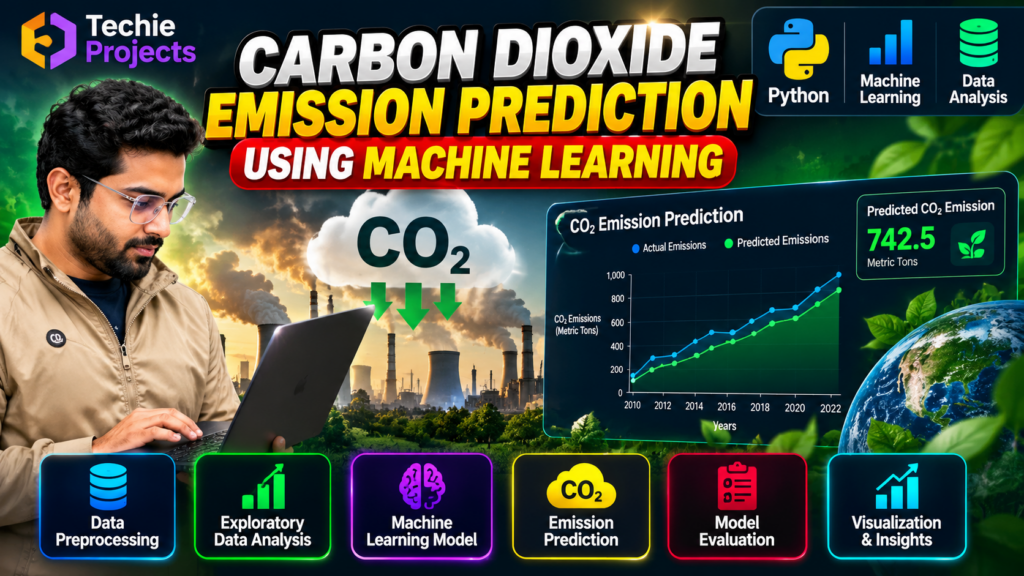
The carbon dioxide emission prediction using machine learning project can follow these stages:
In this carbon dioxide emission prediction project, the trained regression model uses relevant dataset features to generate estimated emission values and evaluate prediction performance.
1. Data Collection
Collect a suitable dataset containing CO₂ emission values and relevant explanatory variables. The dataset should be appropriate for the intended prediction task.
2. Data Preprocessing
Use Python libraries such as Pandas and NumPy to inspect missing values, handle inconsistent records, and prepare the data for analysis.
3. Exploratory Data Analysis
Analyze the dataset using charts, statistical summaries, and correlation analysis to identify patterns and relationships among variables.
4. Feature Selection
Select relevant input features based on the dataset and the project’s prediction objective. Avoid using information that would not be available when making a real prediction.
5. Machine Learning Model Training
Train an appropriate regression algorithm. Depending on the dataset, possible choices include Linear Regression, Random Forest Regressor, or other suitable regression models.
6. Emission Prediction
Provide supported input values to the trained model and generate an estimated CO₂ emission value.
7. Model Evaluation
Evaluate the model using suitable metrics such as Mean Absolute Error (MAE), Mean Squared Error (MSE), and the coefficient of determination (R²). These metrics help assess prediction performance on data that was not used for training.
🚀 Key Features
The project can include the following features, depending on the implemented version:
- Historical emission data analysis.
- Data cleaning and preprocessing.
- Exploratory data visualization.
- Machine learning model training.
- CO₂ emission value prediction.
- Model performance evaluation.
- Graphical presentation of results.
- A Python-based workflow suitable for academic demonstration.
🛠️ Technologies Used
The exact technology stack depends on the implementation. A typical version may use:
- Programming language: Python
- Data processing: Pandas and NumPy
- Visualization: Matplotlib and Seaborn
- Machine learning: Scikit-learn
- Development environment: Jupyter Notebook, VS Code, or another Python IDE
💻 Software and Hardware Requirements
Software Requirements
- Python 3
- Pandas
- NumPy
- Matplotlib
- Seaborn
- Scikit-learn
- Jupyter Notebook or VS Code
Hardware Requirements
- A computer capable of running Python
- Recommended 4 GB or more RAM
- Sufficient storage for the dataset, source code, and project files
A GPU is generally not necessary for a conventional tabular-data regression project.
📊 Applications of Carbon Dioxide Emission Prediction
Environmental Data Analysis
Analyze historical emission records and identify trends in the available data.
Industrial Emission Studies
Explore emission patterns associated with industrial activity when suitable data is available.
Transportation Analysis
Study emission trends related to vehicle activity, fuel consumption, or transportation datasets.
Sustainability Research
Use data analysis to support academic research into environmental indicators and emission-related trends.
Academic Demonstrations
Demonstrate regression, feature selection, model evaluation, and data visualization in a final-year engineering project.
This project is an educational prediction system. Its outputs should not be treated as verified environmental measurements or official emissions reports.
🎓 Why Choose This Machine Learning Project for Your Final Year?
Carbon dioxide emission prediction combines several important data science concepts in one practical project. Students can demonstrate their knowledge of Python programming, dataset preparation, exploratory analysis, regression algorithms, and model evaluation.
Students working on a carbon dioxide emission prediction using machine learning project can gain practical experience with Python, regression algorithms, data visualization, and environmental data analysis.
The project can also be adapted to different datasets and academic requirements. Depending on the scope, additional features may include model comparisons, interactive visualizations, a Streamlit interface, or analysis of emission trends across years or regions.
📦 Get the Carbon Dioxide Emission Prediction Project
Looking for a carbon dioxide emission prediction using machine learning project for your academic work? Techie Projects can help you explore project availability and discuss suitable implementation options.
Depending on the selected package and agreed scope, you can enquire about:
- Project source code and setup guidance.
- Explanation of the project workflow.
- Dataset and model details, where included.
- Assistance with running the application.
- Customization options for specific academic requirements.
Interested in this project?
- 📲 Call/WhatsApp: +91-9460060699
- 🌎 Website: www.techieprojects.com
- 📺 Instagram: @pythonprojects_
Contact us to confirm the current package, deliverables, price, and customization availability before purchasing.
❓ Frequently Asked Questions
1. What is carbon dioxide emission prediction using machine learning?
It is a data science application that trains a machine learning model on historical emission data and related input variables to estimate CO₂ emission values.
2. Which programming language is used in this project?
Python is commonly used because it provides libraries for data processing, visualization, and machine learning.
3. Which machine learning algorithms can be used?
Regression algorithms such as Linear Regression and Random Forest Regressor are possible choices. The most suitable model depends on the dataset and evaluation results.
4. Is this project suitable for B.Tech final-year students?
Yes. It can be suitable for computer science, AI, machine learning, and data science students, subject to their institution’s project requirements.
5. Can the project be customized?
Customization may be possible depending on the selected package, dataset, and requested features. Contact Techie Projects to discuss your requirements before ordering.
6. Does the prediction represent actual measured emissions?
Not necessarily. The model estimates emissions based on its training data and input features. Predictions require appropriate validation and should not replace official measurements.
🎓 Explore Related Projects
- Flood Prediction using Machine Learning
- Crop Prediction using Machine Learning
- Crop Yield Prediction based on Indian Agriculture
- Crop Prediction Using Machine Learning
Explore more ideas in our Machine Learning Projects and Deep Learning Projects collections.
Conclusion
Carbon dioxide emission prediction using machine learning is a useful educational project for learning how data science techniques can be applied to environmental datasets. It brings together data preprocessing, exploratory analysis, regression, and visualization in a practical Python workflow.
If you need a project for your final-year academic work, contact Techie Projects to discuss source code availability, implementation details, and customization options. Choose a scope that matches your syllabus and make sure you understand the model, dataset, and evaluation results before presenting your project.