
🌱 Introduction
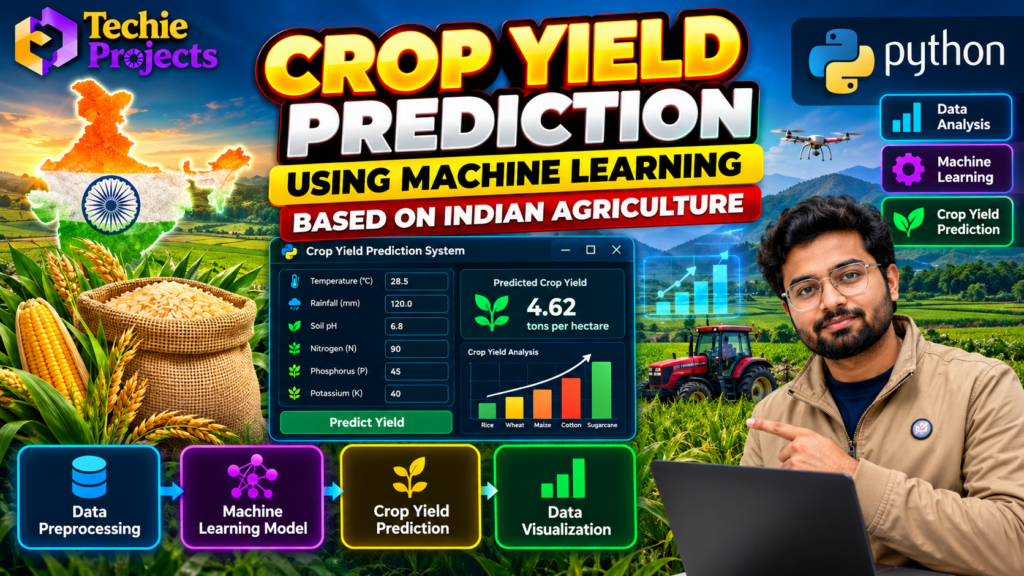
Crop yield prediction using machine learning is a Python-based project that analyzes agricultural data to estimate crop production and support data-driven farming research. This project combines machine learning, data preprocessing, and predictive analytics to explore how historical agricultural information can be used to estimate crop yields.
🇮🇳 Agriculture is an important part of India’s economy, providing livelihoods to millions of people. Crop production depends on several factors, including rainfall, temperature, soil quality, nutrient availability, crop variety, and regional farming conditions. Understanding these factors can help researchers and students explore better ways to analyze agricultural data.
Traditional crop estimation methods often rely on historical experience, field observations, and agricultural knowledge. Although these methods remain valuable, machine learning offers another approach by identifying patterns in available datasets and using those patterns to generate predictions.
The Crop Yield Prediction Based on Indian Agriculture Using Machine Learning project demonstrates how Python and machine learning algorithms can be applied to agricultural data. Students can learn how to prepare datasets, train predictive models, evaluate performance, and present results through charts or an application interface.
Crop yield prediction using machine learning helps analyze agricultural data, including rainfall, temperature, soil conditions, and fertilizer usage, to estimate crop production and support data-driven farming decisions.
🎓 At Techie Projects, we provide project options for B.Tech, BCA, MCA, computer science engineering, information technology, and data science students. If you are looking for a crop yield prediction project with source code, implementation guidance, or customization options, contact our team to discuss availability and requirements.
🎬 Crop Yield Prediction Using Machine Learning – Project Demo Video
Watch the project demonstration to understand how a machine learning application can process agricultural data and produce estimated crop yields. The demonstration can help students understand the relationship between input features, model predictions, and data visualization.
This project is designed to demonstrate the practical application of Python programming and predictive analytics to an agriculture-related problem.
📺 Explore the project demonstration and available project options through Techie Projects.
🌾 What Is Crop Yield Prediction Using Machine Learning?
Crop yield prediction is the process of estimating the quantity of agricultural produce that may be obtained from a particular crop under specified conditions. Machine learning models learn relationships from historical data and use those relationships to estimate outcomes for new inputs.
For example, an agricultural dataset may contain information about rainfall, temperature, crop type, soil nutrients, and historical production. A regression model can learn patterns from this information and generate an estimated yield when suitable input values are provided.
The result depends on the quality of the dataset, the selected algorithm, and the similarity between the new input data and the training data.
🌿 Why Is This Project Important?
Crop yield analysis is useful for exploring the relationship between agricultural conditions and crop production. Machine learning makes it possible to test different variables, compare algorithms, and evaluate prediction errors systematically.
This project helps students understand how computer science techniques can be applied to agriculture, one of the important application areas for data analytics and artificial intelligence.
🎯 Objectives of the Crop Yield Prediction Project
The main objective of the crop yield prediction using machine learning project is to demonstrate a complete predictive modelling workflow using agricultural data.
The crop yield prediction using machine learning system preprocesses agricultural data, selects relevant features, trains a prediction model, and evaluates its performance using suitable metrics.
The key objectives include:
- 🌱 Analyze historical agricultural data and crop production records.
- 📊 Identify relevant features associated with crop yield.
- 🧹 Clean and preprocess data before model training.
- 🤖 Apply suitable machine learning algorithms to estimate crop production.
- 📈 Evaluate model performance using appropriate statistical metrics.
- 💻 Present prediction results in a clear and understandable format.
- 🎓 Provide students with practical experience in Python and machine learning.
- 🔬 Explore how predictive analytics can support agricultural research.
⚙️ How Does the Crop Yield Prediction System Work?
The crop yield prediction system follows a series of data processing and machine learning steps. The exact implementation depends on the dataset, selected algorithm, and application interface.
1. 📥 Agricultural Dataset Collection
The first step is collecting a suitable agricultural dataset. It may contain historical crop production records and related information such as rainfall, temperature, soil properties, nutrient levels, crop type, or geographical region.
The dataset should be relevant to the intended prediction task. For Indian agriculture, region-specific data can be particularly useful when available because agricultural conditions vary considerably across states and districts.
Students should review the dataset’s source, units, missing values, and coverage before using it.
2. 🧹 Data Preprocessing
Raw datasets may contain missing values, duplicate records, inconsistent formats, or categorical variables that require conversion.
Data preprocessing may include:
- Handling missing or invalid values.
- Removing duplicate records where appropriate.
- Converting categorical features into numerical representations.
- Checking units and data types.
- Scaling numerical features when required by the selected algorithm.
- Separating input features from the target variable.
Careful preprocessing helps reduce avoidable errors during model training.
3. 🔍 Feature Selection
Feature selection identifies which input variables should be used by the model. Depending on the available data, relevant features may include rainfall, temperature, crop type, soil nutrients, soil pH, and historical production indicators.
Not every dataset contains all these variables. Only features supported by the actual dataset should be included in the implementation.
Selecting meaningful features can help simplify the model and make its results easier to interpret.
4. 🤖 Machine Learning Model Training
After preprocessing, the dataset is divided into training and testing portions. The training data is used to fit the model, while the test data helps evaluate its performance on records not used during training.
Potential algorithms include:
- Linear Regression: Provides a baseline for modelling relationships between input variables and yield.
- Decision Tree Regression: Learns rule-based relationships from the data.
- Random Forest Regression: Combines multiple decision trees to produce predictions.
- Other regression models: May be considered when justified by the dataset and evaluation results.
The best-performing algorithm should be determined through appropriate testing rather than assumed in advance.
5. 🌾 Crop Yield Prediction
Once the model has been trained, the application can accept input values supported by the implementation and generate an estimated crop yield.
For example, a model may use rainfall, temperature, and selected soil characteristics to estimate yield for a particular crop. The output should include the correct unit, such as tonnes per hectare, only when the dataset and implementation support that unit.
Predictions are estimates, not guarantees of actual harvest results.
6. 📊 Model Evaluation
Model evaluation measures how well the system performs. Suitable regression metrics include:
- Mean Absolute Error (MAE): Measures the average absolute difference between predicted and actual values.
- Mean Squared Error (MSE): Measures squared prediction errors.
- Root Mean Squared Error (RMSE): Expresses the square root of the average squared error in the target’s units.
- R-squared: Indicates how much variation in the target is explained by the model under the evaluation setup.
Testing should be conducted on data that was not used to train the model. Any reported accuracy or performance figures should come from actual experiments.
7. 📈 Result Visualization
The final step may present the estimated yield through charts, tables, or a user interface. Visualization can help students compare actual and predicted values, examine trends, and understand model behaviour.
Depending on the implementation, the project may use Matplotlib, Seaborn, Streamlit, Flask, or another suitable tool. These technologies should only be listed as included features if they are actually part of the selected project version.
✨ Key Features of the Crop Yield Prediction Project
The following are common capabilities that may be included in a crop yield prediction application:
- 🌱 Agricultural data analysis: Explore crop production records and related variables.
- 🧹 Data preprocessing: Prepare datasets for reliable model training.
- 🤖 Predictive modelling: Apply a trained regression model to supported inputs.
- 📊 Data visualization: Present trends and prediction comparisons when implemented.
- 📉 Performance evaluation: Assess errors using appropriate regression metrics.
- 💻 Python implementation: Demonstrate the use of data science libraries.
- 🔧 Customization potential: Adapt the project to suitable datasets and academic requirements.
- 🎓 Educational workflow: Learn how data moves from collection to prediction and evaluation.
The availability of an interactive interface, specific algorithms, documentation, and additional modules should be confirmed before purchase.
🛠️ Technologies Used
The project can use the following technologies, depending on the implementation.
🐍 Programming Language
Python is commonly used for data processing and machine learning because it has a large ecosystem of libraries for analysis, model development, and visualization.
📚 Data Processing Libraries
- Pandas: For loading, cleaning, and organizing tabular agricultural data.
- NumPy: For numerical calculations and array operations.
🧠 Machine Learning Library
Scikit-learn provides tools for training regression models, splitting datasets, preprocessing features, and evaluating predictions.
📊 Visualization Tools
Matplotlib or Seaborn can be used to create charts for exploring data and comparing model outputs.
💻 Development Environment
The project can be developed in Jupyter Notebook, Visual Studio Code, or another compatible Python environment.
A web or desktop interface may be included if it is part of the selected implementation.
💻 Software and Hardware Requirements
Software Requirements
- Python installation compatible with the project’s dependencies.
- Required libraries for data processing and machine learning.
- A code editor or notebook environment.
- The agricultural dataset used by the model.
- A compatible operating system.
- Internet access when downloading dependencies or datasets is necessary.
Hardware Requirements
- A laptop or desktop computer.
- Sufficient RAM to load the dataset and train the selected model.
- Adequate disk space for source code, datasets, and dependencies.
- A compatible processor.
A dedicated GPU is generally unnecessary for conventional machine learning models trained on tabular agricultural data.
🚜 Applications of Crop Yield Prediction Using Machine Learning
1. 🌾 Agricultural Research
Researchers can use agricultural datasets to investigate relationships between crop production and environmental variables.
2. 🇮🇳 Indian Agriculture Analysis
Region-specific datasets can be used to explore crop production patterns across different agricultural areas of India, provided the dataset contains suitable regional information.
3. 📊 Agricultural Data Analytics
Students can use the project to practise data cleaning, exploratory analysis, feature selection, regression, and performance evaluation.
4. 🌱 Smart Agriculture Research
The project provides a starting point for exploring data-driven agricultural applications and potential decision-support prototypes.
5. 🎓 Final-Year Engineering Projects
The project is relevant to students studying computer science, information technology, artificial intelligence, machine learning, or data science.
6. 🔬 Predictive Modelling Experiments
Students can compare algorithms and evaluate how different features influence model performance.
Important: The project is an educational and research prototype. It should not be treated as a validated agricultural advisory system without independent testing and real-world evaluation.
✅ Advantages of the Crop Yield Prediction Project
- 📚 Provides practical experience with Python and machine learning.
- 🌾 Applies predictive analytics to an agriculture-related problem.
- 🧹 Demonstrates the importance of data preprocessing.
- 🤖 Allows comparison of different regression algorithms.
- 📈 Encourages evaluation using measurable performance metrics.
- 💡 Offers opportunities to explore additional agricultural datasets.
- 🎓 Supports academic demonstrations and machine learning learning objectives.
- 🔧 Can potentially be extended with suitable new features and data.
⚠️ Limitations and Challenges
Crop yield prediction depends heavily on the information available to the model.
Dataset quality: Incomplete, inaccurate, or outdated records can reduce the reliability of predictions.
Regional differences: A model trained on data from one area may not perform well in another area with different soil, climate, or farming practices.
Weather variability: Unexpected droughts, floods, heatwaves, or other weather events may affect real crop production.
Missing variables: Factors such as irrigation, pests, seed variety, fertilizer practices, and disease may not be represented in the dataset.
Model generalization: A model may perform well on training data but poorly on unseen examples.
Prediction uncertainty: A predicted value is an estimate based on learned patterns and should not be interpreted as a guaranteed yield.
Recognizing these challenges helps students develop more responsible and scientifically sound machine learning applications.
🚀 Future Enhancements
The crop yield prediction system can be extended in several ways, depending on project scope and available data.
- 🌦️ Integrate reliable weather data for additional analysis.
- 🗺️ Explore region-specific agricultural datasets.
- 🤖 Compare Random Forest, Decision Tree, Linear Regression, and other suitable models.
- 📊 Add interactive charts to compare predicted and actual yields.
- 💻 Develop a web interface for supported agricultural inputs.
- 📄 Generate downloadable prediction summaries.
- 🧪 Evaluate the model using independent datasets.
- 🔍 Investigate feature importance and prediction errors.
- 🌱 Explore integration with soil monitoring or IoT data when suitable hardware and data are available.
These enhancements can provide opportunities for further learning and research, but their feasibility should be assessed before implementation.
🛒 Purchase the Crop Yield Prediction Project from Techie Projects
Are you looking for a crop yield prediction using machine learning project for your final-year engineering submission? 🌾 Techie Projects helps students explore Python, machine learning, and data science project options for academic learning and demonstrations.
This project can be a useful starting point for understanding agricultural data analysis, predictive modelling, and model evaluation.
🎓 Who Can Consider This Project?
This project may be suitable for:
- B.Tech Computer Science Engineering students.
- B.Tech Information Technology students.
- Artificial Intelligence and Data Science students.
- BCA and MCA students.
- Students exploring Python and machine learning.
- Students seeking an agriculture-focused academic project.
📦 What Should You Confirm Before Ordering?
Before purchasing, contact our team to confirm which deliverables are available in the selected version.
- 💻 Source code availability.
- 📁 Dataset details and format.
- ⚙️ Installation and dependency requirements.
- 🧠 Machine learning algorithm used.
- 📊 Model evaluation results, if available.
- 🎬 Project demonstration and execution guidance.
- 📄 Documentation or project-report availability.
- 🔧 Customization options and applicable charges.
- 💬 Support terms and delivery timeline.
The exact features, documentation, pricing, and support depend on the project version and agreed requirements. Please confirm these details before placing an order.
📲 Contact Techie Projects
Ready to discuss your project requirements? Contact us to check availability, pricing, and possible customization options.
📲 Call/WhatsApp: +91-9460060699
🌎 Website: www.techieprojects.com
📺 Instagram: @pythonprojects_
When contacting us, mention your course, submission deadline, required features, and whether you need source code, implementation guidance, or customization.
🎓 Explore Related Projects
If you are interested in agriculture, machine learning, and Python, explore these related project topics:
- 🌿 Crop Yield Prediction Using Machine Learning
- 🍃 Plant Leaf Disease Detection Using Deep Learning
- 🌦️ Weather Prediction Using Machine Learning
- 🌧️ Rainfall Prediction Using Python
- 🧪 Soil Quality Analysis Using Machine Learning
- 🚜 Farm Management System Project
Visit Techie Projects to explore available project categories and confirm the availability of individual projects.
❓ Frequently Asked Questions (FAQs)
1. 🌾 What is crop yield prediction using machine learning?
It is a predictive modelling approach that uses agricultural data to estimate crop production. A model learns patterns from historical records and applies them to supported input features.
2. 🐍 Which programming language is used?
Python is commonly used because it supports data preprocessing, machine learning, statistical analysis, and visualization.
3. 🤖 Which algorithms can be used for crop yield prediction?
Possible algorithms include Linear Regression, Decision Tree Regression, and Random Forest Regression. The appropriate choice depends on the dataset and measured performance.
4. 🎓 Is this project suitable for final-year students?
It may be suitable for students in computer science, information technology, artificial intelligence, and data science, subject to their institution’s project requirements.
5. 📊 Does the project predict every crop?
That depends on the dataset and training procedure. The model should only be used for crop types and input conditions that are supported by the implementation.
6. 🔧 Can the project be customized?
Customization may be possible depending on the required features, dataset, interface, and available project version. Contact Techie Projects to confirm feasibility and cost.
7. 🎯 Does the model guarantee accurate crop production estimates?
No. Model performance depends on the quality of the data, the selected features, the training procedure, and independent evaluation. Predictions should be treated as estimates.
8. 🛒 How can I purchase this project?
Contact Techie Projects on WhatsApp to discuss availability, deliverables, pricing, and support before ordering.
- 📲 Call/WhatsApp: +91-9460060699
- 🌎 Website: www.techieprojects.com
- 📺 Instagram: @pythonprojects_
🏁 Conclusion
Crop yield prediction using machine learning demonstrates how Python and predictive analytics can be applied to agricultural data. By combining dataset collection, data preprocessing, feature selection, model training, evaluation, and visualization, the project introduces students to a practical machine learning workflow.
🌱 For students interested in smart agriculture, data science, and predictive modelling, this project provides an opportunity to explore the intersection of technology and farming.
This crop yield prediction using machine learning project is a useful learning opportunity for students interested in Python, data analytics, and smart agriculture.
If you need a crop yield prediction project for academic learning or a final-year engineering demonstration, contact Techie Projects to discuss source code availability, project features, and customization options.
🚀 Start your project enquiry today: Contact Techie Projects on WhatsApp