
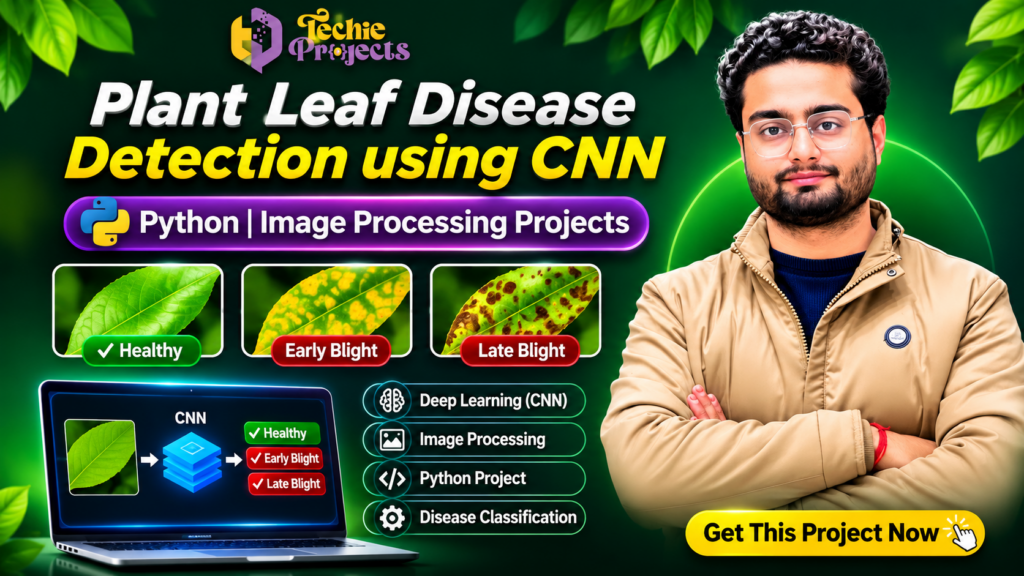
Plant Leaf Disease Detection Using CNN is an excellent practical implementation of artificial intelligence in agriculture. This project demonstrates how Python and deep learning can identify different plant leaf conditions through automated image classification.
🌿 Looking for a ready-to-implement Plant Leaf Disease Detection Using CNN project for your final-year engineering, B.Tech, M.Tech, MCA, or computer science submission? Get a professionally developed Python-based machine learning project from Techie Projects and save valuable development time!
Don’t waste weeks struggling with dataset preparation, image preprocessing, CNN model development, training, testing, and implementation. Techie Projects provides practical project solutions designed to help students understand modern artificial intelligence, machine learning, deep learning, and image processing technologies.
Our Plant Leaf Disease Detection Using CNN project demonstrates how deep learning can analyze plant leaf images and identify different disease categories. It is an excellent project topic for students interested in Python, Artificial Intelligence, Computer Vision, and Machine Learning.
Whether you need a project for your final-year submission, academic demonstration, practical learning, or research reference, connect with Techie Projects to enquire about the complete project package, available source code, implementation support, and customization options.
📞 Contact Techie Projects for Project Enquiries
Interested in purchasing the Plant Leaf Disease Detection Using CNN Project ? Contact us to enquire about package availability, pricing, source code, documentation, installation guidance, and technical support options.
💬 WhatsApp Enquiry: Chat with Techie Projects
📱 Contact Number: +91 94600 60699
🌐 Official Website: www.techieprojects.com
📸 Instagram: Follow Techie Projects
🎓 Project Areas: Robotics, Machine Learning, Arduino, Deep Learning, Artificial Intelligence, and Android App.
✅ Request Project Details: Share your engineering branch, preferred features, and technical requirements to enquire about the most suitable available package.
🚀 Ready to get started? Click here to enquire on WhatsApp and mention Plant Leaf Disease Detection Using CNN Project .
Package contents, prices, hardware availability, and support options should be confirmed before purchase.
🎬 Watch the Plant Leaf Disease Detection Using CNN Project Demo
Explore the project demonstration to understand how the application processes plant leaf images and performs disease classification using Python and Convolutional Neural Networks.
The demonstration introduces the project concept, image processing workflow, disease identification, and the role of deep learning in agricultural applications.
Watch the demonstration to understand the practical implementation before enquiring about purchasing the project.
🌱 What Is Plant Leaf Disease Detection Using CNN?
Plant diseases are among the major challenges affecting agricultural productivity. Various diseases can damage leaves, reduce plant growth, affect crop quality, and negatively impact agricultural production.
Traditional disease identification generally depends on visual inspection and agricultural expertise. However, identifying diseases at an early stage can sometimes be difficult, especially when symptoms look similar.
Plant Leaf Disease Detection Using CNN is a machine learning application that uses image processing and deep learning techniques to identify disease patterns from plant leaf images.
A Convolutional Neural Network (CNN) is a deep learning architecture specifically designed to process image data. It automatically learns important visual characteristics such as:
- Leaf colour variations.
- Spots and damaged regions.
- Texture differences.
- Irregular patterns.
- Disease-related visual features.
- Healthy and infected leaf characteristics.
After training, the CNN model can analyze a new leaf image and predict the corresponding class based on the categories learned during training.
This makes the project a useful practical example of applying artificial intelligence to agriculture.
🎯 Objectives of the Plant Leaf Disease Detection Project
One important objective of Plant Leaf Disease Detection Using CNN is to develop an intelligent classification model that can recognize visual disease patterns and distinguish healthy leaves from infected leaves.
The primary objective of this project is to develop an intelligent image classification application that can identify plant leaf conditions using deep learning.
The important objectives include:
- Automated Disease Identification: Analyze plant leaf images using a trained CNN model.
- Image Processing: Prepare and preprocess input images before classification.
- Deep Learning Implementation: Develop an image classification model using Convolutional Neural Networks.
- Healthy Leaf Recognition: Identify healthy leaf images based on the trained model.
- Disease Classification: Classify images into the disease categories included in the dataset.
- Practical Application: Demonstrate how machine learning can support agricultural technology.
- Academic Learning: Help students understand image classification, neural networks, and Python-based machine learning.
🚀 Key Features of the Project
The Plant Leaf Disease Detection Using CNN application combines image preprocessing, feature extraction, and neural network classification to generate predictions from uploaded plant leaf images.
The project combines several important technologies used in modern machine learning applications.
1. Image Upload and Processing
The application accepts plant leaf images as input. The uploaded image is prepared for model processing through image preprocessing operations.
2. CNN-Based Classification
The Convolutional Neural Network extracts visual patterns from the input image and predicts its corresponding category.
3. Healthy and Diseased Leaf Identification
The model can distinguish between healthy and diseased categories represented in its training dataset.
4. Image Preprocessing
Image preprocessing helps standardize input images before passing them to the deep learning model.
Typical operations include:
- Image resizing.
- Image normalization.
- Pixel value conversion.
- Dataset preparation.
- Training and testing data separation.
5. Prediction Results
The application displays the predicted classification result after processing the uploaded image.
6. Practical Machine Learning Workflow
Students can understand the complete workflow, from dataset preparation to model training and image prediction.
🧠 Technologies Used in Plant Leaf Disease Detection Using CNN
Python plays an important role in Plant Leaf Disease Detection Using CNN because it provides powerful libraries for developing deep learning models, processing images, and evaluating classification results.
This project is suitable for students who want hands-on experience with Python programming, machine learning, and computer vision.
| Technology | Purpose |
|---|---|
| Python | Main programming language |
| CNN | Deep learning architecture |
| TensorFlow / Keras | Deep learning model development |
| OpenCV | Image processing |
| NumPy | Numerical operations |
| Matplotlib | Data visualization |
| Image Dataset | Model training and testing |
| Machine Learning | Intelligent classification |
The exact libraries and implementation depend on the selected project package.
🔬 How Does the Plant Leaf Disease Detection System Work?
Understanding the workflow is important for students preparing project presentations, demonstrations, and viva examinations.
The general working process consists of the following stages.
Step 1: Dataset Collection
The first step is collecting plant leaf images containing different healthy and diseased categories.
The dataset provides the examples required to train the CNN model.
A properly organized dataset helps the model learn the visual differences between the selected classes.
Step 2: Image Preprocessing
Raw images may have different dimensions, resolutions, and lighting conditions.
Therefore, preprocessing is performed to prepare images for model training.
Common preprocessing operations include resizing, normalization, and converting images into numerical arrays.
Step 3: Dataset Splitting
The dataset is generally divided into training, validation, and testing sets.
- Training data helps the model learn image patterns.
- Validation data helps monitor model performance during training.
- Testing data evaluates performance on previously unseen images.
Step 4: CNN Model Development
A Convolutional Neural Network is developed to learn important visual features from plant leaf images.
A typical CNN architecture may contain:
- Convolutional layers.
- ReLU activation functions.
- Pooling layers.
- Flattening layers.
- Fully connected layers.
- Output classification layer.
These layers work together to identify patterns and generate classification predictions.
Step 5: Model Training
The CNN model is trained using the prepared dataset.
During training, the model adjusts its parameters to reduce classification errors and improve its ability to recognize image categories.
Step 6: Image Prediction
After training, a new plant leaf image is supplied to the application.
The image undergoes the required preprocessing steps and is passed to the trained model.
The model then generates a prediction based on the categories it has learned.
Step 7: Displaying Results
The application displays the predicted class to the user.
The final result demonstrates how deep learning can be applied to automated plant leaf image classification.
🌿 Applications of Plant Leaf Disease Detection
The concepts demonstrated in this project have several potential applications in agriculture and research.
1. Smart Agriculture
AI-based image classification can support digital agriculture solutions by helping analyze plant health information.
2. Agricultural Research
Researchers can use image classification techniques to study visual symptoms and develop experimental disease recognition systems.
3. Crop Monitoring
Computer vision systems can be integrated into larger crop monitoring applications.
4. Mobile-Based Agricultural Applications
The trained model can serve as a foundation for mobile applications that analyze leaf images.
5. Agricultural Education
Students can explore the combination of artificial intelligence, computer vision, and agriculture through practical implementation.
Note: The system provides predictions based on its training data. It should not be considered a replacement for professional agricultural diagnosis.
📊 Advantages of Using CNN for Plant Disease Classification
Convolutional Neural Networks offer several advantages for image-based classification.
- Automatic Feature Extraction: CNN models learn relevant image features during training.
- Image Classification: They are designed to identify patterns in image data.
- Scalability: The approach can be extended to additional disease categories with suitable datasets and retraining.
- Deep Learning Experience: Students gain practical knowledge of modern neural network architectures.
- Real-World Applications: The project connects academic concepts with agricultural technology.
- Research Opportunities: The implementation can be extended using transfer learning, data augmentation, and other deep learning techniques.
🎓 Why Choose This Project for Your Final Year?
Choosing the right final-year project is important for engineering students. A good project should demonstrate technical knowledge, practical implementation, and an understanding of real-world applications.
The Plant Leaf Disease Detection Using CNN project combines multiple important areas of computer science.
Suitable for Different Academic Courses
This project topic can be considered by students pursuing:
- B.Tech Computer Science Engineering.
- B.Tech Artificial Intelligence and Machine Learning.
- B.Tech Information Technology.
- M.Tech Computer Science.
- MCA.
- BCA.
- Diploma in Computer Engineering.
The implementation complexity can be adjusted according to academic requirements.
Useful for Project Demonstrations
The image upload and classification workflow makes the project suitable for practical demonstrations.
Students can explain the dataset, image preprocessing, CNN architecture, model training, and prediction process during their presentations.
Supports Technical Learning
Students can gain practical exposure to:
- Python programming.
- Deep learning.
- Computer vision.
- Image classification.
- CNN architecture.
- Dataset management.
- Model evaluation.
💻 Software and Hardware Requirements
The following are typical requirements for developing a Python-based CNN image classification application.
Software Requirements
- Operating System: Windows 10 / Windows 11 or compatible environment.
- Programming Language: Python.
- Deep Learning Framework: TensorFlow / Keras.
- Image Processing: OpenCV.
- Numerical Library: NumPy.
- Development Environment: VS Code, PyCharm, or Jupyter Notebook.
Hardware Requirements
- Processor: Intel Core i3 or higher.
- RAM: 4 GB minimum; 8 GB or higher recommended.
- Storage: Sufficient space for the dataset, source code, and model files.
- GPU: Optional, but useful for faster model training.
Actual requirements depend on dataset size, model architecture, and implementation.
📈 Future Scope of the Project
The project can be extended with additional machine learning and deep learning capabilities.
Some possible improvements include:
1. Mobile Application Integration
The trained model can be integrated into an Android application to enable image-based predictions through a smartphone.
2. Real-Time Leaf Detection
A camera-based system can be developed to capture plant images and analyze them automatically.
3. More Disease Categories
Additional plant species and disease categories can be introduced by preparing suitable datasets and retraining the model.
4. Transfer Learning
Pretrained architectures such as MobileNet, ResNet, and EfficientNet can be explored to improve feature extraction and model performance.
5. Cloud-Based Deployment
The model can be deployed through a web application or cloud platform to make predictions accessible through a browser.
6. Explainable AI
Visualization techniques such as Grad-CAM can help illustrate which regions of an image influenced the model’s prediction.
If you are planning to purchase Plant Leaf Disease Detection Using CNN, contact Techie Projects to enquire about source code, project documentation, demonstration, and available customization options.
🛒 Purchase Plant Leaf Disease Detection Using CNN Project from Techie Projects
Are you searching for a complete machine learning project for your final-year academic requirements?
Techie Projects offers practical engineering project solutions across Artificial Intelligence, Machine Learning, Python, Data Science, Computer Vision, and other technology domains.
Our goal is to help students access practical project implementations and understand how modern technologies work.
By choosing our Plant Leaf Disease Detection Using CNN project, you can enquire about the available project package and the resources required for your academic work.
🎁 What Can You Enquire About?
Depending on the selected package and availability, you can ask our team about:
- Python project source code.
- Dataset details and availability.
- Trained CNN model files.
- Project execution and installation instructions.
- Project documentation.
- Working demonstration.
- Implementation explanation.
- Customization according to academic requirements.
- Technical support options.
Please confirm the exact deliverables, pricing, and support included in your package before purchasing.
⭐ Why Choose Techie Projects?
1. Multiple Technology Domains
We develop and provide project solutions in several domains, including AI, ML, Python, IoT, NLP, Web Development, and Computer Vision.
2. Practical Project Demonstrations
Explore available demonstrations to understand the project’s workflow and expected functionality.
3. Student-Focused Solutions
Our project solutions are designed around the practical learning and academic requirements of engineering students.
4. Customization Enquiries
Discuss your college requirements, preferred technologies, and project specifications with our team.
5. Direct Communication
Connect with Techie Projects to discuss your project requirements and package details before making a purchase.
💡 Recommended Projects
If you are interested in Plant Leaf Disease Detection Using CNN, you may also explore these related final-year engineering project ideas.
- Potato Leaf Disease Detection Using CNN – Identify potato leaf diseases through deep learning and image classification.
- Plant Leaf Disease Detection – Develop an AI-based system for classifying plant leaf conditions.
- Rice Leaf Disease Detection Using Machine Learning – Analyze rice leaf images using computer vision techniques.
- Fruit Disease Detection Using Deep Learning – Identify visible fruit diseases using image classification.
- Crop Recommendation System Using Machine Learning – Recommend suitable crops based on agricultural parameters.
- Plant Species Classification Using CNN – Classify plant species using leaf images.
- Pest Detection Using YOLO – Identify agricultural pests through object detection.
Explore more project ideas and implementations on Techie Projects.
❓ Frequently Asked Questions (FAQs)
1. What is Plant Leaf Disease Detection Using CNN?
It is a deep learning project that analyzes plant leaf images and classifies them into healthy or diseased categories using a trained Convolutional Neural Network.
2. Which programming language is used in this project?
Python is commonly used because it provides powerful libraries for machine learning, deep learning, and image processing.
3. What is the role of CNN in plant disease detection?
CNN automatically extracts visual features from leaf images and learns patterns that help classify different plant disease categories.
4. Is this project suitable for B.Tech final-year students?
Yes. It is a suitable project topic for B.Tech CSE, IT, Artificial Intelligence, Machine Learning, and related academic courses.
5. Can I purchase the complete project from Techie Projects?
Yes. You can contact Techie Projects to enquire about the available project package, source code, documentation, demonstration, and support options.
6. Can the project be customized?
Customization may be available depending on the requirements and selected package. Contact our team to discuss your preferred features and academic specifications.
7. What are the future improvements in this project?
Possible improvements include mobile application integration, real-time image classification, transfer learning, additional disease categories, and cloud deployment.
8. Does CNN require a dataset for training?
Yes. A CNN classification model generally requires labeled image data to learn the visual characteristics of the selected classes.
📞 Get Your Plant Leaf Disease Detection Using CNN Project Today!
Ready to explore a practical deep learning project for your final-year engineering submission?
Don’t spend unnecessary time searching for project implementations from multiple sources. Connect with Techie Projects to discuss the available project package, pricing, source code, documentation, and customization requirements.
Whether you are pursuing B.Tech, M.Tech, MCA, BCA, or another computer science course, our team can help you explore suitable project solutions.
🚀 Take the next step towards your engineering project with Techie Projects!
📞 Contact / WhatsApp: +91 94600 60699
🌐 Website: www.techieprojects.com
📸 Instagram: @pythonprojects_
Techie Projects – Practical Engineering Projects, Innovative Ideas, and Technology Solutions.
Explore. Learn. Develop. Innovate.

