
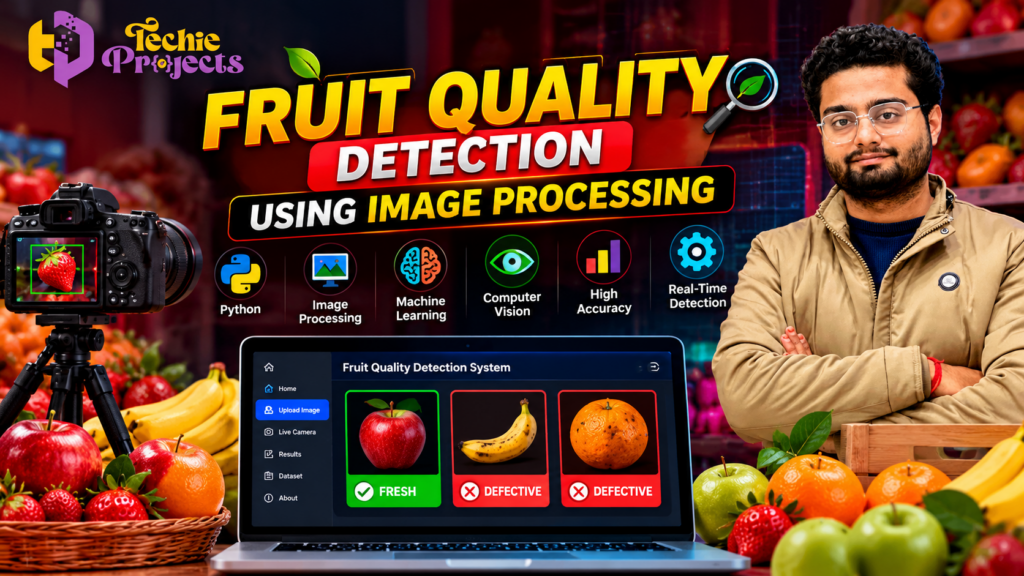
The Fruit Quality Detection Using Image Processing project demonstrates how Python and computer vision can be used to analyze fruit images and classify visible quality characteristics. This practical machine learning project helps engineering students explore image preprocessing, feature analysis, model training, and prediction. If you are planning to purchase a Fruit Quality Detection Using Image Processing project for your academic work, contact Techie Projects to confirm the available source code, documentation, installation instructions, and project features.
🍎 Looking for a practical final-year engineering project that combines Python, image processing, and machine learning? The Fruit Quality Detection Using Image Processing project is an excellent topic to explore how computer vision can analyze fruit images and classify their visible quality characteristics.
If you are a B.Tech CSE, IT, Artificial Intelligence, or Machine Learning student, this project can help you understand how image-based classification works in a real-world application. Instead of spending all your time searching for a suitable project topic, explore this implementation and confirm whether its features, documentation, and technical requirements match your academic needs.
🚀 Want to purchase this project from Techie Projects? Contact us to check the available source code, installation instructions, project documentation, demonstration features, pricing, and support options before ordering. Our goal is to help you identify a project package that fits your learning objectives and engineering requirements.
🎬 Project Demo
Watch the project demonstration to understand the interface, fruit image processing workflow, and possible classification results.
The demonstration can help you see how fruit images are analyzed and how the application presents its output. Review the available demo and confirm the implemented features before purchasing, as functionality may vary between project versions.
🤔 What Is Fruit Quality Detection Using Image Processing?
Fruit Quality Detection Using Image Processing is a computer vision application designed to analyze fruit images and identify visual characteristics associated with fruit quality.
The system may process images to classify fruit into categories such as fresh and defective, depending on its dataset, training process, and implementation. Python-based image processing techniques can help prepare images, extract relevant information, and provide inputs to a classification model.
In a typical implementation, the application receives a fruit image, processes it, and produces a predicted category. Some versions may also provide a graphical interface for uploading images or displaying results.
This project demonstrates how computer vision and machine learning can be applied to agricultural and food-quality research.
🎯 Objectives of the Project
The main objectives of the Fruit Quality Detection Using Image Processing project include:
- 🍎 Analyzing fruit images using computer vision techniques.
- 🖼️ Learning how image preprocessing prepares data for classification.
- 🧠 Exploring machine learning or deep learning approaches.
- 📊 Understanding image classification and model evaluation.
- 🐍 Applying Python programming to a practical project.
- 💻 Creating a visual demonstration of the classification workflow.
- 🎓 Building technical knowledge for project presentations and academic learning.
The exact objectives depend on the model, dataset, and features included in the selected implementation.
⚙️ How Does the Fruit Quality Detection System Work?
A typical fruit quality detection application follows several processing stages.
1. Fruit Image Input
The system receives an image of a fruit from an uploaded file, image dataset, or camera input if supported. The image becomes the input for further processing.
2. Image Preprocessing
The image may be resized, normalized, or converted into a suitable format. Preprocessing helps maintain consistent input dimensions and prepares the image for the next stage.
3. Feature Learning or Extraction
The application uses visual information such as color, texture, shape, or learned image patterns. The specific features depend on whether the implementation uses traditional image processing, machine learning, or deep learning.
4. Classification Model
A trained model analyzes the processed image and predicts the corresponding category. Depending on the implementation, categories might include fresh and defective fruit or different fruit types.
5. Result Display
The system displays its prediction through a label, status indicator, or graphical interface. The output helps users understand the model’s classification for the submitted image.
6. Model Testing and Evaluation
The model should be tested on images that were not used during training. Metrics such as accuracy, precision, recall, and a confusion matrix can help assess classification performance.
Actual results depend on the dataset, image quality, lighting, fruit variety, and training methodology.
Benefits of Fruit Quality Detection Using Image Processing
The Fruit Quality Detection Using Image Processing project offers an opportunity to learn how image-based classification works in practical applications. Students can explore how fruit images are prepared, how classification models analyze visual patterns, and how predictions are displayed through an application interface.
This project can help learners understand Python programming, OpenCV, machine learning workflows, and model evaluation. It can also provide a foundation for experimenting with different datasets and classification algorithms. The actual results depend on the model, dataset quality, and testing process.
🛠️ Technologies Used
The exact technology stack depends on the implementation. A typical Python-based project may use the following tools:
- Python: Main programming language.
- OpenCV: Image reading, resizing, processing, and computer vision operations.
- NumPy: Numerical operations and array processing.
- TensorFlow or Keras: Possible frameworks for deep learning model development.
- Machine Learning: Classification methods for predicting image categories.
- Image Processing: Techniques for preparing and analyzing fruit images.
- Graphical User Interface: An optional interface for image upload and result display.
Before purchasing, ask Techie Projects to confirm the actual libraries, versions, model architecture, and installation requirements for the available package.
✨ Key Features of the Project
The Fruit Quality Detection Using Image Processing project can demonstrate several useful features, depending on the supplied version.
🍏 Fruit Image Classification
The application predicts a category from a fruit image using a trained classification model.
🖼️ Image Upload and Processing
Some versions allow users to upload images and process them through an application interface.
🧠 Machine Learning Integration
The project demonstrates how a model can learn patterns from labeled training data and apply those patterns to new images.
📊 Classification Results
The application may display the predicted class through a label, visual indicator, or result panel.
💻 Practical Python Application
Students can explore the connection between Python programming, image preprocessing, model prediction, and application development.
🔬 Model Evaluation
Students can investigate classification errors and evaluate performance using appropriate test data and metrics.
Note: These are common capabilities for this project type. Confirm which features are actually implemented in the package before placing an order.
🌾 Applications of Fruit Quality Detection
Fruit quality classification is a useful topic for studying agricultural technology and computer vision.
Possible areas of exploration include:
- Agricultural research: Studying visual characteristics of fruits.
- Food-quality experiments: Investigating image-based classification methods.
- Post-harvest research: Exploring how image analysis might support quality assessment.
- Educational demonstrations: Teaching image processing and machine learning concepts.
- Computer vision research: Comparing classification methods and datasets.
- Smart agriculture prototypes: Exploring possible integration with camera-based systems.
A student project should not be presented as a commercially validated inspection system unless it has been appropriately tested. A model’s predictions are limited by its training data and evaluation results.
🎓 Why Choose This Project for Your Engineering Course?
This project connects programming with a visual problem that is easy to demonstrate and explain. It can be useful for students who want to understand how an AI-based application receives data, processes it, and generates a prediction.
The project may be relevant to:
- B.Tech Computer Science Engineering students.
- Information Technology students.
- Artificial Intelligence and Machine Learning students.
- Students learning Python and OpenCV.
- Students exploring image processing projects.
- Students preparing mini projects or final-year demonstrations.
It can also provide a starting point for discussing datasets, model selection, evaluation metrics, limitations, and future improvements.
For academic submissions, make sure you understand the implementation and follow your institution’s rules on originality, external assistance, and source-code use.
🧩 Main Project Modules
A typical system can be divided into the following modules.
| Module | Purpose |
|---|---|
| Image Input Module | Receives fruit images |
| Preprocessing Module | Prepares images for analysis |
| Feature Analysis Module | Processes or learns visual patterns |
| Classification Module | Predicts the fruit category |
| Result Display Module | Presents the prediction |
| Evaluation Module | Measures model performance |
The final module structure may vary according to the selected algorithm and application design.
💻 Hardware and Software Requirements
Check the package requirements before installation. A typical implementation may require:
Software requirements
- A supported operating system such as Windows or Linux.
- Python and compatible package versions.
- OpenCV and the libraries used by the model.
- A code editor or Python IDE.
- A compatible dataset and trained model, if provided.
Hardware requirements
- A laptop or desktop computer.
- Sufficient RAM and storage for the software and dataset.
- A GPU only if required by the chosen model or performance expectations.
Many basic image classification applications can run on a CPU. Actual requirements depend on the model, image size, and implementation.
Get the Fruit Quality Detection Using Image Processing Project
Interested in the Fruit Quality Detection Using Image Processing project for your B.Tech mini project or final-year submission? Contact Techie Projects to discuss your requirements and verify the package details before ordering. Ask about source code availability, project reports, supported technologies, installation requirements, pricing, and delivery.
📲 Contact Techie Projects on WhatsApp to enquire about purchasing this project.
🛒 Purchase the Fruit Quality Detection Project from Techie Projects
Need a Python-based project for your engineering coursework? Techie Projects can help you explore available project options and determine whether this implementation suits your requirements.
📲 Call/WhatsApp: +91-9460060699
🌎 Website: www.techieprojects.com
📺 Instagram: @pythonprojects_
Before purchasing the Fruit Quality Detection Using Image Processing project, contact us to confirm:
- Whether source code is included.
- Which algorithms and libraries are used.
- Whether documentation and a project report are available.
- How the application is installed and executed.
- Which image input and classification features are implemented.
- The price, delivery method, and available support options.
Confirming these details before ordering helps you choose a project with a clear understanding of the included deliverables.
📲 Contact Techie Projects
Discuss your requirements and request the available package details.
- WhatsApp: Chat with Techie Projects
- Website: https://techieprojects.com/
- Instagram: Follow Techie Projects
When contacting us, mention your branch, project title, academic deadline, and any specific requirements from your college.
🔮 Future Enhancements
Students can explore several possible extensions to this project:
- Train the model using a larger and more diverse fruit image dataset.
- Compare different classification algorithms.
- Add support for more fruit categories.
- Improve the graphical interface.
- Display model evaluation metrics.
- Test images under different lighting and background conditions.
- Explore camera-based input if the current version does not support it.
- Investigate deployment through a web application.
These extensions can help students explore the strengths and limitations of image classification systems.
🔗 Explore Related Python and AI Projects
Looking for more ideas for your mini project or final-year submission? Explore related project categories on Techie Projects:
- Machine Learning Projects
- Python Projects
- Image Processing Projects
- Deep Learning Projects
- Artificial Intelligence Projects
Visit the website to explore available options and verify each project’s features and deliverables.
❓ Frequently Asked Questions
1. What is Fruit Quality Detection Using Image Processing?
It is a computer vision application that analyzes fruit images and predicts a category based on visual patterns learned from data or defined by the implementation.
2. Which programming language is used?
Python is commonly used because it supports image processing and machine learning libraries such as OpenCV, NumPy, TensorFlow, and Keras.
3. Is this project suitable for final-year engineering students?
It may be suitable for a mini project or final-year demonstration, depending on your course requirements, implementation depth, and college guidelines. Confirm suitability with your project guide.
4. Can the system identify fresh and defective fruits?
A model trained for these categories may classify images into fresh and defective classes. Its performance depends on the dataset, training process, and image conditions. Confirm the actual classes supported by the available implementation.
5. Can I purchase the source code?
Contact Techie Projects to confirm whether source code is included, what other deliverables are available, and the applicable price and delivery terms.
6. Does the project require a GPU?
Not necessarily. Many basic image processing and classification implementations can run on a CPU, but requirements vary by model and dataset.
7. Is the system 100% accurate?
No classification model should be assumed to be perfectly accurate. Results depend on training data, testing methodology, image quality, and the fruit categories being evaluated.
🚀 Start Your Fruit Quality Detection Project
The Fruit Quality Detection Using Image Processing project offers a practical way to explore Python, computer vision, and machine learning through fruit image classification.
If you want to purchase this project, contact Techie Projects to confirm the available source code, documentation, technologies, installation requirements, pricing, and support options before ordering.
👉 Contact Techie Projects on WhatsApp to discuss your requirements.
🌐 Visit TechieProjects.com to explore more engineering project ideas.
Educational note: This project demonstrates image classification concepts. Its predictions should not be treated as a guarantee of food safety or as a substitute for appropriate quality-control procedures.