
Introduction
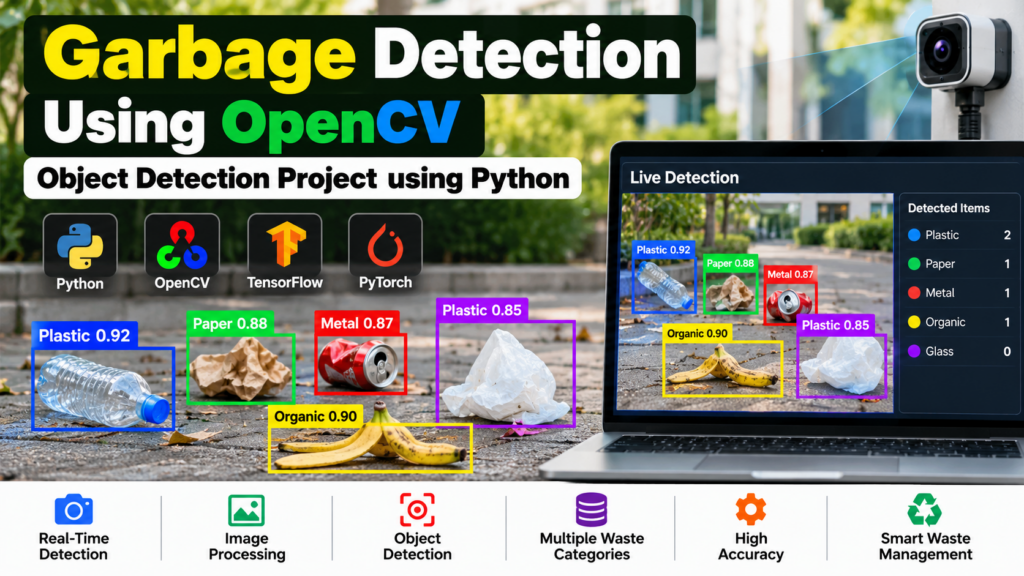
Garbage detection using OpenCV is a computer vision project that can be used to identify and detect waste or garbage from images and video streams. The project demonstrates how Python, OpenCV, image processing, and object detection techniques can be combined to build an automated garbage detection system.
Traditional waste monitoring depends heavily on manual inspection. An automated garbage detection project can help identify waste from camera images and provide useful information for applications such as smart waste management, cleanliness monitoring, recycling support, and environmental monitoring.
This project is also suitable for students looking for a practical Python computer vision project for academic or final-year project development.
Garbage Detection using OpenCV
What Is Garbage Detection?
Garbage detection is the process of identifying waste objects from an image or video using computer vision techniques.
A camera captures an image or video frame, and the computer vision system processes the visual information to determine whether garbage is present. Depending on the model and dataset used, the system can detect different categories of waste such as:
- Plastic bottles
- Paper
- Cans
- Food waste
- Plastic bags
- Glass
- Other recyclable materials
The accuracy of the system depends on the dataset, object detection model, image quality, training process, and environmental conditions.
Garbage Detection Using OpenCV
OpenCV is an open-source computer vision library that provides tools for image and video processing. In a garbage detection project, OpenCV can be used to capture frames from a camera, resize images, process frames, display detection results, and integrate an object detection model.
A typical system can follow this workflow:
Camera/Image → Image Processing → Object Detection Model → Garbage Detection → Result Display
The project can work with both static images and real-time video depending on the implementation.
Objectives of the Project
The main objectives of this garbage detection project are:
- To detect garbage automatically from images or video.
- To demonstrate computer vision using Python and OpenCV.
- To process real-time camera frames.
- To identify waste objects using an object detection approach.
- To display detected objects with bounding boxes.
- To explore automated waste monitoring.
- To provide a foundation for smart waste management applications.
How the System Works
The garbage detection system generally consists of several stages.
1. Image or Video Input
The system receives input from a webcam, uploaded image, video file, or another camera source.
For real-time detection, OpenCV can capture frames continuously from a webcam or camera.
2. Image Preprocessing
The captured image can be resized and processed before being passed to the detection model.
Common preprocessing operations include:
- Image resizing
- Color conversion
- Noise reduction
- Normalization
- Frame processing
Preprocessing helps prepare the input for the detection stage.
3. Object Detection
The processed image is provided to an object detection model.
The model analyzes the image and attempts to identify objects belonging to the classes on which it was trained.
For example, a trained model may identify a plastic bottle and draw a bounding box around it.
4. Detection Result
The system displays the detected object along with information such as:
- Object class
- Confidence score
- Bounding box
- Detection count
The result can be displayed directly on the image or video frame.
Technologies Used
The technologies used in a garbage detection project may include:
- Python
- OpenCV
- NumPy
- Object Detection Model
- Machine Learning / Deep Learning
- Image Processing
- Dataset for Garbage or Waste Detection
The exact technologies depend on the implementation and object detection model used in the project.
Features of Garbage Detection System
A garbage detection system can provide several useful features.
Real-Time Detection
The system can process live camera frames and detect garbage in real time.
Image-Based Detection
Users can provide an image to identify garbage objects present in the image.
Bounding Boxes
Detected objects can be highlighted using bounding boxes.
Object Classification
A trained model can classify different types of waste according to the available dataset.
Confidence Score
The system can display the confidence score associated with each detected object.
Detection Count
The application can count the number of detected objects in an image or video frame.
Automated Monitoring
The system can reduce the need for continuous manual monitoring in suitable environments.
Garbage Detection Workflow
The complete workflow can be represented as:
Input Image/Camera
↓
Frame Capture
↓
Image Preprocessing
↓
Object Detection Model
↓
Garbage/Object Identification
↓
Bounding Box and Confidence Score
↓
Display Detection Result
This workflow can be extended for advanced smart waste-management applications.
Software Requirements
The basic software requirements may include:
- Python 3.x
- OpenCV
- NumPy
- Required machine learning or deep learning libraries
- Object detection model
- Trained garbage/waste dataset
- Windows, Linux, or another supported operating system
- Code editor such as Visual Studio Code or PyCharm
The exact library requirements depend on the object detection model used in the implementation.
Hardware Requirements
A basic implementation can run on a standard computer.
Recommended hardware may include:
- Intel Core i3/i5 processor or equivalent
- 4 GB or more RAM
- Webcam for real-time detection
- Sufficient storage for datasets and models
For larger deep learning models or real-time high-resolution detection, a dedicated GPU can improve processing speed.
Dataset for Garbage Detection
A dataset is an important component of an object detection system.
The dataset should contain images representing the types of garbage that the model needs to identify. Images should include different backgrounds, lighting conditions, object sizes, orientations, and environments.
A good dataset may contain categories such as:
- Plastic
- Paper
- Metal
- Glass
- Organic waste
- General garbage
For object detection, images normally require appropriate annotations that identify the location and class of each object.
The quality and diversity of the dataset can significantly affect the performance of the trained model.
Training an Object Detection Model
If the project uses a custom object detection model, the model needs to be trained using an appropriate dataset.
The general process is:
- Collect garbage images.
- Clean and organize the dataset.
- Annotate the objects.
- Split the dataset into training and validation data.
- Configure the object detection model.
- Train the model.
- Evaluate the model.
- Test it on new images.
- Integrate the trained model with Python and OpenCV.
The trained model can then be used to detect garbage in images or video.
Advantages
Garbage detection using OpenCV and object detection offers several advantages:
- Reduces manual monitoring.
- Supports automated waste identification.
- Can work with images and video.
- Can be extended for real-time applications.
- Provides a practical computer vision use case.
- Can help monitor waste in selected environments.
- Can be integrated with smart-city applications.
- Provides useful experience with Python and machine learning.
Applications
A garbage detection system can have applications in different areas.
Smart Waste Management
The system can be integrated into smart waste-management solutions to monitor waste in selected locations.
Public Places
Computer vision can assist in monitoring waste in areas such as parks, campuses, streets, and public spaces.
Educational Institutions
Schools and colleges can use computer vision-based systems as part of environmental monitoring projects.
Recycling Support
Object detection can help identify recyclable waste categories when the model is trained for those categories.
Smart City Projects
Garbage detection can be combined with IoT sensors, cameras, and centralized dashboards for smart-city applications.
Environmental Monitoring
Computer vision can provide additional information for monitoring waste accumulation in controlled environments.
Limitations
Although garbage detection can be useful, the system has several limitations.
- Detection accuracy depends on the quality of the dataset.
- Poor lighting can affect detection.
- Objects may be partially hidden or overlapping.
- Small objects can be difficult to detect.
- Different types of garbage may have similar visual characteristics.
- Real-time detection may require sufficient computing power.
- The model may produce incorrect detections.
- A model trained on limited categories cannot reliably identify categories that were not included during training.
Therefore, the system should be tested under different real-world conditions before practical deployment.
Future Scope
The project can be improved with several advanced features.
Improved Detection Models
More advanced object detection models can be evaluated to improve detection accuracy and processing speed.
Waste Classification
The system can classify detected waste into categories such as plastic, paper, metal, glass, and organic waste.
IoT Integration
The detection system can be connected to IoT devices and sensors for automated waste monitoring.
Smart Dustbin Integration
A camera and detection model could be integrated with a smart dustbin to identify waste and support automated sorting.
Mobile Application
The project can be extended into a mobile application for image-based garbage detection.
Web Dashboard
A web dashboard can display detection results, waste categories, detection counts, and historical information.
Real-Time Alerts
The system could generate alerts when garbage is detected in predefined areas.
Why This Is a Good Python Project
Garbage detection using OpenCV is a practical project because it combines several important technologies.
Students can learn:
- Python programming
- OpenCV
- Image processing
- Computer vision
- Object detection
- Machine learning concepts
- Dataset preparation
- Model evaluation
- Real-time video processing
It can therefore be useful as a final-year project, mini project, or learning project for students interested in computer vision and artificial intelligence.
Frequently Asked Questions
What is garbage detection using OpenCV?
Garbage detection using OpenCV is a computer vision application that processes images or video and identifies garbage or waste objects using image-processing and object-detection techniques.
Can garbage detection be done using Python?
Yes. Python can be used with OpenCV and machine learning or deep learning libraries to develop a garbage detection system.
Can this project work with a webcam?
Yes. With an appropriate implementation, OpenCV can capture webcam frames and process them for real-time object detection.
What dataset is required for garbage detection?
A dataset containing images of the waste categories that the system needs to detect is required. For object detection, the images should also have suitable annotations.
Can this project detect different types of garbage?
Yes, if the object detection model has been trained using a dataset containing multiple garbage categories.
Is garbage detection an AI project?
It can be considered an AI/computer vision project when machine learning or deep learning models are used to identify and classify garbage.
Explore Related Projects
Students interested in computer vision and Python projects can also explore:
- Waste Classification Using Deep Learning
- YOLO Object Detection Projects
- Smart Waste Management System
- Image Processing Projects Using Python
- Machine Learning Projects for Final-Year Students
Conclusion
Garbage Detection Using OpenCV is a practical computer vision project that demonstrates how Python, OpenCV, image processing, and object detection can be combined to identify waste from images and video.
The project provides students with hands-on experience in computer vision and machine learning while also demonstrating a real-world application related to waste management and environmental monitoring.
With further development, the system can be integrated with IoT devices, smart dustbins, web dashboards, mobile applications, and real-time monitoring systems to create a more advanced smart waste-management solution.
☎️ Contact Us For More Queries:-
📲 Call/WhatsApp: +91-9460060699
🌎 Website: www.techieprojects.com
📺 Instagram: @pythonprojects_