
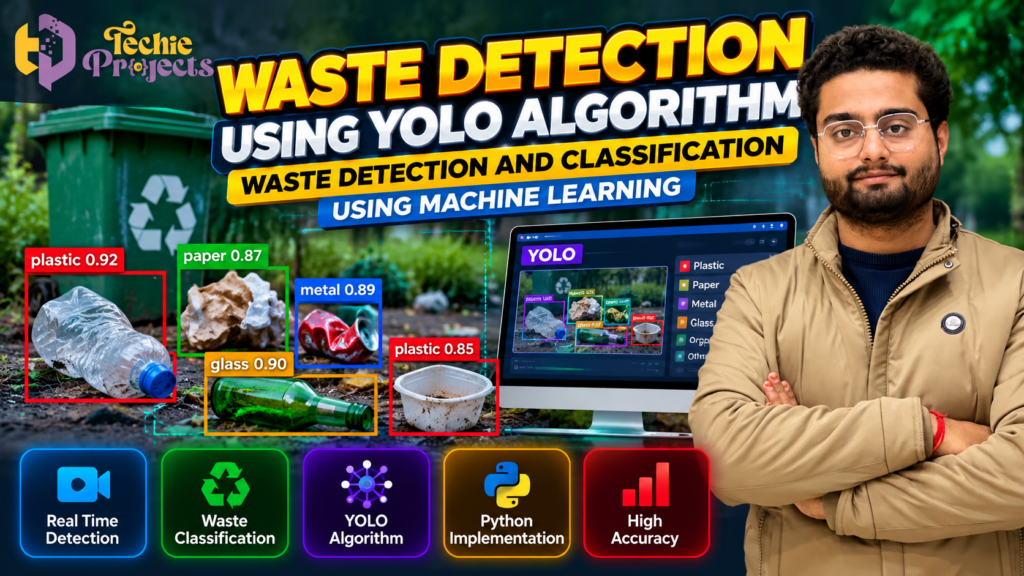
Looking for an impressive machine learning project for your engineering final year? ♻️ Waste Detection Using YOLO Algorithm is a practical project idea that combines computer vision, object detection, and waste classification to address a real-world environmental challenge. Instead of spending weeks struggling to select a suitable topic and build the project from scratch, explore this project from Techie Projects to understand its concept, implementation approach, and suitability for your academic requirements.
Whether you are a B.Tech, B.E., Computer Science, Artificial Intelligence, Data Science, or IT student, this project can help you explore how AI-based object detection can support waste identification and smart waste management. Contact Techie Projects to enquire about the available project package, source code, installation requirements, documentation, and other deliverables before purchasing.
🎬 Watch the Waste Detection Using YOLO Algorithm Project Demo
See how a YOLO-based waste detection system can identify and classify waste objects in images or video frames. A suitable implementation may display bounding boxes, predicted class labels, and confidence scores to illustrate how computer vision works in a practical application.
The project demonstration can help you understand the workflow, visual output, and potential applications before deciding whether it fits your academic project requirements.
♻️ What Is Waste Detection Using YOLO Algorithm?
Waste Detection Using YOLO Algorithm is a computer vision project that applies the YOLO (You Only Look Once) family of object detection models to identify waste items in visual data. Depending on the dataset, model, and implementation, the system may recognise categories such as plastic bottles, paper, cardboard, metal cans, glass, and other waste materials.
Traditional waste sorting often requires manual inspection. An AI-based system can assist this process by analysing images and identifying objects automatically. This makes waste detection an interesting application of machine learning for students exploring environmental technology.
The actual classes detected depend on the dataset used to train or configure the model. The system’s predictions should be evaluated on suitable test images because accuracy can vary with lighting, object overlap, image quality, and unfamiliar waste items.
🎯 Why Choose This Machine Learning Project?
Selecting the right final-year project can be challenging. Students often need a topic that demonstrates technical skills, has a practical use case, and offers enough material for a project report and presentation.
Waste Detection Using YOLO Algorithm brings together several important concepts:
- Computer vision: Learn how a system processes visual information.
- Object detection: Explore how a model locates objects and predicts their classes.
- Machine learning: Understand training, testing, and model evaluation.
- Python programming: Work with a popular language used in AI development.
- Environmental applications: Study how AI could support waste segregation and resource recovery.
This project is suitable for students who want to explore applied AI rather than build only a basic data-entry application. Before selecting it, confirm that the implementation matches your department’s requirements and your current technical level.
🔍 How Does a YOLO-Based Waste Detection System Work?
A typical waste detection workflow includes several stages. The exact steps depend on the chosen YOLO version and project implementation.
1. Image or Video Input
The system receives an image, a video, or frames captured from a camera. The input provides the visual information that the model will analyse.
2. Image Preprocessing
Images may be resized and prepared in the format expected by the selected model. Consistent preprocessing helps the system process input data correctly.
3. YOLO Model Inference
The trained model analyses the image and predicts the locations and classes of objects it recognises. Object detection models can produce bounding boxes, class labels, and confidence scores.
4. Waste Classification
The model assigns detected objects to the categories represented in its training data. For example, a model trained on suitable plastic, paper, and metal classes may identify examples of those materials.
5. Visualisation of Results
The application can display the original image with bounding boxes and labels around detected objects. Some implementations may also show confidence scores or detection summaries.
6. Evaluation
The model can be evaluated using appropriate test data and metrics. Depending on the project, these may include precision, recall, mean Average Precision (mAP), and inference time.
🧠 Key Features of a Waste Detection Project
The available features depend on the specific project version offered by Techie Projects. Common features in this type of application may include:
- Detection of multiple waste objects in a single image.
- Classification of supported waste categories.
- Bounding-box visualisation.
- Confidence scores for model predictions.
- Image-based detection.
- Video-frame processing, where implemented.
- A graphical interface or web interface, if included in the selected version.
- Evaluation using test images and appropriate performance metrics.
Do not assume every feature is included in every version. Contact Techie Projects to confirm the actual functionality, supported input formats, model version, and system requirements before purchasing.
♻️ Benefits of Waste Detection Using YOLO Algorithm for Students
Waste Detection Using YOLO Algorithm is a useful choice for students who want to explore practical applications of artificial intelligence and computer vision. The project demonstrates how an object detection model can locate waste items in images and assign labels to recognised categories. It also introduces important concepts such as dataset preparation, model inference, bounding boxes, confidence scores, and performance evaluation.
For final-year engineering students, this topic offers opportunities to study Python programming, deep learning, and environmental technology in one project. Students can use the implementation to understand how automated waste identification works, analyse its limitations, and suggest improvements based on their test results.
🚀 How Waste Detection Using YOLO Algorithm Supports Smart Waste Management
Waste Detection Using YOLO Algorithm explores how AI-powered visual detection could assist waste segregation and recycling workflows. Depending on the model and dataset, the system may identify objects such as plastic bottles, paper, glass, and metal containers.
In practical environments, automated detection could help identify recyclable materials before sorting. However, reliable deployment requires suitable training data, real-world testing, and integration with appropriate equipment. A student project provides a foundation for understanding these possibilities without claiming that a prototype is ready for industrial use.
🛠️ Technologies Used
A YOLO-based waste detection project may use the following technologies, depending on the implementation.
Python
Python is widely used in AI and computer vision because it provides access to libraries for image processing, data preparation, and machine learning.
YOLO Object Detection
YOLO is a family of object detection models designed to predict object locations and classes. The particular model version should be confirmed for the project package you choose.
OpenCV
OpenCV can be used to read images, process video frames, and display detection results. Its use depends on the project’s implementation.
PyTorch and Supporting Libraries
Some YOLO implementations use PyTorch and related libraries. The required versions should be checked before installation to avoid compatibility problems.
Dataset and Annotations
Training or evaluating a custom detector may require images labelled with object classes and bounding boxes. Dataset quality, class balance, and annotation accuracy can influence model performance.
💻 Software and Hardware Requirements
Check the following general requirements before installing a computer vision project.
Possible software requirements:
- Python and a compatible package environment.
- The required YOLO implementation and dependencies.
- OpenCV, if used.
- PyTorch or another framework required by the selected model.
- A code editor such as Visual Studio Code or PyCharm.
Possible hardware requirements:
- A laptop or desktop computer.
- Sufficient RAM and storage for the environment and dataset.
- A compatible CPU for basic inference.
- A supported NVIDIA GPU, if GPU acceleration is required or desired.
The exact Python version, package versions, RAM, GPU requirements, and installation procedure vary by implementation. Confirm these details before purchasing so you can run the project in your available environment.
🎓 Academic Applications and Learning Outcomes
Waste detection is a useful topic for students studying computer science, AI, data science, and related engineering disciplines.
By studying the project, students can explore:
- The difference between image classification and object detection.
- How labelled datasets are prepared for object detection.
- How a model predicts object classes and locations.
- How to test detection results on unseen images.
- How to interpret model performance metrics.
- The limitations of AI in real-world environments.
- How computer vision may contribute to smart waste management.
For academic use, make sure you understand the code and can explain the design decisions, dataset, model, evaluation, and limitations during your viva or project presentation. Follow your institution’s rules regarding external project resources and disclosure.
🌍 Real-World Applications of Waste Detection
AI-based waste detection has potential applications in several areas.
Smart Waste Segregation
Computer vision may help identify different waste categories before sorting. In a real sorting facility, detection would need to be integrated with suitable mechanical or robotic equipment.
Recycling Facilities
Automated detection can support the identification of selected recyclable materials. Real-world deployment requires testing with varied materials, lighting, conveyor speeds, and overlapping objects.
Smart City Research
Researchers can investigate how image-based waste monitoring could support cleanliness initiatives and waste-management planning.
Environmental Education
A demonstration system can help students understand the connection between artificial intelligence, recycling, and environmental sustainability.
These are potential applications, not a guarantee that a student prototype is ready for commercial deployment. Practical systems require extensive testing and suitable hardware integration.
📊 Advantages and Limitations
Advantages
- Demonstrates a practical application of computer vision.
- Combines AI concepts with an environmental use case.
- Can produce visual and easy-to-explain detection results.
- Offers opportunities to explore datasets and model evaluation.
- Can be extended as a learning exercise with additional classes or input types.
Limitations
- Performance depends on the dataset and quality of annotations.
- Small, damaged, or partially hidden objects can be difficult to detect.
- Similar-looking materials may be misclassified.
- Processing speed depends on hardware and model configuration.
- A trained model may perform poorly on waste categories not represented in its training data.
Understanding these limitations will help you present the project realistically and discuss possible improvements.
🛒 Purchase the Waste Detection Using YOLO Algorithm Project from Techie Projects
Want to explore this project for your engineering submission? Contact Techie Projects to enquire about the Waste Detection Using YOLO Algorithm package, pricing, and available deliverables.
Before purchasing, confirm whether the selected package includes source code, installation instructions, documentation, dataset details, a demonstration, and technical assistance. The exact inclusions may vary by version.
Need a project reference for your engineering coursework? Enquire about the Waste Detection Using YOLO Algorithm project from Techie Projects to check availability and confirm the deliverables before making a purchase.
When contacting us, mention your branch, semester, project deadline, preferred programming environment, and college requirements. This will help you determine whether the available version is appropriate for your needs.
Before confirming your order, ask about:
- Source code availability and the supported model version.
- Installation instructions and software dependencies.
- Project documentation and report availability.
- Dataset details and permitted usage.
- Demonstration video availability.
- Whether code explanation or technical assistance is included.
- Price, delivery method, and any applicable support terms.
Deliverables and support can vary by package, so confirm them directly before payment.
📲 Contact Techie Projects
- 📲 Call/WhatsApp: +91-9460060699
- 🌎 Website: www.techieprojects.com
- 📺 Instagram: @pythonprojects_
Send your enquiry on WhatsApp to discuss the project package, requirements, pricing, and availability. Review the details before placing your order.
🚀 Explore Related Python and AI Projects
If you are comparing final-year project ideas, explore other categories available on Techie Projects:
- Artificial Intelligence Projects
- Machine Learning Projects
- Python Projects
- Computer Vision Projects
- Image Processing Projects
- Data Science Projects
- Deep Learning Projects
- IoT Projects
Compare each project’s scope, technology stack, learning objectives, and deliverables before selecting the best option for your course.
❓ Frequently Asked Questions
1. What is Waste Detection Using YOLO Algorithm?
It is a computer vision application that uses a YOLO object detection model to locate and classify waste items in images or video frames, depending on its implementation.
2. Which programming language is used?
Python is commonly used for YOLO-based waste detection projects. Supporting libraries and framework requirements depend on the selected version.
3. Can this project be used for a final-year engineering submission?
It may be suitable for a final-year project, depending on your department’s requirements, project scope, and assessment criteria. Confirm approval with your project guide before purchasing.
4. Does the system detect every type of waste?
No. A model generally detects the categories it has been trained or configured to recognise. Performance can vary for unseen materials and challenging images.
5. Is a GPU compulsory?
Not always. Some models can run on a CPU, although inference may be slower. Check the selected implementation’s requirements before installation.
6. How can I purchase the project?
Visit Techie Projects or contact us through WhatsApp to enquire about availability, pricing, source code, documentation, installation requirements, and support.
7. Can I explain the project during my viva?
You should study the implementation, understand the model and dataset, practise running the application, and prepare to explain the workflow, evaluation results, limitations, and future improvements. Confirm whether code explanation or additional assistance is included in your chosen package.
✅ Conclusion
Waste Detection Using YOLO Algorithm is a practical project topic for exploring object detection, Python programming, machine learning, and environmental applications. It provides opportunities to study how AI can identify waste items from visual data while learning about model evaluation and real-world limitations.
If you want to explore this project for your engineering coursework, contact Techie Projects to confirm the available version, features, deliverables, installation requirements, and pricing. Choose a package that fits your academic objectives, understand the implementation, and prepare to present your work confidently.
Ready to enquire? Visit techieprojects.com or message Techie Projects on WhatsApp for project details.