
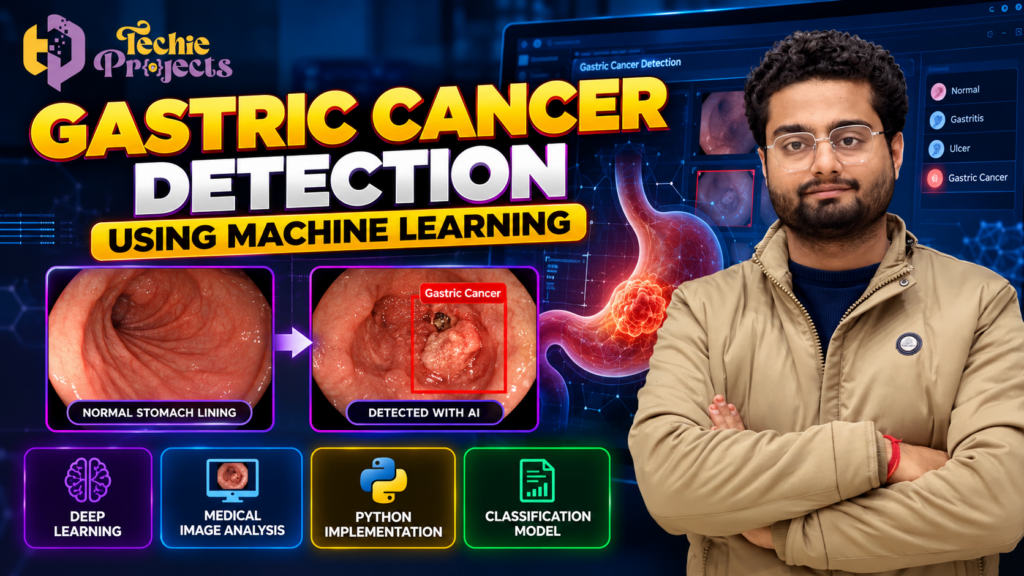
Are you looking for a Gastric Cancer Detection Using Machine Learning project for your final-year engineering submission, academic research, or machine learning portfolio? 🚀 Techie Projects offers project-oriented solutions designed to help students explore real-world applications of artificial intelligence, deep learning, Python programming, and medical image analysis.
Instead of spending weeks trying to identify a suitable project topic, understand its workflow, and configure its technical environment, explore this healthcare AI project as a potential starting point for your academic work. It can help you study how machine learning techniques are applied to medical image classification and how deep learning models can analyze visual patterns in endoscopic images.
🎓 Planning your final-year project? Contact Techie Projects to discuss the available project package, source code, installation requirements, documentation, and other deliverables before purchasing.
- 📲 Call/WhatsApp: +91-9460060699
- 🌎 Website: www.techieprojects.com
- 📺 Instagram: @pythonprojects_
🎬 Watch the Gastric Cancer Detection Project Demo
Explore the project demonstration to understand its intended workflow, interface, and image-analysis approach. The demonstration can help you evaluate whether this project aligns with your academic requirements and interests in artificial intelligence and healthcare technology.
Watch the embedded project demonstration below to explore the implementation and understand how medical image classification can be approached using machine learning.
🧠 What Is Gastric Cancer Detection Using Machine Learning?
Gastric cancer is a disease that affects the stomach. Medical professionals may examine endoscopic images and other clinical information when evaluating suspected abnormalities. Image analysis using artificial intelligence is an active research area that explores whether computer algorithms can identify patterns in medical images.
The Gastric Cancer Detection Using Machine Learning project explores this concept from a technical and educational perspective. Depending on the implementation, it can involve image preprocessing, feature learning, deep learning model training, and classification of input images into predefined categories.
A machine learning model learns patterns from a dataset during training. When an image is supplied for prediction, the trained model processes it and produces an output based on the classes it was designed to recognize.
For engineering students, this project provides an opportunity to explore the relationship between computer vision, machine learning, medical image processing, and healthcare research.
Important: An educational model is not a clinically validated diagnostic system. Its predictions must not be used to diagnose or treat patients, and they do not replace assessment by qualified medical professionals.
🎯 Objectives of the Project
The primary objective is to explore how deep learning and image-processing techniques can be applied to medical image classification.
The main learning objectives may include:
- Understanding the fundamentals of medical image analysis.
- Exploring image preprocessing and dataset preparation.
- Learning how machine learning models process visual data.
- Studying deep learning architectures used for image classification.
- Understanding training, validation, and testing procedures.
- Evaluating classification results using suitable performance metrics.
- Developing practical knowledge of Python-based AI applications.
- Understanding the limitations of machine learning in healthcare.
These objectives make the project relevant to students studying computer science engineering, information technology, artificial intelligence, data science, and related disciplines.
⚙️ How Does the Project Work?
A typical gastric cancer image-classification workflow consists of several stages. The exact steps and features depend on the implementation and the dataset used.
1. Medical Image Dataset Collection
The first stage involves obtaining a suitable dataset containing labelled medical images. Images must be collected from an appropriate, legally usable source and organized according to the intended classification task.
Dataset quality is important because image quality, class balance, labelling accuracy, and the number of samples can affect model performance.
2. Image Preprocessing
Images may have different resolutions, sizes, and visual characteristics. Preprocessing can help prepare them for model input.
Common operations include:
- Resizing images to the required dimensions.
- Normalizing pixel values.
- Organizing images into training, validation, and testing sets.
- Applying suitable data augmentation during training, where appropriate.
Preprocessing methods should be selected according to the dataset and model requirements.
3. Deep Learning Model Development
Deep learning models can learn visual features such as edges, textures, shapes, and more complex image patterns.
For image-classification tasks, convolutional neural networks (CNNs) are a common approach. Transfer learning may also be considered when using a pretrained image model.
The model learns from labelled training examples and adjusts its parameters to reduce prediction errors. The selected architecture and training configuration determine the actual implementation.
4. Model Training and Validation
The training dataset is used to learn model parameters, while validation data can help assess performance during development.
A separate test dataset should be used for final evaluation. Where images come from the same patient or related examination, data splitting must be designed carefully to avoid information leakage and overly optimistic results.
5. Image Classification and Prediction
After training, the model can process an eligible input image and return a prediction among the categories defined by the project.
Depending on the implementation, the output may include a predicted class, class probabilities, or a visual result. These features should be confirmed in the actual project before purchase.
6. Performance Evaluation
Model performance should be evaluated using appropriate metrics rather than relying on accuracy alone.
Common evaluation measures include:
- Accuracy: The proportion of correct predictions.
- Precision: The proportion of positive predictions that are correct.
- Recall (Sensitivity): The proportion of actual positive cases correctly identified.
- F1-score: A combined measure of precision and recall.
- Confusion matrix: A summary of correct and incorrect class predictions.
For medical image research, class-specific performance and the consequences of false negatives and false positives are particularly important.
🌟 Key Features to Explore
The following are potential components of a project in this category. Confirm which features are included in the available Techie Projects package before purchasing.
- Medical image input: Processes images compatible with the selected model.
- Image preprocessing: Prepares images for model inference.
- Deep learning classification: Applies a trained model to the defined classification task.
- Prediction output: Displays the predicted class or other outputs supported by the implementation.
- Performance evaluation: May include metrics and test results, depending on the package.
- Python-based implementation: Provides an opportunity to study Python machine learning workflows.
- Academic demonstration: Can support a student presentation explaining the system architecture and methodology.
Do not assume that a graphical interface, real-time processing, a particular model architecture, or a specific accuracy score is included unless it has been verified.
💻 Technologies Used
A project of this type may use the following technologies, depending on its implementation:
| Technology | Purpose |
|---|---|
| Python | Main programming language |
| TensorFlow or PyTorch | Deep learning model development |
| OpenCV | Image processing, if required |
| NumPy | Numerical operations |
| Matplotlib | Visualization of results |
| Scikit-learn | Evaluation metrics and dataset utilities |
| Streamlit or another UI framework | User interface, if included |
Not every project requires every library listed above. The final technology stack should be checked against the supplied source code and installation instructions.
🖥️ Software and Hardware Requirements
The exact requirements depend on the model architecture, dataset size, software versions, and whether training or inference is required.
Software Requirements
- A compatible Windows or Linux environment.
- A supported Python version.
- Required Python libraries and dependencies.
- A code editor or IDE, such as Visual Studio Code or PyCharm.
- A compatible deep learning framework, if used by the implementation.
Hardware Requirements
- A computer with sufficient RAM and storage for the project.
- A compatible CPU for basic development and inference.
- An NVIDIA GPU may be useful for computationally intensive model training, depending on framework and hardware compatibility.
Before purchasing, confirm the required Python version, library versions, dataset availability, hardware requirements, and installation procedure to avoid environment compatibility issues.
🧠 Benefits of Gastric Cancer Detection Using Machine Learning
The Gastric Cancer Detection Using Machine Learning project helps students explore how artificial intelligence can be applied to medical image analysis. It combines concepts from Python programming, deep learning, image preprocessing, and image classification in a healthcare research context.
Key learning benefits include:
- Deep learning implementation: Understand how neural networks learn visual patterns from labelled images.
- Medical image processing: Explore image preparation and preprocessing techniques.
- Machine learning workflow: Learn about training, validation, testing, and model evaluation.
- Performance analysis: Study accuracy, precision, recall, F1-score, and confusion matrices.
- Practical Python experience: Develop knowledge of AI libraries and image-classification workflows.
For students looking for a healthcare AI project, this topic provides an opportunity to connect theoretical machine learning concepts with a practical implementation.
⚙️ How Gastric Cancer Detection Using Machine Learning Works
The workflow of Gastric Cancer Detection Using Machine Learning generally begins with a suitable labelled image dataset. Images are preprocessed and supplied to a trained deep learning model, which produces predictions based on its predefined classes.
The main stages may include dataset preparation, image resizing, normalization, model training, validation, and performance evaluation. The implementation may also provide a user interface for submitting images and viewing classification results, depending on the available features.
Understanding each stage helps students explain the system architecture, describe the role of Python libraries, and discuss the limitations of machine learning models. Results from an academic project should not be interpreted as a confirmed medical diagnosis.
🎓 Who Should Choose the Gastric Cancer Detection Using Machine Learning Project?
The Gastric Cancer Detection Using Machine Learning project may be suitable for students pursuing computer science engineering, information technology, artificial intelligence, or data science.
It can be useful for students who want to study:
- Python-based machine learning applications.
- Deep learning and computer vision.
- Healthcare AI research.
- Medical image classification.
- Model evaluation and technical documentation.
Before selecting the project, review your institution’s requirements and confirm the implementation, source code, documentation, and other deliverables available from Techie Projects.
🛒 Get the Gastric Cancer Detection Using Machine Learning Project
Looking for a Gastric Cancer Detection Using Machine Learning project for your final-year submission or academic portfolio? Contact Techie Projects to check the current package, technical requirements, pricing, and available deliverables before purchasing.
Discuss your requirements with us to determine whether the project matches your academic objectives.
📲 WhatsApp: Enquire About the Project
🌐 Website: Explore Techie Projects
📸 Instagram: Follow Techie Projects
🎓 Why Choose This Project for Your Academic Portfolio?
Gastric Cancer Detection Using Machine Learning connects several important technical topics within one application.
For computer science and IT students: Explore Python programming, computer vision, model development, and evaluation.
For AI and data science students: Study dataset preparation, model training, validation, classification metrics, and the interpretation of experimental results.
For final-year engineering students: Use the topic to develop an academic presentation explaining the problem statement, methodology, system architecture, implementation, limitations, and future scope.
For project demonstrations: Explain how input images are processed, how the model generates its output, and how the results are evaluated.
Your final submission should reflect your own understanding of the implementation. Review your institution’s project rules and be prepared to explain the code, methods, results, and limitations during your viva.
🏥 Applications and Research Scope
Machine learning for medical image analysis has potential research applications across several areas.
- Endoscopic image research: Investigating visual patterns in gastrointestinal images.
- Medical image classification: Studying models that categorize images into predefined classes.
- Computer vision research: Exploring feature extraction and image representation.
- Healthcare AI education: Demonstrating how image-based machine learning systems are developed.
- Model evaluation research: Comparing architectures and examining how dataset quality affects results.
These are research and educational applications, not claims that this particular project is approved for clinical use. Real-world deployment requires appropriate validation, clinical evaluation, privacy safeguards, and regulatory consideration.
⚠️ Limitations and Challenges
Understanding limitations is an important part of a high-quality engineering project.
- Dataset dependency: A model can perform poorly on images that differ from its training data.
- Class imbalance: Uneven representation of classes can distort performance metrics.
- Overfitting: A model may perform well on training images but poorly on unseen data.
- Image variability: Lighting, image quality, equipment, and acquisition conditions may affect predictions.
- Generalization: Results from one dataset may not transfer to another hospital or patient population.
- Clinical reliability: Academic performance does not establish medical safety or diagnostic accuracy.
Discussing these issues in your project report can demonstrate a stronger understanding of responsible AI development.
🚀 Future Scope
Possible future research directions include comparing different deep learning architectures, evaluating transfer learning, improving dataset diversity, investigating explainable AI methods, and testing model robustness on independent datasets.
Researchers may also explore improved visualization of predictions and more rigorous evaluation protocols. Any proposed improvement should be supported by experiments and appropriate evidence rather than assumed to increase accuracy.
🛒 Purchase Gastric Cancer Detection Using Machine Learning Project from Techie Projects
Looking for a machine learning project for your engineering coursework or academic portfolio? Contact Techie Projects before purchasing to confirm the available implementation and deliverables.
We can discuss your project requirements so you can determine whether the available solution is suitable for your academic needs.
Before placing an order, ask about:
- Source code availability and supported technologies.
- Installation instructions and software dependencies.
- Project documentation and report availability.
- Dataset availability and permitted usage.
- Demonstration video or interface availability.
- Support arrangements, delivery timelines, and pricing.
- Whether the project can be explained and demonstrated in your required environment.
The exact deliverables, pricing, and support depend on the package confirmed at the time of enquiry.
📲 Contact Techie Projects
- Website: https://techieprojects.com/
- WhatsApp Enquiry: https://wa.me/919460060699
- Instagram: https://www.instagram.com/pythonprojects_/
Send your requirements and ask for the current project details before making a purchase.
🔗 Explore Related Python Projects
If you are interested in artificial intelligence and image processing, you can also explore related project topics on Techie Projects:
- Explore Python Projects
- Deep Learning Projects
- Medical Image Processing Projects
- Computer Vision Projects
- Machine Learning Projects
- Healthcare AI Projects
Browse the website to explore available projects and contact us to confirm the current offerings.
❓ Frequently Asked Questions
1. What is Gastric Cancer Detection Using Machine Learning?
It is an educational or research-oriented project that explores the use of machine learning and deep learning techniques to classify gastric or endoscopic images into predefined categories.
2. Which programming language is used in this project?
Python is commonly used for machine learning and deep learning projects. The exact libraries and framework depend on the implementation available from Techie Projects.
3. Is this project suitable for final-year engineering students?
It may be suitable for students in computer science, IT, AI, and data science, subject to their institution’s requirements, project scope, and evaluation criteria.
4. Does the project include source code and documentation?
Availability varies by package. Contact Techie Projects to confirm whether source code, documentation, installation instructions, datasets, and other requested deliverables are included.
5. Can this project diagnose gastric cancer in real patients?
An academic model should not be used to diagnose patients. Clinical use requires rigorous independent validation and appropriate medical oversight. Predictions from an educational project must not replace professional medical assessment.
6. Do I need a GPU to run the project?
Not necessarily. Some models can perform inference on a CPU, while training larger models may benefit from a compatible GPU. Check the specific implementation’s hardware requirements.
7. How can I purchase this project?
Visit Techie Projects or contact us directly through WhatsApp to ask about pricing, availability, deliverables, and installation requirements.
✅ Conclusion
Gastric Cancer Detection Using Machine Learning is a relevant academic topic for exploring deep learning, Python programming, computer vision, and medical image classification. It provides a foundation for understanding how machine learning models process image data, generate predictions, and undergo performance evaluation.
If you are planning an engineering project in healthcare AI, contact Techie Projects to review the available implementation and confirm its suitability for your requirements before purchasing.
📲 Start your project enquiry today: Contact Techie Projects on WhatsApp.