
Introduction
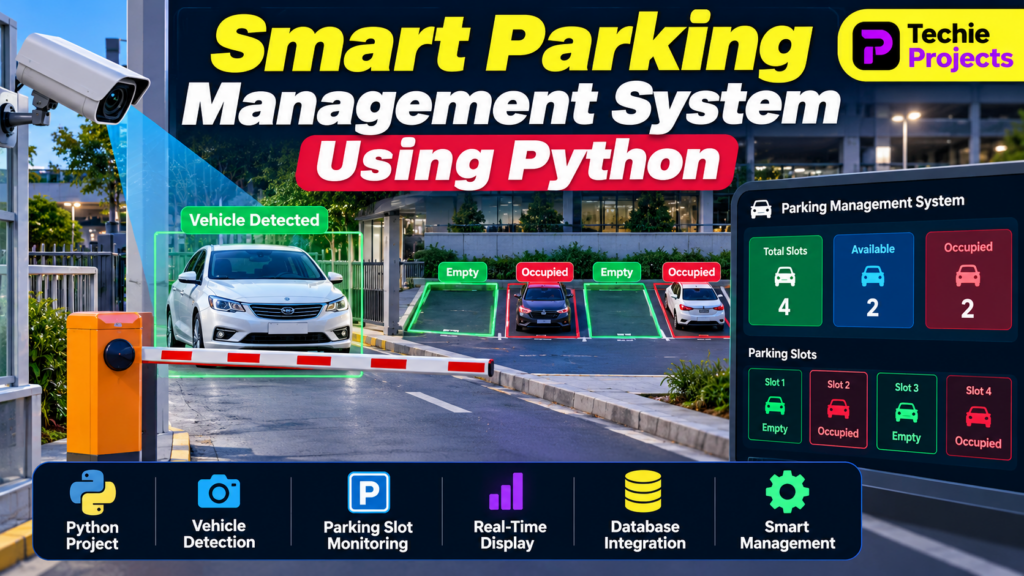
A Smart Parking Management System using Python is a software-based project designed to improve how parking spaces are monitored and managed. Traditional parking systems often require manual checking of available spaces, which can lead to traffic congestion, wasted time, and inefficient parking management.
By using Python, computer vision, and vehicle detection techniques, a smart parking system can help identify vehicles, monitor parking slots, and display parking availability. This project is suitable for computer science engineering students interested in Python programming, machine learning, image processing, and intelligent transportation systems.
The system can be developed as a desktop application or an advanced solution using a camera feed and a parking slot monitoring interface, depending on the project requirements.
🎥 Project Working Demo
Watch the project demonstration to understand the parking management interface, vehicle detection concept, and parking slot monitoring workflow.
Project Demo: Embed your Smart Parking Management System project video here.
What Is a Smart Parking Management System?
A Smart Parking Management System is an application that helps monitor parking spaces and manage vehicle parking more efficiently. Depending on its implementation, the system can identify occupied and vacant parking slots, display parking status, and assist users or administrators in managing available spaces.
A Python-based parking management project may combine image processing, computer vision, a database, and a graphical user interface to provide a more organized parking experience.
For example, a parking area with eight spaces could display which spaces are occupied and which remain available. If a camera-based detection feature is implemented, the system can analyze images or video frames to estimate parking occupancy.
🎯 Objectives of the Project
The main objectives of the Smart Parking Management System using Python are:
- Monitor parking slot availability.
- Identify occupied and vacant parking spaces.
- Reduce the effort required for manual parking management.
- Display parking information through a user-friendly interface.
- Store parking-related information when database functionality is implemented.
- Explore vehicle detection and image processing techniques.
- Build a practical project demonstrating Python programming and software development concepts.
Key Features of the Smart Parking Management System
The features depend on the actual implementation of the project. Common features include the following.
1. Parking Slot Monitoring
The system displays the status of parking spaces and helps identify which slots are available or occupied.
2. Vehicle Detection
In a computer vision-based implementation, a camera feed or image can be analyzed to detect vehicles in a parking area. The detection method depends on the selected algorithm and available training data.
3. Real-Time Parking Status
When connected to a live camera or continuously updated input, the application can refresh the displayed parking status as new information becomes available.
4. Graphical User Interface
A graphical interface can display parking slot information, vehicle status, and other relevant details in an organized format.
5. Database Integration
An optional database can store vehicle entries, parking records, timestamps, slot information, and other details required for reporting.
6. Parking Availability Display
The system can present the total number of parking spaces, occupied slots, and available spaces. These values should be calculated from the actual parking data rather than displayed as fixed values.
7. Extendable Project Architecture
The project can be expanded with features such as entry and exit records, parking fees, user authentication, reporting, and automated parking barriers if the required hardware and software are available.
⚙️ Technologies Used
The following technologies may be used to build a Smart Parking Management System using Python.
| Technology | Purpose |
|---|---|
| Python | Core programming language |
| OpenCV | Image processing and computer vision |
| NumPy | Numerical operations and array processing |
| Machine learning or deep learning | Optional vehicle detection |
| Tkinter or another GUI framework | Desktop application interface |
| SQLite or MySQL | Optional database integration |
| Camera or video input | Parking area monitoring |
Choose the technologies according to your actual implementation. For example, a basic parking slot monitoring application may not require a trained deep learning model.
How Does the Smart Parking Management System Work?
A typical camera-based parking management workflow can be divided into several stages.
Step 1: Capture Parking Area Images
The system receives input from a camera, recorded video, or sample images of the parking area.
Step 2: Process the Input
Python image processing techniques can prepare the input for analysis. Depending on the implementation, this may involve resizing, filtering, color conversion, or region selection.
Step 3: Identify Parking Slots
The application defines parking spaces that need to be monitored. These regions may be configured manually or identified using a suitable computer vision method.
Step 4: Detect Occupied and Vacant Slots
The system evaluates the selected parking regions to estimate whether each space is occupied. The detection approach could use image comparison, thresholding, or a trained vehicle detection model.
Step 5: Calculate Parking Availability
The application counts the occupied and vacant spaces.
For a system with a fixed set of monitored slots:
Available slots = Total monitored slots − Occupied slots
This calculation assumes each monitored slot is classified as either occupied or vacant.
Step 6: Display the Results
The application presents the parking status through its user interface. A live implementation can update the information as new camera frames are processed.
Software Requirements
Typical software requirements include:
- Python 3
- OpenCV
- NumPy
- A code editor such as Visual Studio Code or PyCharm
- Tkinter or another interface framework, if required
- A compatible operating system such as Windows or Linux
- A database such as SQLite or MySQL, if database functionality is included
Additional libraries may be required for a machine learning-based vehicle detection model.
Hardware Requirements
The hardware requirements depend on the complexity of the project.
- A computer or laptop
- A compatible camera or webcam for live monitoring
- Sufficient RAM and storage for the development environment
- A suitable processor for image processing
- An optional GPU for computationally intensive deep learning models
- Optional sensors, a microcontroller, or a barrier controller for hardware-based parking automation
A basic software simulation can be developed without physical parking sensors or an automated barrier.
Database Design
If database integration is included, the project may use tables such as the following.
| Table | Example information |
|---|---|
| Parking Slots | Slot ID, slot number, status |
| Vehicle Records | Vehicle ID, registration number, entry time |
| Parking Sessions | Session ID, slot ID, entry and exit timestamps |
| Users | User ID, username, access role |
These are suggested database structures, not requirements for every version of the project. A simpler implementation may store only parking slot status, while an advanced version may maintain complete vehicle parking records.
Advantages of a Smart Parking Management System
A properly implemented smart parking system can offer several benefits:
- Improved visibility: Users can see parking slot availability more easily.
- Reduced manual effort: Automated monitoring can reduce the need for repeated manual checks.
- Better parking organization: Slot information can help administrators manage parking areas.
- Efficient record management: Database integration can support parking history and reporting.
- Practical learning: Students can apply Python, databases, image processing, and computer vision.
- Future expansion: The system can be extended with additional software or hardware features.
The actual benefits depend on detection accuracy, camera placement, lighting conditions, and the reliability of the implemented system.
Limitations of the Project
Students should also understand the limitations of a smart parking application.
- Poor lighting or camera angles may affect vehicle detection.
- Overlapping vehicles can make parking slot classification difficult.
- Camera-based systems require suitable image or video input.
- Real-time performance depends on hardware and algorithm efficiency.
- Incorrectly configured parking regions can produce inaccurate availability information.
- Automated barriers and physical sensors require additional hardware and integration.
Testing the application under different parking conditions can help identify and address these issues.
Applications of Smart Parking Management
Smart parking management systems can be adapted for:
- Shopping malls and commercial buildings.
- College and university campuses.
- Office parking facilities.
- Hospitals and healthcare facilities.
- Residential complexes.
- Airports and railway stations.
- Public parking areas.
The level of automation will vary according to the requirements and infrastructure of each location.
Future Scope
The project can be enhanced in several ways to explore more advanced smart parking concepts.
- Automatic number plate recognition: Identify vehicle registration numbers using an appropriate OCR and computer vision pipeline.
- Mobile application integration: Display parking availability through a mobile interface.
- Online parking reservations: Allow users to reserve spaces if booking functionality is developed.
- Payment integration: Add parking fee calculation and payment records.
- IoT-based monitoring: Integrate parking sensors or microcontrollers.
- Automated entry barriers: Connect the software to compatible hardware with suitable safety controls.
- Analytics dashboard: Generate reports on parking occupancy and usage patterns.
- Cloud-based monitoring: Store and access parking information remotely.
These enhancements are optional and should be described as future scope unless they are already implemented.
Frequently Asked Questions (FAQs)
1. What is a Smart Parking Management System using Python?
It is a Python-based application designed to monitor parking spaces, display occupancy information, and support parking management. Advanced versions can incorporate computer vision or vehicle detection.
2. Which Python libraries are useful for this project?
OpenCV and NumPy are useful for image processing. A GUI framework such as Tkinter can support the interface, while SQLite or MySQL can be used for database functionality.
3. Does the project require machine learning?
No. A basic parking management system can use predefined parking slots and status records. Machine learning or deep learning is optional for implementations that require automated vehicle detection.
4. Can this project detect empty parking spaces automatically?
Yes, if the implementation includes a suitable occupancy detection method and appropriate image or video input. Detection accuracy depends on camera quality, lighting, slot configuration, and the algorithm used.
5. Can this project be used for a final-year engineering submission?
Yes. It can be developed as an academic project in computer science or information technology. Students should understand the implementation, test its features, document the workflow, and follow their institution’s project requirements.
6. Can IoT be added to a smart parking system?
Yes. Parking sensors, microcontrollers, and network communication can be integrated to monitor parking occupancy. These features require additional hardware and software development.
Recommended Projects 🎓
Explore these related project ideas on Techie Projects:
- Vehicle Detection Using Python — for exploring vehicle identification from images or video.
- Automatic Number Plate Recognition Using Python — for extracting vehicle registration numbers.
- Smart Traffic Management System Using Python — for studying intelligent transportation systems.
- Object Detection Using OpenCV and Python — for learning computer vision fundamentals.
- Face Recognition Attendance System Using Python — for exploring another practical computer vision application.
Add links to the corresponding project pages on your website to improve navigation and internal linking.
🚀 Need Help With Your Final-Year Project?
Techie Projects can help you explore project ideas, implementation options, technical requirements, and project scope.
- 📲 Call/WhatsApp: +91-9460060699
- 🌎 Website: www.techieprojects.com
- 📺 Instagram: @pythonprojects_
Conclusion
The Smart Parking Management System using Python is a useful engineering project for learning about parking slot monitoring, software development, and intelligent transportation concepts. Depending on its implementation, the system can combine image processing, vehicle detection, database management, and a graphical interface to provide an organized view of parking availability.
Students can begin with a basic parking slot monitoring application and gradually add camera-based detection, reporting, database integration, or IoT features. A well-documented implementation helps demonstrate practical programming skills while providing a foundation for more advanced smart parking solutions.