
Introduction
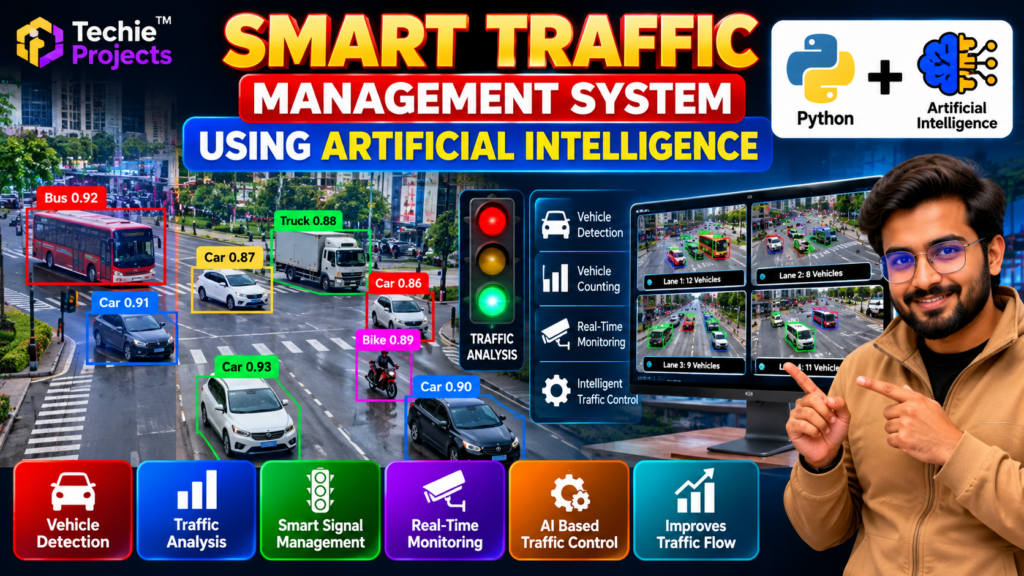
A Smart Traffic Management System Using Artificial Intelligence is a computer vision project that explores how AI and Python can help analyze traffic scenes, detect vehicles, and monitor traffic flow. By using vehicle detection and image processing techniques, the system can demonstrate how traffic information may be collected from images or video footage.
Traffic congestion is a common challenge in urban areas. Intelligent transportation systems explore ways to improve traffic monitoring, analyze vehicle movement, and support better traffic management decisions. This project gives students practical exposure to Python programming, artificial intelligence, and computer vision.
The smart traffic management system using artificial intelligence project demonstrates how Python and computer vision can analyze traffic footage, identify vehicles, and support traffic monitoring. It also provides a foundation for exploring vehicle counting and intelligent transportation applications.
If you are a B.Tech, B.E., BCA, MCA, or computer science student looking for a mini-project or final-year engineering project, this topic offers an opportunity to explore AI applications in traffic analysis.
🎬 Project Demo
Explore the project demonstration to understand the interface, vehicle detection process, traffic analysis workflow, and visual output.
🎯 Objectives of the Project
The main objectives of this project are:
- Explore vehicle detection using artificial intelligence and computer vision.
- Analyze traffic images or video footage.
- Understand how Python can process and visualize traffic data.
- Demonstrate vehicle counting where supported by the implementation.
- Explore the concepts behind intelligent traffic monitoring.
- Investigate how traffic analysis could support future smart city applications.
🚦 Key Features of the Smart Traffic Management System
1. Vehicle Detection
The application can identify vehicles in supported images or video footage using a computer vision method or trained object detection model.
2. Vehicle Counting
If implemented, the system can count vehicles passing through a defined region or crossing a virtual line in a video.
3. Traffic Analysis
Vehicle counts and detection results can help demonstrate traffic patterns across selected video frames or observation periods.
4. Visual Monitoring
The application can display processed video frames with bounding boxes, class labels, or other detection information, depending on the selected model.
5. Traffic Signal Management Concept
The project can be extended to explore how traffic data might inform signal timing decisions. Automatic signal control should only be considered implemented if the project includes and tests the required control logic and hardware or simulator integration.
6. Scope for Real-Time Processing
A compatible implementation may process video streams or camera input to demonstrate real-time vehicle detection and monitoring.
⚙️ How Does the Project Work?
The general workflow of an AI-based traffic monitoring application includes the following steps.
Step 1: Input Traffic Video
The system receives a traffic video, recorded footage, or a supported camera stream.
Step 2: Frame Processing
Python and an image processing library prepare the video frames for analysis.
Step 3: Vehicle Detection
A supported object detection model identifies vehicles in each frame. The detected classes depend on the model and its training data.
Step 4: Vehicle Counting
If counting is included, the application tracks vehicles or uses a defined counting region to estimate the number passing through it.
Step 5: Display Results
The system displays detected vehicles, labels, counts, or other available traffic statistics.
Step 6: Analyze Traffic Information
The resulting information can be used to demonstrate traffic monitoring and explore potential improvements to traffic management.
🛠️ Technologies Used
The following technologies may be suitable, depending on the actual implementation:
- Python: Main programming language.
- OpenCV: Video processing and image analysis.
- YOLO or another object detection model: Vehicle detection, if included.
- NumPy: Numerical operations and data handling.
- Machine Learning or Deep Learning Framework: Model training or inference, if required.
- Matplotlib: Visualization of results, if needed.
Confirm the actual libraries and model used in your project before installation.
💻 Software Requirements
Typical software requirements may include:
- Python 3.x compatible with the selected dependencies
- Visual Studio Code, PyCharm, or another Python IDE
- OpenCV
- NumPy
- The selected object detection model and its dependencies
- Compatible video files or a supported camera input
🖥️ Hardware Requirements
- Desktop computer or laptop
- At least 4 GB RAM for a basic development environment; more may be needed for deep learning
- Adequate storage for video files and model weights
- Webcam or camera if live input is supported
- GPU acceleration if required for faster inference
Actual requirements depend on the selected model and whether processing is performed on recorded or live video.
🌆 Applications of Smart Traffic Management
Urban Traffic Monitoring
Vehicle detection and counting can help demonstrate how traffic activity is monitored at selected road locations.
Intelligent Transportation Systems
Traffic analysis is one component of broader intelligent transportation research.
Smart City Projects
The project can serve as an educational prototype for exploring traffic monitoring in smart city environments.
Traffic Data Analysis
Collected vehicle counts may help students study traffic volume over selected periods.
Academic Research
The project provides a foundation for investigating object detection, vehicle tracking, video analytics, and traffic flow estimation.
✅ Advantages of the Project
- Demonstrates practical applications of Python and computer vision.
- Introduces vehicle detection and video processing concepts.
- Can provide visual results for project demonstrations.
- Offers opportunities to study traffic counting and monitoring.
- Can be extended with additional detection models and analytics.
- Supports further exploration of intelligent transportation systems.
⚠️ Limitations
- Poor lighting, rain, camera angles, and occlusion can affect detection.
- Detection errors can produce inaccurate vehicle counts.
- Processing speed depends on hardware and model complexity.
- Vehicle detection alone does not automatically optimize traffic signals.
- Real-world traffic control requires additional safety validation and integration.
🔮 Future Scope
A smart traffic management system using artificial intelligence can be further developed with vehicle tracking, traffic density estimation, and adaptive signal simulation, depending on the project’s implementation.
The project may be extended with:
- Improved Vehicle Detection: Evaluate suitable models on representative traffic footage.
- Vehicle Tracking: Track vehicles across video frames to support counting.
- Traffic Density Estimation: Estimate congestion using defined regions and measured vehicle activity.
- Traffic Data Dashboard: Display vehicle counts and trends over time.
- Adaptive Signal Simulation: Explore signal timing decisions in a traffic simulator.
- Real-Time Camera Integration: Process live input where hardware and software support it.
- Performance Evaluation: Measure detection accuracy, counting errors, and processing speed.
These features may require additional development beyond the existing project version.
🎓 Why Choose This as a Final-Year Project?
A smart traffic management project is a useful choice for students interested in artificial intelligence, computer vision, and intelligent transportation.
It provides opportunities to demonstrate:
- Python programming
- Video and image processing
- Object detection concepts
- Vehicle counting and traffic analysis
- Model evaluation and testing
- Project documentation and presentation
Choose a version that matches your course requirements and confirm which features are implemented before finalizing your topic.
🛒 Get the Smart Traffic Management Project
Looking for a Smart Traffic Management System Using AI in Python for your B.Tech, B.E., BCA, MCA, or final-year engineering submission?
Techie Projects helps students explore engineering projects and enquire about available implementations.
Contact us to discuss this project and confirm the available features, deliverables, and pricing.
Depending on the selected package, you can enquire about:
- Python source code availability
- Installation and execution instructions
- Required libraries and dependencies
- Project documentation and report availability
- Vehicle detection and counting features
- Demonstration and customization options
📲 Interested in Purchasing This Project?
Enquire About the Smart Traffic Management Project on WhatsApp
📲 Call/WhatsApp: +91-9460060699
🌎 Website: www.techieprojects.com
📺 Instagram: @pythonprojects_
Share your course, deadline, and required features so we can discuss the available options.
🎓 Recommended Projects
Explore these related project topics on Techie Projects. Link each title to its corresponding published article.
- Vehicle Detection and Counting Using Python — explore vehicle identification and traffic analysis.
- Car Crash Detection Using Python — investigate accident detection concepts.
- Number Plate Detection Using OpenCV — explore vehicle number plate identification.
- Helmet Detection Using Python — study computer vision for road safety.
- Intrusion Detection System Using Machine Learning — explore machine learning classification.
- Real-Time Object Measurement Using Python OpenCV — learn about image processing and object analysis.
Visit Techie Projects to explore more Python, AI, machine learning, and computer vision projects.
❓ Frequently Asked Questions
1. What is a smart traffic management system using AI?
It is an application that uses artificial intelligence or computer vision techniques to analyze traffic scenes and may detect or count vehicles, depending on its features.
2. Which programming language is used?
Python is commonly used for video processing, vehicle detection, and computer vision development.
3. Does the project use YOLO?
Some implementations use YOLO for vehicle detection. The exact model depends on the selected project version.
4. Can the system control traffic signals automatically?
Only if automatic signal control has been implemented and tested. Vehicle detection and counting alone do not provide automatic signal control.
5. Is this project suitable for final-year students?
It can be suitable for students studying computer science, artificial intelligence, data science, and related engineering fields, subject to their academic requirements.
6. How can I purchase the project?
Contact Techie Projects through WhatsApp to enquire about source code availability, documentation, implementation features, and pricing.
Conclusion
A Smart Traffic Management System Using Artificial Intelligence demonstrates how Python and computer vision can be applied to vehicle detection, traffic monitoring, and traffic data analysis. It offers students a practical way to explore AI-based transportation applications and develop skills in video processing and object detection.
If you want to use this topic for your mini-project or final-year submission, contact Techie Projects to discuss the available implementation and deliverables.