
Introduction
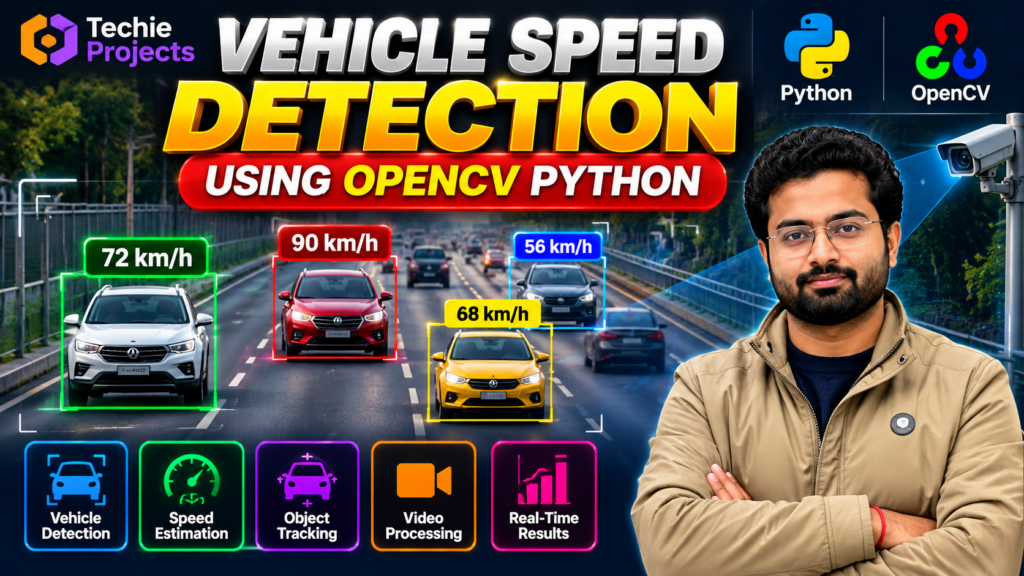
Vehicle speed detection using OpenCV Python is a computer vision project that demonstrates how vehicles can be detected and tracked in video footage to estimate their speed. This project combines Python programming, video processing, object detection, and tracking techniques to explore traffic monitoring applications.
If you are a B.Tech, B.E., Computer Science, Artificial Intelligence, or Data Science student looking for a practical final-year project, this implementation offers an opportunity to understand how computer vision can be applied to road traffic analysis.
Techie Projects helps students explore Python and AI-based engineering projects. Contact us to enquire about source code availability, project documentation, implementation details, and customization options.
🎬 Vehicle Speed Detection Using OpenCV Python – Project Demo Video
Watch the project demonstration to see how the application analyzes road footage, identifies vehicles, and displays estimated speed values for detected vehicles. The demo provides a practical introduction to the user interface, video-processing workflow, and the results produced by the implemented system.
The displayed speeds depend on the project’s detection, tracking, and calibration methods. A properly calibrated setup is required before estimates can be treated as meaningful real-world speeds.
🎯 Project Overview
The main objective of vehicle speed detection using OpenCV Python is to demonstrate how computer vision techniques can analyze vehicle movement across video frames and estimate speed.
Project details:
- Project Name: Vehicle Speed Detection Using OpenCV Python
- Programming Language: Python
- Domain: Computer Vision and Image Processing
- Technology: OpenCV
- Project Type: Final-Year Engineering Project
- Input: Road video footage or a supported video stream
- Output: Detected vehicles, tracking information, and estimated speed values, depending on the implementation
The specific detection and tracking algorithms depend on the version of the project supplied.
🚗 Key Features of the Vehicle Speed Detection Project
1. Vehicle Detection
The application identifies vehicles appearing in supported video footage. Detection can be implemented using suitable computer vision techniques or a trained object detection model.
2. Vehicle Tracking
Tracking helps associate detected vehicles across consecutive frames so that their movement can be analyzed over time.
3. Speed Estimation
The system estimates vehicle speed from movement across frames. Reliable real-world speed estimation requires appropriate calibration, frame timing, and knowledge of the distance represented in the video.
4. Video Processing
OpenCV provides tools to read video files, process frames, draw bounding boxes, and display results.
5. Visual Results
Depending on the implementation, the output may display vehicle bounding boxes, tracking identifiers, and estimated speed labels.
6. Customization Opportunities
Students can discuss possible improvements, such as adding new visualizations, comparing detection methods, or adapting the interface to their academic requirements.
⚙️ How Does Vehicle Speed Detection Using OpenCV Python Work?
A typical implementation follows these steps:
- Video input: Load a supported road video or camera stream.
- Frame extraction: Read consecutive frames for analysis.
- Vehicle detection: Identify vehicles in each frame.
- Object tracking: Associate detections across frames.
- Movement calculation: Measure changes in vehicle position over time.
- Speed estimation: Apply the configured timing and distance calibration to estimate speed.
- Result visualization: Display vehicle tracking and estimated speed information on the video.
The exact workflow varies according to the detection algorithm, tracking method, and calibration used in the project.
🛠️ Technologies Used
Python
Python is the primary programming language for implementing the processing workflow and integrating computer vision libraries.
OpenCV
OpenCV supports video capture, image processing, frame manipulation, drawing operations, and visual output.
NumPy
NumPy can be used for numerical operations and processing coordinate data.
Object Detection and Tracking
Depending on the implementation, the project may use background subtraction, contour-based detection, a trained object detector, or a dedicated tracking algorithm.
Only advertise specific models or libraries, such as YOLO, if they are actually included in your version.
💻 Software and Hardware Requirements
Software Requirements
- Python
- OpenCV
- NumPy, if required by the implementation
- VS Code, PyCharm, or another compatible IDE
- A supported video file or camera source
Hardware Requirements
- Laptop or desktop computer
- Adequate RAM and storage
- Webcam or road video footage, depending on the input method
- A compatible operating system
Exact requirements depend on the model, libraries, and video resolution used.
🌍 Applications of Vehicle Speed Detection
Vehicle speed detection using OpenCV Python can help students explore concepts related to:
- Traffic video analysis
- Intelligent transportation systems
- Vehicle movement tracking
- Road safety research
- Traffic flow monitoring
- Computer vision and image processing
- Smart-city research prototypes
A student implementation is not automatically suitable for real-world enforcement. Practical deployment requires careful calibration, testing, and validation under different road and camera conditions.
✅ Advantages of the Project
- Demonstrates practical computer vision concepts.
- Introduces video-frame processing and object tracking.
- Helps students understand motion-based speed estimation.
- Uses Python and widely used computer vision tools.
- Provides opportunities to compare detection and tracking methods.
- Can be extended for academic experiments and demonstrations.
🚀 Future Scope
The project can be extended in several ways, depending on the existing implementation:
- Support multiple vehicle categories.
- Compare different object detection models.
- Improve tracking when vehicles overlap or leave the frame.
- Add vehicle counting and traffic-density estimation.
- Develop a dashboard for displaying video analysis results.
- Evaluate speed estimates against known reference measurements.
- Explore integration with other traffic-monitoring prototypes.
Any claimed improvement should be tested against suitable reference data before being described as accurate.
🛒 Purchase Vehicle Speed Detection Using OpenCV Python Project
Looking for a vehicle speed detection using OpenCV Python project for your final-year engineering submission?
Techie Projects helps students explore Python, machine learning, computer vision, and deep learning projects. Contact our team to enquire about the availability of this project and discuss the package that best fits your academic requirements.
What can you enquire about?
- Python source code availability
- Vehicle detection and tracking implementation
- Speed-estimation method and calibration requirements
- Setup and execution instructions
- Project documentation and demonstration details
- Customization options
- Current pricing and delivery details
Package contents, included features, and support depend on the available project version. Confirm these details with our team before placing an order.
Contact Techie Projects
- 📲 Call/WhatsApp: +91-9460060699
- 🌎 Website: www.techieprojects.com
- 📺 Instagram: @pythonprojects_
Have a specific requirement from your college? Send us a WhatsApp message to discuss the project, available features, and possible customization.
❓ Frequently Asked Questions
1. What is vehicle speed detection using OpenCV Python?
It is a computer vision application that analyzes video footage to detect and track vehicles and estimate their speed using a configured method.
2. Which programming language is used?
Python is used for the main implementation, while OpenCV supports video processing and computer vision operations.
3. Is this project suitable for final-year engineering students?
It can be suitable for Computer Science, AI, Data Science, and related engineering students, subject to their college’s project requirements.
4. How is vehicle speed estimated?
Speed can be estimated by measuring vehicle movement across video frames and combining that movement with timing information and calibrated real-world distance.
5. Can I purchase the project source code?
Contact Techie Projects to confirm source code availability, pricing, documentation, included features, and support.
6. Can the project be customized?
Customization may be possible depending on the existing implementation. Contact the team to discuss your requirements and confirm feasibility.
7. Is the estimated speed always accurate?
No. Estimates can be affected by camera angle, frame rate, perspective, tracking errors, and calibration. Real-world accuracy requires validation against a reliable reference.
🎓 Explore Related Projects
Explore these related computer vision and traffic-monitoring project ideas:
- Vehicle Detection and Counting Using Python
- Number Plate Recognition Using OpenCV
- Road Accident Detection Using Machine Learning
- Helmet Detection Using Deep Learning
- Traffic Sign Recognition Using Computer Vision
- Object Detection Using YOLO and Python
Explore more ideas in our OpenCV Projects, Machine Learning Projects, and Deep Learning Projects collections.
Link individual project names to their actual published pages when available.
Conclusion
Vehicle speed detection using OpenCV Python is a practical educational project for exploring vehicle detection, object tracking, video processing, and speed estimation. It provides engineering students with an opportunity to connect Python programming with real-world computer vision concepts.
If you want to explore this project for your final-year engineering work, contact Techie Projects to enquire about source code availability, project details, and customization options.