
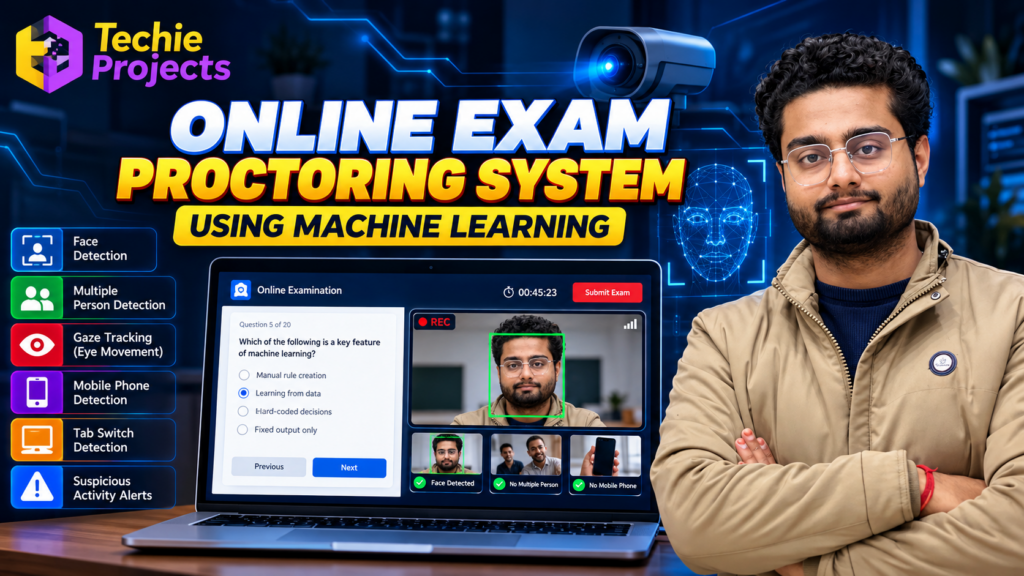
The Online Exam Proctoring System Using Machine Learning is an AI-based academic project that demonstrates how computer vision and machine learning techniques can support online examination monitoring. Developed as a Python project concept, it is suitable for students interested in artificial intelligence, online examination systems, image processing, and final-year engineering projects.
As online education continues to expand, maintaining examination integrity has become an important challenge. Traditional online examinations may not provide sufficient tools for observing examination sessions remotely. AI-assisted proctoring systems explore ways to analyze webcam images and identify events that may require further review.
This Online Exam Proctoring System Using Machine Learning project provides an opportunity to explore automated monitoring concepts, image processing, face detection, and examination interfaces. The actual features depend on the supplied implementation and the models used.
If you are searching for an online exam proctoring project with Python source code, Techie Projects can help you enquire about project availability, implementation details, pricing, documentation, and customization options.
📞 Contact Techie Projects for Project Enquiries
Interested in the Online Exam Proctoring System using Machine Learning? Contact Techie Projects to discuss available resources and find out which options match your academic requirements.
💬 WhatsApp Enquiry: Chat with Techie Projects
📱 Contact Number: +91 94600 60699
🌐 Official Website: www.techieprojects.com
📸 Instagram: Follow Techie Projects
🎓 Project Areas: Robotics, Machine Learning, Arduino, Deep Learning, Artificial Intelligence, and Android App.
✅ What to Ask: Available package details, technical documentation, component requirements, source code availability, and project guidance.
🚀 Ready to enquire? Message Techie Projects on WhatsApp and mention Online Exam Proctoring System using Machine Learning.
Package contents, pricing, hardware availability, and support arrangements must be confirmed before purchase.
🎬 Online Exam Proctoring System – Project Demo Video
Explore the project demonstration to understand the application’s interface and examination-monitoring workflow. The demonstration can help you see how the system is organized, how users interact with the examination interface, and how supported monitoring functions may operate.
For students preparing a final-year project, reviewing a demonstration is a useful first step before selecting a project. It helps you understand the concept and identify the implementation details you may need to study.
🧠 What Is an Online Exam Proctoring System Using Machine Learning?
An online exam proctoring system is an application designed to support the monitoring of remote examinations. Depending on its implementation, it may use a webcam, image processing, machine learning models, and event detection to observe selected aspects of an examination session.
The Online Exam Proctoring System Using Machine Learning explores how AI-based techniques can be integrated into an examination application. For example, a computer vision model may detect whether a face is visible in a webcam frame, while additional logic may identify events that warrant review.
Possible monitoring features include face detection, multiple-person detection, gaze-related analysis, mobile-phone detection, and browser activity monitoring. However, these capabilities require different techniques, and not every implementation supports all of them.
Importantly, an automated alert is not proof that a student has cheated. Lighting conditions, camera positioning, accessibility needs, and ordinary behavior can affect detection results. Human review and appropriate privacy safeguards remain essential.
🎯 Objectives of the Project
The primary objective is to demonstrate how Python, machine learning, and computer vision can be combined to explore online examination monitoring.
The main project objectives include:
- 💻 Developing an online examination interface, where included.
- 📷 Exploring webcam-based image acquisition.
- 🧠 Understanding how machine learning models process visual information.
- 👤 Investigating face detection and face visibility.
- 🔍 Exploring additional monitoring functions where supported.
- 📊 Displaying examination information and supported alerts.
- 🧪 Evaluating the performance and limitations of automated detection.
- 🔒 Understanding privacy, consent, and responsible AI use.
These objectives help students connect theoretical AI concepts with practical application development.
⚙️ How Does the Online Exam Proctoring System Work?
The workflow depends on the source code and available components. A typical implementation may include the following stages.
1. 📝 Examination Setup
The application prepares the examination interface and presents questions or other assessment content, if these features are included.
2. 📷 Webcam Input
With appropriate user consent, the application can receive webcam frames for supported monitoring functions. Camera access and permissions depend on the operating environment.
3. 🖼️ Image Preprocessing
Images may be resized, converted into a supported format, or otherwise prepared before being passed to a computer vision model.
4. 👤 Face Detection
A face detection component can identify faces visible in an image. Depending on the implementation, the system may generate an alert if a face is not detected or if multiple faces appear.
5. 🔍 Additional Event Detection
Some implementations may explore gaze estimation, mobile-phone detection, or other visual events. These functions require suitable models and should only be described as project features when they are actually implemented.
6. 📊 Alert Generation
The application may display or record an alert when a supported rule or detection condition is triggered. Alerts should be treated as indicators for review rather than definitive evidence of misconduct.
7. 📋 Result Review
If the application supports event logs or reports, an authorized reviewer can examine recorded information. Data collection and retention should be limited to what is necessary and communicated clearly to users.
🌟 Key Features of the Project
💻 1. Online Examination Interface
An examination interface can provide a structured way for users to access questions and submit answers. The exact examination functions depend on the supplied project.
📷 2. Webcam-Based Monitoring
Where implemented, webcam input allows the application to process visual information during an examination session.
👤 3. Face Detection
Face detection can identify visible faces in camera frames and support basic monitoring rules.
👥 4. Multiple-Person Detection
If a compatible detection model is included, the application may identify frames containing multiple people. Such results can be affected by camera angle, background conditions, and model accuracy.
👁️ 5. Gaze-Related Analysis
Some systems explore eye or head movement to identify patterns for further review. Looking away from the screen does not, by itself, establish misconduct.
📱 6. Mobile-Phone Detection
A project may incorporate an object detection model to identify mobile phones in camera frames. Performance depends on the trained model, image quality, and object visibility.
🚨 7. Automated Alerts
Supported detection events may trigger alerts or messages. The rules and alert types depend on the implementation.
📊 8. Monitoring Results
If available, the application can present detection results through a user interface, log, or report.
Note: Confirm which of these functions are included in the actual source code before advertising them as working features.
🛠️ Technologies Used
The exact technology stack should be confirmed against the supplied implementation. Common technologies for this type of Python project include:
- 🐍 Python: Main programming language.
- 👁️ OpenCV: Webcam handling and image processing, if used.
- 📊 NumPy: Numerical and array operations, if required.
- 🧠 Machine learning or deep learning framework: For supported prediction models.
- 🎯 Object detection model: If mobile-phone or other object detection is implemented.
- 💻 Tkinter, Flask, Streamlit, or another framework: For the user interface, depending on the project.
- 📷 Webcam: For camera-based functions where supported.
Not every implementation uses all these technologies. Check the dependency files and source code before installation.
💻 Software and Hardware Requirements
Software Requirements
A typical development environment may require:
- Windows or another compatible operating system.
- A compatible Python installation.
- Required Python packages.
- Project source code and model files.
- A code editor or Python IDE.
- A webcam, if camera monitoring is supported.
- A compatible browser, if the application uses a web interface.
Hardware Requirements
Recommended hardware depends on the model and application:
- Laptop or desktop computer.
- Adequate RAM for the application and model.
- Sufficient storage for project files and dependencies.
- Webcam for camera-based monitoring.
- GPU where needed for faster inference.
A GPU is not mandatory for every implementation. The actual system requirements should be confirmed before purchasing or installing the project.
🎓 Advantages of the Project
The Online Exam Proctoring System offers several potential educational benefits.
- 🧠 Practical AI learning: Understand how machine learning models are integrated into an application.
- 📷 Computer vision experience: Explore image acquisition and visual analysis.
- 💻 Python development: Learn how application components interact.
- 🔍 Detection concepts: Study supported face or object detection techniques.
- 📊 Performance evaluation: Investigate false positives, false negatives, and detection limitations.
- 🎓 Academic relevance: Explore a topic connected to online education and AI.
- 🚀 Future development: Experiment with additional monitoring features and usability improvements.
For the best academic experience, students should understand the source code, test the application, and prepare to explain its methodology and limitations.
🌍 Applications of Online Exam Proctoring
🎓 Online Education
Educational institutions can investigate digital examination tools and remote assessment workflows.
🏫 Academic Project Demonstrations
Students can use an implementation to demonstrate concepts related to machine learning, computer vision, and software development.
🧪 AI Research and Experimentation
The project can provide a starting point for evaluating detection algorithms, testing datasets, and comparing model behavior.
💻 Examination Software Prototypes
Developers can explore how examination interfaces and selected monitoring components might work together.
📊 Detection Performance Studies
Students can investigate how lighting, camera position, and different environments affect model output.
These are potential applications and learning scenarios. A student prototype should not be represented as a fully validated or institution-ready examination security product without appropriate testing.
⚠️ Limitations and Ethical Considerations
Automated examination monitoring has technical and ethical limitations.
- Detection errors: Models may miss relevant events or flag harmless behavior.
- Lighting and camera quality: Poor visibility can affect detection.
- Bias and accessibility: Model performance may vary across people and circumstances.
- Privacy: Webcam monitoring can involve sensitive personal information.
- Security: Recorded images, logs, and examination data require appropriate protection.
- Human oversight: Automated alerts should not be treated as conclusive evidence of cheating.
- Consent and transparency: Users should understand what is monitored, why data is collected, and how long it is retained.
These considerations make an excellent discussion topic for a final-year project report and presentation.
🚀 Future Scope of the Project
The system may be extended in several directions, depending on the original implementation and project requirements.
- 🧠 Model improvement: Evaluate more suitable detection models and preprocessing methods.
- 📊 Performance dashboard: Present detection results and system performance metrics.
- 🌐 Web-based interface: Explore deployment through a compatible web framework.
- 🔐 Access control: Investigate secure authentication and role-based access.
- 📋 Event reporting: Add carefully designed logs for supported detection events.
- ⚙️ Performance optimization: Improve processing speed and resource use.
- 🧪 Testing: Evaluate detection performance under varied conditions.
- 🔒 Privacy protection: Minimize data collection and implement suitable retention controls.
- ♿ Accessibility improvements: Ensure examination workflows account for legitimate accessibility requirements.
- 👨🏫 Human review: Provide an appropriate review process for alerts before consequential decisions are made.
Future improvements should be evaluated carefully to ensure that additional monitoring does not create unnecessary privacy risks or unfair outcomes.
👨🎓 Who Can Choose This Project?
This project may interest:
- B.Tech Computer Science Engineering students.
- B.E. Information Technology students.
- Final-year engineering students.
- Students learning artificial intelligence.
- Learners interested in Python and computer vision.
- Students exploring machine learning applications in education.
Before selecting a project, review your institution’s requirements for implementation, documentation, demonstrations, and individual academic contribution.
🛒 Purchase Online Exam Proctoring System Source Code from Techie Projects
Looking for an Online Exam Proctoring System Using Machine Learning project with Python source code for your final-year engineering project?
Techie Projects helps students explore project options and discuss their implementation requirements. Contact us to enquire about the available package, source code, pricing, documentation, installation guidance, and customization options.
Depending on the available package, you can ask about:
- 🐍 Python source code and project structure.
- ⚙️ Installation and setup instructions.
- 🧠 Details of the models and algorithms used.
- 📷 Supported camera and monitoring features.
- 📄 Available project documentation.
- 💻 Demonstration and application requirements.
- 🛠️ Customization possibilities.
- 💬 Pricing and delivery details.
The actual deliverables, working features, and support arrangements should be confirmed before placing an order.
Choose a project that fits your academic requirements, and make sure you understand the implementation so you can explain it confidently during your project demonstration or viva.
📲 Contact Techie Projects for Project Details and Pricing
Ready to explore this online exam proctoring project?
Contact Techie Projects to check availability, discuss your requirements, and enquire about the current price and source-code package.
- 📲 Call/WhatsApp: +91-9460060699
- 🌎 Website: www.techieprojects.com
- 📺 Instagram: @pythonprojects_
Send your course, project requirements, and preferred features through WhatsApp so we can discuss the available options.
🎓 Explore Related Projects
Explore these related AI and computer science project topics:
- Face Recognition Attendance System
- Emotion Recognition Using Facial Expressions
- Sign Language Detection Using Python
- Intrusion Detection System Using Machine Learning
- Human Activity Recognition Using Deep Learning
- Object Detection Using Python and OpenCV
❓ Frequently Asked Questions
1. What is an Online Exam Proctoring System Using Machine Learning?
It is an application concept that explores how machine learning and computer vision can support selected monitoring functions during online examinations.
2. Which programming language is used?
Python is commonly used for this type of project. The actual programming language and libraries depend on the supplied implementation.
3. Is the project suitable for final-year engineering students?
It may be suitable for CSE, IT, and related engineering students, subject to institutional requirements and the student’s ability to understand and explain the implementation.
4. Can I purchase the Python source code?
Contact Techie Projects to confirm availability, package contents, current pricing, and delivery details.
5. Does the project include face detection?
Face detection may be included, but you should confirm the available features and working implementation before ordering.
6. Does the system detect mobile phones or gaze movement?
These features require appropriate models and supporting code. Contact Techie Projects to confirm whether they are included in the available version.
7. Does the project require a GPU?
Not necessarily. Hardware requirements depend on the models, framework, and expected processing speed.
8. Can the project be customized?
Customization may be possible depending on the source code and requested changes. Contact Techie Projects to discuss feasibility and pricing.
9. Can an AI alert prove that a student cheated?
No. An alert may be incorrect or lack context. Automated results should be reviewed carefully and should not be treated as definitive proof of misconduct.
🏁 Conclusion
The Online Exam Proctoring System Using Machine Learning is an educational project topic that combines Python, machine learning, computer vision, and online examination workflows. It provides opportunities to explore face detection, supported monitoring features, automated alerts, and responsible AI development.
For final-year students, the project can serve as a practical learning opportunity when its implementation, testing, and limitations are understood clearly.
If you want to explore the source code or available project package, contact Techie Projects for current pricing, implementation details, documentation, and customization options.
📱 Contact Techie Projects on WhatsApp to enquire about the project today.

