
Introduction 🎯
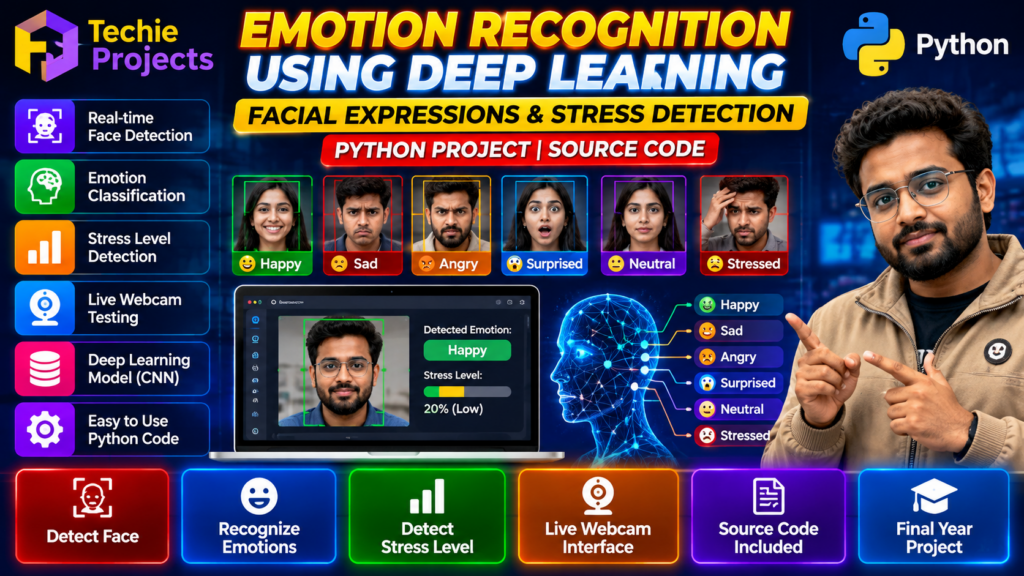
Emotion Recognition Using Deep Learning project is an artificial intelligence application that demonstrates how facial expressions can be classified using computer vision and deep learning techniques. The system analyzes facial images or webcam input to predict expression categories such as happy, sad, angry, surprised, and neutral, depending on the trained model.
This Python-based project also explores experimental stress-level estimation through facial expression analysis. It combines image processing, deep learning, facial detection, and prediction visualization in one educational application. It can be an interesting project option for B.Tech, B.E., Computer Science Engineering (CSE), Information Technology (IT), and other engineering students interested in artificial intelligence.
If you are searching for an Emotion Recognition Using Deep Learning project with Python source code, Techie Projects can help you explore project availability, implementation features, pricing, and customization options for your final-year engineering requirements.
In this blog, you will learn about the project’s objectives, working process, features, technologies, requirements, advantages, applications, and future improvements. 🎓
🎬 Emotion Recognition Using Deep Learning – Project Demo Video
Explore the project demonstration to understand how facial expression classification works through a Python-based application. The demo showcases the interface, facial analysis workflow, and prediction display.
The demonstration can help you understand how image input is processed and how the model displays its predicted expression category. If the implementation supports webcam input, it can also illustrate the live analysis workflow.
Students interested in AI and computer vision can use this demonstration to understand the project’s functionality before choosing it for their academic work.
🤖 What Is Emotion Recognition Using Deep Learning?
Emotion recognition is a computer vision task that attempts to classify visible facial expressions from images or video frames. Deep learning models can learn patterns from labeled facial images and use those patterns to predict predefined expression categories.
The Emotion Recognition Using Deep Learning project demonstrates how a trained model can be integrated into a Python application. Depending on the implementation, the application may process static images, prerecorded video, or live webcam input.
For example, when a facial image is provided, the system can detect the face, prepare the image for the model, and generate a prediction for one of the supported categories.
Common expression categories include:
- 😊 Happy: A facial expression classified as happy by the trained model.
- 😢 Sad: An expression predicted as sad.
- 😠 Angry: An expression predicted as angry.
- 😮 Surprised: An expression predicted as surprised.
- 😐 Neutral: An expression predicted as neutral.
The available categories depend on the model and training dataset.
Important: Facial expressions do not reliably reveal a person’s actual feelings or psychological state. Predictions should be treated as model classifications, not definitive measurements of emotion or stress.
🎯 Objectives of Emotion Recognition Using Deep Learning Project
The main objective of the Emotion Recognition Using Deep Learning project is to demonstrate how facial expression classification can be implemented using Python and a trained deep learning model.
The key objectives include:
- 📷 Capture or load facial images for analysis.
- 🔍 Detect facial regions in the input image.
- 🧠 Apply image preprocessing before model inference.
- 😊 Classify facial expressions into supported categories.
- 💻 Display predictions through a user interface.
- ⚙️ Explore webcam-based analysis where supported.
- 📊 Understand the performance and limitations of an image classification model.
- 🚀 Investigate possible improvements to the application.
These objectives help students connect theoretical concepts in artificial intelligence with a practical software implementation.
⚙️ How Does the Emotion Recognition Project Work?
The project follows a series of steps, beginning with image input and ending with a displayed prediction.
1. 📷 Image Capture
The application receives an image from a webcam or loads an image file. The input source depends on the available implementation.
2. 🔍 Face Detection
A face detection component identifies the facial region in the input image. This helps the application focus on the relevant portion of the image instead of processing the entire scene as facial data.
3. 🖼️ Image Preprocessing
The detected facial region is prepared for the trained model. This may involve resizing, normalization, color conversion, or other transformations required by the model.
4. 🧠 Deep Learning Model Processing
The processed image is passed to a trained model. A convolutional neural network (CNN), for example, can learn visual patterns from facial images and use them to classify the input.
5. 😊 Emotion Classification
The model produces a prediction for one of its supported classes. The application can display the predicted category, such as happy, sad, angry, surprised, or neutral.
6. 📊 Result Visualization
The predicted category is displayed in the application interface. If supported, the system may also show a confidence score or other model output.
7. 📈 Experimental Stress-Related Output
If the implementation includes a stress-related feature, it may display an experimental estimate derived from the model’s configured inputs. This output must not be treated as a validated psychological or medical assessment.
🌟 Key Features of the Emotion Recognition Project
😊 1. Facial Expression Classification
The application demonstrates how a trained deep learning model can classify visible facial expressions into predefined categories.
📷 2. Webcam Integration
If supported, the system can receive live camera input and process individual frames for prediction.
🧠 3. Deep Learning Integration
The project introduces students to model inference, image preprocessing, and the integration of a trained model into a Python application.
💻 4. User-Friendly Interface
A graphical interface, if included, can help users provide image input, start supported operations, and view prediction results.
📊 5. Prediction Visualization
The application can display the predicted expression category and, where implemented, additional model output.
⚡ 6. Automated Image Processing
The image-processing workflow can reduce the need for manual analysis of each input image.
📈 7. Experimental Stress Estimation
If the feature is present, it demonstrates how an application might display a stress-related indicator. Such an indicator is not proof of a person’s actual stress level.
🐍 8. Python-Based Development
Python provides the programming environment for connecting computer vision libraries, deep learning models, and the user interface.
🛠️ Technologies Used
The technology stack depends on the actual source code. Common technologies for this type of project may include:
- 🐍 Python: Main programming language.
- 👁️ OpenCV: Image processing and face detection, if included.
- 🧠 TensorFlow or Keras: Deep learning model integration, if used.
- 🔥 PyTorch: An alternative framework if the implementation uses it.
- 📷 Webcam input: For live image acquisition where supported.
- 🖥️ GUI framework: A compatible Python interface framework, if included.
- 📊 Trained model: A model configured to predict the supported facial expression classes.
Not every implementation uses all these technologies. Check the supplied source code and dependency list to confirm the actual libraries and versions.
💻 Software and Hardware Requirements
💿 Software Requirements
The project may require:
- Windows or another supported operating system.
- A compatible Python installation.
- Required Python libraries and dependencies.
- Trained model files, if supplied separately.
- A compatible code editor or Python IDE.
- Camera permissions for webcam-based operation.
🖥️ Hardware Requirements
The typical hardware setup may include:
- Laptop or desktop computer.
- Webcam for live testing, if required.
- Adequate RAM for the selected model.
- Sufficient CPU resources for inference.
- Internet connectivity only where required by the implementation.
A dedicated GPU may improve performance for some models, but it is not automatically required for every version of this project.
🎓 Advantages of Emotion Recognition Using Deep Learning
This project offers several educational benefits for students exploring AI-based software development.
- 🧠 Practical AI learning: Understand how trained models process images and generate predictions.
- 👁️ Computer vision experience: Explore facial detection and image preprocessing.
- 🐍 Python development: Learn how libraries and application components work together.
- ⚙️ Model integration: Understand how to load a trained model and use it for inference.
- 💻 Application development: Explore how model predictions can be presented through a user interface.
- 🚀 Future improvements: Investigate model evaluation, data quality, and interface enhancements.
- 🎓 Academic relevance: Explore a project topic that combines deep learning and computer vision.
The project is most valuable when students understand the code, test its behavior, and can explain the underlying methods.
🌍 Applications of Facial Expression Recognition
Facial expression classification can be explored in educational, research, and prototype applications, including:
🎓 AI and Machine Learning Education
Students can use the project to understand image classification, training data, model inference, and evaluation.
👁️ Computer Vision Experiments
The project demonstrates how image-processing methods and trained models can be combined in a single application.
💻 Human-Computer Interaction Research
Researchers can investigate how visual input and interface design affect interactions with experimental software.
📊 Facial Expression Dataset Analysis
Students can compare expression categories and explore the effects of dataset quality, lighting, and facial pose on model performance.
🧪 AI Application Prototyping
The project can serve as a starting point for experimenting with additional classes, improved models, or alternative interfaces.
Responsible use: Facial appearance alone cannot reliably determine a person’s emotional state, mental health, or stress level. This project should not be used for medical diagnosis, employment screening, or other high-stakes decisions.
⚠️ Limitations of the Project
Like other image classification applications, emotion recognition has limitations.
- 📷 Lighting conditions: Poor lighting may reduce the quality of the input image.
- 🔄 Facial pose: Side angles and partially obscured faces may affect recognition.
- 📚 Dataset quality: Biased or limited training data can affect model performance.
- 🧠 Model accuracy: Predictions may be incorrect or inconsistent on unseen images.
- 💻 Hardware performance: Processing speed depends on the model and computer.
- 📈 Stress estimation: Facial expression predictions cannot independently establish a person’s actual stress level.
Students should test the model on appropriate data and report its limitations honestly.
🚀 Future Scope of the Project
The project can be extended in several directions, depending on the source code and available resources.
- 🧠 Model comparison: Evaluate different deep learning architectures.
- 📚 Dataset improvement: Explore more diverse and representative facial image datasets.
- 📊 Performance evaluation: Measure accuracy and other relevant classification metrics on held-out data.
- 📷 Improved webcam support: Enhance frame processing where live input is implemented.
- 💻 Interface improvements: Make the application easier to use and understand.
- 🌐 Deployment options: Explore a web interface or another deployment approach if suitable.
- 🔒 Privacy improvements: Process and store facial data securely and with appropriate consent.
- 🧪 Responsible evaluation: Investigate whether model performance varies across different conditions and user groups.
These improvements can help students develop a deeper understanding of AI model development and evaluation.
🎓 Who Can Choose This Project?
The Emotion Recognition Using Deep Learning project may be suitable for:
- 🎓 B.Tech Computer Science Engineering students.
- 🎓 B.E. Information Technology students.
- 💻 Final-year engineering students.
- 🤖 Students interested in artificial intelligence.
- 👁️ Learners exploring computer vision.
- 🧠 Students studying deep learning and image classification.
- 🐍 Python developers interested in AI applications.
Before selecting the project, review your college’s requirements for implementation, documentation, demonstrations, and individual contribution.
🛒 Get the Emotion Recognition Project from Techie Projects
Looking for an Emotion Recognition Using Deep Learning project with Python source code for your final-year engineering work?
Techie Projects helps students explore engineering project options and discuss implementation requirements. Contact us to confirm source code availability, current pricing, package contents, and customization options.
Depending on the available package, you can enquire about:
- 🐍 Python source code.
- ⚙️ Setup and installation guidance.
- 🧠 Deep learning model details.
- 📷 Project demonstration and supported features.
- 📄 Available documentation.
- 🛠️ Customization options.
- 💬 Pricing and delivery information.
The actual deliverables and support arrangements should be confirmed before placing an order. Students should test the project, understand the implementation, and prepare their own explanation for academic evaluation.
💬 Contact Techie Projects for Pricing and Source Code
Want to know the price or check the availability of the Emotion Recognition Using Deep Learning project?
Contact Techie Projects with your course, college requirements, and preferred features. We can discuss the available package and whether it fits your academic needs.
📲 Call/WhatsApp: +91-9460060699
🌎 Website: www.techieprojects.com
📺 Instagram: @pythonprojects_
Send your enquiry to discuss source code availability, features, pricing, and customization options.
🎓 Explore Related Projects
Explore these related project topics if you are interested in Python, AI, and computer vision:
- Facial Expression Recognition Using Python
- Face Recognition Attendance System
- Real-Time Object Detection Using Deep Learning
- Sign Language Detection Using Python
- Human Activity Recognition Using Deep Learning
- AI-Based Exam Proctoring System
❓ Frequently Asked Questions
1. What is an Emotion Recognition Using Deep Learning project?
It is an AI-based application that uses a trained model to classify visible facial expressions from images or video input.
2. Which programming language is used?
Python is commonly used, along with compatible computer vision and deep learning libraries. The exact technology stack depends on the implementation.
3. Can the project recognize expressions in real time?
Real-time classification may be supported if the implementation includes webcam input and a model capable of processing incoming frames.
4. Does facial expression recognition accurately measure stress?
No. Facial expression classification alone cannot reliably establish a person’s actual stress level. Any stress-related output should be treated as experimental unless independently validated.
5. Can I purchase the project source code from Techie Projects?
You can contact Techie Projects to check source code availability, current pricing, package inclusions, and customization options.
6. Is the project suitable for final-year engineering students?
It may be suitable for B.Tech, B.E., CSE, and IT students, subject to institutional guidelines and the student’s understanding of the implementation.
7. Can the project be customized?
Customization may be possible depending on the available source code and requested features. Contact Techie Projects to discuss your requirements before ordering.
8. Does the project require a GPU?
Not necessarily. Hardware requirements depend on the selected model, implementation, and expected processing speed.
🏁 Conclusion
The Emotion Recognition Using Deep Learning project combines Python programming, computer vision, and image classification in an educational AI application. It provides engineering students with an opportunity to explore facial image preprocessing, trained models, and prediction visualization.
With suitable testing and responsible interpretation, the project can help students understand the practical workflow of a deep learning application and explore potential future improvements.
If you want to explore Emotion Recognition Using Deep Learning Project for your final-year engineering work, contact Techie Projects to discuss source code availability, features, pricing, and customization options.
📱 Contact Techie Projects on WhatsApp to get started.