
Introduction
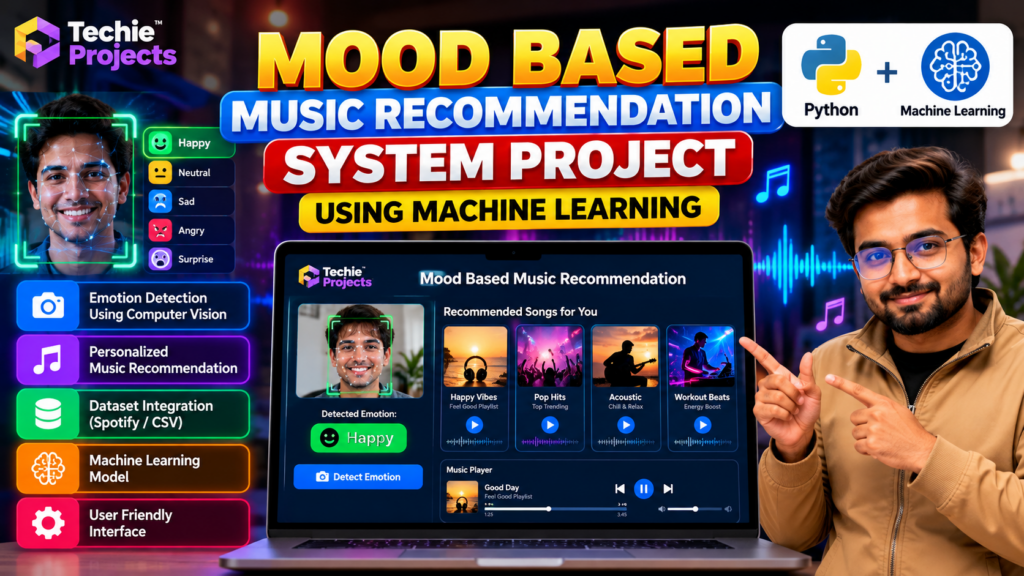
The emotion based music recommendation system using Python is a machine learning project that explores how a user’s emotional state can be used to recommend suitable music. By combining emotion detection, machine learning, and music recommendation techniques, this project demonstrates how personalized music suggestions can be generated through a Python application.
Music preferences can vary depending on a person’s mood. This project explores how emotion-related inputs can be mapped to music categories to provide relevant song recommendations. It is suitable for B.Tech, BCA, and MCA students interested in Python, artificial intelligence, machine learning, and computer vision.
The emotion based music recommendation system using Python combines emotion detection and music recommendation techniques to suggest songs based on mood categories. This project helps students understand how Python, machine learning, and recommendation logic can work together in an interactive application.
🎬 Project Demo
Watch the project demonstration to understand the interface, mood detection workflow, and music recommendation process. The demo provides an overview of how the application works and helps you evaluate whether it matches your academic project requirements.
🎵 What Is a Mood Based Music Recommendation System?
A mood based music recommendation system is a software application that suggests songs based on a user’s mood or emotional state. Depending on the implementation, mood information may be provided manually or estimated using facial emotion recognition.
In this project, machine learning techniques can be used to classify emotion-related inputs and connect the resulting mood category with suitable music recommendations. Python provides the programming environment for implementing the model, processing data, and building the application interface.
The quality of recommendations depends on the dataset, emotion classification model, recommendation logic, and available music metadata.
🎯 Objectives of the Project
The main objectives are to:
- Develop a Python-based music recommendation application.
- Explore machine learning for emotion classification.
- Understand the role of computer vision in facial emotion detection.
- Map mood categories to relevant music recommendations.
- Learn how datasets can support recommendation systems.
- Demonstrate the integration of machine learning and application development.
🚀 Key Features
1. Emotion Detection
If facial emotion recognition is included in the implementation, the system can analyze an image or camera input and predict an emotion category supported by the trained model.
Predictions are estimates and may be affected by lighting, facial expressions, image quality, and model limitations.
2. Mood-Based Music Recommendations
The application associates mood categories with suitable songs or playlists using the implemented recommendation logic.
3. Music Dataset Integration
A dataset can provide song information, labels, metadata, or other features required by the recommendation process. The available dataset and its format depend on the supplied project version.
4. User-Friendly Interface
A graphical interface can help users interact with the application, view detected moods, and explore recommended tracks.
5. Machine Learning Integration
The project demonstrates how a trained model can be integrated into a Python application to process inputs and generate predictions.
6. Expandable Recommendation Logic
The recommendation component can be extended with additional songs, mood categories, or user preferences, depending on the application’s architecture.
Note: Confirm the actual modules, dataset, and working features included in the project before purchasing.
🧠 How Does the System Work?
In an emotion based music recommendation system using Python, the application processes mood-related input, identifies the relevant emotion category when emotion detection is implemented, and maps that category to suitable songs using the configured recommendation logic.
The general workflow can be divided into the following steps:
- Input collection: The application receives an image, camera input, or mood selection, depending on the implementation.
- Image preprocessing: If facial emotion recognition is used, the input image may be resized, normalized, or otherwise prepared.
- Emotion classification: A trained machine learning model predicts an emotion category.
- Mood mapping: The detected or selected mood is mapped to a suitable music category.
- Recommendation generation: The application retrieves songs or playlists using its recommendation rules.
- Results display: The interface displays the recommendations for the user.
The exact workflow varies according to the model, dataset, and music recommendation method used in the project.
🛠️ Technologies Used
The project may use the following technologies, depending on the supplied implementation:
- Python: Main programming language.
- Machine Learning: Emotion classification and prediction.
- OpenCV: Image processing and camera input, if implemented.
- TensorFlow or Keras: Model development or inference, if used.
- NumPy and Pandas: Data processing, if required.
- Tkinter: Desktop graphical interface, if included.
- Music dataset: Song metadata or recommendation data.
Always verify the actual libraries and versions before installation.
💻 Software Requirements
- Python and a compatible development environment.
- Required machine learning and image-processing libraries.
- Dataset files used by the project.
- A compatible graphical interface framework, if applicable.
- Webcam access if live facial emotion detection is included.
🖥️ Hardware Requirements
- A desktop computer or laptop.
- Recommended minimum 4 GB RAM for a basic development environment.
- Webcam if camera-based emotion detection is required.
- Sufficient storage for the source code, datasets, and dependencies.
Actual requirements depend on the selected model and implementation.
📊 Applications of the Project
A mood-based recommendation system can demonstrate concepts relevant to:
- Personalized music applications.
- Machine learning and recommendation systems.
- Facial emotion recognition experiments.
- Human-computer interaction.
- Multimedia software development.
- Academic research into emotion-aware interfaces.
The system should not be treated as a reliable psychological assessment tool. Facial expressions do not always reveal a person’s actual emotional state.
✅ Advantages
- Combines multiple useful machine learning concepts.
- Provides practical experience with Python development.
- Demonstrates a complete input-to-recommendation workflow.
- Offers opportunities to explore datasets and model predictions.
- Can be extended with additional music categories and recommendation rules.
- Supports academic demonstrations and technical presentations.
⚠️ Limitations
- Emotion predictions may be inaccurate.
- Lighting and camera quality can affect image processing.
- Dataset quality can influence model performance.
- Music recommendations depend on the available data and mapping rules.
- Some implementations may require additional configuration or compatible library versions.
🔮 Future Scope
The project can be extended by introducing personalized listening history, user-selected preferences, additional emotion categories, improved recommendation algorithms, and a larger music dataset.
Other possible improvements include a web-based interface, playlist management, recommendation evaluation, and integration with a music service where its API and usage permissions allow it.
🎓 Why Choose This Project for Your Final Year?
The Mood Based Music Recommendation System Project Using Machine Learning is a useful option for students who want to explore Python, machine learning, and personalized recommendations in one application.
It provides opportunities to discuss dataset preparation, model selection, emotion classification, recommendation logic, and system limitations during a project presentation or viva.
Before choosing the project, review the demonstration and confirm that the available implementation satisfies your institution’s requirements.
❓ Frequently Asked Questions
1. What is a mood based music recommendation system?
It is an application that suggests music based on mood information, which may be selected by the user or estimated using an emotion recognition model.
2. Which programming language is used?
Python is the main programming language for the application and its machine learning components.
3. Does the project use facial emotion recognition?
It may use facial emotion recognition if that module is included. Confirm whether the available version supports camera input, image-based prediction, or manual mood selection.
4. Is this project suitable for final-year students?
It can be suitable for B.Tech, BCA, MCA, and computer science students interested in machine learning, computer vision, and recommendation systems.
5. Can I purchase the source code?
Contact Techie Projects to confirm the current availability, included modules, source code, dataset, documentation, installation requirements, and pricing.
🎓 Recommended Projects
Explore these related projects to discover more machine learning and AI applications:
- Emotion Detection Using Machine Learning — explore emotion classification.
- Face Recognition Attendance System Using Python — learn about face recognition.
- AI Chatbot Using Python — explore conversational applications.
- Sign Language Recognition Using Machine Learning — investigate computer vision and gesture recognition.
- Object Detection Using Python and OpenCV — learn about image processing and object detection.
Visit Techie Projects to explore more engineering project ideas.
🚀 Get the Mood Based Music Recommendation System Project
Looking for a machine learning project for your mini-project or final-year submission?
Techie Projects can help you enquire about the available project package, source-code options, dataset, documentation, installation requirements, and implementation support.
Contact us before purchasing to confirm the included features and pricing.
- 📲 Call/WhatsApp: +91-9460060699
- 🌎 Website: www.techieprojects.com
- 📺 Instagram: @pythonprojects_
Conclusion
The emotion based music recommendation system using Python offers a practical way to explore machine learning, emotion classification, and personalized music suggestions. Students can review the project demo and enquire about source code, documentation, and implementation support from Techie Projects.
Review the project demo, confirm the available features, and contact Techie Projects to discuss whether the project is suitable for your academic goals.