
🎓 Introduction to Emotion Detection Using Machine Learning
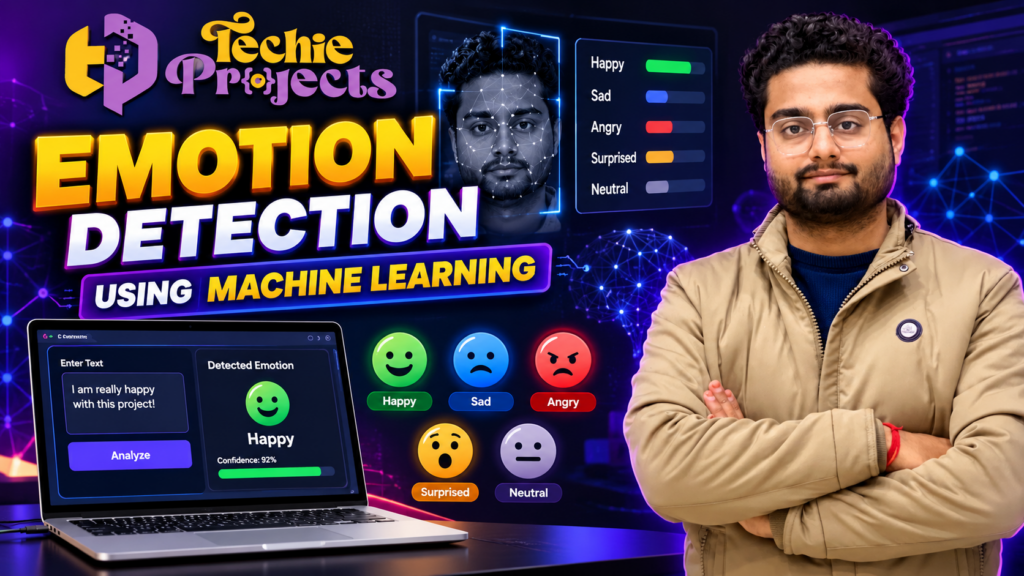
Emotion Detection Using Machine Learning is an interesting Python project that demonstrates how artificial intelligence can analyze facial expressions or text to classify emotions. It combines machine learning, computer vision, and natural language processing concepts to create an interactive application for students and technology enthusiasts.
Emotion detection is an important research area in artificial intelligence. Depending on the implementation, a system can analyze facial images, written sentences, or other supported inputs to estimate an emotion category such as happy, sad, angry, surprised, or neutral.
This project is suitable for computer science engineering students who want to explore AI and machine learning through a practical application. It can also help students understand data preprocessing, model training, prediction, and application development.
If you are looking for an Emotion Detection Using Machine Learning project in Python for your college project, final-year submission, or technical demonstration, Techie Projects can help you explore a suitable project package.
🎬 Project Demo
Watch the Emotion Detection project demonstration to understand the application’s interface, workflow, and possible output.
The demo can help you see how an emotion detection application presents its results and how machine learning concepts can be applied in a practical project. Actual features and output depend on the implementation and the model used.
🤖 What Is Emotion Detection Using Machine Learning?
Emotion detection is the process of using computational techniques to estimate emotional categories from selected input data. A machine learning model learns patterns from a labelled dataset and uses those patterns to classify new inputs.
There are two common approaches:
1. Facial Emotion Detection
Facial emotion detection uses images or video frames as input. A computer vision system identifies a face, processes the relevant image region, and passes the extracted information to an emotion classification model.
Depending on the trained model, the system may classify expressions into categories such as happy, sad, angry, surprised, fearful, or neutral.
2. Text Emotion Detection
Text emotion detection uses written sentences, messages, or other textual input. Natural language processing techniques transform text into numerical representations that a machine learning model can use to predict an emotion category.
For example, a sentence expressing excitement may be classified as happy, while a sentence expressing disappointment may be classified as sad.
These are different technical approaches. Before purchasing, confirm whether the specific project supports facial emotion detection, text emotion detection, or both.
🎯 Objectives of the Project
The main objective of the Emotion Detection Using Machine Learning project is to demonstrate how AI models can classify selected input data into predefined emotion categories.
Key learning objectives include:
- Understanding the fundamentals of machine learning.
- Learning how labelled datasets are used for classification.
- Exploring image preprocessing or text preprocessing.
- Understanding model training and prediction.
- Developing an interface for entering or capturing input.
- Displaying predicted emotion categories in a readable format.
- Learning how to evaluate model performance.
- Preparing project documentation and a technical demonstration.
The project can be adapted to academic requirements, depending on the selected model, dataset, programming framework, and available features.
Benefits of Emotion Detection Using Machine Learning
Emotion Detection Using Machine Learning helps engineering students explore artificial intelligence, Python programming, and classification techniques through a practical project. By working on this application, students can understand how data preprocessing, model training, and prediction work together. The project also provides opportunities to learn about computer vision or natural language processing, depending on the selected implementation.
How to Develop an Emotion Detection Using Machine Learning Project
To develop an Emotion Detection Using Machine Learning project, first select the input type, such as facial images or text. Next, prepare a suitable labelled dataset and apply the required preprocessing techniques. Train or integrate an appropriate classification model, evaluate its performance, and connect it to a user-friendly interface. Finally, test the application and document its limitations, installation steps, and results.
Why Choose This Emotion Detection Project?
This Emotion Detection Using Machine Learning project can help students understand practical AI concepts and prepare for an academic demonstration. Techie Projects can help you explore the available project package, implementation details, and deliverables. Before purchasing, confirm whether the version includes source code, documentation, installation guidance, and the specific emotion detection features required by your college.
Purchase an Emotion Detection Using Machine Learning Project
Looking for an Emotion Detection Using Machine Learning project in Python for your engineering course? Contact Techie Projects to discuss the available implementation, pricing, and package details. Share your project deadline and requirements so you can confirm whether the project meets your academic needs before ordering.
📲 Call/WhatsApp: +91-9460060699
🌎 Website: www.techieprojects.com
⚙️ Technologies Used in Emotion Detection
The technologies depend on the implementation selected for the project. A typical Python-based version may use the following tools.
1. Python Programming
Python is widely used for machine learning and AI development because it supports a large ecosystem of libraries for data processing, model training, and application development.
2. OpenCV
OpenCV is a computer vision library that can be used to read images, process video frames, and support face-related image processing in facial emotion detection applications.
3. TensorFlow or PyTorch
TensorFlow and PyTorch can be used to build, train, or run deep learning models for image-based emotion classification. The exact framework depends on the project’s implementation.
4. NumPy and Pandas
NumPy supports numerical operations, while Pandas helps organise and analyse structured datasets. These libraries can be useful during data preparation and experimentation.
5. Scikit-learn
Scikit-learn provides machine learning algorithms and evaluation tools. It may be used for traditional classification models, data preprocessing, and performance evaluation.
6. Streamlit, Flask, or Another Interface
A web interface can make a project easier to demonstrate. Depending on the implementation, Streamlit or Flask may be used to accept inputs and display predictions.
Important: The actual libraries, versions, and requirements vary by project package. Confirm the included technologies before ordering.
🔄 How the Emotion Detection System Works
A typical emotion detection application follows a sequence of processing steps.
Step 1: Input Collection
The application receives an input, such as a facial image, a camera frame, or a text sentence. The supported input type depends on the selected version.
Step 2: Data Preprocessing
The input is prepared for analysis. Image-based systems may resize images, normalise pixel values, or identify a face region. Text-based systems may clean text and convert words into numerical features.
Step 3: Feature Extraction
The system represents useful patterns in a form the model can process. A deep learning model may learn image features automatically, while a text model may use tokenisation, embeddings, or other text representations.
Step 4: Model Prediction
The prepared input is passed to a trained classification model. The model produces a predicted emotion category based on patterns learned during training.
Step 5: Displaying Results
The application displays the predicted category. Some implementations may also show confidence scores, visual labels, or other supporting information.
A confidence score should not be interpreted as a guaranteed measure of a person’s actual emotional state. Model predictions can be inaccurate or affected by the input quality and training data.
🚀 Key Features of an Emotion Detection Project
Features vary by implementation, but an academic project may include some of the following:
- Emotion classification: Predicts a category from supported input.
- Image or text input: Accepts the input type supported by the selected version.
- Prediction interface: Presents the output in an understandable format.
- Model integration: Connects a trained machine learning model to the application.
- Data preprocessing: Prepares input before classification.
- Result visualisation: May show labels, confidence scores, or visual summaries.
- Testing and evaluation: Supports analysis of model performance.
- Customisation potential: May allow changes to the dataset, interface, or model when technically supported.
Contact Techie Projects to confirm which features are included in the package you intend to purchase.
🎓 Benefits for Engineering Students
Practical AI Learning
Students can connect theoretical concepts with an application that performs predictions from real or sample inputs.
Understanding Machine Learning
The project offers an opportunity to explore classification, datasets, preprocessing, training, and model evaluation.
Support for Academic Demonstrations
A working application can help students explain the project’s architecture, methodology, workflow, and limitations during a presentation or viva.
Portfolio Development
With appropriate understanding and personal modifications, students can use the project as a learning reference while developing their programming and AI skills.
Scope for Further Development
Students may investigate different models, datasets, interface designs, or evaluation techniques to extend the project according to their academic requirements.
🏢 Applications of Emotion Detection Technology
Emotion detection techniques are explored in several research and application areas, including:
- Human-computer interaction: Investigating ways to make interfaces respond to selected input patterns.
- Educational research: Exploring interaction patterns in controlled learning studies.
- Customer feedback analysis: Classifying emotional language in text feedback.
- Media analysis: Studying expressions or sentiment in selected datasets.
- AI research: Comparing machine learning models for emotion classification.
- Assistive interfaces: Researching alternative ways for users to interact with digital systems.
These are potential application areas, not guaranteed outcomes of this student project. Facial expressions and written language do not reliably reveal a person’s full internal emotional state, so results should be interpreted carefully.
📦 What Should You Confirm Before Purchasing?
Before purchasing an Emotion Detection Using Machine Learning project, discuss your academic requirements with Techie Projects and confirm the deliverables.
Depending on the selected package, you may wish to ask about:
- Python source code availability.
- Supported input type: face images, live video, or text.
- Dataset and pretrained model availability.
- Installation instructions and dependency versions.
- Project report or documentation.
- Explanation of the workflow and important code modules.
- Demonstration video or screenshots.
- Hardware and software requirements.
- Customisation options.
- Installation assistance or technical support, if offered.
Not every package necessarily includes all these items. Confirm the scope, delivery format, price, and support terms before placing an order.
💼 Why Choose Techie Projects?
Techie Projects helps students explore engineering and computer science project ideas across areas such as Python, machine learning, artificial intelligence, computer vision, data science, and web development.
If you are interested in this project, share your course, semester, project deadline, and required features. This will help clarify whether the available implementation matches your college requirements.
You can also ask about the programming language, model, installation process, documentation, and available project guidance before deciding.
Looking for an Emotion Detection Using Machine Learning project in Python? Contact Techie Projects to discuss the available package and confirm the deliverables before purchasing.
🔧 Possible Future Enhancements
Students who want to extend the project may consider the following improvements, where supported by their chosen implementation:
- Compare multiple classification algorithms.
- Improve dataset quality and class balance.
- Add a more accessible user interface.
- Display model evaluation metrics.
- Support additional languages for text-based emotion classification.
- Test the system with varied lighting and image conditions.
- Add a history of previous predictions with appropriate privacy safeguards.
- Document limitations, bias, and responsible use.
Any enhancement should be tested and evaluated rather than assumed to improve accuracy.
🎓 Explore Related Projects
Explore these related project topics from Techie Projects:
- Face Recognition Attendance System
- Human Activity Recognition Using Machine Learning
- Sentiment Analysis Using Natural Language Processing
- Fake News Detection Using Machine Learning
- Speech Emotion Recognition Using Deep Learning
- Real-Time Face Detection Using OpenCV
- AI-Based Exam Proctoring System
Visit Techie Projects to explore available engineering project topics and related learning resources.
❓ Frequently Asked Questions
1. What is an Emotion Detection Using Machine Learning project?
It is a machine learning application that predicts an emotion category from supported inputs, such as facial images or text.
2. Which programming language is used?
Python is commonly used for this type of project. The exact libraries and framework depend on the selected implementation.
3. Is this project suitable for final-year engineering students?
It can be suitable for computer science and related engineering courses, provided the implementation, documentation, complexity, and evaluation meet the college’s requirements.
4. Does the project detect facial and text emotions both?
Not necessarily. Facial and text emotion detection use different processing methods. Confirm the supported input types before purchasing.
5. Can the project be customised?
Customisation may be possible depending on the code structure, model, dataset, and requested changes. Discuss your requirements before ordering.
6. Does the system always predict emotions correctly?
No. Predictions can be affected by dataset quality, model limitations, lighting, image quality, language, and other factors. Results should be treated as estimates rather than definitive judgments.
7. How can I purchase the project?
Contact Techie Projects through WhatsApp, share your requirements, and confirm the available package, price, deliverables, and support terms before purchasing.
📞 Contact Techie Projects to Discuss Your Project
Ready to explore the Emotion Detection Using Machine Learning project in Python for your academic work?
Contact Techie Projects to check availability, understand the project features, and discuss the deliverables that match your requirements.
- 📲 Call/WhatsApp: +91-9460060699
- 🌎 Website: www.techieprojects.com
- 📺 Instagram: @pythonprojects_
Share your course, deadline, and required features so you can confirm the most suitable option before ordering.
Start your AI project journey with Techie Projects and build a better understanding of machine learning through practical learning.
Disclaimer: Emotion detection is an AI classification task. Predictions may be inaccurate and should not be treated as a reliable assessment of a person’s true emotions, mental health, or intentions. Use appropriate datasets, respect privacy, and follow your institution’s academic integrity rules.