
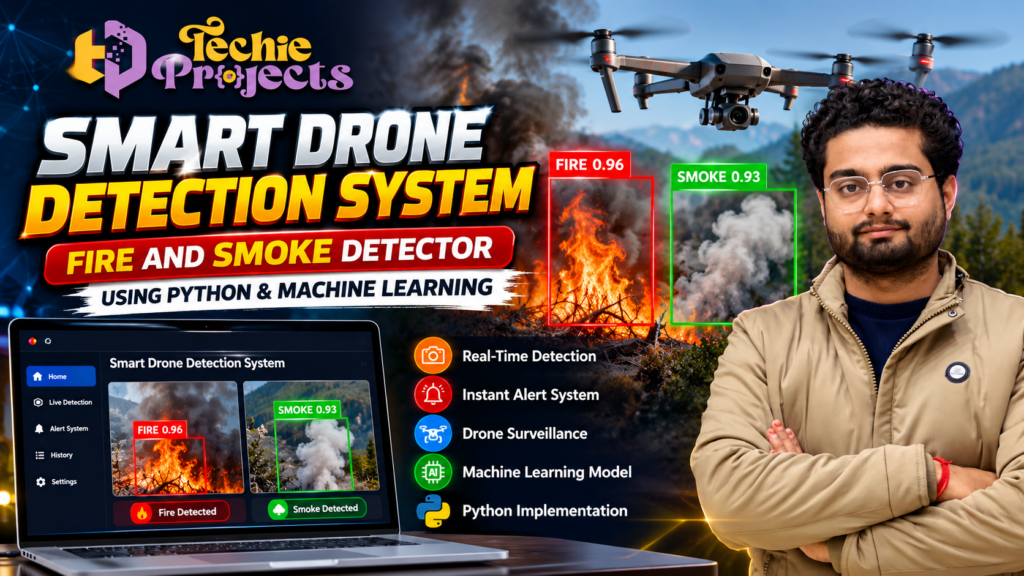
Are you looking for an innovative final-year engineering project based on Artificial Intelligence, Computer Vision, and Machine Learning? The Smart Drone Detection System Project Using Python is an interesting project concept that combines intelligent image analysis with fire and smoke detection. It can help students explore how computer vision models identify visual patterns and how automated alerts can support monitoring applications.
The Smart Drone Detection System Project is a Python-based engineering project that explores computer vision and machine learning for fire and smoke detection. It demonstrates how an AI model can analyze images or video frames, identify visual patterns associated with fire or smoke, and display prediction results. This project is suitable for students interested in Artificial Intelligence, Machine Learning, Python programming, and computer vision. Techie Projects helps students explore practical engineering project options and confirm available source code, documentation, installation requirements, and project features before purchase.
Fire and smoke detection is important in forests, industrial areas, warehouses, agricultural land, and other locations where early awareness of a potential hazard can help people respond more quickly. A computer vision-based system can analyze images or video frames and identify visual patterns associated with fire and smoke. When integrated with a drone or aerial camera, this concept can also be explored for remote monitoring.
At Techie Projects, we help engineering students explore practical project ideas involving Python, Artificial Intelligence, Machine Learning, and Computer Vision. If you are interested in developing or purchasing a Smart Drone Detection System project, contact us to confirm the available implementation, source code, documentation, installation requirements, and other deliverables before placing your order.
🎬 Project Demo
Watch the Smart Drone Detection System demonstration to understand the project’s concept, visual detection workflow, and potential applications. The demonstration can help you explore how a Python-based detection application may identify fire and smoke in supported images or video frames.
Pay attention to the detection interface, the visual output, and the way the application presents its results. These details can help you prepare questions about the implementation and understand which features you may want to demonstrate in your academic project.
🚀 What Is a Smart Drone Detection System?
A Smart Drone Detection System is a computer vision application designed to analyze visual data captured by a camera or drone and identify selected objects or events. In this project, the primary objective is to explore fire and smoke detection using Python and a suitable machine learning or deep learning model.
The system processes image frames and evaluates whether they contain visual patterns associated with fire or smoke. Depending on the implementation, the output may include detection labels, confidence scores, bounding boxes, and an interface for viewing the results.
A drone-based setup can extend this concept by providing aerial images of areas that may be difficult to inspect manually. However, actual drone integration requires compatible hardware, camera access, communication components, and appropriate testing. A software demonstration using recorded video is not automatically equivalent to a fully operational autonomous drone.
This makes the project suitable for students who want to study computer vision, object detection, Python programming, and the practical challenges of building AI-powered monitoring applications.
🎯 Objectives of the Project
The main objective is to develop an educational application that demonstrates how computer vision can be applied to fire and smoke detection.
Key objectives include:
- Understand the fundamentals of image processing and computer vision.
- Explore machine learning or deep learning techniques for visual detection.
- Process images or video frames using Python.
- Display detection results through a suitable interface.
- Study the use of confidence scores and detection boundaries.
- Explore how alerts could be connected to a detection workflow.
- Evaluate model performance using appropriate test data.
- Understand the limitations of AI-based environmental monitoring.
These objectives can be adapted to your academic requirements and the actual features included in the selected implementation.
⚙️ Technologies Used in the Smart Drone Detection System Project
The exact technology stack depends on the model and application design. A typical implementation may use the following technologies.
1. Python Programming
Python is commonly used for AI and computer vision projects because it provides a large ecosystem of libraries for data processing, model inference, and application development. Students can use Python to connect the detection model with image or video input and present the results.
2. OpenCV for Image and Video Processing
OpenCV is a computer vision library that can read images, process video frames, resize inputs, and display visual output. It can support the video-processing component of a fire and smoke detection application.
3. Machine Learning and Deep Learning
A suitable trained model can be used to identify visual patterns associated with fire and smoke. Depending on the implementation, the model may use an object detection architecture or another image classification approach.
Students should confirm which algorithm, model architecture, and dataset are included in the project package rather than assuming that every implementation uses the same model.
4. Object Detection and Visualisation
An object detection model may return class labels, confidence scores, and bounding boxes around detected regions. Visualisation helps users understand what the model has identified in a frame.
5. User Interface
A project may use a desktop interface, a web interface, or a simple OpenCV display window. The available interface and its features should be verified before purchase.
6. Drone or Camera Integration
A camera or recorded video can provide input to the detection application. Connecting the software to a physical drone requires additional compatibility checks and hardware integration. Confirm whether drone integration is included or whether the project is limited to software-based video detection.
🔍 How Does the Fire and Smoke Detection System Work?
A typical implementation follows a sequence of processing steps.
Step 1: Image or Video Input
The application receives an image, a recorded video, or a live camera stream, depending on its supported input options.
Step 2: Frame Processing
The input is prepared for the detection model. This may include resizing frames, converting image formats, and applying the preprocessing required by the selected model.
Step 3: Model Inference
The trained model analyzes the input and produces predictions. These predictions may indicate whether fire or smoke is present in the visible scene.
Step 4: Detection Visualisation
The application displays supported detection results, which may include labels, bounding boxes, and confidence scores.
Step 5: Alert Handling
An alert mechanism may be added to notify a user when a detection condition is met. The notification method depends on the implementation and could require additional configuration.
Step 6: Testing and Evaluation
The system should be tested using suitable images or videos. Evaluation can consider false positives, missed detections, processing speed, lighting conditions, and performance on scenes that differ from the training data.
Important: A detection result is a model prediction, not a guarantee that a fire exists. The system should not be treated as a certified fire alarm or a replacement for professional safety equipment.
✨ Key Features to Explore
Depending on the version selected, the project may demonstrate several useful features:
- Fire Detection: Identify visual patterns associated with fire in supported inputs.
- Smoke Detection: Analyze scenes for smoke-like visual patterns when supported by the model.
- Video Processing: Process recorded video or supported camera streams.
- Detection Labels: Display predicted classes on the output.
- Confidence Scores: Show the model’s confidence for a prediction.
- Visual Results: Present detection boxes or other visual indicators.
- Alert Integration: Explore an alert mechanism if it is included or configured.
- Performance Testing: Evaluate results on selected test images and videos.
- Future Drone Integration: Investigate the additional components required for aerial monitoring.
Before ordering, confirm which of these features are included in the actual package and which would require further development.
🎓 Applications of a Smart Drone Detection System
Forest and Wildfire Monitoring
Aerial imagery can help researchers investigate how computer vision might assist in identifying visible signs of fire or smoke across large areas.
Industrial Safety Research
The project can be adapted as an educational prototype for studying visual hazard detection in selected industrial environments.
Warehouse Monitoring
Computer vision can be explored for identifying smoke-like or fire-like patterns in indoor monitoring footage, subject to camera placement and environmental conditions.
Agricultural Areas
Aerial image analysis can be studied for monitoring large agricultural areas and exploring potential applications of computer vision.
Academic Research
Students can use the project concept to learn about model training, inference, evaluation, and the practical limitations of AI-based detection.
These are potential application areas for research and prototyping. Real-world deployment requires rigorous validation, appropriate hardware, and suitable safety procedures.
📚 Benefits for Engineering Students
The Smart Drone Detection System Project can provide a practical learning opportunity for students pursuing Computer Science, Information Technology, Artificial Intelligence, Data Science, or related engineering disciplines.
Practical Python Experience: Understand how Python connects input data, model inference, and output visualisation.
Computer Vision Learning: Explore image processing and visual pattern recognition.
AI Model Understanding: Learn about predictions, confidence scores, datasets, and evaluation metrics.
Project Demonstration: Prepare a technical presentation explaining the system architecture, workflow, features, and limitations.
Customisation Opportunities: Depending on the code and project scope, students may investigate improvements such as additional classes, alternative models, or performance comparisons.
Technical Documentation: Study how to document installation, dependencies, configuration, testing, and project limitations.
The learning value depends on how actively you explore the implementation, understand the code, and test the system.
🧩 Possible Project Modules
A modular design can make the project easier to understand and maintain. A typical architecture may include:
| Module | Purpose |
|---|---|
| Input Management | Load images or video from supported sources |
| Image Processing | Prepare frames for analysis |
| Detection Model | Predict fire or smoke classes |
| Result Visualisation | Display labels and detection regions |
| Alert Handling | Trigger configured notifications, if implemented |
| Testing and Evaluation | Measure performance on test data |
| Documentation | Explain setup, workflow, and limitations |
The actual modules may vary according to the project version and selected features.
💻 Software and Hardware Requirements
A typical Python-based prototype may require:
- A laptop or desktop computer.
- A compatible Python installation.
- Required Python libraries and model dependencies.
- Adequate storage for code, model files, and test data.
- Sample images or videos for evaluation.
- A compatible camera if live input is supported.
GPU requirements depend on the model and the desired processing speed. A physical drone is not necessarily required for a software demonstration based on recorded video. If you want to operate a drone or use live aerial footage, confirm the hardware, communication, software compatibility, and safety requirements in advance.
🛒 Purchase the Smart Drone Detection System Project from Techie Projects
Are you searching for a Python-based AI project for your college submission, final-year demonstration, or computer vision learning?
Techie Projects helps students explore engineering project options in Artificial Intelligence, Machine Learning, Python, Deep Learning, Data Science, and related domains.
Before purchasing the Smart Drone Detection System Project, share your requirements so the available deliverables can be confirmed.
You can ask about:
- Available source code and project files.
- Installation instructions and compatible software versions.
- Explanation of the implementation and main modules.
- Dataset and model details, where applicable.
- Technical documentation and demonstration materials.
- Included features and possible customisation.
- Pricing, delivery method, and support options.
Availability, pricing, documentation, and support depend on the selected package. Please confirm these details before making payment so the project matches your academic requirements.
📲 Contact Techie Projects
- 📲 Call/WhatsApp: +91-9460060699
- 🌎 Website: www.techieprojects.com
- 📺 Instagram: @pythonprojects_
Send a message describing your branch, project deadline, preferred technologies, and required deliverables. This will help you check whether the available project is suitable for your needs.
🔗 Explore Related Projects
Explore more engineering project ideas from Techie Projects:
- Fire and Smoke Detection System Using Python
- Forest Fire Detection Using Deep Learning
- Accident Detection and Alert System
- Intrusion Detection System Using Machine Learning
- Vehicle Detection and Counting Using OpenCV
- Helmet Detection System Using Computer Vision
- Plant Disease Detection Using Machine Learning
Choose a project based on your interests, available resources, academic guidelines, and the time you have to implement and test it.
❓ Frequently Asked Questions
1. What is a Smart Drone Detection System Project?
It is a computer vision project concept that analyzes visual input to identify selected objects or events. This version focuses on exploring fire and smoke detection using Python and an appropriate detection model.
2. Which programming language is used?
Python is commonly used for image processing, model inference, and application development in this type of project.
3. Is a physical drone necessary?
Not necessarily. A software prototype may work with recorded images or videos. Actual drone-based monitoring requires compatible hardware and additional integration.
4. Can this project be used for a final-year engineering demonstration?
It may be suitable for an academic demonstration if its scope, complexity, and deliverables meet your institution’s requirements. Confirm the project details with your faculty and the provider before ordering.
5. Does the system guarantee fire detection?
No. Computer vision models can produce false positives or miss hazards. Performance depends on the data, model, environment, and testing. The project should not replace certified fire detection equipment.
6. What should I confirm before purchasing?
Ask about the source code, installation process, model and dataset details, documentation, included features, compatibility, price, and support. Confirm all deliverables before payment.
7. Can the project be customised?
Customisation depends on the code, available model, project scope, and technical requirements. Contact Techie Projects to discuss the changes you need and confirm feasibility.
✅ Start Your AI Project with Techie Projects
The Smart Drone Detection System Project offers an opportunity to explore Python programming, computer vision, fire and smoke detection, and AI-based monitoring concepts in one application. It can be a useful starting point for students who want to understand how visual data is processed and how model predictions are presented in a practical demonstration.
If you are interested in purchasing this project, visit Techie Projects or contact us on WhatsApp to confirm the available package, pricing, installation requirements, and documentation.
Choose a project you can understand, demonstrate, test, and explain confidently. Use it as a learning opportunity to build your technical knowledge and strengthen your engineering project presentation.
Disclaimer: This project is intended for educational and research purposes. Detection outputs are not guaranteed to be accurate and should not be used as the sole basis for emergency decisions or as a substitute for certified safety systems.