
Introduction
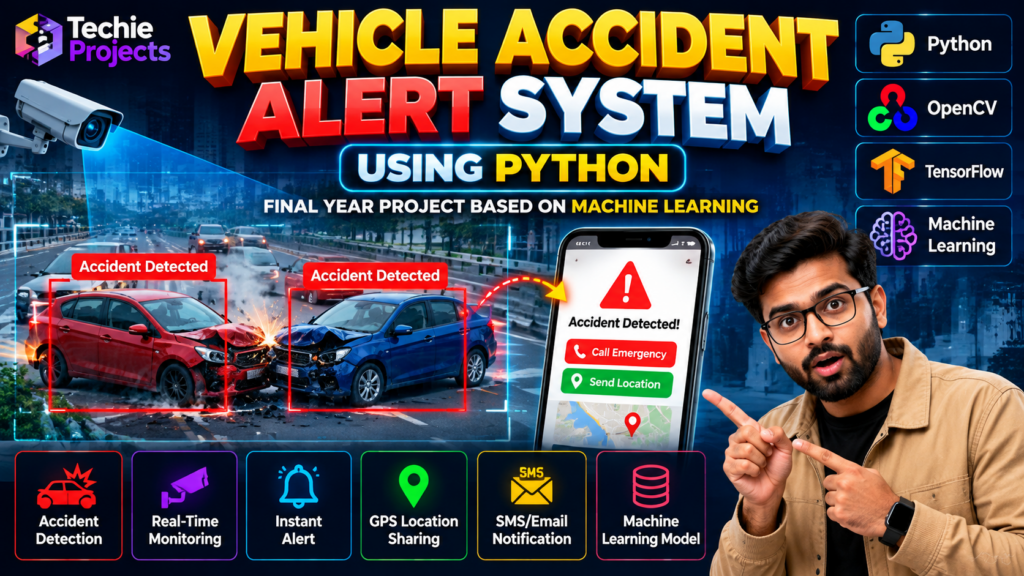
The vehicle accident alert system using Python is a machine learning project designed to demonstrate how computer vision and artificial intelligence can help identify potential vehicle accidents from images or video footage. This project is suitable for B.Tech, B.E., BCA, MCA, and computer science engineering students interested in Python programming, machine learning, and intelligent transportation systems.
Road accidents can result in injuries, traffic congestion, and property damage. An accident detection application can analyze supported visual data and identify patterns associated with possible collisions. Depending on the implementation, the system may display an alert or initiate a configured notification workflow.
This vehicle accident alert system using Python project helps students explore image processing, machine learning, object detection, and alert generation through a practical academic application.
🎥 Watch the Vehicle Accident Alert System Using Python Working Demo
Watch the Vehicle Accident Alert System Using Python Project Demo to see how the application analyzes road scenes and displays potential accident detection results.
Explore the implemented detection workflow, user interface, and alert features to understand how Python and machine learning can be applied to vehicle safety projects. This demonstration also helps students evaluate the project’s suitability for a final-year engineering submission.
Watch the video below to explore the project in action.
What Is a Vehicle Accident Alert System Using Python?
A vehicle accident alert system is a software application that uses supported detection techniques to identify events that may indicate a vehicle collision. Depending on the implementation, it may analyze images, video frames, or other input data.
The system can use a trained machine learning model or computer vision logic to process the input and produce detection results. If an alert feature is implemented, the application may display a warning when configured conditions are met.
The actual performance depends on the model, dataset, input quality, and detection logic. An academic prototype should not be considered a certified emergency response system without appropriate testing and validation.
🎯 Objectives of the Project
The main objectives of this vehicle accident alert project are:
- Develop an accident detection application using Python.
- Explore machine learning and computer vision techniques.
- Analyze road images or video footage where supported.
- Understand accident-related pattern recognition.
- Display potential accident detection results.
- Implement an alert workflow if included in the application.
- Demonstrate an AI-based application for academic learning.
✨ Key Features of the Vehicle Accident Alert System
1. Vehicle Accident Detection
The system can use a trained model or configured detection logic to identify visual patterns associated with potential collisions.
2. Machine Learning Integration
Machine learning techniques can help identify patterns in data used to train or configure the detection model.
3. Image and Video Processing
If supported, the application can process road images or video frames to analyze vehicles and potential accident events.
4. Accident Alert Interface
The application may display an accident warning when the implemented detection logic identifies a possible collision.
5. Object Detection
A framework such as YOLO can detect supported objects if it is included in the project. Vehicle detection alone does not establish that an accident has occurred; accident identification requires suitable classification or additional logic.
6. Notification Support
Email, SMS, GPS location sharing, or external notifications can be added if the project includes the required integrations and configuration.
Important: Confirm the features present in your actual source code before advertising live monitoring, GPS tracking, SMS/email notifications, or automatic emergency calls as functional.
🛠️ Technologies Used
The following technologies may be used, depending on the implementation:
- Python: Main programming language.
- Machine Learning: Supports pattern recognition and classification.
- Computer Vision: Enables analysis of images and video.
- OpenCV: Can be used for image and video processing.
- YOLO: An object detection framework, if included.
- TensorFlow or PyTorch: Deep learning frameworks, if used.
- NumPy: Supports numerical operations and data processing.
- Notification APIs: May be used for external alerts when configured.
The exact libraries, model architecture, and versions should be verified from the project source code.
⚙️ How the Vehicle Accident Alert System Works
The general workflow includes these steps:
- Input Collection: The application receives compatible road images or video footage.
- Preprocessing: The input is prepared according to the model’s requirements.
- Model Processing: The model analyzes the input for supported objects or accident-related patterns.
- Detection Evaluation: The application interprets predictions using its configured detection logic.
- Alert Generation: If implemented, an alert is triggered when the configured conditions are satisfied.
- Result Display: The application displays detection results or annotated video.
- Optional Notification: If configured, the system can send a notification through a supported service.
This workflow introduces students to the integration of machine learning, computer vision, and application logic.
💻 Software Requirements
Typical requirements may include:
- Operating System: Windows or another supported platform
- Programming Language: Python
- IDE: Visual Studio Code, PyCharm, or another compatible editor
- Libraries: The packages required by the supplied source code
- Model: A trained model, if the implementation uses one
- Input Data: Compatible road images or video footage
- Hardware: A computer capable of running the selected model
- Internet Connection: Required for online services or external notifications, if used
Actual requirements depend on the model, Python version, and included integrations.
🎓 Applications of the Project
Potential applications of vehicle accident detection technology include:
- Intelligent traffic monitoring research
- Road safety analysis
- Video-based accident detection prototypes
- Smart transportation research
- Computer vision experiments
- Academic machine learning demonstrations
- Traffic event analysis
Real-world use requires appropriate validation, monitoring, and evaluation of false detections and missed incidents.
✅ Advantages of the Project
The vehicle accident alert system using Python demonstrates how machine learning and computer vision can support accident detection research. This project helps students understand vehicle monitoring, detection workflows, and alert generation in a practical Python application.
- Demonstrates practical machine learning concepts.
- Helps students learn Python and computer vision.
- Introduces image and video processing.
- Provides experience integrating a model into an application.
- Can be extended with additional detection features.
- Supports final-year engineering demonstrations and technical presentations.
🚀 Future Scope
The project can be extended with additional capabilities, depending on its architecture:
- Live camera stream processing
- Improved accident classification
- Incident timestamps and event logging
- Dashboard-based monitoring
- GPS integration where supported
- Email or SMS notification integration
- Model optimization for suitable hardware
- Evaluation using representative test datasets
Any automatic emergency notification feature should be thoroughly tested before real-world deployment.
🛒 Purchase the Vehicle Accident Alert System Project
Are you looking for a vehicle accident alert system using Python for your final-year engineering project, computer science assignment, or machine learning portfolio?
Techie Projects can help you enquire about project availability, source code, installation requirements, included features, and customization options.
Before purchasing, discuss your requirements with us and confirm which detection, alert, and notification features are included in the available implementation.
📲 Call/WhatsApp: +91-9460060699
🌎 Website: www.techieprojects.com
📺 Instagram: @pythonprojects_
🔗 Explore Related Projects
- Road Accident Detection Using Machine Learning
- Car Crash Detection Using Python
- Fire Detection and Alarm System Using Python
- Vehicle Detection and Counting Using OpenCV
- Machine Learning Projects
- Deep Learning Projects
- OpenCV Projects
❓ Frequently Asked Questions
1. What is a vehicle accident alert system using Python?
It is a Python-based application that uses supported detection techniques to identify potential accident-related events and display results or configured alerts.
2. Which technologies are used in this project?
Depending on the implementation, the project may use Python, OpenCV, machine learning, YOLO, or a deep learning framework.
3. Can the system analyze video footage?
Yes, if the implementation includes video processing and an appropriate detection workflow.
4. Does the system automatically send accident alerts?
Not necessarily. External notifications require the relevant functionality, service integration, and configuration. Confirm this before purchasing.
5. Is this project suitable for final-year engineering students?
It can be suitable for students studying computer science, artificial intelligence, machine learning, or related subjects, depending on their academic requirements.
6. How can I purchase the project?
Contact Techie Projects through WhatsApp to enquire about source code, installation requirements, included features, and pricing.
Conclusion
The vehicle accident alert system using Python project demonstrates how machine learning and computer vision can be applied to vehicle safety research. It provides an opportunity to explore image processing, model inference, accident-related detection, and alert workflows.
If you need this project for your final-year engineering submission, contact Techie Projects to discuss the available implementation, source code, customization options, and pricing.