
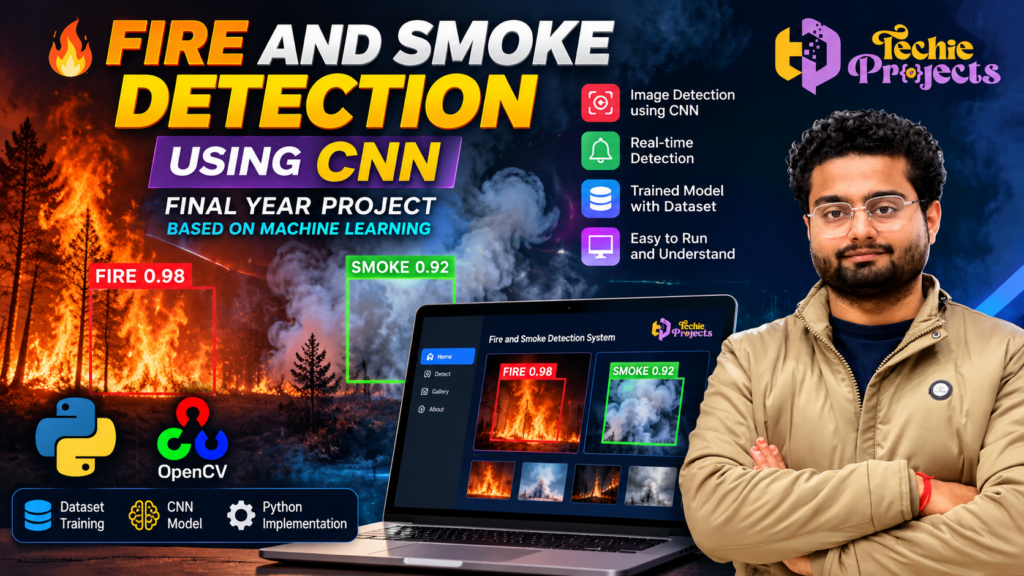
Are you looking for an innovative Fire and Smoke Detection Using CNN project for your final-year engineering submission? 🔥 This computer vision and machine learning project demonstrates how a trained Convolutional Neural Network (CNN) can analyze images and identify visual patterns associated with fire and smoke.
The project is suitable for students exploring Artificial Intelligence (AI), Deep Learning, Python programming, and image processing. It can help you understand how image datasets, model training, prediction logic, and a user-friendly interface work together in a practical engineering application.
At Techie Projects, we help students explore practical software projects for academic learning, demonstrations, and technical presentations. If you want to implement a fire and smoke detection system, this project is an option to consider for your college project work.
The Fire and Smoke Detection Using CNN project demonstrates how deep learning can be applied to image-based safety monitoring. By training a Convolutional Neural Network on labeled images, students can explore how a computer vision model identifies visual patterns associated with flames and smoke. This practical Python project combines image processing, model training, and prediction techniques in one educational application.
🎬 Project Demo: Fire and Smoke Detection Using CNN
Watch the project demonstration to understand the system’s concept, visual detection process, and possible application workflow. The demo can help you evaluate whether this project matches your technical interests and academic requirements.
The demonstration is intended to explain the project’s functionality. Actual detection accuracy and available features depend on the implemented model, dataset, and software package.
🔥 What Is Fire and Smoke Detection Using CNN?
Fire and Smoke Detection Using CNN is a computer vision project designed to identify fire- and smoke-related visual patterns in images. CNNs are deep learning models commonly used for image classification because they can learn useful visual features from training data.
Traditional fire detection systems often depend on physical sensors, such as heat or smoke detectors. An image-based system takes a different approach by analyzing visual information from photographs, recorded footage, or a camera feed, depending on its implementation.
For example, a trained model may examine an image containing flames or smoke and predict the relevant category. The result can then be displayed through an application interface.
This project introduces students to the practical use of deep learning in safety-related applications. However, an educational prototype should not be treated as a certified fire alarm or a replacement for approved fire safety equipment.
🎯 Objectives of the Project
The main objectives of this project are:
- To understand image-based fire and smoke detection.
- To learn the fundamentals of CNN architecture and deep learning.
- To prepare and process image datasets for model training.
- To classify images into supported categories.
- To display prediction results through an understandable interface.
- To explore the limitations of computer vision in real-world environments.
- To develop technical documentation and prepare for a project demonstration.
These objectives make the project useful for students interested in practical machine learning and computer vision.
⚙️ How Does the System Work?
Developing a Fire and Smoke Detection Using CNN system involves preparing an image dataset, preprocessing images, training a suitable model, and evaluating its predictions. Students can examine the model’s performance on unseen images and investigate how lighting, background conditions, and dataset quality affect detection results.
A typical CNN-based fire and smoke detection application follows several stages.
1. Image Dataset Collection
The first stage involves collecting or selecting a suitable dataset containing images of fire, smoke, and relevant background scenes. The quality and diversity of the dataset influence how well the trained model performs.
2. Image Preprocessing
Images may need to be resized, normalized, and organized into appropriate categories. Data augmentation can also be used to introduce variations during training, depending on the chosen approach.
3. CNN Model Training
The CNN learns visual patterns from labeled training images. During training, the model adjusts its parameters to reduce prediction errors. Students can study training performance, validation results, and model evaluation.
4. Image Prediction
After training, the model receives an image and generates a prediction for the categories it supports. The output may include a predicted label and a confidence score, depending on the implementation.
5. Results Display
The application can present the prediction through a simple interface. Some implementations may support image uploads, a results page, or live camera input. Confirm which features are included in the specific project package before purchasing.
6. Evaluation and Testing
The model should be tested on separate images that were not used for training. Evaluation helps identify incorrect predictions, limitations, and areas that need improvement.
🧰 Technologies Used
The exact technology stack depends on the selected implementation. A typical version may use the following tools.
| Technology | Purpose |
|---|---|
| Python | Main programming language |
| CNN | Deep learning approach for image analysis |
| TensorFlow or Keras | Model development and training, if used |
| OpenCV | Image processing and camera integration, if included |
| NumPy | Numerical operations |
| Matplotlib | Visualizing training results, if used |
| Streamlit or Flask | Creating an application interface, if included |
Students should verify the actual libraries, versions, and interface framework supplied with the project before installation.
🚀 Key Features to Explore
Image-Based Fire Detection
The model can be trained to recognize visual characteristics associated with flames in supported images.
Smoke Recognition
Smoke-related image patterns can be included as a separate prediction category when the model and training dataset support it.
CNN-Based Image Classification
The project introduces students to convolutional layers, feature extraction, classification, and model evaluation.
Python Implementation
Python provides an accessible environment for developing and testing machine learning applications.
Results Visualization
Depending on the implementation, prediction labels, confidence values, or training metrics may be displayed to help users understand the output.
Opportunities for Enhancement
Students can explore additional features such as video input, camera integration, notifications, and improved model evaluation. These enhancements may require extra development and should not be assumed to be part of the base package.
🎓 Applications of Fire and Smoke Detection
Computer vision research has potential applications in different environments, including:
- Industrial environments: Exploring visual monitoring around manufacturing facilities.
- Warehouses: Studying image-based monitoring in storage areas.
- Forests: Researching fire-related visual patterns in outdoor imagery.
- Buildings: Exploring camera-based safety monitoring as a supplementary concept.
- Educational laboratories: Demonstrating deep learning and image classification.
- Smart monitoring research: Investigating how computer vision can be combined with other sensors.
Real-world deployment requires careful validation, appropriate camera placement, consideration of lighting and environmental conditions, and integration with certified safety systems where necessary.
🎓 Why Choose This Project for Your Final Year?
Choosing a Fire and Smoke Detection Using CNN project gives engineering students an opportunity to practise Python programming, deep learning, and computer vision. It can also support a technical presentation by helping students explain the dataset, CNN architecture, prediction workflow, evaluation metrics, and possible improvements.
The Fire and Smoke Detection Using CNN project brings together several important areas of computer science and engineering.
Practical machine learning: Understand how a model learns from labeled images and produces predictions.
Computer vision experience: Explore image preprocessing, feature extraction, and classification.
Technical presentation: Explain the dataset, model workflow, evaluation process, and limitations during your project demonstration.
Customization opportunities: Investigate additional functionality, alternative model architectures, and improved testing methods.
Portfolio development: A well-documented implementation can help demonstrate your understanding of Python and deep learning when discussing academic or personal projects.
The most important learning outcome is understanding the implementation rather than relying only on the final prediction screen.
🛒 Get the Fire and Smoke Detection Project from Techie Projects
Looking for a practical machine learning project for your engineering coursework? Techie Projects can help you explore project options and clarify the available implementation details before placing an order.
Before purchasing, confirm the deliverables you need for your college submission. Depending on the package, you may want to ask about:
- Source code availability and supported Python version.
- Installation instructions and required dependencies.
- Dataset availability and model files.
- Project report or documentation availability.
- Explanation of the model workflow and major code modules.
- Demonstration video or screenshots.
- Customization options and technical support availability.
Package contents and support options may vary, so confirm these details directly before payment.
📲 Contact Techie Projects
Discuss your requirements and check the availability of this project through the following official channels:
- 📲 Call/WhatsApp: +91-9460060699
- 🌎 Website: www.techieprojects.com
- 📺 Instagram: @pythonprojects_
When contacting us, mention “Fire and Smoke Detection Using CNN” and share your course, project deadline, and required deliverables. This helps clarify whether the available package matches your requirements.
📋 Basic Requirements
The requirements depend on the selected model and implementation. A typical Python-based project may need:
Software requirements
- Python and compatible library versions.
- A code editor such as Visual Studio Code or PyCharm.
- The required machine learning and image processing packages.
- A compatible operating system.
- Dataset and model files, if required.
Hardware requirements
- A computer capable of running the selected Python environment.
- Sufficient RAM and storage for the dataset and dependencies.
- A webcam only if camera-based input is included.
A dedicated GPU may help with model training, but whether it is necessary depends on the model size, dataset, and available pre-trained weights.
🔮 Future Enhancements
Students can use this project as a starting point for further experimentation. Possible enhancements include:
- Real-Time Video Detection: Analyze frames from a compatible camera or video stream.
- Notification Integration: Explore alerts when a prediction meets a defined threshold.
- Improved Dataset Diversity: Test images under different lighting and environmental conditions.
- Model Comparison: Compare CNN architectures or other suitable computer vision models.
- Web-Based Interface: Create a dashboard for uploading images and viewing predictions.
- Sensor Integration: Research how camera-based predictions could complement independent fire safety sensors.
These are potential extensions, not guaranteed features of the current project. A safety-critical system requires rigorous testing and appropriate professional review.
❓ Frequently Asked Questions
1. What is the Fire and Smoke Detection Using CNN project?
It is a computer vision project that uses a CNN-based model to identify fire- and smoke-related visual patterns in supported images.
2. Which programming language is used?
Python is commonly used for this type of implementation. The exact libraries and framework depend on the project package.
3. Is this project suitable for final-year engineering students?
It can be suitable for students interested in machine learning, deep learning, Python, and image processing. Confirm that its complexity and deliverables meet your college guidelines.
4. Does the project support real-time detection?
Real-time detection depends on whether camera or video-stream processing is implemented. Ask Techie Projects to confirm this feature before purchasing.
5. Is the source code included?
Source code availability depends on the selected package. Confirm the included files, documentation, and usage permissions before ordering.
6. Can I customize the project?
Possible customizations include dataset changes, model comparisons, interface improvements, and additional modules. The feasibility and cost depend on the requested changes.
7. Can this project replace a commercial fire alarm?
No. An academic prototype should not replace certified fire detection equipment, approved alarms, or professional fire safety procedures.
🎓 Explore Related Projects
Explore these related project ideas from the computer vision, AI, and machine learning domains:
- Forest Fire Detection Using Machine Learning
- Real-Time Object Detection Using YOLO
- Accident Detection System Using Computer Vision
- Pothole Detection Using Deep Learning
- Helmet Detection System Using YOLO
- Vehicle Detection and Counting System
- Intrusion Detection System Using Machine Learning
Visit Techie Projects to explore available engineering project options and identify one that fits your course and interests.
✅ Conclusion
The Fire and Smoke Detection Using CNN project provides an educational introduction to deep learning, image classification, and computer vision for safety-related applications. It helps students explore dataset preparation, model training, prediction, and evaluation while identifying opportunities for further development.
If you are planning a final-year or mini project, contact Techie Projects to confirm the available source code, documentation, installation requirements, demonstration resources, and support options. Choose a package that aligns with your academic guidelines and gives you an opportunity to understand and explain the implementation.
Ready to discuss this project? Visit https://techieprojects.com/ or message us directly on WhatsApp to enquire about availability and purchasing details.