
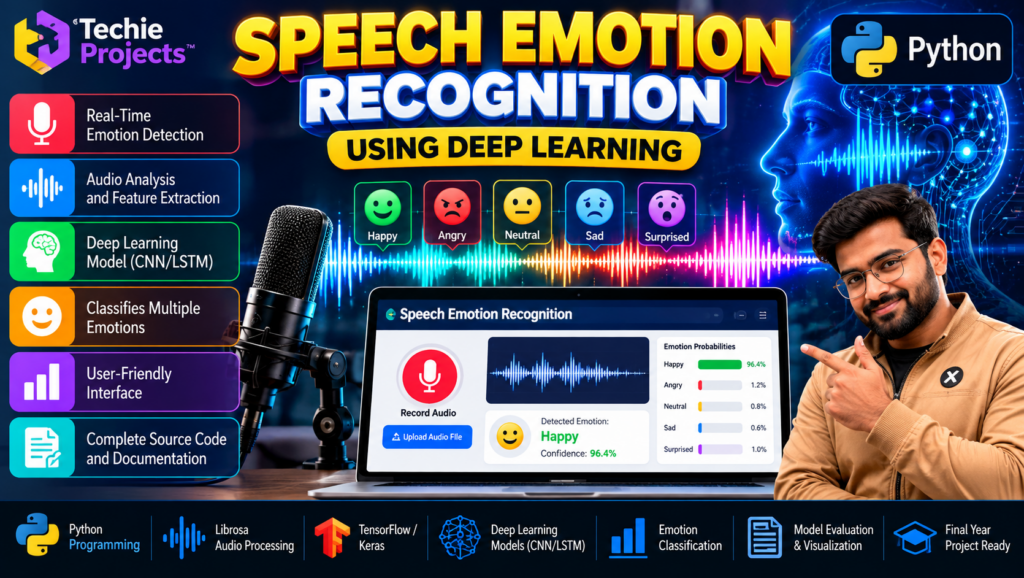
Speech Emotion Recognition Using Deep Learning | Python Project
Speech emotion recognition using deep learning is an AI project that analyzes speech audio and predicts an emotion category based on vocal features. This project demonstrates how Python, audio processing, and deep learning can be combined to build an application that classifies emotions such as happy, sad, angry, neutral, or surprised, depending on the trained model.
If you are a B.Tech, B.E., BCA, MCA, Computer Science, Artificial Intelligence, or Data Science student looking for a practical final-year project, this topic can help you explore audio classification, feature extraction, neural networks, and machine learning model evaluation.
Techie Projects offers engineering project solutions for students who want to understand practical AI and Python applications. Contact us to confirm project availability, source code, documentation, setup requirements, and pricing.
🎬 Project Demo: Speech Emotion Recognition Using Deep Learning
Watch the project demonstration to understand its interface and workflow. The application may process an audio recording or uploaded audio file, extract relevant features, and display a predicted emotion, depending on the implementation.
Use the demo to review the actual features before purchasing. Emotion predictions are model outputs and should not be treated as a reliable assessment of a person’s mental state or personality.
🎯 What Is Speech Emotion Recognition Using Deep Learning?
Speech emotion recognition using deep learning is a classification task in which a trained model analyzes characteristics of speech audio to predict an emotion label.
Speech signals contain information such as pitch, intensity, rhythm, pauses, and spectral characteristics. Audio-processing techniques can convert speech into numerical representations that a machine learning model can process.
A deep learning model can learn patterns from labelled audio examples and use those patterns to predict categories represented in its training data.
For example, a model might classify an audio sample as happy, angry, sad, neutral, or surprised. The available categories depend on the dataset and the trained model.
✨ Key Features of the Project
The following features may be available depending on the supplied implementation:
- Audio input: Process supported speech recordings or uploaded audio files.
- Audio preprocessing: Prepare audio data for feature extraction.
- Feature extraction: Generate numerical representations of speech.
- Deep learning integration: Use a trained model for emotion classification.
- Emotion prediction: Display a predicted category supported by the model.
- User interface: Provide a convenient way to interact with the application.
- Result display: Present the classification output to the user.
- Model evaluation: Explore performance metrics if evaluation code and test data are included.
Live microphone input, real-time processing, model retraining, and advanced visualization should be advertised only if they are actually included in the project version you purchase.
🎓 Objectives of Speech Emotion Recognition Using Deep Learning
The primary objectives are:
- Understand the fundamentals of speech emotion classification.
- Learn how audio data can be prepared for machine learning.
- Explore feature extraction from speech signals.
- Understand how a deep learning model predicts emotion categories.
- Build or use a Python application for audio classification.
- Evaluate model performance using suitable test data.
- Identify the limitations of emotion prediction from speech.
⚙️ How Does the Speech Emotion Recognition System Work?
1. Audio Dataset Collection
The process begins with speech recordings labelled with emotion categories. Dataset quality, speaker diversity, recording conditions, and label consistency can influence the model’s performance.
2. Audio Preprocessing
Audio files may need to be converted to a consistent sampling rate, trimmed, normalized, or processed into suitable segments. The exact steps depend on the model and dataset.
3. Feature Extraction
The system converts audio into features that can be processed by a model. Common approaches include Mel-frequency cepstral coefficients (MFCCs), spectrograms, and other audio representations.
The actual features used should match the supplied implementation.
4. Deep Learning Model
A model learns patterns from labelled audio examples. Depending on the project, this could involve a convolutional neural network (CNN), a recurrent neural network (RNN), an LSTM network, or another suitable architecture.
Not every implementation uses all these architectures.
5. Emotion Classification
The trained model processes the prepared audio features and produces a prediction among the emotion categories it supports.
6. Result Display
The application displays the predicted category through its interface. If the project includes probability scores or visualizations, these can help explain the model’s output.
7. Model Evaluation
The model can be evaluated using held-out test data. Suitable metrics include accuracy, precision, recall, F1-score, and a confusion matrix. Report actual results from the implementation rather than assuming a particular accuracy.
🧰 Technologies Used
Python
Python is used to connect the audio-processing workflow, model, and application interface.
Audio Processing Libraries
Libraries such as Librosa may be used to load audio, extract features, and prepare speech signals. Confirm the actual dependencies in the supplied code.
TensorFlow or Keras
These frameworks can be used to build, load, or run a deep learning model when the implementation is based on them.
NumPy
NumPy supports numerical calculations and array processing.
Scikit-learn
Scikit-learn may be used for preprocessing, splitting datasets, or evaluating model predictions.
Matplotlib
Matplotlib can be used to plot audio waveforms, spectrograms, or evaluation results if visualizations are included.
The precise libraries and versions depend on the project. Confirm the requirements before installation.
💻 Software and Hardware Requirements
Software Requirements
- Python
- A compatible operating system
- Required audio-processing libraries
- Required deep learning framework
- Trained model and supporting files, if supplied
- Compatible code editor, such as VS Code or PyCharm
Hardware Requirements
- Laptop or desktop computer
- Compatible processor
- Sufficient RAM for the model and audio data
- Storage for the application, datasets, and model files
- Microphone only if live audio input is supported
A dedicated GPU may not be necessary for running a compact pretrained model, but requirements depend on the architecture and implementation.
🌟 Advantages of Speech Emotion Recognition
- Demonstrates a practical application of deep learning.
- Introduces speech processing and audio feature extraction.
- Helps students understand classification models.
- Combines Python programming with AI concepts.
- Can be extended with different datasets and model architectures.
- Offers an educational example of human-computer interaction.
🏢 Applications of Speech Emotion Recognition
Speech emotion recognition is explored in several research and application areas:
- Human-computer interaction: Studying ways for interfaces to respond to vocal cues.
- Customer-service research: Analyzing speech patterns in controlled research settings.
- Call analysis prototypes: Exploring emotion classification on permitted recordings.
- Speech and audio research: Comparing audio features and classification methods.
- Educational applications: Demonstrating audio processing and deep learning.
- Multimodal research: Combining audio with other data sources in carefully designed experiments.
These are potential application areas, not a guarantee that the student project is ready for commercial deployment.
⚠️ Limitations and Ethical Considerations
Speech emotion recognition has important limitations:
- People express emotions differently across cultures, languages, and speaking styles.
- Background noise and recording quality can affect predictions.
- A model may perform differently on speakers or accents not represented in its training data.
- Emotion labels in datasets can be subjective.
- A predicted emotion does not establish what a person truly feels.
- Performance on a test dataset does not guarantee reliable results in real-world settings.
Obtain appropriate consent before recording or analyzing people’s voices. Avoid using predictions alone to make decisions about employment, education, health, or other high-impact matters.
🚀 Future Scope
Possible future improvements include:
- Adding support for more audio formats.
- Comparing different audio feature extraction methods.
- Testing alternative deep learning architectures.
- Improving performance across different speakers and recording conditions.
- Adding waveform and spectrogram visualizations.
- Developing a web interface for supported audio uploads.
- Evaluating the model using more diverse and independent datasets.
- Exploring multilingual speech datasets where appropriate.
These improvements may require additional development beyond the existing project.
🎓 Why Choose This Project for Your Final Year?
Speech emotion recognition using deep learning is a suitable topic to explore if you are interested in Artificial Intelligence, Machine Learning, Python, or audio processing.
The project can help you learn:
- Audio data preprocessing
- Feature extraction
- Deep learning model integration
- Classification and evaluation
- Python application development
- Technical documentation and project presentation
Before selecting the project, check your college’s requirements and confirm that the implementation provides the complexity and deliverables you need.
📦 What Do You Need to Confirm Before Purchasing?
Contact Techie Projects to confirm which deliverables are available in the current version:
- Python source code
- Trained model files, if applicable
- Dataset or dataset access instructions
- Installation and dependency instructions
- Project documentation or report
- Instructions for running the application
- Available setup assistance or technical support
Also confirm whether the project supports audio upload, microphone input, real-time prediction, or only prerecorded audio. These features can vary by implementation.
📲 Purchase Speech Emotion Recognition Using Deep Learning
Looking for a speech emotion recognition using deep learning project for your B.Tech, B.E., BCA, MCA, or final-year submission?
Techie Projects can help you enquire about the available project version, source code, documentation, technical requirements, and pricing before you purchase.
Get Project Details and Pricing on WhatsApp
👉 Enquire About This Project on WhatsApp
🌐 Explore More Engineering Projects
📸 Follow Techie Projects on Instagram
Contact us to confirm availability, included deliverables, installation requirements, and pricing before placing your order.
🔗 Explore Related Projects
Explore these related project topics on Techie Projects:
- Speech Recognition Using Python
- Human Activity Recognition Using Deep Learning
- Sign Language Recognition Using Machine Learning
- Face Emotion Recognition Using Deep Learning
- Voice Assistant Using Python
Link each project title to its relevant published article on your website when available.
❓ Frequently Asked Questions
1. What is speech emotion recognition using deep learning?
It is an audio classification task in which a trained deep learning model predicts an emotion category from speech signals.
2. Which programming language is used?
Python is commonly used for audio preprocessing, model integration, and application development.
3. Which emotions can the project recognize?
The supported categories depend on the training dataset and model. Common categories may include happy, sad, angry, neutral, and surprised.
4. Does the project work in real time?
Real-time operation depends on the supplied implementation. Confirm whether it supports live microphone input or only prerecorded audio.
5. Which deep learning model is used?
The architecture depends on the project version. CNN, LSTM, and other architectures are possible, but the actual model should be verified in the supplied code.
6. Is the predicted emotion always correct?
No. Predictions can be affected by background noise, speaker differences, dataset limitations, and model quality. They should not be treated as definitive judgments about a person’s feelings.
7. Is this project suitable for final-year students?
It can be suitable for students studying Computer Science, Artificial Intelligence, Data Science, or related subjects, subject to institutional requirements.
8. How can I purchase the project?
Contact Techie Projects on WhatsApp to enquire about current availability and pricing.
📝 Conclusion
Speech emotion recognition using deep learning is a practical educational project for exploring audio processing, feature extraction, neural networks, and classification with Python.
It provides a foundation for understanding how machine learning models analyze speech signals and generate predictions while highlighting the importance of reliable evaluation, privacy, and responsible use.
If you want to purchase this project for learning or academic purposes, contact Techie Projects to confirm the implementation, source code availability, documentation, and price.
👉 Contact Techie Projects on WhatsApp to get started.
📲 Call/WhatsApp: +91-9460060699
🌎 Website: www.techieprojects.com
📺 Instagram: @pythonprojects_