
Introduction
Brain stroke is a serious medical condition that requires timely evaluation and treatment. Medical imaging techniques such as Computed Tomography (CT) and Magnetic Resonance Imaging (MRI) help healthcare professionals examine the brain and identify abnormalities.
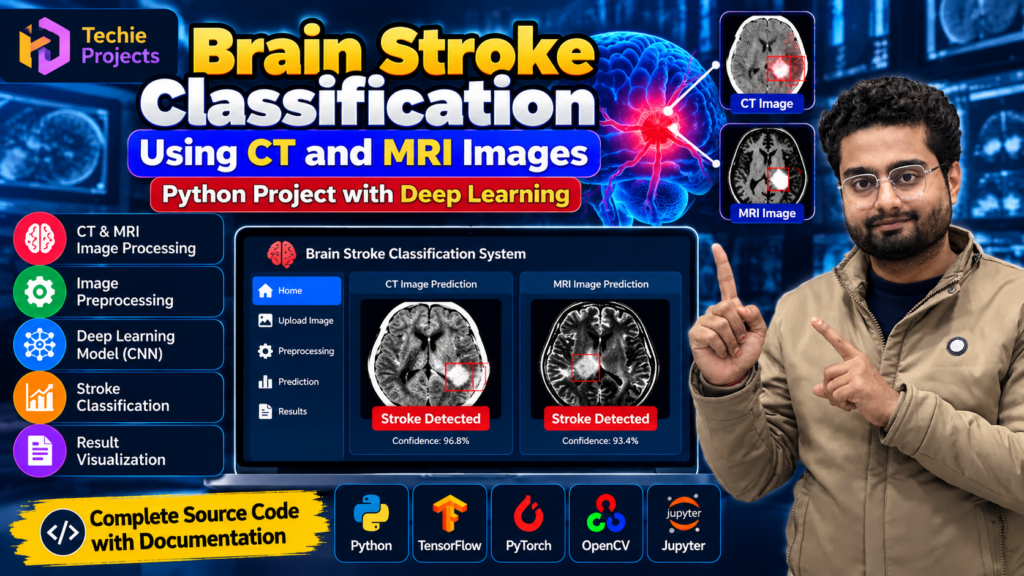
Brain Stroke Classification Using CT and MRI Images is a deep learning project in Python that explores medical image processing and image classification. The project demonstrates how artificial intelligence techniques can be applied to analyze brain scan images and classify them according to the labels available in a research dataset.
This project is suitable for B.Tech Computer Science students, final-year engineering students, and learners interested in Python, deep learning, medical image analysis, and computer vision.
🎬 Project Working Demo
Watch the project demonstration to understand the interface, image-processing workflow, and classification results.
Watch the Brain Stroke Classification Project Demo on YouTube
🎯 Objectives of the Project
The main objectives of the brain stroke classification project are:
- Process CT and MRI brain images for classification.
- Explore image preprocessing techniques.
- Apply deep learning models to medical image datasets.
- Display model predictions through a user-friendly interface.
- Understand the role of artificial intelligence in medical imaging research.
- Evaluate model performance using appropriate classification metrics.
🧠 Key Features of Brain Stroke Classification
1. CT and MRI Image Processing
The project explores the use of brain scan images as input for a classification workflow. Image preprocessing helps prepare the dataset for model training and evaluation.
2. Image Preprocessing
Depending on the dataset, preprocessing may include resizing, normalization, image-quality checks, and preparation of training and testing data.
3. Deep Learning-Based Classification
A convolutional neural network (CNN) or another suitable deep learning architecture can be trained to identify patterns associated with the dataset’s defined classes.
4. Prediction Results
The application can display the predicted class and relevant output information. Prediction confidence should only be shown when the implemented model supports a properly calculated confidence score.
5. User-Friendly Interface
A graphical or web-based interface can allow users to select an image, submit it for analysis, and view the model output.
⚙️ Technologies Used
The exact technology stack depends on the implementation. A typical version of this project may use:
- Python: Main programming language.
- TensorFlow or PyTorch: Deep learning model development.
- OpenCV: Image processing.
- NumPy: Numerical operations.
- Matplotlib: Data visualization.
- Scikit-learn: Model evaluation and classification metrics.
- Tkinter or Streamlit: Optional application interface.
🔄 How Does the Brain Stroke Classification System Work?
Step 1: Collect the Dataset
Obtain an appropriately licensed and labeled CT or MRI image dataset for research and educational purposes. Verify the dataset’s class definitions and image quality.
Step 2: Preprocess the Images
Prepare the images using suitable resizing, normalization, and other preprocessing techniques. Keep training and testing data separated to avoid data leakage.
Step 3: Train the Deep Learning Model
Train the selected model using the training dataset. Choose model parameters and training settings according to the dataset and computing resources.
Step 4: Evaluate Model Performance
Evaluate the model on data that was not used during training. Suitable metrics include accuracy, precision, recall, F1-score, and a confusion matrix. For medical applications, sensitivity and specificity are also important.
Step 5: Display the Results
Integrate the trained model into an application interface so that users can submit an eligible image and review the output.
💻 Software Requirements
- Python 3
- TensorFlow or PyTorch
- OpenCV
- NumPy
- Matplotlib
- Scikit-learn
- Jupyter Notebook or a Python IDE
- A compatible operating system
🖥️ Hardware Requirements
- Laptop or desktop computer
- Minimum 8 GB RAM recommended, depending on dataset size
- Sufficient storage for datasets and trained models
- GPU acceleration where available for larger deep learning workloads
Actual requirements depend on the model architecture, dataset size, and implementation.
🎓 Applications of the Project
Brain stroke classification using CT and MRI images can support learning and research in:
- Medical image classification
- Deep learning and computer vision
- Healthcare AI research
- Image preprocessing and visualization
- Academic demonstrations of machine learning workflows
This project is an educational prototype, not a clinically validated diagnostic system. Its predictions must not be used to diagnose a patient, delay emergency care, or make treatment decisions.
⚠️ Limitations and Challenges
- Model performance depends on dataset quality and representativeness.
- Different scanners and imaging protocols can affect image appearance.
- Imbalanced datasets may produce misleading accuracy scores.
- Data leakage can cause artificially high evaluation results.
- Clinical use requires rigorous external validation, appropriate approvals, and assessment by qualified medical professionals.
🚀 Future Scope
Possible extensions include:
- Comparing multiple deep learning architectures.
- Improving data preprocessing and augmentation.
- Adding model-performance visualizations.
- Evaluating performance across independent datasets.
- Developing a more accessible interface for research demonstrations.
- Exploring explainability methods to better understand model predictions.
❓ Frequently Asked Questions
1. What is brain stroke classification using CT and MRI images?
It is a medical-image analysis task that uses image-processing and machine-learning techniques to classify brain scan images according to predefined dataset labels.
2. Which programming language is used?
Python is commonly used because it supports deep learning, image processing, numerical computing, and data visualization libraries.
3. Is this project suitable for final-year B.Tech students?
Yes. It can be a suitable academic project for students interested in artificial intelligence, machine learning, deep learning, and computer vision, subject to their institution’s project requirements.
4. Can I customize the project?
Customization depends on the implementation. Potential additions include a different dataset, alternative model architectures, improved evaluation reports, and an updated user interface.
5. Does this project provide a medical diagnosis?
No. An academic model is not a substitute for professional medical evaluation or a clinically validated diagnostic tool.
🛒 Get the Brain Stroke Classification Project
Looking for a Brain Stroke Classification Using CT and MRI Images project in Python for your final-year engineering submission?
Techie Projects can help you explore project availability, implementation details, source-code options, and documentation requirements.
Before purchasing, confirm the supported features, dataset requirements, software dependencies, and deliverables for the specific implementation.
📲 Contact Techie Projects
- 📲 Call/WhatsApp: +91-9460060699
- 🌎 Website: www.techieprojects.com
- 📺 Instagram: @pythonprojects_
Share your course, project requirements, and preferred features to discuss a suitable option.
🔗 Recommended Projects
- Breast Cancer Detection Using Thermal Images
- Skin Cancer Detection Using Machine Learning
- Pneumonia Detection Using Chest X-Ray Images
- Dental Caries Detection Using Deep Learning
- Brain Tumor Detection Using Deep Learning
- Heart Disease Prediction Using Machine Learning
Conclusion
The Brain Stroke Classification Using CT and MRI Images project provides an educational way to explore Python programming, medical image processing, and deep learning. By working through dataset preparation, model training, evaluation, and result visualization, students can develop practical experience with AI-based image classification.
For students seeking a final-year project, Techie Projects offers a starting point for exploring implementation options and project requirements. Contact the team to discuss availability, source code, documentation, and customization before purchasing.
Disclaimer: This project is intended for academic and research purposes only. It is not a clinically validated diagnostic system and must not be used for medical decision-making.