
Introduction
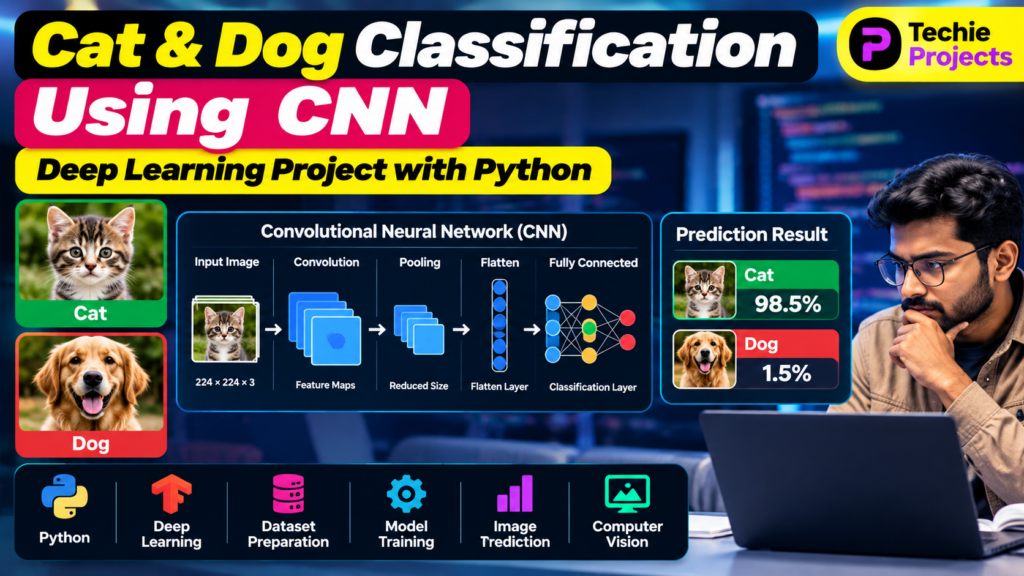
Cat and dog classification using CNN is a popular deep learning project that uses computer vision to identify whether an image contains a cat or a dog. A Convolutional Neural Network (CNN) automatically learns visual features such as shapes, edges, textures, and patterns from images to perform classification.
This project demonstrates how Python and deep learning can be used to build an image classification system. It is suitable for students exploring artificial intelligence, machine learning, computer vision, and final-year engineering projects.
The system can be trained on a dataset of labeled cat and dog images and then used to predict the class of a new image.
🎥 Project Working Demo
Watch the project demonstration to understand how the cat and dog classification system works, including image input, model prediction, and classification results.
What Is Cat and Dog Classification Using CNN?
Cat and dog classification is an image recognition task in which a trained model predicts whether an input image belongs to the cat class or the dog class.
A CNN is well suited to image classification because it learns useful image features automatically rather than requiring every feature to be manually designed.
The main components of a CNN-based image classification model include:
- Convolutional layers: Extract visual features from images.
- Pooling layers: Reduce feature-map dimensions and computational requirements.
- Flatten layer: Converts feature maps into a one-dimensional representation.
- Fully connected layers: Learn patterns useful for classification.
- Output layer: Produces a prediction for the cat or dog class.
🎯 Objectives of the Project
The main objectives of this project are to:
- Build an image classification model using a Convolutional Neural Network.
- Prepare and process cat and dog image datasets.
- Train a deep learning model to recognize visual patterns.
- Evaluate the model using validation or test images.
- Predict whether a new image contains a cat or a dog.
- Understand the practical use of deep learning in computer vision.
Key Features of the Cat and Dog Classification Project
Depending on the implementation, the project can include the following features:
- Classification of cat and dog images.
- Image resizing and preprocessing.
- CNN model training and validation.
- Prediction for new images.
- Display of the predicted class and confidence score.
- Training and validation accuracy visualization.
- A simple graphical interface or web application.
- Model saving and loading for future predictions.
📊 Dataset Used
The model requires a labeled dataset containing images of cats and dogs. Each image should be associated with the correct class so that the model can learn the differences between the two categories.
A dataset can be organized as follows:
dataset/
├── train/
│   ├── cats/
│   └── dogs/
├── validation/
│   ├── cats/
│   └── dogs/
└── test/
    ├── cats/
    └── dogs/
The training set is used to learn model parameters. The validation set helps monitor training performance and tune model settings, while the test set provides an independent evaluation of the trained model.
The dataset should contain varied images, backgrounds, lighting conditions, and animal poses to help the model generalize to new images.
Technologies Used
The project can be implemented using the following technologies:
- Python: Main programming language.
- TensorFlow and Keras: Tools for building and training CNN models.
- NumPy: Numerical operations and array processing.
- Matplotlib: Visualization of training results.
- Pillow or OpenCV: Image loading and preprocessing.
- Jupyter Notebook or VS Code: Development environment.
The exact libraries depend on the selected implementation.
⚙️ How the CNN Model Works
Step 1: Load the Dataset
Load cat and dog images from the dataset directories and assign each image its corresponding class label.
Step 2: Preprocess the Images
Resize images to a consistent input size, convert them into numerical arrays, and normalize pixel values when appropriate.
For example, pixel values in the range 0–255 can be scaled to the range 0–1 by dividing by 255.
Step 3: Build the CNN Architecture
Create a CNN using convolutional, activation, pooling, and dense layers. The architecture should match the size of the training dataset and the required level of performance.
Step 4: Train the Model
Train the network on labeled images. During training, the model updates its parameters to reduce the difference between predicted and actual class labels.
Step 5: Evaluate Model Performance
Use validation and test data to assess the model. Useful evaluation measures include accuracy, precision, recall, and a confusion matrix.
Accuracy alone may not reveal all classification errors, so additional metrics can be helpful.
Step 6: Predict a New Image
Load a previously unseen image, apply the same preprocessing used during training, and pass it to the trained model. The output can then be converted into a cat or dog prediction.
Sample Python Code for Cat and Dog Classification
The following example demonstrates a basic CNN using TensorFlow and Keras. It assumes that the training and validation folders follow the directory structure shown above.
import tensorflow as tf
from tensorflow.keras import layers, models

IMG_SIZE = (150, 150)
BATCH_SIZE = 32

train_ds = tf.keras.utils.image_dataset_from_directory(
    "dataset/train",
    image_size=IMG_SIZE,
    batch_size=BATCH_SIZE,
    label_mode="binary"
)

val_ds = tf.keras.utils.image_dataset_from_directory(
    "dataset/validation",
    image_size=IMG_SIZE,
    batch_size=BATCH_SIZE,
    label_mode="binary"
)

model = models.Sequential([
    layers.Input(shape=(150, 150, 3)),
    layers.Rescaling(1.0 / 255),
    layers.Conv2D(32, (3, 3), activation="relu"),
    layers.MaxPooling2D((2, 2)),
    layers.Conv2D(64, (3, 3), activation="relu"),
    layers.MaxPooling2D((2, 2)),
    layers.Conv2D(128, (3, 3), activation="relu"),
    layers.MaxPooling2D((2, 2)),
    layers.Flatten(),
    layers.Dense(128, activation="relu"),
    layers.Dropout(0.3),
    layers.Dense(1, activation="sigmoid")
])

model.compile(
    optimizer="adam",
    loss="binary_crossentropy",
    metrics=["accuracy"]
)

history = model.fit(
    train_ds,
    validation_data=val_ds,
    epochs=10
)

model.save("cat_dog_classifier.keras")
Important: Check the class order returned by the dataset loader before interpreting the sigmoid output. The code provides a starting point; the number of epochs, architecture, and training settings may need adjustment. Actual accuracy depends on the dataset and training process.
Software Requirements
- Python 3
- TensorFlow
- NumPy
- Matplotlib
- Pillow or OpenCV, if needed
- Jupyter Notebook or VS Code
Install the primary packages with:
pip install tensorflow numpy matplotlib pillowHardware Requirements
- A computer or laptop capable of running Python.
- Sufficient RAM for loading and processing the dataset.
- Storage space for images, model files, and training results.
- A compatible GPU is optional and can accelerate training on supported systems.
Applications of Cat and Dog Image Classification
CNN-based image classification provides a useful introduction to real-world computer vision applications, including:
- Pet image organization: Automatically categorize cat and dog photos.
- Animal image recognition: Classify animal images in digital collections.
- Educational demonstrations: Explain deep learning concepts through a practical example.
- Computer vision research: Explore image preprocessing, model architectures, and evaluation techniques.
- Transfer learning experiments: Compare a custom CNN with pretrained image classification models.
This two-class project can also be extended to recognize more animal categories when an appropriately labeled dataset is available.
Advantages of the Project
- Demonstrates practical CNN implementation.
- Helps students understand image preprocessing and model training.
- Provides a foundation for learning computer vision.
- Can be expanded with new datasets and model architectures.
- Supports experimentation with accuracy and other evaluation metrics.
Limitations
- Performance depends on the quality and diversity of the training data.
- The model may struggle with unusual poses, poor lighting, or unfamiliar backgrounds.
- Training can require significant time and computing resources.
- A model trained only on cats and dogs cannot reliably classify arbitrary animal categories.
- Prediction confidence should not be treated as a guarantee that a result is correct.
Future Scope
The project can be improved through several extensions:
- Use transfer learning with models such as MobileNet or EfficientNet.
- Add a web interface for uploading images.
- Expand the dataset to include other animal categories.
- Apply data augmentation to improve generalization.
- Compare different CNN architectures and training strategies.
- Deploy the trained model in a suitable application.
Frequently Asked Questions
1. What is cat and dog classification using CNN?
It is an image classification project that uses a Convolutional Neural Network to predict whether an image contains a cat or a dog.
2. Which programming language is used?
Python is commonly used with TensorFlow and Keras to build, train, and evaluate the CNN model.
3. Is a GPU required?
No. A compatible GPU is optional, although it can make model training faster. Training time depends on the dataset and hardware.
4. Can this project be used for a final-year engineering submission?
Yes. It can be developed as an educational computer vision project, with suitable documentation, evaluation, testing, and implementation work based on the institution’s requirements.
5. How can the classification accuracy be improved?
Use a diverse dataset, apply appropriate preprocessing and augmentation, tune the model architecture, monitor validation performance, and evaluate the final model on unseen test images.
🔗 Explore Related Python and Deep Learning Projects
Explore these related project topics on Techie Projects:
- Machine Learning Projects Using Python
- Deep Learning Projects Using Python
- Image Processing Projects Using Python
- Object Detection Using OpenCV
Link each topic to its corresponding page on your website.
🎓 Need Help With Your Final-Year Project?
Looking for a Python, Artificial Intelligence, Machine Learning, or Computer Vision project?
Techie Projects can help you discuss project ideas, implementation options, source-code requirements, documentation, and project scope.
- WhatsApp: +91-9460060699
- Website: www.techieprojects.com
- Instagram: @pythonprojects_
Conclusion
Cat and dog classification using CNN is a practical Python deep learning project that demonstrates how neural networks learn image features and classify visual data. By preparing a labeled dataset, building a CNN, training the model, and evaluating its predictions, students can explore fundamental computer vision concepts through hands-on implementation.
The project can be extended with transfer learning, additional animal classes, and a user-friendly prediction interface to explore more advanced deep learning techniques.