
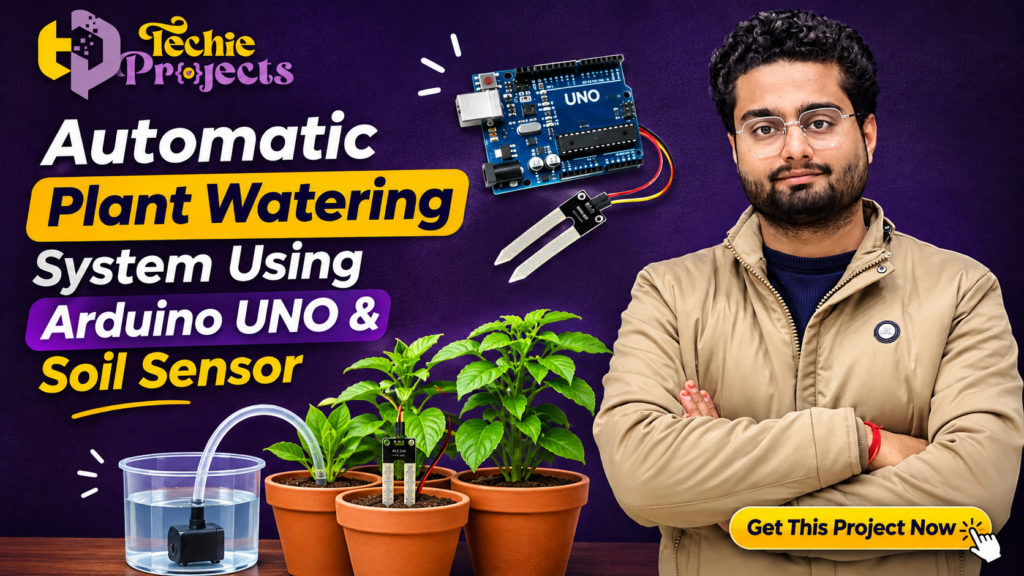
🌱 Looking for an innovative Arduino-based IoT or electronics project for your final-year engineering submission? Purchase the Automatic Plant Watering System Using Arduino UNO and Soil Sensor from Techie Projects!
The Automatic Plant Watering System Using Arduino is designed to demonstrate how smart irrigation technology can simplify plant care. By combining soil moisture monitoring with automatic pump control, this project provides a practical introduction to Arduino-based agricultural automation.
Are you interested in developing a smart agriculture project that automatically waters plants according to soil moisture conditions? The Automatic Plant Watering System Using Arduino UNO and Soil Sensor is a practical electronics and automation project that demonstrates how sensors and microcontrollers can be used to automate plant irrigation.
Traditional plant watering requires regular human attention. Sometimes plants receive too much water, while at other times they remain dry because watering is forgotten. An automatic irrigation system can help address these challenges by monitoring soil moisture and controlling water supply according to predefined conditions.
This project combines Arduino UNO, a soil moisture sensor, a water pump, and electronic components to demonstrate an intelligent plant watering mechanism.
🎓 Whether you are a B.Tech, M.Tech, Diploma, BCA, or MCA student, this project offers an excellent opportunity to explore Arduino programming, embedded systems, sensor integration, and smart agriculture.
Want to purchase this project for your final-year submission? Techie Projects provides practical engineering project solutions across Arduino, IoT, Robotics, Artificial Intelligence, Machine Learning, Python, and Image Processing.
Contact our team today to enquire about project availability, source code, hardware requirements, documentation, pricing, and customization options.
📞 Contact Techie Projects for Project Enquiries
📱 Contact / WhatsApp: +91 94600 60699
🌐 Website: www.techieprojects.com
📸 Instagram: @pythonprojects_
🎬 Watch the Automatic Plant Watering System Using Arduino Project Demo
Want to see how an automatic plant irrigation system works?
Watch the project demonstration to understand how Arduino UNO, soil moisture sensors, and a water pump work together to automate plant watering.
Project Name: Automatic Plant Watering System Using Arduino UNO and Soil Sensor
Technology: Arduino | Embedded Systems | Smart Agriculture
🌱 Introduction to Automatic Plant Watering System Using Arduino
Plants require an appropriate amount of water to grow properly. Water is essential for plant development, nutrient absorption, and maintaining healthy growth.
However, manually watering plants every day can become difficult, especially when managing multiple plants, gardens, or agricultural areas.
Another challenge is determining when plants actually need water. Watering plants without checking soil conditions may lead to unnecessary water consumption or excessive moisture.
Technology provides an opportunity to make plant irrigation more efficient. Sensors can monitor soil conditions, while microcontrollers can process sensor readings and control irrigation equipment.
The Automatic Plant Watering System Using Arduino UNO and Soil Sensor demonstrates how these technologies can be combined to develop an automated irrigation solution.
The system uses a soil moisture sensor to detect moisture conditions in the soil. Arduino UNO processes the sensor readings and controls a water pump according to the programmed threshold.
When the soil becomes sufficiently dry, the controller can activate the pump to supply water. Once the required moisture condition is reached, the pump can be switched off.
This project introduces students to practical applications of electronics, automation, and smart agriculture.
💧 What Is an Automatic Plant Watering System?
An automatic plant watering system is an electronic irrigation solution designed to supply water to plants with minimal manual intervention.
It uses sensors and a control mechanism to determine when watering is required.
A typical automatic plant watering system contains:
- Arduino or another microcontroller.
- Soil moisture sensor.
- Water pump.
- Relay module or suitable motor driver.
- Water storage container.
- Connecting wires.
- Power supply.
- Water delivery pipe.
The system monitors soil moisture and activates the irrigation mechanism when the measured moisture level falls below a predefined threshold.
Unlike traditional manual watering, this approach allows irrigation decisions to be based on sensor measurements.
🎯 Objectives of the Project
The main objective of this project is to develop an automated plant watering mechanism using Arduino UNO and soil moisture sensing technology.
The major objectives include:
- To monitor soil moisture using an electronic sensor.
- To develop an Arduino-based automatic irrigation system.
- To control a water pump according to soil moisture conditions.
- To reduce unnecessary manual watering activities.
- To explore water management through automation.
- To understand sensor interfacing with microcontrollers.
- To demonstrate the practical applications of embedded systems in agriculture.
- To develop a foundation for future smart irrigation applications.
This project helps students understand how electronic sensors and programming can solve practical problems in agriculture and gardening.
⚙️ How Does the Automatic Plant Watering System Work?
The Automatic Plant Watering System Using Arduino follows a simple sensor-based control process.
The complete working procedure can be understood through the following stages.
1. Soil Moisture Detection
The soil moisture sensor is inserted into the soil near the plant roots.
It measures the moisture condition of the soil and generates an electrical signal.
Depending on the sensor type, the output may be analog or digital.
2. Data Transmission to Arduino UNO
The sensor is connected to the Arduino UNO board.
Arduino receives the sensor readings through its input pins and processes the information according to the programmed instructions.
3. Moisture Level Comparison
The controller compares the measured moisture value with a predefined threshold.
For example, if the measured moisture level indicates that the soil is too dry, the controller initiates the watering operation.
The threshold should be calibrated according to the sensor, soil type, and plant requirements.
4. Water Pump Activation
When the soil moisture condition falls below the configured threshold, Arduino activates the connected relay module or suitable motor driver.
The switching circuit controls the water pump.
The pump starts supplying water to the plant through the connected pipe.
5. Automatic Irrigation
Water is delivered to the soil through the irrigation arrangement.
The water supply helps increase the moisture level around the plant roots.
6. Continuous Moisture Monitoring
The soil moisture sensor continues monitoring the soil condition.
Arduino repeatedly checks the readings and determines whether additional watering is necessary.
7. Water Pump Deactivation
When the moisture level reaches the desired condition, Arduino switches off the water pump.
This completes the automatic watering cycle.
The process repeats whenever the soil becomes sufficiently dry again. An important feature of the Automatic Plant Watering System Using Arduino is its ability to monitor soil conditions continuously and activate irrigation when the moisture level falls below the configured threshold.
🔩 Hardware Components Required
The project combines electronic components and basic irrigation equipment.
1. Arduino UNO
Arduino UNO is the main microcontroller board used in the project.
It receives sensor readings, processes the information, and controls the water pump through the connected switching circuit.
2. Soil Moisture Sensor
The soil moisture sensor is responsible for detecting the moisture condition of the soil.
It provides readings that help Arduino determine whether the plant requires watering.
3. Water Pump
The water pump supplies water to the plant when the controller activates the irrigation mechanism.
A suitable pump should be selected according to the required water flow and operating voltage.
4. Relay Module
A relay module acts as an electrically controlled switch.
It allows the low-voltage Arduino controller to operate a suitably rated water pump circuit.
The relay rating and electrical connections must match the pump requirements.
5. Water Pipe
The water pipe transports water from the storage container to the plant.
It helps deliver water to the required location.
6. Water Container
A container stores the water used by the irrigation system.
Its capacity depends on the number of plants and watering requirements.
7. Connecting Wires
Connecting wires are used to establish electrical connections between Arduino, the sensor, and the switching circuit.
8. Power Supply
The power supply provides electrical power to the controller and pump.
The pump should use an appropriately rated supply rather than being powered directly from an Arduino output pin.
💻 Software Requirements
The following software technologies can be used to develop the project.
Arduino IDE
Arduino IDE is used to write, compile, and upload the program to the Arduino UNO board.
Embedded C/C++
Arduino programming uses C/C++-based syntax to implement the sensor monitoring and pump control logic.
Arduino Libraries
Additional libraries may be required if the implementation includes display modules, wireless communication, or other supported components.
Serial Monitor
The Arduino Serial Monitor helps display sensor readings and debug the irrigation control program.
🖥️ Basic Working Logic
The following pseudocode explains the basic operation of the automatic irrigation system.
- Start the Arduino controller.
- Initialize the soil moisture sensor.
- Configure the water pump control pin.
- Read the soil moisture value.
- Compare the reading with the predefined threshold.
- If the soil is dry, activate the water pump.
- If the soil has sufficient moisture, deactivate the pump.
- Repeat the monitoring process.
This simple control logic demonstrates how sensor-based automation works.
⭐ Key Features of the Project
The Automatic Plant Watering System Using Arduino offers several useful features for understanding embedded systems and agricultural automation.
- Automatic soil moisture monitoring.
- Arduino UNO-based control.
- Sensor-based irrigation operation.
- Automatic water pump activation.
- Automatic pump deactivation.
- Reduced manual watering requirements.
- Real-time soil moisture monitoring.
- Simple embedded system implementation.
- Practical smart agriculture application.
These features make the project suitable for students interested in electronics, Arduino, and smart irrigation technology.
🌾 Applications of Automatic Plant Watering Systems
The Automatic Plant Watering System Using Arduino can be explored for home gardening, greenhouse automation, nursery management, and educational smart agriculture demonstrations. Automatic irrigation technology can be explored in several environments.
1. Home Gardening
The system can help automate watering for indoor and outdoor plants.
It is useful for people who maintain multiple plants and want to reduce repetitive manual watering.
2. Agricultural Fields
Sensor-based irrigation systems can be explored in agricultural environments to monitor soil conditions and control water supply.
Larger agricultural installations may require multiple sensors, suitable pumps, and advanced control systems.
3. Greenhouse Automation
Greenhouses require controlled environmental conditions for plant growth.
Automatic irrigation systems can help monitor soil moisture and manage watering operations.
4. Nursery Management
Plant nurseries often contain many plants that require regular watering.
Automation can help manage irrigation in suitable nursery environments.
5. Smart Gardens
Smart gardening systems combine sensors, microcontrollers, and automation to simplify plant maintenance.
6. Educational Laboratories
Engineering institutions can use this project to demonstrate sensor interfacing, Arduino programming, and embedded system applications.
7. Vertical Farming
Automatic watering technology can be explored in vertical farming installations where irrigation needs to be managed across multiple plant levels.
📈 Advantages of the Automatic Plant Watering System
Students developing the Automatic Plant Watering System Using Arduino can gain practical experience with sensor interfacing, embedded programming, relay control, and automated irrigation.
1. Reduces Manual Effort
The system automatically controls the watering mechanism according to soil moisture readings.
This reduces the need for continuous manual monitoring.
2. Supports Efficient Water Management
Water is supplied according to measured soil conditions rather than relying only on a fixed watering schedule.
Proper calibration can help reduce unnecessary watering.
3. Easy to Understand
The project uses a simple combination of sensors, Arduino programming, and pump control.
It is suitable for students who are learning embedded systems.
4. Practical Agricultural Application
The project demonstrates how electronics can be applied to real-world agricultural challenges.
5. Expandable Design
Additional sensors and communication modules can be integrated to create a more advanced irrigation system.
6. Low-Cost Prototype Development
Arduino-based irrigation prototypes can be developed using commonly available electronic components, depending on the required features.
🔬 Future Scope of the Project
The project can be enhanced with advanced technologies to develop an intelligent irrigation solution.
1. IoT-Based Smart Irrigation
Internet of Things technology can be integrated to monitor soil moisture remotely.
Users can access sensor readings through a connected dashboard.
2. Mobile Application Integration
A mobile application can be developed to display soil moisture readings and allow users to monitor irrigation activities.
3. Weather-Based Irrigation
Weather information can be incorporated into irrigation decisions.
For example, the system can consider expected rainfall before activating watering operations.
4. Multiple Soil Moisture Sensors
Additional sensors can be installed to monitor different plant locations.
This can help manage irrigation across larger gardening areas.
5. Solar-Powered Irrigation
Solar panels can be explored as an alternative energy source for suitable irrigation installations.
6. AI-Based Water Management
Machine learning can be explored to estimate irrigation requirements using historical soil moisture, weather, and environmental information.
7. LCD Display Integration
An LCD module can be added to display sensor readings and pump status.
8. Cloud-Based Monitoring
Cloud platforms can be used to store sensor information and analyze irrigation patterns over time.
These enhancements can help transform a basic Arduino prototype into an advanced smart agriculture system.
🎓 Why Choose This Project for Your Final-Year Engineering Submission?
Choosing a suitable final-year project is an important step in engineering education.
Students need projects that demonstrate practical implementation, technical understanding, and real-world applications.
The Automatic Plant Watering System Using Arduino UNO and Soil Sensor combines electronics, embedded programming, sensor technology, and agricultural automation.
It is suitable for students from:
- Electrical Engineering.
- Electronics and Communication Engineering.
- Computer Science Engineering.
- Information Technology.
- Instrumentation Engineering.
- Robotics and Automation.
- Internet of Things.
Students can explore Arduino programming, sensor interfacing, relay control, and automated irrigation.
The project can also be extended with IoT and intelligent monitoring features to increase its technical complexity.
🛒 Purchase Automatic Plant Watering System Using Arduino from Techie Projects
Looking to purchase the Automatic Plant Watering System Using Arduino for your final-year project? Contact Techie Projects to enquire about source code, hardware requirements, documentation, and project availability.
Get the Automatic Plant Watering System Using Arduino UNO and Soil Sensor from Techie Projects!
Techie Projects provides engineering project solutions for students who want to explore practical implementations in different technology domains.
Whether you are interested in Arduino programming, IoT development, robotics, machine learning, or artificial intelligence, our team can help you explore suitable project options.
What Can You Enquire About?
Contact our team to discuss the availability of:
- Arduino project source code.
- Hardware component requirements.
- Circuit connections.
- Project demonstration video.
- Project documentation.
- Installation and execution guidance.
- Project customization.
- Technical support options.
The exact deliverables, hardware availability, pricing, and support arrangements can be confirmed before purchasing.
Why Choose Techie Projects?
1. Multiple Project Domains
Explore engineering projects across Arduino, Python, Robotics, IoT, Artificial Intelligence, Machine Learning, and Image Processing.
2. Practical Project Solutions
Find projects that demonstrate the application of technology to real-world problems.
3. Project Demonstrations
Review available project demonstrations to understand the working concept before purchasing.
4. Academic Project Options
Explore projects suitable for B.Tech, M.Tech, Diploma, MCA, BCA, and other technical courses.
5. Direct Project Enquiry Support
Discuss your academic requirements, project availability, and customization options with our team.
🚀 Get This Project Now!
Don’t wait until your final-year submission deadline approaches.
Contact Techie Projects today to enquire about the Automatic Plant Watering System Using Arduino UNO and Soil Sensor.
📱 Contact / WhatsApp: +91 94600 60699
🌐 Website: www.techieprojects.com
📸 Instagram: @pythonprojects_
Techie Projects – Engineering Projects for Students and Future Innovators!
💡 Recommended Projects from Techie Projects
Interested in exploring more Arduino, IoT, and smart agriculture projects?
Check out these related project ideas:
- Smart Agriculture Monitoring System Using IoT – Monitor agricultural conditions through connected sensors.
- Automatic Fruit Picking Robot Using Arduino – Explore robotic fruit harvesting and agricultural automation.
- Smart Irrigation System Using Arduino – Develop an automated irrigation system using sensor-based control.
- Weather Monitoring System Using Arduino – Measure environmental parameters using electronic sensors.
- IoT-Based Plant Monitoring System – Monitor plant conditions through an internet-connected platform.
- Greenhouse Monitoring and Automation System – Monitor and control greenhouse environmental conditions.
- Soil Moisture Monitoring System Using Arduino – Measure soil moisture through a microcontroller-based system.
Explore more engineering projects at www.techieprojects.com.
❓ Frequently Asked Questions (FAQs)
1. What is an Automatic Plant Watering System Using Arduino?
It is an automated irrigation project that uses a soil moisture sensor and Arduino UNO to control a water pump according to soil moisture conditions.
2. Which microcontroller is used in this project?
Arduino UNO is used as the main microcontroller.
3. Which sensor is used for detecting soil moisture?
A soil moisture sensor is used to measure the moisture condition of the soil.
4. Which programming language is used?
Embedded C/C++ is generally used for Arduino programming through Arduino IDE.
5. Is this project suitable for B.Tech students?
Yes. It is suitable for students interested in Electrical Engineering, Electronics, Computer Science, IoT, and Embedded Systems.
6. Can I purchase this project from Techie Projects?
Yes. Contact Techie Projects to enquire about project availability, pricing, source code, documentation, and implementation details.
7. Can IoT functionality be added to this project?
Yes. IoT modules can be integrated to monitor soil moisture and irrigation status remotely.
8. Does the system automatically switch off the water pump?
Yes. The controller can deactivate the pump when the soil moisture reaches the configured threshold.
9. What are the applications of automatic plant watering systems?
They can be explored in home gardening, agricultural fields, greenhouses, nurseries, smart gardens, and vertical farming.
10. Can this project be powered using solar energy?
Yes. A suitable solar power arrangement can be explored as a future enhancement, provided that the power requirements of the Arduino and pump are properly considered.
🏁 Conclusion
The Automatic Plant Watering System Using Arduino UNO and Soil Sensor is a practical electronics and smart agriculture project that demonstrates how sensors and microcontrollers can automate irrigation activities.
By combining soil moisture monitoring, Arduino programming, and water pump control, the project provides a simple way to understand sensor-based automation.
It is suitable for engineering students interested in Arduino, embedded systems, IoT, electronics, and agricultural technology.
The project also offers opportunities for future improvements through wireless communication, mobile applications, cloud monitoring, solar energy, and intelligent irrigation algorithms.
🎓 Ready to build your final-year engineering project?
Get in touch with Techie Projects to enquire about purchasing the Automatic Plant Watering System Using Arduino UNO and Soil Sensor.
🚀 Learn Technology. Build Innovation. Grow with Techie Projects!
📱 Contact / WhatsApp: +91 94600 60699