
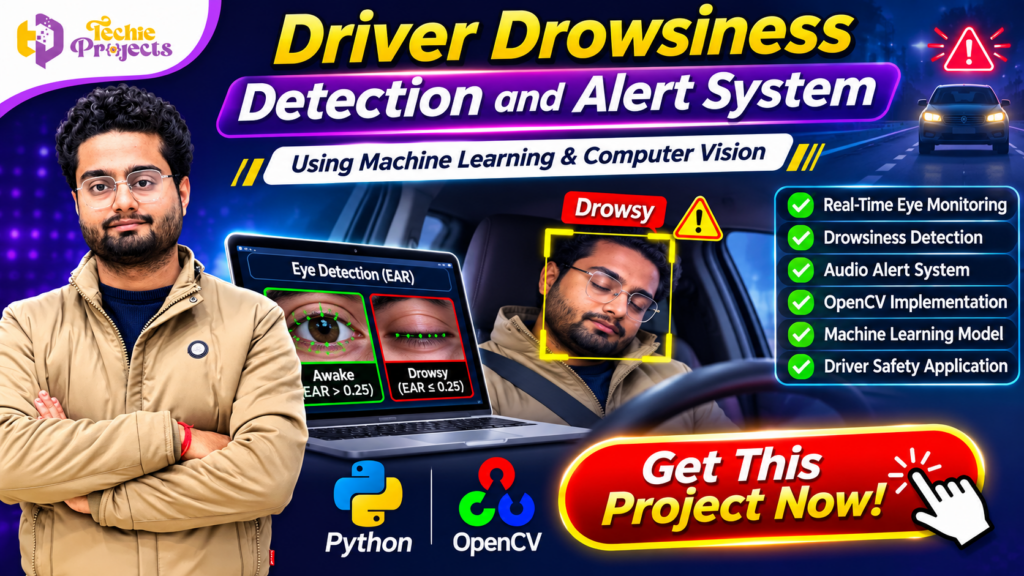
Are you looking for a practical Driver Drowsiness Detection and Alert System project for your final-year engineering project, college submission, or machine learning portfolio? Get a ready-to-explore project package from Techie Projects and understand how Python, OpenCV, and computer vision can be used to detect driver fatigue and generate alerts.
This project demonstrates an intelligent driver-monitoring approach that analyses facial and eye movements to identify signs of drowsiness. It is an excellent choice for students pursuing Computer Science, Information Technology, Artificial Intelligence, Machine Learning, and related engineering disciplines.
🎯 Get this Driver Drowsiness Detection project from Techie Projects to explore its implementation, understand the working process, study the source code, and prepare for your project demonstration. Contact us today for project availability, package details, and pricing.
📞 Contact Techie Projects for Project Enquiries
Interested in purchasing the Driver Drowsiness Detection and Alert System project? Contact Techie Projects for details.
- 📱 WhatsApp: https://wa.me/919460060699
- ☎️ Contact Number: +91 94600 60699
- 🌐 Website: www.techieprojects.com
- 📸 Instagram: @pythonprojects_/
🎬 Driver Drowsiness Detection and Alert System – Project Demo
The Driver Drowsiness Detection and Alert System demonstrates how computer vision can monitor a driver’s eyes and identify potential signs of fatigue. The project uses a camera-based monitoring approach to analyse facial features and eye conditions. When the system detects a drowsiness condition based on its configured detection logic, it can trigger an alert to notify the driver.
The demonstration highlights the main project workflow, including face detection, eye monitoring, drowsiness identification, and alert generation.
📌 1. Introduction to Driver Drowsiness Detection
Driver fatigue is an important road-safety concern. Long journeys, insufficient sleep, continuous driving, and demanding road conditions can reduce a driver’s alertness. Drowsiness may affect concentration, reaction time, and the ability to respond to unexpected situations.
A Driver Drowsiness Detection and Alert System is a computer vision-based project designed to identify visual signs associated with driver fatigue. It uses a camera to capture facial information and analyse eye-related features. Based on the detection results, the system can generate an alert when it identifies a possible drowsy condition.
This project combines Python programming, OpenCV, image processing, and machine learning concepts to demonstrate an intelligent monitoring application.
For engineering students, it provides an opportunity to understand how software technologies can be applied to a real-world safety problem.
🎯 2. Project Objectives
The main objective of the Driver Drowsiness Detection and Alert System is to demonstrate an automated method of identifying possible driver drowsiness through visual monitoring.
The important objectives include:
- Detecting a driver’s face using a camera.
- Identifying and monitoring eye regions.
- Analysing eye conditions during continuous monitoring.
- Recognising possible signs of drowsiness using configured detection logic.
- Generating an audio alert when a drowsiness condition is detected.
- Demonstrating real-time image processing using Python and OpenCV.
- Understanding the role of machine learning and computer vision in driver-safety applications.
The project is also useful for learning how a real-time computer vision application processes camera frames and produces meaningful outputs.
⚙️ 3. 🚗 Driver Drowsiness Detection and Alert System – Working Process
The system follows a sequence of image-processing and detection steps. A camera captures the driver’s face, and the application processes the incoming frames to identify facial and eye-related features.
The general working process includes the following stages:
Step 1: Camera Initialization
The system starts by accessing a connected camera or webcam. The camera continuously captures video frames for analysis.
Step 2: Face Detection
The captured frame is processed to identify the driver’s face. Face detection helps the system locate the region that contains the facial features required for further analysis.
Step 3: Eye Detection
After identifying the face, the system analyses the eye regions. Eye-related information is important because changes in eye openness and blinking patterns may indicate fatigue.
Step 4: Eye Aspect Ratio Analysis
One commonly used computer vision technique for eye monitoring is the Eye Aspect Ratio (EAR). It measures the relationship between vertical and horizontal distances between selected eye landmarks.
The EAR value can help identify whether an eye appears open or closed. A configured threshold can be used to classify eye conditions.
Step 5: Drowsiness Detection
The application analyses eye conditions over multiple frames. If the detected condition meets the configured drowsiness criteria, the system identifies a possible drowsiness event.
Step 6: Audio Alert Generation
When the system detects a possible drowsiness condition, it can generate an audio warning to notify the driver.
This workflow demonstrates how image processing and computer vision can be combined to build a real-time driver-monitoring application.
🧠 4. Technologies Used in the Project
The Driver Drowsiness Detection and Alert System uses programming and computer vision technologies.
Python
Python is the primary programming language used to develop the project. It offers a simple programming structure and supports many libraries for image processing, automation, and machine learning.
OpenCV
OpenCV is a computer vision library used for image and video processing. It provides functionality for capturing camera frames, processing images, detecting visual features, and displaying results.
Machine Learning
Machine learning concepts help students understand intelligent detection systems and how data-driven approaches can be applied to visual monitoring applications.
Computer Vision
Computer vision enables computers to process and interpret visual information. In this project, it is used to analyse camera frames and monitor facial and eye-related features.
Eye Aspect Ratio (EAR)
EAR is a mathematical measurement used in eye-state analysis. It can help distinguish between open and closed eye conditions when suitable facial landmarks are available.
⭐ 5. Key Features of the Driver Drowsiness Detection Project
The project demonstrates several important features related to driver monitoring.
1. Real-Time Eye Monitoring
The application processes camera frames to monitor the driver’s eye region. This provides a practical demonstration of real-time image processing.
2. Drowsiness Detection
The system uses configured detection logic to identify possible signs of drowsiness based on eye-related information.
3. Audio Alert System
An audio warning can be generated when the system identifies a possible drowsiness condition. This demonstrates how software detection results can trigger an alert.
4. OpenCV Implementation
OpenCV supports camera access and image processing operations required by the application.
5. Python-Based Development
Python makes the project suitable for students who want to understand computer vision and machine learning implementation.
6. Driver Safety Application
The project demonstrates a technology concept that can be explored for driver-monitoring and road-safety research.
📊 6. System Architecture
The general architecture of the Driver Drowsiness Detection and Alert System can be divided into different modules.
Input Module: The camera captures the driver’s face and provides video frames to the application.
Image Processing Module: The system processes the captured frames using OpenCV and prepares the visual information for detection.
Face and Eye Detection Module: Facial and eye regions are identified for further analysis.
Drowsiness Analysis Module: Eye-related measurements and configured detection conditions are analysed to identify possible drowsiness.
Alert Module: When the detection conditions are satisfied, the application generates an audio alert.
These modules work together to demonstrate a computer vision-based monitoring system.
💻 7. Software and Hardware Requirements
The following are general development requirements for a Python-based implementation. Exact requirements may vary depending on the project package and library versions.
Software Requirements
- Programming Language: Python
- Computer Vision Library: OpenCV
- Development Environment: Python IDE or Visual Studio Code
- Operating System: Windows 10/11 or a compatible system
- Additional Libraries: As specified in the project source code
Hardware Requirements
- Processor: Intel or AMD processor
- RAM: 4 GB or higher recommended
- Storage: Sufficient space for Python, libraries, and project files
- Input Device: Webcam or compatible camera
- Output Device: Speaker or audio output for alerts
A compatible camera and properly configured software environment are important for testing the application.
🎓 8. Why Choose This Project for Your Final-Year Engineering Project?
The Driver Drowsiness Detection and Alert System is a useful choice for students who want to work on a practical application of artificial intelligence and computer vision.
Practical Implementation
Unlike a purely theoretical topic, this project demonstrates how camera input, image processing, and detection logic can be combined in a working application.
Computer Vision Learning
Students can explore face detection, eye monitoring, video processing, and visual feature analysis.
Python Programming Experience
The project provides an opportunity to understand Python-based application development and the use of external libraries.
Real-World Problem Application
Driver fatigue is a relevant safety concern, making this project suitable for discussions about intelligent transportation and road-safety technologies.
Project Demonstration
The visual output and alert mechanism can help students explain the project workflow during a college presentation or viva.
📚 9. Applications of Driver Drowsiness Detection
The concepts demonstrated in this project can be explored in several areas.
- Driver Monitoring: Monitoring driver alertness in vehicle environments.
- Transportation Research: Studying computer vision techniques for transportation safety.
- Fleet Management Research: Exploring driver-monitoring concepts for commercial vehicle operations.
- Automotive Technology: Understanding intelligent monitoring features used in modern vehicle systems.
- Academic Research: Studying eye-state detection, facial landmarks, and fatigue-related visual patterns.
- Artificial Intelligence Learning: Exploring real-time computer vision applications using Python.
The project is an academic demonstration and should not be treated as a certified automotive safety device. Real-world deployment requires extensive validation under different lighting, camera, driver, and road conditions.
🔍 10. Advantages of the Project
The Driver Drowsiness Detection and Alert System offers several learning benefits:
- Demonstrates real-time image processing.
- Introduces students to computer vision.
- Explains eye-state analysis using visual features.
- Demonstrates audio alert generation.
- Provides practical Python programming experience.
- Connects machine learning concepts with a real-world problem.
- Can be extended for further academic experimentation.
- Supports project presentation and technical discussion.
🚘 11. Why Choose a Driver Drowsiness Detection and Alert System Project?
The Driver Drowsiness Detection and Alert System is a practical project for students interested in artificial intelligence, Python programming, and computer vision. It demonstrates how a camera can capture facial information and how image-processing techniques can analyse eye movements.
With this Driver Drowsiness Detection and Alert System, students can understand the complete workflow, from camera initialization and face detection to eye monitoring and alert generation.
The project also introduces important concepts such as OpenCV, facial landmarks, Eye Aspect Ratio (EAR), and real-time video processing. These concepts are useful for students who want to develop their technical knowledge through practical implementation.
🎓 12. Learning Outcomes of the Driver Drowsiness Detection and Alert System
Working with the Driver Drowsiness Detection and Alert System provides valuable learning opportunities:
- Understand how Python applications capture and process video.
- Learn face and eye detection using computer vision.
- Explore how Eye Aspect Ratio helps analyse eye conditions.
- Understand how a detection threshold can identify possible drowsiness.
- Implement an audio alert based on detection results.
- Explore real-time applications of machine learning and image processing.
The Driver Drowsiness Detection and Alert System can also help students prepare for technical presentations by explaining the project’s architecture, modules, algorithms, and output.
If you want to explore this project for your academic work, contact Techie Projects to enquire about the available source code, documentation, and package details.
🚀 13. Future Scope of Driver Drowsiness Detection
The project can be extended with additional features to explore more advanced driver-monitoring concepts.
Advanced Facial Landmark Detection
More advanced facial landmark techniques can be explored to improve the identification of eye and facial regions.
Yawning Detection
The system can be extended to analyse mouth movements and identify possible yawning events as another fatigue-related indicator.
Head Pose Estimation
Head position and movement can be analysed to explore additional indicators of driver attention.
Mobile Application Integration
A mobile application interface could be developed to display monitoring information and alerts.
Improved Detection Models
Students can experiment with different computer vision and machine learning approaches to evaluate detection performance.
Night-Time Monitoring Research
Further experiments can investigate how camera quality, infrared imaging, and low-light conditions affect detection.
These extensions provide opportunities for students to develop an advanced version of the project.
🛒 14. Get the Driver Drowsiness Detection Project from Techie Projects
Are you ready to explore a practical Python and machine learning project?
Techie Projects provides engineering project resources for students who want to understand software development, artificial intelligence, machine learning, and computer vision applications.
You can enquire about the Driver Drowsiness Detection and Alert System project package and confirm the available deliverables before purchasing.
What to Confirm Before Purchase
Contact our team to confirm the package details, which may include:
- Python project source code.
- Required libraries and setup instructions.
- Project execution guidance.
- Project documentation, if included.
- Demonstration and technical explanation, if available.
- Any additional support included in the selected package.
The exact inclusions, compatibility, and support depend on the package confirmed at the time of purchase.
Why Contact Techie Projects?
- 🎓 Engineering and final-year project resources.
- 💻 Python, AI, machine learning, and computer vision projects.
- 📂 Project information and package enquiries.
- 📱 Direct communication through WhatsApp.
- 🌐 Online access to project categories and resources.
Don’t wait until the last minute to explore your project requirements. Contact Techie Projects today and enquire about getting the Driver Drowsiness Detection and Alert System project.
📲 WhatsApp Now: +91-9460060699
🌐 Visit: www.techieprojects.com
❓ 15. Frequently Asked Questions (FAQs)
Q1. What is a Driver Drowsiness Detection and Alert System?
It is a computer vision-based application designed to analyse visual indicators, such as eye conditions, to identify possible signs of driver drowsiness and generate an alert.
Q2. Which programming language is used in this project?
Python is used as the primary programming language. OpenCV and other compatible libraries can support image processing and detection functionality.
Q3. What is the role of OpenCV in this project?
OpenCV is used for camera access, video capture, image processing, and other computer vision operations.
Q4. What is Eye Aspect Ratio (EAR)?
Eye Aspect Ratio is a measurement based on facial landmark distances. It can be used to estimate whether an eye is open or closed.
Q5. Does the project generate an alert?
The described implementation includes an audio alert feature that can be triggered when the configured drowsiness detection condition is met.
Q6. Is this project suitable for final-year engineering students?
Yes. It is a relevant academic project for students interested in Python, artificial intelligence, machine learning, image processing, and computer vision.
Q7. Does the project require a webcam?
A compatible webcam or camera is generally required for the real-time monitoring implementation.
Q8. Can the project be extended?
Yes. Students can explore additional features such as yawning detection, head pose estimation, improved facial landmark detection, and mobile application integration.
Q9. Can I purchase this project from Techie Projects?
You can contact Techie Projects through WhatsApp or the official website to enquire about availability, pricing, package inclusions, and technical details.
Q10. Is this project a certified vehicle safety system?
No. It is an academic project demonstration. It should not replace certified driver-monitoring or vehicle safety equipment.
🔗 16. Explore Related Projects
Explore more engineering and technology projects from Techie Projects:
- Artificial Intelligence Projects
- Machine Learning Projects
- Python Projects
- Computer Vision Projects
- Image Processing Projects
- Deep Learning Projects
- Data Science Projects
- IoT Projects
- Final-Year Engineering Projects
Visit www.techieprojects.com to explore available project categories.
🏁 17. Conclusion
The Driver Drowsiness Detection and Alert System is an interesting application of Python, OpenCV, machine learning concepts, and computer vision. It demonstrates how camera-based monitoring can be used to analyse eye conditions and generate alerts when possible signs of drowsiness are detected.
For engineering students, the project provides practical exposure to image processing, facial analysis, real-time video capture, and intelligent application development. It can also serve as a starting point for exploring advanced driver-monitoring research.
If you are searching for a Driver Drowsiness Detection and Alert System project with Python, contact Techie Projects to enquire about the available project package, source code, documentation, and support.
📞 Get Your Project Now!
- 📲 Call/WhatsApp: +91-9460060699
- 🌎 Website: www.techieprojects.com
- 📺 Instagram: @pythonprojects_