
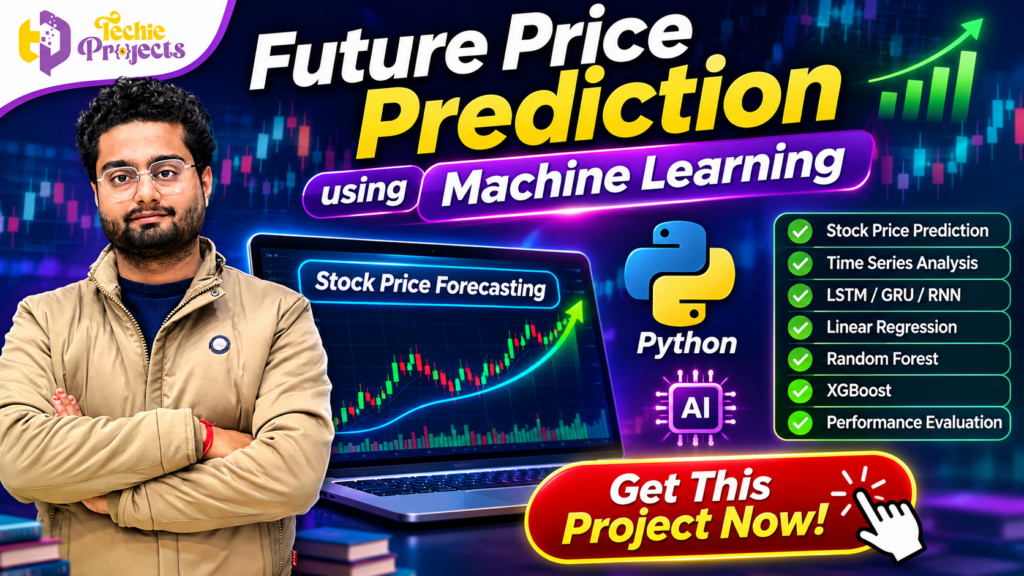
Are you looking for a ready-to-implement Future Price Prediction Using Machine Learning project with Python source code, practical implementation, and technical guidance? Get a complete machine learning project package from Techie Projects and explore how artificial intelligence can analyze historical market data, identify patterns, and forecast future price trends.
Whether you are an engineering student, computer science student, postgraduate learner, or Python enthusiast, this project provides an opportunity to understand machine learning algorithms, time-series analysis, stock market forecasting, and deep learning techniques through practical implementation.
Get your Future Price Prediction Using Machine Learning project today! Contact Techie Projects to enquire about source code, project documentation, implementation details, and technical support.
📞 Contact Techie Projects for Project Enquiries
Looking for a practical machine learning project? Connect with our team for project details and package availability.
- 📲 Call/WhatsApp: +91-9460060699
- 🌎 Website: www.techieprojects.com
- 📺 Instagram: @pythonprojects_
🎬 Future Price Prediction Using Machine Learning – Project Demo
📊 Introduction to Future Price Prediction Using Machine Learning
The financial market generates large amounts of historical data every day. Stock prices, trading volumes, opening prices, closing prices, and market trends can be analyzed to understand historical behaviour and build forecasting models.
Future Price Prediction Using Machine Learning is a Python-based project that applies machine learning and deep learning techniques to historical price datasets. The system processes available data, identifies patterns, trains prediction models, and produces estimated future values.
Traditional analysis often depends on manual calculations and predefined statistical methods. Machine learning provides another approach by learning relationships from historical datasets. Different algorithms can be evaluated to understand which approach performs better for a particular dataset.
This project is suitable for students interested in:
- Artificial Intelligence and Machine Learning
- Python programming
- Stock market data analysis
- Time-series forecasting
- Deep learning
- Predictive analytics
- Data science and visualization
The project is designed as an educational and technical demonstration. Its predictions are estimates, not guaranteed future market prices or financial advice.
🚀 Project Overview
The main objective of this project is to develop a forecasting system that uses historical price information to estimate future price movements.
The system follows a structured machine learning workflow:
- Collect historical price data.
- Load and inspect the dataset.
- Clean missing or inconsistent values.
- Perform exploratory data analysis.
- Select relevant input features.
- Prepare training and testing datasets.
- Train machine learning models.
- Generate predictions.
- Evaluate model performance.
- Display results through charts and visualizations.
The project can be adapted to different price-prediction applications depending on the dataset and available features.
🎯 Key Features of the Project
The Future Price Prediction Using Machine Learning project can include the following features, depending on the selected implementation.
1. Historical Data Analysis
The system analyzes historical price information to understand market behaviour. Data such as opening price, closing price, high, low, and trading volume can be used where available.
2. Data Preprocessing
Raw datasets may contain missing values, duplicate records, inconsistent formats, or unsuitable data types. Preprocessing prepares the information for model training.
3. Machine Learning Model Training
Different algorithms can be trained using historical data. Their performance can then be compared using suitable evaluation metrics.
4. Future Price Forecasting
After training, the selected model generates estimated price values based on the input data and forecasting methodology.
5. Graphical Visualization
Charts help users understand historical price movement, actual values, predicted values, and differences between model outputs.
6. Model Performance Evaluation
Evaluation metrics help determine how closely model predictions match actual observations in the test dataset.
7. Python-Based Implementation
Python provides libraries for data processing, numerical computation, machine learning, deep learning, and visualization.
🤖 Algorithms Used in Future Price Prediction Using Machine Learning
The project can use multiple algorithms to compare forecasting performance. The appropriate choice depends on dataset size, feature selection, time-series structure, and prediction requirements.
1. Linear Regression
Linear Regression is a supervised machine learning algorithm that estimates the relationship between input variables and a numerical target.
It can be used as a baseline model for price prediction. Its simplicity makes it useful for understanding how input features influence estimated values.
2. Random Forest Regression
Random Forest is an ensemble learning algorithm that combines multiple decision trees to generate predictions.
It can model nonlinear relationships and is useful when the dataset contains several input features. Proper validation is required to prevent overfitting.
3. XGBoost
XGBoost is a gradient boosting framework that builds decision trees sequentially to improve predictive performance.
It is commonly used for structured datasets and can be evaluated against other regression models.
4. LSTM – Long Short-Term Memory
LSTM is a type of recurrent neural network designed to learn patterns in sequential data.
It is particularly relevant to time-series forecasting because previous observations can provide useful context for later observations.
5. GRU – Gated Recurrent Unit
GRU is another recurrent neural network architecture. It uses gating mechanisms to learn sequential patterns and can be compared with LSTM for forecasting tasks.
6. Recurrent Neural Network
RNN models process sequential information and can be used for time-series applications. Basic RNN architectures may struggle with long-term dependencies, which is why LSTM and GRU are also commonly explored.
7. Support Vector Regression
Support Vector Regression applies support vector machine principles to regression problems. It can be considered as an additional model for comparing prediction results.
🧠 How Does the Prediction System Work?
The Future Price Prediction Using Machine Learning system follows a sequence of data-processing and prediction operations.
Step 1: Dataset Collection
Historical price information is collected from a suitable dataset. The dataset may contain date, opening price, closing price, high price, low price, and volume.
Step 2: Data Loading
Python libraries such as Pandas are used to load and inspect the dataset.
Step 3: Data Cleaning
Missing values, duplicate entries, incorrect formats, and inconsistent records are checked and handled.
Step 4: Exploratory Data Analysis
The dataset is analyzed using statistical summaries and visualizations. This helps identify trends, fluctuations, and relationships between variables.
Step 5: Feature Selection
Relevant input variables are selected according to the forecasting objective. Feature selection should be based on data availability and the model design.
Step 6: Data Splitting
The dataset is divided into training and testing portions. For time-series forecasting, chronological splitting is generally preferable to random shuffling because it helps preserve the order of observations.
Step 7: Model Training
Selected algorithms are trained using historical observations. Hyperparameters can be adjusted to improve model performance.
Step 8: Prediction Generation
The trained model receives appropriate input data and generates estimated future values.
Step 9: Model Evaluation
Predicted values are compared with actual test values using suitable evaluation metrics.
Step 10: Result Visualization
The system displays prediction results through charts, tables, and other visual representations.
💻 Technologies Used
The project can be implemented using the following technologies.
| Technology | Purpose |
|---|---|
| Python | Main programming language |
| Pandas | Data processing |
| NumPy | Numerical calculations |
| Matplotlib | Data visualization |
| Scikit-learn | Machine learning algorithms |
| TensorFlow / Keras | Deep learning models |
| XGBoost | Gradient boosting |
| Jupyter Notebook | Development and experimentation |
| Streamlit or Flask | Optional web interface |
The final technology stack depends on the project version and implementation included in the selected package.
📈 Performance Evaluation Metrics
A machine learning model should not be evaluated only by looking at its prediction graph. Quantitative evaluation helps measure the difference between actual and predicted values.
Common regression metrics include:
Mean Absolute Error (MAE)
MAE calculates the average absolute difference between actual and predicted values. A lower MAE generally indicates smaller prediction errors.
Mean Squared Error (MSE)
MSE calculates the average squared prediction error. It gives greater weight to larger errors.
Root Mean Squared Error (RMSE)
RMSE is the square root of MSE. It expresses prediction error in the same unit as the target variable.
R-Squared Score
R-squared measures how much variation in the target variable is explained by the model under the evaluation setup. It should be interpreted alongside other metrics.
For financial time-series applications, testing should also consider chronological validation, changing market conditions, and the possibility of data leakage.
🎓 Why Choose This Project for Your Final Year?
A practical machine learning project can help students connect theoretical concepts with real implementation.
The Future Price Prediction Using Machine Learning project offers exposure to several important technical areas:
- Python programming and data handling.
- Supervised machine learning.
- Regression algorithms.
- Neural networks and deep learning.
- Time-series data preparation.
- Data visualization.
- Model comparison and evaluation.
- Practical software development.
Students can use the project to understand the complete machine learning workflow and explore possible improvements.
📦 What Can You Get from Techie Projects?
Techie Projects provides engineering and computer science project resources. Enquire about the available package for this particular project.
Depending on the selected package, the project may include:
- Python project source code.
- Dataset and preprocessing files.
- Machine learning model implementation.
- Project execution instructions.
- Documentation or project report.
- Result screenshots and visualizations.
- Presentation or explanation material, where available.
- Technical guidance according to the selected package.
Please confirm the exact deliverables, software requirements, and support availability before purchasing.
🌍 Project Support for International Students
Techie Projects welcomes enquiries from students and learners in different countries who are exploring Python, machine learning, artificial intelligence, and data science projects.
If you are searching online for a machine learning project with Python source code, technical project guidance, or educational programming resources, you can contact our team to discuss your requirements.
We welcome enquiries from:
- 🇨🇦 Canada
- 🇺🇸 United States
- 🇦🇺 Australia
- 🇩🇪 Germany
- 🇬🇧 United Kingdom
- 🇦🇪 United Arab Emirates
- 🇳🇿 New Zealand
- 🌎 Other international locations
Students looking for machine learning assignment help, Python programming guidance, data science project support, or project debugging assistance can enquire about the services available.
Our resources are intended to support learning and independent development. Students should follow their institution’s academic integrity policies and complete assessed work in accordance with their course requirements.
💼 Applications of Future Price Prediction
Machine learning-based forecasting techniques can be explored in several domains.
1. Stock Market Analysis
Historical stock market data can be used to study price patterns and evaluate forecasting models.
2. Cryptocurrency Data Analysis
Time-series techniques can be applied to historical cryptocurrency prices to explore changes and volatility.
3. Commodity Price Forecasting
Historical commodity prices can be analyzed to study trends in markets such as metals and agricultural products.
4. Business Data Forecasting
Businesses can explore predictive models for historical sales prices, product demand, and other numerical business indicators.
5. Financial Data Research
Researchers can compare forecasting methods and study how different features influence prediction performance.
These are potential applications of forecasting techniques, not guarantees of accurate real-world predictions.
⚙️ Software and Hardware Requirements
Software Requirements
- Operating System: Windows 10/11 or Linux.
- Programming Language: Python.
- IDE: VS Code, PyCharm, or Jupyter Notebook.
- Libraries: NumPy, Pandas, Matplotlib, Scikit-learn.
- Deep Learning Framework: TensorFlow/Keras, if included.
- Browser: Chrome or another modern browser for web-based interfaces.
Hardware Requirements
- Processor: Intel Core i3 or equivalent and above.
- RAM: 8 GB recommended.
- Storage: Sufficient space for Python packages, datasets, and project files.
- GPU: Optional for many implementations; useful for larger deep learning experiments.
Actual requirements depend on dataset size and model architecture.
🛒 Get Future Price Prediction Using Machine Learning Project Now!
Are you interested in purchasing a practical Python machine learning project for learning, demonstration, or further development?
Techie Projects can help you explore project resources and understand the implementation requirements.
When enquiring, mention that you are interested in the Future Price Prediction Using Machine Learning project.
Why Enquire with Techie Projects?
- Project resources for engineering and computer science learners.
- Python and machine learning project options.
- Practical implementation-focused learning.
- Enquiry support through WhatsApp.
- Project information and package details before purchase.
👉 GET THIS PROJECT NOW
📲 Call/WhatsApp: +91-9460060699
🌎 Website: www.techieprojects.com
📺 Instagram: @pythonprojects_
Contact us to check the current project package, price, deliverables, and availability.
❓ Frequently Asked Questions (FAQs)
1. What is Future Price Prediction Using Machine Learning?
It is a Python-based forecasting project that uses historical price data and machine learning algorithms to estimate future numerical values.
2. Which programming language is used?
Python is the primary programming language. Libraries such as Pandas, NumPy, Scikit-learn, and TensorFlow can be used depending on the implementation.
3. Which algorithms are used in this project?
Possible algorithms include Linear Regression, Random Forest, XGBoost, LSTM, GRU, and other regression or time-series models.
4. Is this project suitable for final-year engineering students?
Yes. It can be explored as a machine learning or data science project by computer science and related engineering students.
5. Does the project predict exact future stock prices?
No. Machine learning models generate estimates based on historical data. Actual market prices are influenced by many unpredictable factors, so predictions are not guaranteed.
6. Can beginners understand this project?
Beginners with basic Python and machine learning knowledge can use the project as a learning resource. Understanding the implementation may require studying data preprocessing, model training, and evaluation.
7. Can I get the Python source code?
Contact Techie Projects to enquire about the available source code package and its included files.
8. Is project documentation available?
Documentation availability depends on the selected package. Confirm the included report and supporting materials before purchase.
9. Can international students contact Techie Projects?
Yes. Students from Canada, the USA, Australia, Germany, the UK, and other countries can contact Techie Projects to enquire about available project resources and technical guidance.
10. How can I purchase this project?
Send a WhatsApp message to +91 94600 60699 or visit https://techieprojects.com/ and mention the project name.
🔗 Explore Related Machine Learning and Python Projects
Explore more project ideas and resources from Techie Projects:
- Artificial Intelligence Projects
- Machine Learning Projects
- Python Projects
- Deep Learning Projects
- Data Science Projects
- Data Analytics Projects
- Natural Language Processing Projects
- Web Development Projects
Visit: https://techieprojects.com/
🎯 Conclusion
Future Price Prediction Using Machine Learning is a practical project for exploring Python programming, machine learning algorithms, deep learning, and time-series forecasting. It demonstrates how historical data can be processed, analyzed, and used to build models that estimate future values.
From Linear Regression and Random Forest to LSTM, GRU, and XGBoost, the project provides an opportunity to compare different approaches to predictive analytics.
If you are searching for a Python-based machine learning project with source code and implementation resources, contact Techie Projects to enquire about the available package.
Start exploring machine learning through practical project development!
👉 Get Your Project Now: +91-9460060699
Techie Projects – Engineering Projects, Python Projects, AI and Machine Learning Solutions.