
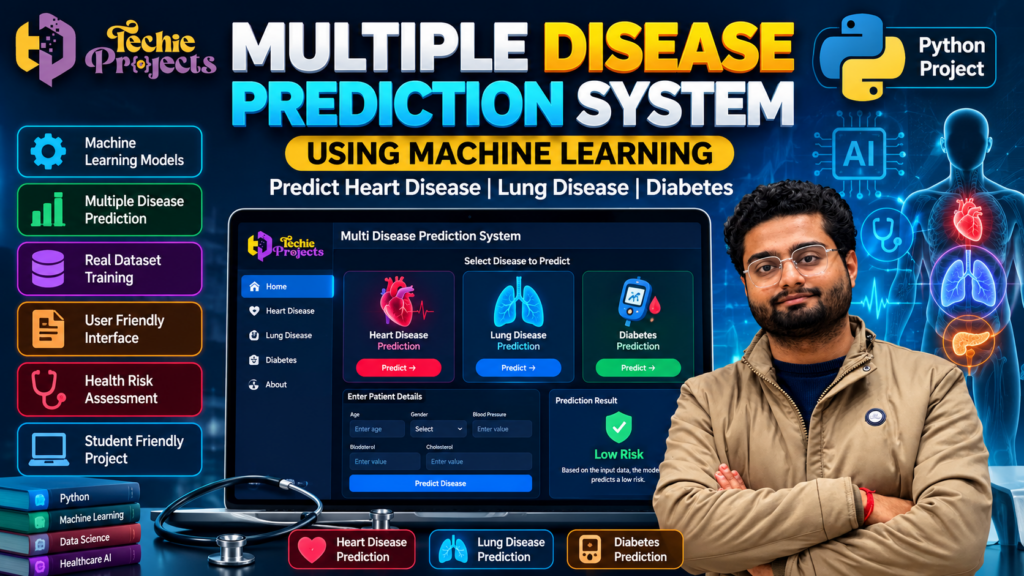
Multiple Disease Prediction System Using Machine Learning
Looking for a practical Multiple Disease Prediction System Using Machine Learning for your final-year engineering project or academic demonstration? Choose a project that combines Python programming, machine learning concepts, and healthcare-related data analysis in one application. At Techie Projects, students can explore project options designed to help them understand practical software development and demonstrate technical concepts.
Instead of spending weeks starting from an empty folder, you can enquire about purchasing this project and review the available implementation before making your decision. The project focuses on predicting multiple health-related conditions, such as heart disease, lung disease, and diabetes, depending on the models and datasets included in the actual implementation.
This project can be relevant to students pursuing Computer Science Engineering, Information Technology, Artificial Intelligence, Machine Learning, and Data Science. It offers a practical topic for learning about datasets, model training, prediction workflows, and user interfaces.
Want to get started? Contact Techie Projects to enquire about the project price, availability, technical requirements, and included deliverables.
- Website: https://techieprojects.com/
- WhatsApp: https://wa.me/919460060699
🎬 Multiple Disease Prediction System Project Demo
The demonstration introduces the application’s interface and shows how a user can interact with the prediction system. It provides an overview of the healthcare prediction concept and the workflow implemented in the project.
🏥 What Is a Multiple Disease Prediction System?
A Multiple Disease Prediction System is a software application that uses data and computational models to estimate the likelihood of selected health conditions. In machine learning applications, models learn patterns from training data and use those patterns to generate predictions for new inputs.
The Multiple Disease Prediction System Using Machine Learning is an educational project concept that demonstrates how different prediction tasks can be brought together within a single application.
Depending on the implementation, users may select a disease category, enter relevant input values, and view the model’s output. For example, a system may include separate models for heart disease risk, diabetes-related predictions, or other conditions.
The exact diseases, input fields, algorithms, and supported features depend on the version of the project. Predictions are not medical diagnoses and must not be used to make healthcare decisions.
🎯 Objectives of the Project
The primary objective is to demonstrate how machine learning can be applied to healthcare-related datasets through a Python application.
The main objectives include:
- Understanding the fundamentals of supervised machine learning.
- Learning how datasets are prepared for model training.
- Exploring the relationship between input features and prediction outputs.
- Understanding how multiple prediction tasks can be organised in one application.
- Developing or studying a user interface for entering data and displaying results.
- Learning how to test and evaluate a predictive model.
- Exploring the limitations and responsible use of machine learning in healthcare.
These objectives make the project useful for students who want to connect theoretical machine learning concepts with a practical software application.
💡 Key Features of the Multiple Disease Prediction System
The following features describe common capabilities of this project category. Confirm which features are present in the specific version available from Techie Projects before purchasing.
1. Multiple Disease Prediction
The application may provide separate prediction modules for different conditions. Depending on the implementation, these could include heart disease, diabetes, or lung disease prediction.
2. Python-Based Implementation
Python provides tools for data processing, machine learning, and application development. Students can study how Python functions, libraries, and model pipelines contribute to a predictive application.
3. User-Friendly Interface
A graphical or web-based interface can help users enter input values and view prediction results. The interface technology depends on the actual project implementation.
4. Machine Learning Models
The project may use trained machine learning models to generate predictions from structured input data. The included algorithms should be verified in the project’s documentation.
5. Data Processing
Machine learning workflows often require data cleaning, feature selection, encoding, scaling, or other preprocessing steps. The specific preprocessing operations depend on the dataset and model.
6. Prediction Results
The application displays the output generated by the model. Results should be explained carefully because predictive outputs can be incorrect and do not establish whether a person has a medical condition.
7. Academic Demonstration
The project can help students explain the relationship between datasets, algorithms, model evaluation, and software interfaces during a project presentation.
⚙️ Technologies Used in the Project
A machine learning prediction application may use several Python libraries and development tools.
| Technology | Purpose |
|---|---|
| Python | Core application programming |
| Pandas | Dataset handling and data analysis |
| NumPy | Numerical operations |
| Scikit-learn | Machine learning and model evaluation |
| Matplotlib or Seaborn | Data visualisation, if included |
| Flask or Streamlit | User interface, if used |
| CSV datasets | Structured training or testing data, where applicable |
Not every version uses all these tools. Check the project’s requirements and dependency files to confirm the exact technologies included.
🔄 How the Disease Prediction System Works
A typical machine learning prediction workflow contains several stages.
Step 1: Dataset Collection
A dataset containing relevant input features and target labels is selected. Data quality and suitability are important because the model’s performance depends partly on the data used to train and evaluate it.
Step 2: Data Preprocessing
The data may require cleaning, missing-value handling, encoding, scaling, or other transformations. These operations prepare the data for model training.
Step 3: Model Training
A machine learning algorithm learns patterns from the training dataset. The choice of algorithm depends on the prediction task, data structure, and project design.
Step 4: Model Evaluation
The trained model should be evaluated using suitable test data and appropriate metrics. Accuracy alone may not be sufficient, particularly when the classes are imbalanced or prediction errors have different consequences.
Step 5: User Input
The application collects input values through its interface. These values should be validated and processed consistently with the model’s training pipeline.
Step 6: Prediction Output
The application passes the processed input to the trained model and displays the resulting prediction. The output should be presented as an estimate rather than a confirmed diagnosis.
🎓 Why Choose This Machine Learning Project?
Choosing an appropriate engineering project can help you develop practical technical knowledge and prepare for your academic presentation.
Practical learning: Explore how datasets, algorithms, preprocessing, and prediction functions work together.
Relevant technology: Machine learning and healthcare data applications provide useful topics for technical discussion.
Multiple modules: If included in the implementation, separate disease prediction modules can demonstrate how different models can be organised within one application.
Viva preparation: The workflow provides opportunities to explain model training, testing, evaluation metrics, and limitations.
Portfolio development: After understanding and appropriately customising the implementation, you can describe your contribution and learning outcomes in a technical portfolio.
The real value of this project comes from understanding its design, testing its behaviour, and being able to explain the results—not simply running the application.
🏥 Benefits of Multiple Disease Prediction System Using Machine Learning
The Multiple Disease Prediction System Using Machine Learning demonstrates how Python and predictive models can be used to analyse healthcare-related datasets. It provides students with an opportunity to explore data preprocessing, model training, prediction outputs, and application development in one academic project.
Key learning benefits include:
- Understanding machine learning algorithms and their applications.
- Exploring structured datasets and input features.
- Learning how trained models generate predictions.
- Studying how multiple prediction modules can be organised in one application.
- Understanding model evaluation and the limitations of predictive results.
These concepts can help engineering students connect classroom theory with practical machine learning development.
⚙️ Working Process of Multiple Disease Prediction System Using Machine Learning
The Multiple Disease Prediction System Using Machine Learning generally follows a workflow involving data preparation, model training, evaluation, and prediction. First, relevant datasets are prepared for the selected prediction tasks. Next, suitable algorithms learn patterns from the training data. The trained models are then evaluated before being connected to the application’s interface.
When a user enters the required information, the application processes the input and displays the model’s output. The exact workflow, algorithms, and supported disease categories depend on the project’s implementation.
Understanding this process helps students explain the technical design during project demonstrations and viva examinations.
🧪 Software and Hardware Requirements
The exact requirements depend on the project’s libraries, interface, and model files. A typical small Python machine learning application may run on a standard laptop or desktop computer.
Common requirements may include:
- Windows or another supported operating system.
- A compatible Python installation.
- Visual Studio Code, PyCharm, or another suitable Python IDE.
- Required Python libraries.
- Sufficient RAM and storage for datasets and model files.
- An internet connection if external resources or APIs are required.
A dedicated GPU is generally not necessary for running many small, already-trained tabular prediction models. However, requirements can vary depending on the implementation.
Review the installation instructions and supported Python version before setting up the application.
📊 Applications of Machine Learning in Healthcare
Machine learning is being explored in healthcare research and digital health applications. Examples include:
- Risk estimation: Analysing data to estimate the likelihood of selected outcomes.
- Clinical research: Investigating patterns in structured health datasets.
- Medical data analysis: Studying relationships between input features and target variables.
- Decision-support research: Evaluating tools that may assist qualified professionals under appropriate clinical oversight.
- Healthcare education: Demonstrating data analysis and predictive modelling concepts.
These are examples of the broader field, not a guarantee that the project includes every application listed.
Real-world healthcare systems require rigorous validation, appropriate data protection, expert oversight, and evaluation across relevant populations. A student project should not be presented as a clinically validated diagnostic system without appropriate evidence.
⚠️ Limitations and Responsible Use
The quality of a machine learning prediction depends on the data, preprocessing, model design, and evaluation process. A model trained on limited or unrepresentative data may perform poorly on new cases.
Other limitations include incorrect input values, overfitting, class imbalance, and differences between the training data and real-world data. A model’s accuracy on a sample dataset does not automatically establish its suitability for clinical use.
The Multiple Disease Prediction System Using Machine Learning should therefore be treated as an educational project. Its predictions must not replace medical examination, professional advice, or diagnostic testing.
Students should explain the dataset’s limitations, identify possible sources of error, and avoid making unsupported claims about the system’s reliability.
🛒 Purchase the Multiple Disease Prediction System Using Machine Learning Project
Looking for a practical Python machine learning project for your academic requirements? Contact Techie Projects to enquire about the availability of the Multiple Disease Prediction System Using Machine Learning.
This project may suit students interested in Python, predictive modelling, healthcare-related datasets, and application development. Before placing an order, confirm the actual features and package contents so that the project matches your requirements.
When contacting Techie Projects, ask about:
- Current price and availability.
- Supported Python version and software requirements.
- Disease prediction modules included.
- Machine learning algorithms and datasets used.
- Source-code availability.
- Project documentation and installation instructions.
- Technical assistance and applicable support terms.
These details should be confirmed before payment rather than assumed from a general project description.
Contact Techie Projects:
- 📲 Call/WhatsApp: +91-9460060699
- 🌎 Website: www.techieprojects.com
- 📺 Instagram: @pythonprojects_
Share your course, academic level, and project requirements to discuss the available package. Make sure you understand the implementation and follow your institution’s rules for project purchases, customisation, and submission.
🚀 Explore Related Python and AI Projects
Students interested in similar technologies can explore other project categories on Techie Projects:
- Machine Learning Projects
- Artificial Intelligence Projects
- Python Projects
- Data Science Projects
- Deep Learning Projects
- Healthcare AI Projects
Compare the technical scope, software requirements, and learning objectives before choosing a project. Selecting a suitable topic early can make development, testing, and presentation preparation easier.
❓ Frequently Asked Questions
1. What is a Multiple Disease Prediction System Using Machine Learning?
It is a software application that applies machine learning models to estimate the likelihood of multiple selected health conditions based on input data. Its exact capabilities depend on the models and datasets used.
2. Is this project suitable for final-year engineering students?
It may be suitable for students in Computer Science, IT, Artificial Intelligence, and Data Science, subject to their college’s requirements and the complexity of the implementation.
3. Which algorithms are used in the project?
The algorithms depend on the supplied implementation. Confirm the exact models and evaluation methods before purchasing.
4. Does the project require a GPU?
Many small prediction models can run on a regular computer CPU. The actual requirements depend on the libraries, model architecture, and application.
5. Can this project diagnose diseases?
No. A student project is not a substitute for medical diagnosis. Its output should be treated as an educational prediction, not a confirmed medical result.
6. How can I purchase the project?
Visit https://techieprojects.com/ or contact Techie Projects through https://wa.me/919460060699 to enquire about availability, pricing, and package details.
7. What should I check before purchasing?
Confirm the project features, supported Python version, source-code availability, datasets, documentation, installation requirements, and support terms before ordering.
🎓 Conclusion
The Multiple Disease Prediction System Using Machine Learning is a practical educational topic for students who want to explore Python, predictive modelling, data processing, and healthcare-related software applications.
By studying the model workflow, evaluating prediction results, and understanding the limitations, students can develop a clearer understanding of machine learning implementation.
If you are looking for a project for your mini project or final-year engineering work, contact Techie Projects to confirm the available package, technical details, and deliverables.
Enquire today: +91-9460060699
Explore more projects at www.techieprojects.com and choose an option that fits your academic goals.