
Introduction
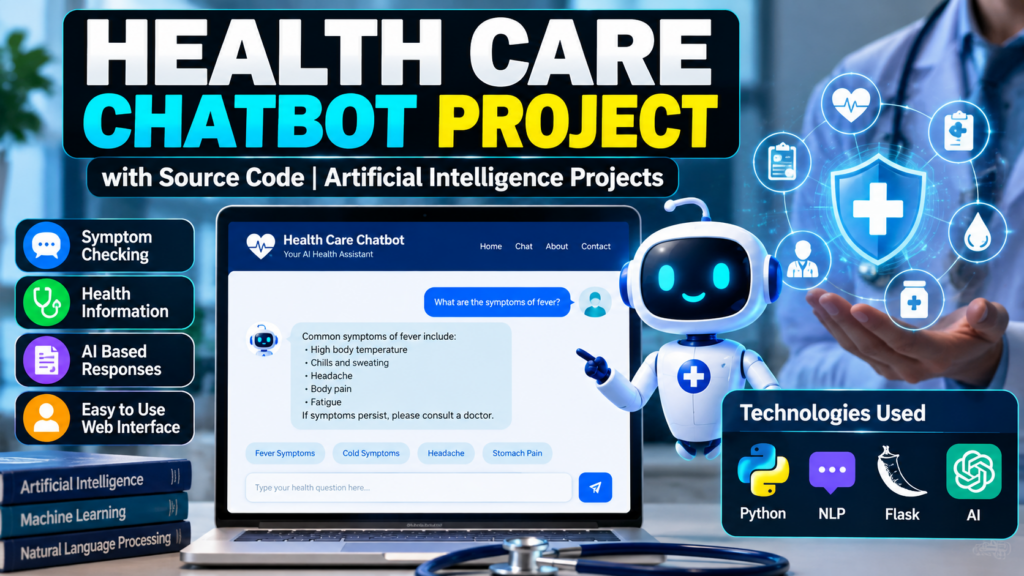
A Health Care Chatbot Project with Source Code is an Artificial Intelligence project designed to provide basic health-related information through a conversational chatbot interface. The system allows users to enter their symptoms or health-related questions and receive relevant information based on the chatbot’s trained knowledge or predefined responses.
This project demonstrates how Artificial Intelligence, Natural Language Processing (NLP), and Python can be used to develop an interactive healthcare assistance system. It is suitable for B.Tech, BCA, MCA, Computer Science, Artificial Intelligence, and Machine Learning students.
Important: This project is intended for educational and demonstration purposes only. It does not provide medical diagnosis or replace a qualified healthcare professional.
What Is a Health Care Chatbot?
A health care chatbot is a software application that communicates with users through text-based conversations. It can understand user queries and provide appropriate responses related to common health topics, symptoms, medicines, preventive care, and general health information.
A typical chatbot follows this process:
- User enters a health-related question or symptom.
- The system processes the user’s text.
- NLP techniques identify important words or patterns.
- The chatbot determines the most relevant response.
- The response is displayed to the user.
Objectives of the Project
The main objectives of the Health Care Chatbot Project are:
- To develop an interactive AI-based chatbot.
- To understand basic Natural Language Processing concepts.
- To process user health-related queries.
- To provide general health information.
- To create a simple and user-friendly chatbot interface.
- To demonstrate the practical application of Artificial Intelligence.
- To provide students with a real-world AI project idea.
Key Features
The Health Care Chatbot can include the following features:
1. Interactive Chat Interface
Users can communicate with the chatbot through a simple text-based interface.
2. Natural Language Processing
The chatbot can process user input and identify relevant words, phrases, or intents.
3. Health Information
The system can provide general information about common health conditions, symptoms, prevention, and healthy practices.
4. Symptom-Based Responses
The chatbot can recognize predefined symptoms and return educational information related to them.
5. Instant Responses
The chatbot automatically generates or retrieves a response without requiring manual intervention.
6. User-Friendly Interface
The application can be designed with a simple interface so that users can easily enter questions and read responses.
7. AI-Based Interaction
The project demonstrates how AI can be integrated into conversational applications.
How the Health Care Chatbot Works
The basic workflow of the project is:
User Query → Text Processing → Intent/Symptom Detection → Response Selection → Chatbot Response
Step 1: User Input
The user enters a question such as:
“What are common symptoms of fever?”
Step 2: Text Processing
The chatbot processes the entered sentence and extracts relevant words.
Step 3: Intent Detection
The system identifies the purpose of the query using predefined intents or an NLP/ML model.
Step 4: Response Generation
The chatbot selects an appropriate educational response.
Step 5: Display Response
The response is displayed to the user through the chatbot interface.
Technologies Used
Depending on the implementation, this project can be developed using:
- Python
- Natural Language Processing (NLP)
- Machine Learning
- Artificial Intelligence
- HTML and CSS
- Flask or Django
- JSON/CSV dataset
- SQLite/MySQL database
- NLTK or other NLP libraries
Software Requirements
- Python 3.x
- Windows/Linux/macOS
- Visual Studio Code or PyCharm
- Required Python libraries
- Web browser
- Flask/Django, if developing a web-based version
Hardware Requirements
- Processor: Intel Core i3 or above
- RAM: Minimum 4 GB
- Storage: Minimum 500 MB free space
- Keyboard and Mouse
- Internet connection for installing packages and optional APIs
Artificial Intelligence in the Project
Artificial Intelligence allows the chatbot to process user queries and provide relevant responses.
For example, different users may ask the same question in different ways:
- “What are the symptoms of flu?”
- “Tell me flu symptoms.”
- “How can I identify flu symptoms?”
An NLP-based chatbot can process these variations and identify that they are related to the same intent.
Natural Language Processing
NLP is an important component of an AI chatbot.
Common NLP operations include:
- Text cleaning
- Tokenization
- Lowercase conversion
- Stop-word removal
- Stemming or lemmatization
- Keyword extraction
- Intent classification
These techniques help the chatbot understand user messages more effectively.
Dataset for Health Care Chatbot
A chatbot can use a dataset containing intents, example user queries, and corresponding responses.
A simple dataset structure may contain:
| Intent | Example Query | Response |
|---|---|---|
| Greeting | Hello | Hello! How can I help you? |
| Fever | What are fever symptoms? | Provides general educational information |
| Headache | Why do I have a headache? | Provides general information |
| Cold | What are common cold symptoms? | Provides general information |
| Emergency | I need urgent medical help | Advises contacting emergency medical services |
The dataset can be expanded with additional health topics.
Machine Learning Approach
For an advanced version, the chatbot can use a machine learning model for intent classification.
The workflow can be:
Dataset → Text Preprocessing → Feature Extraction → Model Training → Intent Prediction → Response
Possible machine learning techniques include:
- Logistic Regression
- Naive Bayes
- Support Vector Machine
- Decision Tree
- Neural Networks
For more advanced implementations, deep learning and transformer-based NLP models can also be explored.
Chatbot Interface
The user interface can contain:
- Chat window
- User message area
- Send button
- Chatbot response area
- Clear chat option
- Optional voice input
- Optional text-to-speech output
A web-based implementation can be developed using Flask or Django with HTML, CSS, and JavaScript.
Example Conversation
User: Hello
Chatbot: Hello! How can I help you with general health information?
User: What are common symptoms of a cold?
Chatbot: Common cold symptoms may include a runny nose, sore throat, cough, sneezing, and mild fatigue. If symptoms are severe or persistent, consult a healthcare professional.
User: When should I see a doctor?
Chatbot: If you have severe, worsening, or unusual symptoms, contact a qualified healthcare professional for appropriate medical advice.
Advantages
- Easy to use
- Provides quick access to general information
- Available through a web interface
- Demonstrates practical AI application
- Reduces repetitive information requests
- Useful for educational demonstrations
- Can be expanded with additional datasets
- Can support NLP and machine learning experimentation
Limitations
The chatbot also has some limitations:
- It cannot replace a doctor.
- Responses depend on the quality of the dataset or AI model.
- It may misunderstand ambiguous questions.
- It should not be used for emergency diagnosis.
- Medical information may require professional interpretation.
- Accuracy can vary depending on the implementation.
Future Scope
The project can be improved by adding advanced features such as:
- Voice-based interaction
- Multilingual chatbot support
- Speech-to-text
- Text-to-speech
- Advanced NLP models
- Transformer-based models
- Personalized health information
- Integration with healthcare APIs
- Appointment booking
- Doctor consultation integration
- Mobile application
- Secure user authentication
- Conversation history
- Cloud deployment
Applications
A health care chatbot can be used for educational and informational purposes in:
- Healthcare websites
- Educational institutions
- Health information portals
- Hospital information systems
- Medical awareness applications
- Patient information systems
- Healthcare research projects
Why Choose This as a Final-Year Project?
The Health Care Chatbot Project with Source Code is a good final-year project because it combines several important areas of computer science, including:
- Artificial Intelligence
- Machine Learning
- Natural Language Processing
- Python Programming
- Web Development
- Database Management
Students can start with a rule-based chatbot and gradually upgrade it to an NLP or machine-learning-based system.
Conclusion
The Health Care Chatbot Project with Source Code demonstrates how Artificial Intelligence and Natural Language Processing can be used to create an interactive conversational application for general health information.
The project provides students with practical experience in chatbot development, NLP, Python, machine learning, and web application development. With additional datasets and advanced AI models, the system can be extended into a more sophisticated healthcare information assistant.
However, such a system should always be treated as an educational and informational tool, not as a replacement for professional medical diagnosis or treatment.
Frequently Asked Questions
What is a Health Care Chatbot Project?
It is an AI-based application that communicates with users and provides general health-related information through a conversational interface.
Which programming language is used for this project?
Python is commonly used because it provides extensive libraries for Artificial Intelligence, NLP, and machine learning.
Can this project use Machine Learning?
Yes. A machine-learning model can be trained to classify user queries into different intents.
Can I develop this project as a web application?
Yes. Flask or Django can be used to create a web-based health care chatbot.
Is the chatbot a replacement for a doctor?
No. The chatbot should only provide general educational information and should not be used for medical diagnosis or emergency decisions.
Can the project be extended with voice interaction?
Yes. Speech recognition and text-to-speech technologies can be integrated into an advanced version.
Is source code available for this project?
The project can be developed with Python and the required AI/NLP components. Students can also extend the implementation according to their project requirements.
Explore Related AI Projects
- Artificial Intelligence Projects
- Machine Learning Projects
- NLP Projects Using Python
- Python Final-Year Projects
- Deep Learning Projects
- Chatbot Projects Using Python
Need Help With Your Final-Year Project?
Get project ideas, implementation guidance, source-code information, and project support from Techie Projects.
📲 Call/WhatsApp: +91-9460060699
🌎 Website: www.techieprojects.com
📺 Instagram: @pythonprojects_