
Introduction
Sign Language Recognition Using Machine Learning is a computer vision project that uses artificial intelligence and image-processing techniques to recognize hand gestures and convert them into meaningful signs or characters. The project can help students understand how machine learning models can analyze visual information and classify different hand gestures.
In this project, images of hand signs are collected and processed to train a machine learning or deep learning model. When a new hand gesture is provided through an image or camera, the trained model analyzes the visual features and predicts the corresponding sign.
This project is suitable for B.Tech, BCA, MCA, Computer Science, Artificial Intelligence, Machine Learning, and Computer Vision students.
Important: Sign-language recognition systems should be designed with awareness of the language and dataset being used. A gesture classifier trained on a limited academic dataset may not represent complete real-world sign language.
What Is Sign Language Recognition?
Sign language recognition is the process of using computer vision and machine learning to identify hand gestures associated with signs, letters, numbers, or words.
A camera or image provides visual input to the system. The system processes the hand image and extracts useful features before passing them to a trained classification model.
A basic workflow is:
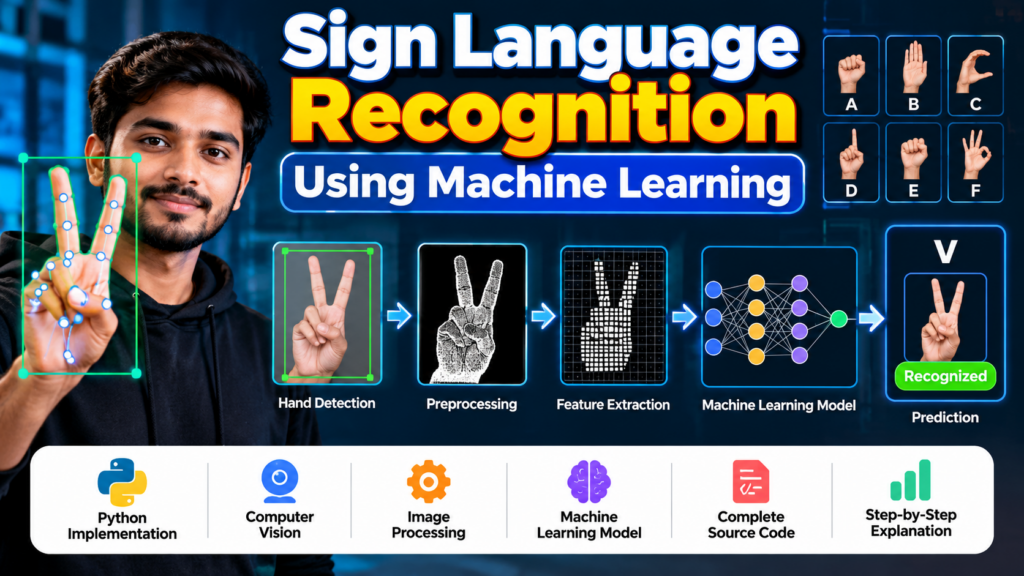
Camera/Image → Hand Detection → Image Preprocessing → Feature Extraction → Machine Learning Model → Predicted Sign
Objectives of the Project
The main objectives of the Sign Language Recognition Using Machine Learning project are:
- To understand computer vision-based gesture recognition.
- To detect and process hand gestures from images or video.
- To preprocess hand gesture images.
- To extract useful visual features.
- To train a machine learning or deep learning classification model.
- To recognize predefined hand signs.
- To evaluate the performance of the trained model.
- To develop an educational prototype for gesture recognition.
How Sign Language Recognition Works
The system can be divided into several stages.
1. Dataset Collection
The first step is to collect a dataset containing images of different hand signs.
For example, a dataset may contain classes representing:
- A
- B
- C
- D
- E
- F
or other signs depending on the selected sign-language dataset.
Each image should have an appropriate label corresponding to the gesture represented.
The number of classes depends on the scope of the project and the dataset.
2. Image Preprocessing
Raw images may have different dimensions, lighting conditions, and backgrounds. Preprocessing helps create more consistent inputs for the model.
Common preprocessing operations include:
- Image resizing
- Pixel normalization
- Background handling
- Cropping
- Noise reduction
- Color conversion
- Data augmentation
Data augmentation can include suitable transformations such as:
- Rotation
- Zoom
- Translation
- Brightness adjustment
The selected transformations should not change the meaning of the sign.
3. Hand Detection
The system can identify the hand region before classification.
Computer vision libraries such as OpenCV can be used for image processing, while hand-landmark frameworks can be explored for extracting hand keypoints.
For example, a hand detection pipeline can identify:
- Palm region
- Finger positions
- Hand boundaries
- Landmark coordinates
Using landmarks can reduce the amount of image information that the classification model needs to process.
4. Feature Extraction
After detecting the hand, relevant features are extracted.
Depending on the implementation, the system can use:
Image-Based Features
The complete hand image is provided to a CNN or another image classification model.
Landmark-Based Features
Hand joint coordinates are extracted and provided to a machine learning model.
Important hand landmarks may include:
- Wrist
- Thumb joints
- Index finger joints
- Middle finger joints
- Ring finger joints
- Little finger joints
The selected approach depends on the dataset and project requirements.
5. Machine Learning Model
The extracted features are provided to a classification model.
Possible models include:
- Convolutional Neural Network (CNN)
- Support Vector Machine (SVM)
- Random Forest
- K-Nearest Neighbors (KNN)
- Decision Tree
- Artificial Neural Network
For image-based recognition, CNNs are commonly explored because they can automatically learn visual features from images.
For landmark-based recognition, models such as Random Forest, SVM, or neural networks can be evaluated.
6. Model Training
The dataset is divided into training, validation, and test sets.
The training data is used to learn the relationship between hand gestures and their labels.
During training, the model attempts to minimize prediction errors.
Important parameters can include:
- Learning rate
- Batch size
- Number of epochs
- Optimizer
- Loss function
After training, the model is evaluated on previously unseen test images.
7. Sign Prediction
When a new image or camera frame is provided, the system processes it using the same preprocessing pipeline used during training.
The trained model then generates predictions.
For example:
Input: Hand gesture
↓
Image/landmark processing
↓
Machine learning model
↓
Prediction: V
↓
Display: Recognized Sign = V
The output depends on the classes included in the training dataset.
Project Workflow
The complete workflow can be represented as:
Collect Sign Language Dataset
↓
Image Preprocessing
↓
Hand Detection
↓
Feature Extraction
↓
Train Machine Learning Model
↓
Evaluate Model
↓
Save Trained Model
↓
Capture New Hand Gesture
↓
Process Input
↓
Predict Sign
↓
Display Result
Key Features
The Sign Language Recognition project can include:
- Hand gesture detection
- Image-based sign classification
- Real-time camera input
- Machine learning-based prediction
- Multiple gesture classes
- Prediction display
- Confidence score
- Dataset-based training
- Simple user interface
An advanced version can support continuous gesture recognition rather than classifying only individual static gestures.
Technologies Used
| Technology | Purpose |
|---|---|
| Python | Programming |
| OpenCV | Image processing and camera input |
| NumPy | Numerical operations |
| TensorFlow/Keras | Deep learning |
| MediaPipe | Optional hand landmark detection |
| Pandas | Dataset handling |
| Matplotlib | Visualization |
| Scikit-learn | Traditional machine learning |
The exact technology stack depends on the implementation.
Software Requirements
The project can be developed using:
- Windows, Linux, or macOS
- Python 3.x
- VS Code or PyCharm
- Jupyter Notebook
- OpenCV
- NumPy
- TensorFlow/Keras
- Scikit-learn
- MediaPipe, if used
Hardware Requirements
Recommended hardware includes:
- Intel/AMD processor
- Minimum 4 GB RAM
- 8 GB RAM recommended
- Webcam for real-time recognition
- Adequate storage for the dataset
- GPU recommended for larger deep learning models
A GPU is not required for small datasets or lightweight models.
Dataset Preparation
A good dataset is important for building an effective gesture-recognition model.
The dataset should ideally contain:
- Multiple images per class
- Different hand positions
- Different lighting conditions
- Different backgrounds
- Different users where possible
- Correct labels
- Sufficient variation within each class
Avoid allowing nearly identical images from the same recording session to appear in both training and test sets, as this can produce overly optimistic evaluation results.
Model Evaluation
After training, evaluate the model using unseen test data.
Useful metrics include:
Accuracy
Measures the percentage of correctly classified samples.
Precision
Measures how often predictions for a particular class are correct.
Recall
Measures how many samples belonging to a class are successfully identified.
F1-Score
Combines precision and recall.
Confusion Matrix
Shows which gesture classes are being confused with one another.
A confusion matrix is particularly useful when two hand gestures have similar visual characteristics.
Advantages of Sign Language Recognition
The project provides several educational benefits:
- Demonstrates practical machine learning
- Introduces computer vision
- Helps students understand image classification
- Can support real-time experimentation
- Can use a webcam for live input
- Can be extended to multiple gesture classes
- Provides experience with Python and ML libraries
- Can be developed as an academic final-year project
Applications
Sign language recognition technology can be explored in areas such as:
- Human-computer interaction
- Educational applications
- Gesture-controlled interfaces
- Accessibility research
- Computer vision research
- Interactive systems
- Communication-assistance research
- Smart-device interfaces
Real-world communication systems require broader language coverage and careful validation with representative users and signing communities.
Limitations
The project has several limitations.
Limited Vocabulary
A model trained on a small number of signs cannot recognize every sign in a complete sign language.
Background Sensitivity
Complex backgrounds may make hand detection and classification more difficult.
Lighting Conditions
Poor lighting can affect image quality and prediction performance.
Similar Gestures
Some gestures may have similar hand configurations and can be difficult to distinguish.
Dataset Bias
A dataset collected from limited users or environments may not generalize to other users.
Dynamic Signs
Static image classification is not sufficient for signs that depend on movement or temporal information.
Future Scope
The project can be improved in several ways.
Real-Time Sign Recognition
Integrate the trained model with a webcam to recognize gestures continuously.
Word and Sentence Recognition
Instead of recognizing individual letters or static gestures, the system can be extended to recognize sequences of signs.
Dynamic Gesture Recognition
Recurrent neural networks, temporal models, or video-based architectures can be explored for signs involving movement.
Text-to-Speech
The recognized output can be converted into speech using a text-to-speech system.
Speech-to-Sign Integration
A more advanced system could combine speech or text input with sign-language generation.
Mobile Application
The trained model can be optimized for deployment on smartphones.
Improved Hand Tracking
Hand-landmark detection can be combined with classification to improve real-time gesture processing.
Frequently Asked Questions
What is Sign Language Recognition Using Machine Learning?
It is a computer vision application that uses machine learning to classify predefined hand gestures from images or camera frames.
Can Python be used for sign language recognition?
Yes. Python provides libraries such as OpenCV, TensorFlow, Keras, NumPy, and Scikit-learn that can be used to develop sign-language recognition projects.
Which machine learning model is suitable for sign language recognition?
CNNs are commonly used for image-based gesture recognition. Traditional models such as SVM and Random Forest can also be used with suitable extracted features.
Can this project recognize signs in real time?
Yes. A webcam can be used to capture hand gestures and send frames to a trained model for prediction. Real-time performance depends on the model, hardware, camera quality, and implementation.
Is MediaPipe required?
No. MediaPipe is optional. It can be useful for detecting hand landmarks, but an image-based CNN can also perform classification directly from hand images.
Is this a good final-year project?
Yes. Sign Language Recognition Using Machine Learning is a strong educational project for students interested in artificial intelligence, computer vision, machine learning, and human-computer interaction.
Can the project convert sign language into speech?
A basic classifier normally predicts a sign or character. A larger system can combine recognition, text processing, and text-to-speech technologies to produce spoken output.
Conclusion
Sign Language Recognition Using Machine Learning is a practical computer vision project that demonstrates how artificial intelligence can be used to classify hand gestures. By combining image preprocessing, hand detection, feature extraction, and machine learning, a system can recognize predefined signs from images or camera input.
The project provides practical experience with Python, OpenCV, machine learning, CNNs, image processing, hand landmarks, and model evaluation. It can also be extended into real-time gesture recognition, dynamic sign recognition, text-to-speech systems, and accessibility-focused applications.
Sign language recognition using machine learning provides a practical way to explore computer vision, gesture classification, and artificial intelligence using Python.
Architecture Diagram for Sign Language Recognition:-

Flow Chart of Sign Language to Text Conversion
