
Introduction
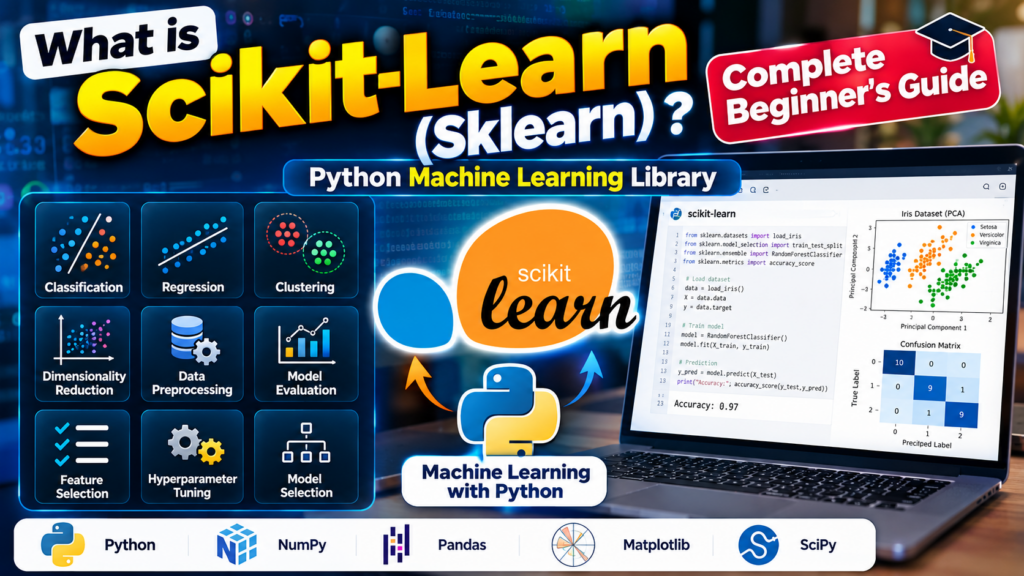
Scikit-learn, commonly written as Scikit-Learn or sklearn, is one of the most popular open-source Python libraries for Machine Learning and data analysis. It provides simple and efficient tools for building machine learning models for classification, regression, clustering, dimensionality reduction, preprocessing and model evaluation.
Scikit-Learn in Python is one of the most popular ways to get started with traditional Machine Learning. Scikit-learn, commonly written as sklearn, is an open-source Python library that provides efficient tools for classification, regression, clustering, data preprocessing, model evaluation and machine learning model selection.
For students, developers and beginners learning Machine Learning with Python, Scikit-learn is an excellent library because it provides a consistent API and supports many commonly used machine learning algorithms.
🎓 Whether you are learning Machine Learning, preparing a B.Tech final-year project, or developing a real-world predictive system, understanding Scikit-learn can help you build and experiment with machine learning models more efficiently.
What Is Scikit-Learn in Python?
Scikit-learn is a free and open-source Machine Learning library for Python.
It is built on top of popular Python scientific computing libraries such as NumPy, SciPy and Matplotlib and provides implementations of many traditional machine learning algorithms.
Scikit-Learn in Python provides a simple API for implementing many traditional machine learning algorithms without requiring developers to build these algorithms from scratch.
Scikit-learn can be used for tasks such as:
- Classification
- Regression
- Clustering
- Data preprocessing
- Feature selection
- Feature extraction
- Dimensionality reduction
- Model selection
- Model evaluation
- Hyperparameter tuning
For example, Scikit-learn can be used to build a model that predicts whether an email is spam or not.
from sklearn.model_selection import train_test_splitfrom sklearn.linear_model import LogisticRegressionmodel = LogisticRegression()model.fit(X_train, y_train)predictions = model.predict(X_test)The simple and consistent API is one of the major reasons why Scikit-learn is widely used by Python Machine Learning learners and developers.
Why Is Scikit-Learn Popular?
One of the biggest advantages of Scikit-learn is its simple API.
The workflow for many machine learning algorithms is similar:
Load Dataset
     ↓
Preprocess Data
     ↓
Split Dataset
     ↓
Select Model
     ↓
Train Model
     ↓
Make Predictions
     ↓
Evaluate Model
This makes it easier for beginners to understand the complete Machine Learning workflow.
Scikit-learn also provides implementations of many algorithms without requiring developers to implement the mathematical equations from scratch.
🎓 Why Should Students Learn Scikit-Learn?
Scikit-learn is particularly useful for students who are learning:
- Python
- Machine Learning
- Data Science
- Artificial Intelligence
- Predictive Analytics
- Data Analysis
It can also be useful when developing B.Tech, BE, BCA, MCA and other academic Machine Learning projects.
For example, students can use Scikit-learn to develop projects such as:
- Fake News Detection
- Spam Email Detection
- Student Performance Prediction
- House Price Prediction
- Customer Churn Prediction
- Disease Prediction
- Credit Card Fraud Detection
- Intrusion Detection
- Sentiment Analysis
How to Install Scikit-Learn
Before using Scikit-learn, make sure Python is installed on your computer.
You can install Scikit-learn using pip:
pip install scikit-learnIf you are using Jupyter Notebook, you can run:
!pip install scikit-learnAfter installation, verify the library:
import sklearnprint(sklearn.__version__)This displays the installed Scikit-learn version.
Basic Scikit-Learn Example
Let’s look at a simple example of training a machine learning model.
from sklearn.datasets import load_irisfrom sklearn.model_selection import train_test_splitfrom sklearn.linear_model import LogisticRegressionfrom sklearn.metrics import accuracy_score# Load datasetdata = load_iris()X = data.datay = data.target# Split datasetX_train, X_test, y_train, y_test = train_test_split( X, y, test_size=0.2, random_state=42)# Create modelmodel = LogisticRegression(max_iter=200)# Train modelmodel.fit(X_train, y_train)# Make predictionsy_pred = model.predict(X_test)# Calculate accuracyaccuracy = accuracy_score(y_test, y_pred)print("Accuracy:", accuracy)This example uses the popular Iris dataset to demonstrate a basic classification workflow.
Important Features of Scikit-Learn
Scikit-learn provides a large collection of tools for traditional machine learning.
Classification Algorithms
Classification algorithms are used when the output belongs to a particular category or class.
Popular classification algorithms available in Scikit-learn include:
- Logistic Regression
- K-Nearest Neighbors
- Decision Tree
- Random Forest
- Support Vector Machine
- Naive Bayes
- Gradient Boosting
- AdaBoost
For example, a classification model can predict:
Email → Spam / Not Spamor:
Transaction → Fraud / GenuineRegression Algorithms
Regression is used when the model needs to predict a continuous numerical value.
Examples include:
- Linear Regression
- Ridge Regression
- Lasso Regression
- Decision Tree Regression
- Random Forest Regression
- Support Vector Regression
- Gradient Boosting Regression
For example:
House Features
      ↓
Machine Learning Model
      ↓
Predicted House Price
Clustering
Clustering algorithms group similar data points without requiring predefined labels.
Scikit-learn provides algorithms such as:
- K-Means
- DBSCAN
- Agglomerative Clustering
- Mean Shift
Clustering can be useful in applications such as customer segmentation.
Data Preprocessing
Data preprocessing is an important part of Machine Learning.
Scikit-learn provides tools for:
- Feature scaling
- Normalization
- Encoding categorical variables
- Handling missing values
- Feature transformation
For example:
from sklearn.preprocessing import StandardScalerscaler = StandardScaler()X_scaled = scaler.fit_transform(X)Feature Selection
Not every feature in a dataset is necessarily useful.
Scikit-learn provides feature selection techniques that can help identify important features and reduce unnecessary data.
This can potentially improve model efficiency and simplify the model.
Dimensionality Reduction
Scikit-learn also provides algorithms for reducing the number of features in a dataset.
One popular technique is Principal Component Analysis (PCA).
from sklearn.decomposition import PCApca = PCA(n_components=2)X_reduced = pca.fit_transform(X)Dimensionality reduction can be useful when working with datasets containing many features.
Scikit-Learn Model Evaluation
Training a machine learning model is only one part of the process.
You also need to evaluate how well the model performs.
Scikit-learn provides many evaluation metrics, including:
- Accuracy
- Precision
- Recall
- F1-score
- Confusion Matrix
- Mean Absolute Error
- Mean Squared Error
- R² Score
- ROC-AUC
For classification:
from sklearn.metrics import accuracy_scoreaccuracy = accuracy_score(y_test, y_pred)print(accuracy)Different evaluation metrics should be selected according to the problem being solved.
Train-Test Split
A common machine learning workflow is to divide the dataset into training and testing data.
Scikit-learn provides train_test_split() for this purpose.
from sklearn.model_selection import train_test_splitX_train, X_test, y_train, y_test = train_test_split( X, y, test_size=0.2, random_state=42)The training data is used to train the model, while the test data is used to evaluate how well the model performs on unseen data.
Cross-Validation
Cross-validation is another important technique for evaluating machine learning models.
Scikit-learn provides several cross-validation tools.
For example:
from sklearn.model_selection import cross_val_scorescores = cross_val_score( model, X, y, cv=5)print(scores)Cross-validation can provide a more reliable understanding of model performance than relying on a single train-test split.
Hyperparameter Tuning
Machine learning models often have parameters that need to be selected before training.
Scikit-learn provides tools such as:
- GridSearchCV
- RandomizedSearchCV
For example:
from sklearn.model_selection import GridSearchCVgrid = GridSearchCV( model, param_grid, cv=5)grid.fit(X_train, y_train)This allows different parameter combinations to be evaluated systematically.
Scikit-Learn Pipelines
Scikit-learn also provides Pipeline, which can combine preprocessing and model training into a single workflow.
For example:
from sklearn.pipeline import Pipelinefrom sklearn.preprocessing import StandardScalerfrom sklearn.linear_model import LogisticRegressionpipeline = Pipeline([ ("scaler", StandardScaler()), ("model", LogisticRegression())])pipeline.fit(X_train, y_train)Pipelines can help organize machine learning workflows and reduce the possibility of applying preprocessing inconsistently.
Scikit-Learn Architecture
A simplified Scikit-learn machine learning workflow can be represented as:
              Dataset
                 ↓
        Data Preprocessing
                 ↓
        Feature Engineering
                 ↓
          Train-Test Split
                 ↓
          Select Algorithm
                 ↓
            Train Model
                 ↓
          Model Evaluation
                 ↓
        Hyperparameter Tuning
                 ↓
         Final Predictions
This workflow can be adapted for many traditional Machine Learning applications.
Advantages of Scikit-Learn
Scikit-learn provides several advantages for students and developers.
Easy to Learn
Its consistent API makes it relatively easy for beginners to understand.
Large Collection of Algorithms
It provides many traditional machine learning algorithms in a single ecosystem.
Good Documentation
Scikit-learn provides extensive documentation and examples for its tools and algorithms.
Efficient Development
Developers can use existing implementations instead of implementing algorithms from scratch.
Data Preprocessing Tools
It includes many useful preprocessing and feature transformation utilities.
Model Evaluation
A wide range of metrics and model-selection tools are available.
Open Source
Scikit-learn is freely available as an open-source Python library.
Limitations of Scikit-Learn
Although Scikit-learn is powerful, it is not designed for every type of AI problem.
Not Primarily Designed for Deep Learning
For complex deep learning applications involving large neural networks, frameworks such as TensorFlow and PyTorch are generally more suitable.
Limited GPU-Oriented Deep Learning
Scikit-learn’s traditional algorithms are not intended to provide the same GPU-focused deep learning workflows available in dedicated deep learning frameworks.
Large-Scale Deep Learning
Applications involving computer vision, large language models and advanced neural networks generally require other frameworks.
Dataset Size Considerations
Some algorithms may become computationally expensive when working with very large datasets.
Applications of Scikit-Learn
Scikit-learn can be used in many Machine Learning applications.
Spam Detection
Classify emails or messages as spam or legitimate.
Fraud Detection
Identify potentially fraudulent transactions.
Customer Segmentation
Group customers based on their characteristics and behavior.
Predictive Analytics
Use historical data to predict future outcomes.
Sentiment Analysis
Classify text according to sentiment categories.
Recommendation Systems
Traditional machine learning techniques can be used as part of recommendation systems.
Medical Data Analysis
Machine learning models can assist in analyzing structured healthcare datasets.
Intrusion Detection
Machine learning can be used to identify suspicious patterns in network traffic.
Scikit-Learn vs TensorFlow
Scikit-learn and TensorFlow are both important tools in the Python AI ecosystem, but they are designed for different types of workloads.
| Feature | Scikit-Learn | TensorFlow |
|---|---|---|
| Primary Use | Traditional Machine Learning | Deep Learning |
| Beginner Friendly | Very Easy | Moderate |
| Classification | Yes | Yes |
| Regression | Yes | Yes |
| Clustering | Yes | Limited/Custom |
| Neural Networks | Basic/limited | Advanced |
| Computer Vision | Limited | Strong |
| Deep Learning | Not its primary purpose | Yes |
| GPU-Oriented Workflows | Limited | Strong |
For beginners learning traditional Machine Learning, Scikit-learn is often an excellent starting point.
For advanced neural networks and deep learning applications, TensorFlow or PyTorch may be more appropriate.
🎓 Scikit-Learn for Final-Year Projects
Scikit-learn can be used to develop many academic and final-year projects.
Students can combine Scikit-learn with Python, Pandas, NumPy, Matplotlib, Flask, Streamlit and other technologies to build complete applications.
Some project ideas include:
- Fake News Detection Using Machine Learning
- Intrusion Detection System
- Student Performance Prediction
- House Price Prediction
- Customer Churn Prediction
- Credit Card Fraud Detection
- Email Spam Detection
- Disease Prediction
- Loan Approval Prediction
- Sentiment Analysis
- Employee Attrition Prediction
- Customer Segmentation
The final project can be extended with a web interface, database, visualization dashboard and additional machine learning models.
🚀 Recommended Machine Learning Projects
If you are learning Scikit-learn and looking for a practical project, explore these related project ideas:
Fake News Detection Using Machine Learning
Build a machine learning system that classifies news articles as potentially fake or genuine using text-based features.
Intrusion Detection System Using Machine Learning
Develop a system that analyzes network traffic data and identifies potentially suspicious activity.
Student Performance Prediction
Use student-related features to build a predictive model for academic performance.
Customer Churn Prediction
Predict whether a customer may leave a service based on historical customer data.
Credit Card Fraud Detection
Build a machine learning model to identify potentially fraudulent transactions.
House Price Prediction
Develop a regression model that predicts property prices based on selected features.
Email Spam Detection
Train a classification model to distinguish spam emails from legitimate emails.
💡 Looking for a different Python or Machine Learning project? Explore more project ideas on Techie Projects or contact us with your requirements.
🎓 Why Scikit-Learn Is Useful for Students
Learning Scikit-learn gives students practical experience with the complete machine learning workflow.
You can learn how to:
- Load datasets
- Clean data
- Preprocess features
- Split datasets
- Train machine learning models
- Compare algorithms
- Evaluate model performance
- Tune hyperparameters
- Make predictions
- Build complete ML applications
These concepts are useful not only for academic projects but also for building a foundation in Machine Learning and Data Science.
Common Scikit-Learn Modules
Some commonly used Scikit-learn modules include:
sklearn.model_selection
sklearn.preprocessing
sklearn.linear_model
sklearn.tree
sklearn.ensemble
sklearn.svm
sklearn.neighbors
sklearn.cluster
sklearn.metrics
sklearn.decomposition
sklearn.pipeline
Each module provides tools for a particular part of the machine learning workflow.
Frequently Asked Questions
What is Scikit-Learn used for?
Scikit-learn is primarily used for traditional Machine Learning tasks such as classification, regression, clustering, preprocessing, model selection and evaluation.
Is Scikit-Learn suitable for beginners?
Yes. Its consistent API, documentation and large collection of algorithms make it a popular choice for people learning Machine Learning with Python.
Is Scikit-Learn free?
Yes. Scikit-learn is an open-source Python library that can be used for learning, development and research.
Can Scikit-Learn be used for final-year projects?
Yes. Students can use Scikit-learn to develop numerous Machine Learning and Data Science projects.
Is Scikit-Learn better than TensorFlow?
Neither library is universally better. Scikit-learn is mainly focused on traditional Machine Learning, while TensorFlow is designed for deep learning and neural network applications.
Can Scikit-Learn be used with Pandas?
Yes. Pandas and Scikit-learn are commonly used together. Pandas can be used for data manipulation and analysis, while Scikit-learn can be used for machine learning.
Can Scikit-Learn be used with Python?
Yes. Scikit-learn is specifically designed as a Python machine learning library.
Which projects can be developed using Scikit-Learn?
Projects such as Fake News Detection, Spam Detection, Customer Churn Prediction, House Price Prediction, Fraud Detection, Student Performance Prediction and Intrusion Detection can be developed using Scikit-learn.
🎓 Need a Machine Learning or Python Project?
Are you looking for a Scikit-learn, Python, Machine Learning or Artificial Intelligence final-year project?
Techie Projects can help students with project development and customization based on their academic requirements.
Project assistance can include:
- Python Source Code
- Machine Learning Model
- Dataset
- Project Documentation
- Project Report
- PPT Presentation
- Project Demo
- Flowcharts and Diagrams
- Viva Preparation
- Feature Customization
- Project Setup Guidance
Have your own project idea? Share your requirements and discuss the project scope, features and customization options.
📞 Contact Techie Projects
Contact us for project-related queries and requirements.
📲 Call/WhatsApp: +91-9460060699
🌎 Website: www.techieprojects.com
Have a project idea but don’t know where to start? Contact Techie Projects and discuss your requirements.
Conclusion
Scikit-learn is one of the most useful Python libraries for learning and implementing traditional Machine Learning.
With support for classification, regression, clustering, preprocessing, dimensionality reduction, model evaluation and hyperparameter tuning, it provides many of the tools required to develop a complete machine learning workflow.
🎓 For students, learning Scikit-learn can be particularly valuable when developing B.Tech, BE, BCA, MCA and other Machine Learning final-year projects.
Whether you are a beginner learning Python Machine Learning or a student looking for a practical project idea, Scikit-learn provides a strong foundation for building and experimenting with machine learning applications.
For students learning Scikit-Learn in Python, the library provides a practical foundation for building Machine Learning projects and understanding the complete model development workflow.