
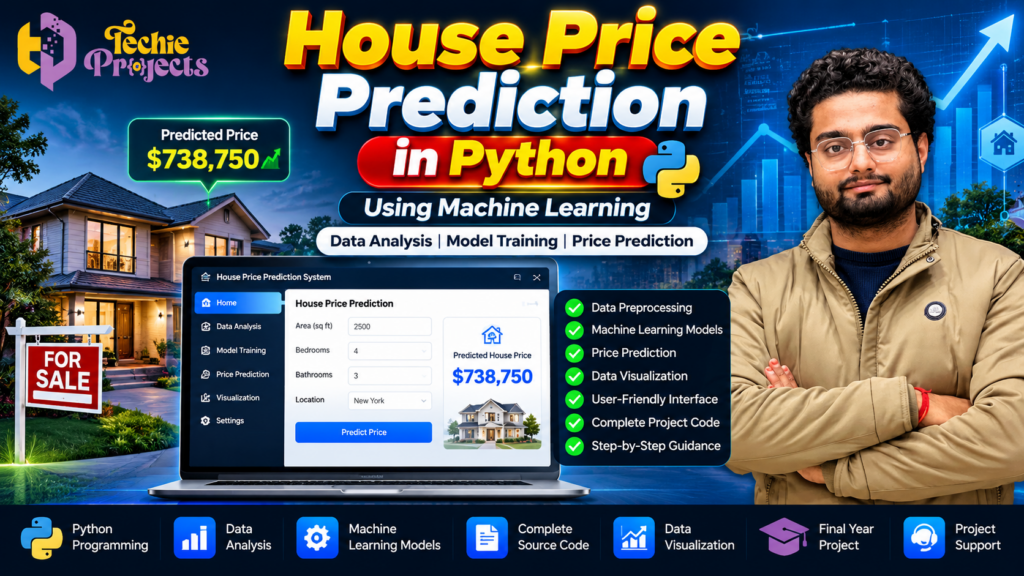
Looking for a practical machine learning project that you can demonstrate during your college presentation, explain in your viva, and use to showcase your Python skills? House Price Prediction in Python Using Machine Learning is a valuable project idea for students who want to explore real-world data analysis, predictive modelling, and intelligent software applications.
Instead of spending weeks trying to select a suitable topic and build a complete application from scratch, you can explore the House Price Prediction project from Techie Projects and enquire about purchasing the project for your academic learning and development needs. It offers an opportunity to understand how property-related data can be processed and used to estimate house prices through machine learning techniques.
Whether you are pursuing a B.Tech, BCA, MCA, computer science degree, or another IT-related course, this project can help you explore the practical relationship between Python programming, data science, and predictive analytics.
Visit Techie Projects to explore engineering projects, or contact us directly on WhatsApp to enquire about availability, pricing, and the deliverables included with this project.
🎬 House Price Prediction Project Demo
Explore the project demonstration to see how a machine learning application can present property information and generate an estimated price.
The demonstration introduces the House Price Prediction system developed using Python and machine learning concepts. It provides a visual overview of the project and helps students understand the relationship between property inputs, data processing, and predicted results.
Watching a demonstration before purchasing can help you assess whether the project aligns with your academic requirements and presentation goals.
🏠 What Is House Price Prediction Using Machine Learning?
House price prediction is a data science problem in which a machine learning model estimates the price of a property using relevant features. Depending on the dataset, these features may include the property’s area, number of bedrooms, number of bathrooms, location, age, and other characteristics.
House Price Prediction in Python Using Machine Learning demonstrates how historical property data can be analysed to identify patterns associated with property prices.
For example, a dataset may contain information about houses of different sizes and locations alongside their recorded selling prices. A model can learn relationships between the available features and the target price during training. When new property details are provided, the trained model can generate an estimated value.
The result is a useful educational example of supervised machine learning, particularly regression, where the objective is to predict a numerical value.
It is important to understand that predictions depend on the quality of the dataset, the selected features, the training process, and the model’s limitations. A student project demonstrates the underlying concepts rather than guaranteeing accurate prices in every real estate market.
🎯 Why Choose This Machine Learning Project for Your Final Year?
Selecting a suitable academic project can be challenging. Students often need a topic that is practical, relevant to their course, and understandable enough to explain during a presentation or viva.
This project connects several important areas of computer science within one application.
1. Practical Python programming
Python is widely used in data science and machine learning because of its readable syntax and extensive ecosystem of libraries. Developing a prediction application can help students understand how programming logic is applied to a practical problem.
2. Real-world data analysis
Property datasets provide an opportunity to explore numerical and categorical information, identify missing values, examine data distributions, and understand relationships between different variables.
3. Machine learning fundamentals
The project introduces important concepts such as training data, target variables, feature selection, regression algorithms, model evaluation, and prediction.
4. Application development
When the implementation includes a user interface, students can explore how inputs are collected, processed, and displayed as results.
5. Presentation and viva preparation
The project provides several technical topics for academic discussion, including dataset selection, preprocessing, algorithm selection, prediction results, and model limitations.
These learning opportunities make the project relevant to students interested in Python development, artificial intelligence, data analytics, and machine learning.
🏠 Benefits of House Price Prediction in Python Using Machine Learning
House Price Prediction in Python Using Machine Learning helps students understand how real-world data can be used to estimate property values. The project connects Python programming, data preprocessing, regression algorithms, and model evaluation in a practical application.
Students can explore how property features influence predicted prices, compare machine learning approaches, and understand the importance of selecting suitable training data. These concepts are useful for academic demonstrations, technical presentations, and learning the fundamentals of predictive analytics.
⚙️ How the House Price Prediction System Works
A typical machine learning application follows a structured workflow. The exact implementation depends on the project’s source code, dataset, selected algorithm, and interface.
Step 1: Collect property data
The process begins with a dataset containing property attributes and corresponding prices. Data may come from a publicly available dataset or another suitable source.
The dataset should be relevant to the prediction task. Property markets vary by region and time, so the data’s source and limitations should be understood before training the model.
Step 2: Prepare and clean the dataset
Raw data may contain missing values, duplicate records, inconsistent formats, or unsuitable columns. Data preprocessing helps prepare the information for analysis.
Common operations include handling missing values, checking data types, removing unnecessary fields, and converting categorical information into a format supported by the chosen algorithm.
Step 3: Select useful features
Features are the input variables used by the model. Examples may include property area, bedrooms, bathrooms, and location, depending on the dataset.
The target variable is the house price that the model attempts to predict.
Choosing relevant features can influence how effectively a model learns patterns from the available data.
Step 4: Train a machine learning model
The prepared dataset is used to train a suitable regression algorithm. Depending on the implementation, possible approaches include Linear Regression, Decision Tree Regression, Random Forest Regression, or other regression methods.
Different algorithms may perform differently on the same dataset. The most appropriate model should be selected through testing rather than assuming that one algorithm is always best.
Step 5: Evaluate model performance
Model evaluation helps determine how closely predictions match actual values on data that was not used for training.
Common regression metrics include Mean Absolute Error (MAE), Mean Squared Error (MSE), Root Mean Squared Error (RMSE), and the coefficient of determination, R².
These measurements provide a more meaningful assessment than relying only on a few example predictions.
Step 6: Generate a price estimate
After training, the model can receive property information in the format expected by the implementation. It processes those inputs and returns a predicted price.
If a graphical interface is included, users may enter property details through form fields and view the resulting estimate on the screen.
📊 How House Price Prediction in Python Using Machine Learning Works
The House Price Prediction in Python Using Machine Learning process generally starts with a property dataset containing features such as area, location, and the number of bedrooms. The data is cleaned and prepared before a suitable regression model is trained.
After training, the model accepts property details and generates an estimated price. Model evaluation helps students understand how closely the predicted values match actual prices and where improvements may be needed.
The exact workflow and algorithm depend on the implementation included in the project.
🧠 Technologies Used in the Project
The technologies used depend on the actual version of the application. The following tools are commonly associated with Python-based property prediction projects.
Python
Python provides the programming foundation for data preparation, model training, prediction logic, and application functionality.
Pandas
Pandas is commonly used to load tabular datasets, inspect columns, handle missing values, and prepare information for analysis.
NumPy
NumPy supports numerical calculations and operations on arrays and numerical data.
Scikit-learn
Scikit-learn provides machine learning algorithms, dataset utilities, preprocessing tools, and evaluation metrics. It is frequently used for regression-based prediction projects.
Matplotlib and Seaborn
These libraries can be used to create charts and visualise data patterns. Their use depends on whether the project includes exploratory analysis or graphical reporting.
Graphical user interface
A user interface may be developed using a Python framework such as Tkinter or another suitable tool, depending on the implementation. The actual framework should be confirmed before installation.
🚀 Main Features to Explore
A property prediction application may include several functions depending on its implementation.
- Property data input: Enter relevant property characteristics required by the model.
- Price estimation: Generate a numerical estimate using a trained model.
- Data preprocessing: Prepare the dataset for machine learning.
- Regression modelling: Learn patterns between property features and prices.
- Prediction results: Display the model’s estimated value.
- Data visualisation: Present property trends or model results when supported.
- Application interface: Provide a structured way to interact with the prediction system, if included.
Before purchasing, confirm which of these features are available in the specific project package. Feature availability should be based on the actual application rather than assumptions about a typical machine learning system.
📊 Understanding the Role of Data in Price Prediction
Data quality is one of the most important factors in a machine learning project. Even a well-written algorithm can produce unreliable predictions when the training dataset is incomplete, outdated, biased, or poorly matched to the target market.
For example, the relationship between property area and price may differ significantly between urban and rural locations. Other factors, such as neighbourhood, transport access, building condition, and local market conditions, may also influence property values.
A student project can explore these relationships using descriptive statistics, charts, and model evaluation.
It is also useful to divide a dataset into training and testing portions. The training data helps the model learn patterns, while the testing data provides a separate basis for evaluating performance.
Students should avoid evaluating a model only on the same records used to train it, because that can give an overly optimistic picture of its performance.
🎓 Who Should Choose This House Price Prediction Project?
This project may be suitable for B.Tech, BCA, MCA, computer science, information technology, and data science students who want to study Python-based machine learning.
The House Price Prediction in Python Using Machine Learning project can help learners explore regression, data analysis, feature selection, and prediction workflows. Before purchasing, confirm that the available project version matches your college’s technical requirements and expected deliverables.
🎓 Academic Benefits for Engineering Students
The project can support learning across several subjects commonly covered in computer science and IT courses.
Data science and analytics
Students can practise examining datasets, calculating statistics, visualising relationships, and interpreting numerical results.
Artificial intelligence and machine learning
The project introduces supervised learning, regression, feature selection, model training, and performance evaluation.
Software development
If an application interface is included, students can explore input validation, user interaction, application logic, and output presentation.
Project documentation and viva
The workflow creates clear discussion points for an academic report or oral presentation. Students can explain the problem statement, objectives, dataset, methodology, algorithm, results, and limitations based on the actual implementation.
For the best learning experience, students should understand the source code and be able to explain how the model processes inputs and produces predictions.
🌍 Real-World Applications of House Price Prediction
Property price estimation is relevant to several areas of the real estate industry. Machine learning can support exploratory analysis and decision-making when appropriate data is available.
Potential application areas include:
- Real estate analysis: Study historical price patterns across property types or locations.
- Property listing platforms: Explore ways to present estimated values alongside property information.
- Market research: Analyse differences between areas, property sizes, and recorded prices.
- Investment research: Compare property characteristics when evaluating possible opportunities.
- Academic research: Experiment with regression algorithms and compare their performance on property datasets.
- Data analytics demonstrations: Show how structured data can be transformed into a predictive application.
These are potential applications of the underlying concept, not a guarantee that the student project is ready for commercial deployment. Real-world systems require suitable data, validation, security, maintenance, and domain-specific assessment.
⚖️ Advantages and Limitations
Advantages
- Provides a practical introduction to machine learning and regression.
- Combines Python programming with data analysis.
- Offers measurable model evaluation using regression metrics.
- Can be extended for learning and experimentation.
- Creates useful material for technical presentations and project discussions.
Limitations
- Predictions depend on the quality and relevance of the training dataset.
- A model trained on one region may not generalise to another.
- Real estate market conditions change over time.
- Missing or misleading features can affect prediction quality.
- A student-level prototype may not include the security, validation, or infrastructure required for commercial use.
Understanding these limitations is important for presenting the project accurately and demonstrating sound technical knowledge.
💻 System Requirements and Installation
The exact requirements depend on the libraries and interface used in the project. A typical Python machine learning setup may include:
- A computer running a compatible operating system.
- A supported Python version.
- Required Python packages listed by the project.
- The dataset and any model files needed by the application.
- Sufficient memory and storage for the dataset and dependencies.
Before installation, check the package documentation and Python version compatibility. Install the required dependencies in an appropriate environment and follow the project’s actual setup instructions.
If you plan to purchase this project from Techie Projects, confirm the supported Python version, installation procedure, included files, and any additional requirements before placing your order.
🛒 Purchase the House Price Prediction Project from Techie Projects
Looking for a practical machine learning project for your academic work? Contact Techie Projects to enquire about the House Price Prediction in Python Using Machine Learning project, including its current price, availability, source code, dataset, documentation, and installation requirements.
Techie Projects helps students explore engineering and computer science project ideas for learning and academic development. Before purchasing, share your course, project requirements, preferred technologies, and submission timeline so the available project can be checked against your needs.
Enquire about this project today:
- 📲 Call/WhatsApp: +91-9460060699
- 🌎 Website: www.techieprojects.com
- 📺 Instagram: @pythonprojects_
Contact us to confirm current pricing, availability, included files, documentation, installation assistance, and any other deliverables relevant to your order. Please verify the package details before making a payment.
🔗 Explore Related Python Projects
Students interested in data science and machine learning can also explore related topics on Techie Projects, including:
- Student Performance Prediction: Analyse student-related data to estimate academic outcomes.
- Sales Prediction Using Machine Learning: Explore patterns in historical sales data.
- Loan Approval Prediction: Learn how classification models can analyse structured financial data.
- Crop Yield Prediction: Study price-related datasets in an agricultural context.
- Car Price Prediction: Apply regression techniques to vehicle characteristics and prices.
- Fake News Detection: Explore natural language processing and text classification.
- Customer Churn Prediction: Analyse customer data to identify patterns associated with churn.
These are related project ideas; availability and package details should be confirmed separately.
❓ Frequently Asked Questions
1. What is House Price Prediction in Python?
It is a machine learning application that uses property-related features and historical data to estimate a property’s price. The prediction depends on the dataset and the trained model.
2. Which algorithm is used for house price prediction?
Regression algorithms are commonly used. Examples include Linear Regression, Decision Tree Regression, and Random Forest Regression. The algorithm used in a specific project should be confirmed from its implementation.
3. Is this project suitable for final-year engineering students?
It can be suitable for students studying computer science, information technology, data science, or related subjects. Suitability depends on the course requirements, expected complexity, and project guidelines provided by the institution.
4. Do I need machine learning knowledge to understand this project?
Basic Python knowledge is helpful. Students can learn the machine learning concepts progressively by studying the dataset, preprocessing steps, training process, and evaluation metrics.
5. Can the model predict the exact market price of a house?
No model can guarantee an exact market price in every situation. Predictions are estimates based on the information and patterns available in the training data.
6. What should I confirm before purchasing?
Ask about the current price, source code, dataset, supported Python version, setup instructions, documentation, and any assistance included. Confirm which items are actually supplied with the package.
7. How can I enquire about purchasing this project?
Visit Techie Projects or message our WhatsApp number to discuss availability and package details.
✅ Conclusion
House Price Prediction in Python Using Machine Learning is a useful academic project for exploring how data can be converted into predictions through supervised learning. It combines Python programming, dataset preparation, regression algorithms, and model evaluation in a practical application.
For students who want to explore machine learning through a property-related use case, this project offers opportunities to develop technical understanding and prepare for project discussions.
If you are considering purchasing it for your academic work, contact Techie Projects to confirm the available version, pricing, included deliverables, and installation requirements. Choose a package that matches your course expectations and make sure you understand the implementation before presenting it.