
Introduction
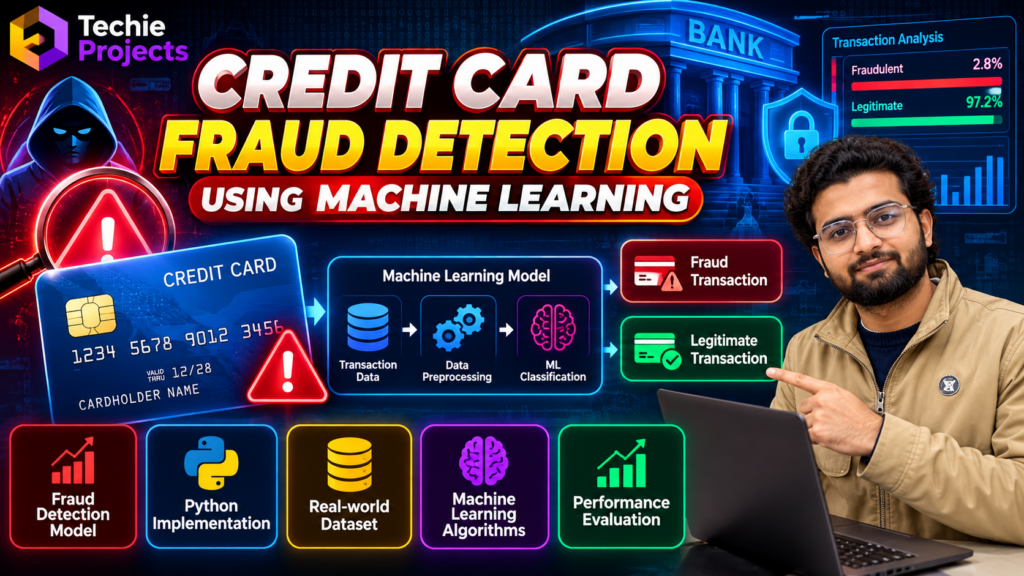
The credit card fraud detection project using machine learning demonstrates how Python and machine learning techniques can help identify potentially fraudulent financial transactions. This project explores transaction data, preprocessing, feature selection, model training, and prediction to understand how automated fraud detection systems work.
Designed as an educational project for computer science, artificial intelligence, and data science students, it provides practical experience with data analysis and classification algorithms. Students can explore the workflow, evaluate model performance, and understand the challenges involved in detecting unusual transaction patterns.
🎬 Credit Card Fraud Detection Project – Demo
Watch the project demonstration to understand its interface, workflow, and fraud prediction process. The demo helps students explore the implementation before deciding whether the project meets their academic requirements.
💳 Credit Card Fraud Detection Project Using Machine Learning: Overview
A credit card fraud detection system uses data analysis and machine learning techniques to identify transactions that may have suspicious characteristics. The system learns patterns from a labeled dataset and uses those patterns to predict whether a new transaction resembles a fraudulent or legitimate transaction.
In a typical academic implementation, transaction records are processed and supplied to a trained classification model. The model returns a predicted class, which the application displays to the user.
A credit card fraud detection project using machine learning provides students with hands-on experience in data preprocessing, classification algorithms, model evaluation, and Python application development.
It is important to understand that a student project is an educational prototype. Its predictions are not a guarantee of real-world fraud detection, and it should not be used to make actual banking or financial decisions without rigorous testing and appropriate security controls.
A credit card fraud detection project using machine learning combines transaction data preprocessing, classification algorithms, and model evaluation to predict whether a transaction may be fraudulent or legitimate. The project helps students understand how Python and machine learning techniques can be applied to financial data analysis.
🎯 Objectives of the Project
The primary objective is to demonstrate how machine learning can support the identification of suspicious financial transactions.
Key objectives include:
- 📊 Analyze transaction data and identify useful patterns.
- 🧹 Clean and preprocess the dataset before training.
- 🤖 Train a machine learning classification model.
- 🔍 Predict whether a transaction may be fraudulent or legitimate.
- 📈 Evaluate the model using suitable performance metrics.
- 🖥️ Display prediction results through the available application interface.
- 🎓 Help students understand a real-world application of data science and machine learning.
These objectives make the project relevant to academic demonstrations, machine learning practice, and final-year project work.
⚙️ How Does the System Work?
The project generally follows a series of data-processing and prediction steps.
1. Transaction Dataset Collection 📂
The system begins with a transaction dataset containing records used for training and evaluation. Depending on the dataset, the records may contain transaction-related numerical features and a target label indicating whether a transaction is fraudulent.
The quality and suitability of the dataset strongly influence the model’s results.
2. Data Preprocessing 🧹
Before training, the dataset is inspected and prepared. Preprocessing may include checking missing values, handling duplicate records, scaling numerical features, and separating input features from target labels.
Fraud datasets often contain far fewer fraudulent transactions than legitimate transactions. Therefore, students should pay attention to class imbalance when preparing the data.
3. Feature Selection and Preparation 🔎
The input features are organized into a format suitable for the selected algorithm. The exact features depend on the dataset and project implementation.
Training and test data should be separated appropriately to evaluate performance on records that were not used to train the model.
4. Machine Learning Model Training 🤖
A classification algorithm learns patterns from the training dataset. Depending on the implementation, suitable algorithms may include Logistic Regression, Decision Tree, Random Forest, or other classification methods.
The actual algorithm used should match the supplied project code and trained model.
5. Transaction Classification 💳
Once trained, the model receives prepared transaction features and generates a prediction. The application can display the result as a potentially fraudulent or legitimate transaction, depending on the model’s output and configured classification threshold.
6. Model Evaluation 📈
The model should be evaluated using metrics such as precision, recall, F1-score, confusion matrix, and, where appropriate, precision-recall AUC.
Accuracy alone can be misleading when fraudulent transactions are rare. For a fraud detection application, it is especially important to understand how many fraudulent transactions the model detects and how many legitimate transactions it incorrectly flags.
⚙️ How the Credit Card Fraud Detection Project Using Machine Learning Works
The credit card fraud detection project using machine learning generally follows these steps:
- 📂 Dataset collection: Load a suitable transaction dataset for experimentation.
- 🧹 Data preprocessing: Handle missing values, prepare features, and inspect class imbalance where applicable.
- 🧠 Model training: Train a suitable classification algorithm using the prepared data.
- 🔍 Fraud prediction: Evaluate transactions and classify them according to the model’s learned patterns.
- 📊 Model evaluation: Review appropriate metrics, such as precision, recall, F1-score, and the confusion matrix.
Actual performance depends on the dataset, selected algorithm, and implementation. This educational project is not a production-ready banking fraud prevention system.
🌟 Key Features of the Project
The exact features depend on the version and implementation supplied. Common features in an academic fraud detection project include:
- Transaction classification: Predicts a class for prepared transaction data.
- Machine learning integration: Uses a trained classification model.
- Data preprocessing: Prepares input features for model prediction.
- Prediction output: Displays the predicted class through the available interface.
- Performance evaluation: Supports analysis of model performance using appropriate metrics.
- Python implementation: Demonstrates a machine learning workflow in Python.
- Learning-focused design: Helps students understand the relationship between datasets, model training, and predictions.
- Customization potential: Additional features may be discussed depending on the project scope.
Before purchasing, confirm the exact interface, algorithms, dataset, and features included in the available project package.
🧰 Technologies Used
A typical Python implementation may use the following technologies:
- Programming language: Python
- Data processing: Pandas and NumPy
- Machine learning: Scikit-learn
- Data visualization: Matplotlib or Seaborn, if included
- Model persistence: Joblib or Pickle, if used by the implementation
- User interface: The interface provided by the project, such as a Python GUI or web application
These are common technology options rather than a guarantee that every package is included in the current project. Please confirm the final technology stack before purchase.
💻 Software and Hardware Requirements
Software Requirements
- Python installed on the computer
- A compatible code editor or IDE, such as Visual Studio Code or PyCharm
- Required Python libraries
- The transaction dataset used by the implementation
- A compatible operating system
Hardware Requirements
- A computer or laptop capable of running Python
- Adequate RAM for the selected dataset and libraries
- Sufficient storage for the source code, dataset, and model files
A GPU is generally not necessary for a basic tabular machine learning implementation. Actual requirements depend on the dataset size and selected algorithms.
📚 Applications of Credit Card Fraud Detection
Credit card fraud detection is relevant to several financial and analytical applications.
🏦 Digital Banking and Payments
Machine learning can help analyze payment patterns and identify transactions that deserve further review.
🛒 E-commerce Transactions
Online shopping platforms can use fraud detection techniques as one component of a broader payment risk management process.
📊 Financial Data Analytics
The project demonstrates how transaction datasets can be analyzed to identify patterns and build classification models.
🎓 Academic and Research Projects
Students can use the project to study data preprocessing, supervised learning, imbalanced datasets, classification metrics, and model evaluation.
These are potential application areas for the underlying techniques; the academic prototype itself is not a production-ready financial security system.
📈 Advantages of the Project
- Provides practical experience with Python and machine learning.
- Demonstrates a relevant financial technology use case.
- Helps students understand classification and data preprocessing.
- Introduces important model evaluation techniques.
- Can be extended for additional academic experimentation.
- Offers a useful starting point for learning about imbalanced datasets and prediction errors.
⚠️ Limitations and Challenges
A responsible project report should also explain the limitations.
Imbalanced data: Fraudulent transactions may represent a very small proportion of the dataset, making model evaluation more challenging.
False positives: A legitimate transaction may be classified as suspicious.
False negatives: A fraudulent transaction may be classified as legitimate.
Dataset limitations: Patterns in a training dataset may not reflect new or changing fraud techniques.
Privacy and security: Real financial transaction data requires appropriate authorization, privacy safeguards, and secure handling.
Model reliability: Performance on a sample dataset does not establish reliability in a real banking environment.
Discussing these challenges makes the project report more technically meaningful and demonstrates an understanding of responsible machine learning.
🚀 Future Enhancements
The project can potentially be extended with additional functionality, subject to the dataset and implementation.
- 📊 Add a dashboard showing transaction statistics and model evaluation results.
- 📈 Compare multiple classification algorithms.
- ⚖️ Experiment with class-weighting or resampling techniques for imbalanced data.
- 🔍 Add feature-importance analysis where supported by the selected model.
- 🌐 Develop a web interface for entering transaction features.
- 🧪 Evaluate the model on separate test data and investigate false positives and false negatives.
- 🔐 Introduce appropriate authentication and secure data handling if developing a larger application.
Any proposed enhancement should be implemented and tested before it is presented as an existing feature.
🛒 Purchase the Credit Card Fraud Detection Project from Techie Projects
Looking for a credit card fraud detection project using machine learning for your final-year project? Contact Techie Projects to ask about source code availability, implementation details, project demonstrations, documentation, and customization options.
🎓 Who can benefit from this project?
- B.Tech and B.E. Computer Science students
- Information Technology students
- Artificial Intelligence and Data Science students
- Students learning Python and machine learning
- Students preparing academic project demonstrations
What Should You Confirm Before Ordering?
Before making a purchase, contact us to confirm:
- Availability of the current project version
- Source code and dataset inclusion
- Software and library requirements
- Project documentation and report availability
- Installation and implementation support
- Customization options and applicable charges
- Delivery timeline and payment details
The included deliverables depend on the package agreed upon before purchase.
📲 Contact Us to Discuss Your Project
📲 Call/WhatsApp: +91-9460060699
🌎 Website: www.techieprojects.com
📺 Instagram: @pythonprojects_
Send us your course, project requirements, preferred technologies, and deadline. We can discuss availability, pricing, and suitable customization options before you order.
🎓 Explore Related Projects
Explore other project areas on Techie Projects to find ideas related to machine learning, artificial intelligence, and Python development.
- Machine Learning Projects – Explore projects based on classification, prediction, and data analysis.
- Deep Learning Projects – Discover projects using neural networks and deep learning techniques.
- OpenCV Projects – Explore computer vision and image processing applications.
- Data Science Projects – Learn about data analysis, preprocessing, and predictive modeling.
- Python Projects – Explore Python-based academic and practical applications.
- Final Year Engineering Projects – Browse Techie Projects and contact us about available final-year project options.
Check each category for current listings and contact us to confirm the availability of a specific project.
❓ Frequently Asked Questions
1. What is a credit card fraud detection project using machine learning?
It is an academic software project that uses transaction data and a trained classification model to predict whether a transaction resembles a fraudulent or legitimate transaction.
2. Which programming language is used?
Python is commonly used for this type of project. Libraries such as Pandas, NumPy, and Scikit-learn may support data preparation and model training, depending on the implementation.
3. Is this project suitable for final-year engineering students?
Yes, it can be suitable for students in computer science, information technology, artificial intelligence, and data science, subject to their institution’s project guidelines.
4. Can I customize the project?
Possible customizations may include the user interface, model comparison, evaluation dashboard, or additional analytical features. Confirm feasibility and pricing with Techie Projects before ordering.
5. Will the system detect every fraudulent transaction?
No. Machine learning predictions can contain false positives and false negatives. Performance depends on the dataset, preprocessing, model, evaluation methodology, and operating conditions.
6. Does the project include source code and documentation?
Please confirm the available deliverables with Techie Projects before purchasing. Source code, datasets, documentation, and implementation support should be agreed upon in advance.
7. How can I purchase the project?
Contact Techie Projects through WhatsApp. Share your course, deadline, and requirements to discuss project availability, pricing, and delivery details.
✅ Conclusion
The credit card fraud detection project using machine learning introduces students to an important application of data science in financial transaction analysis. It combines data preprocessing, classification, model evaluation, and prediction into a practical academic project.
For final-year students, the project offers an opportunity to explore Python programming and machine learning while understanding the limitations of automated fraud classification.
If you want to purchase this project or discuss customization for your academic requirements, contact Techie Projects through WhatsApp or visit techieprojects.com. Confirm the available features, deliverables, pricing, and support before placing your order.