
Introduction
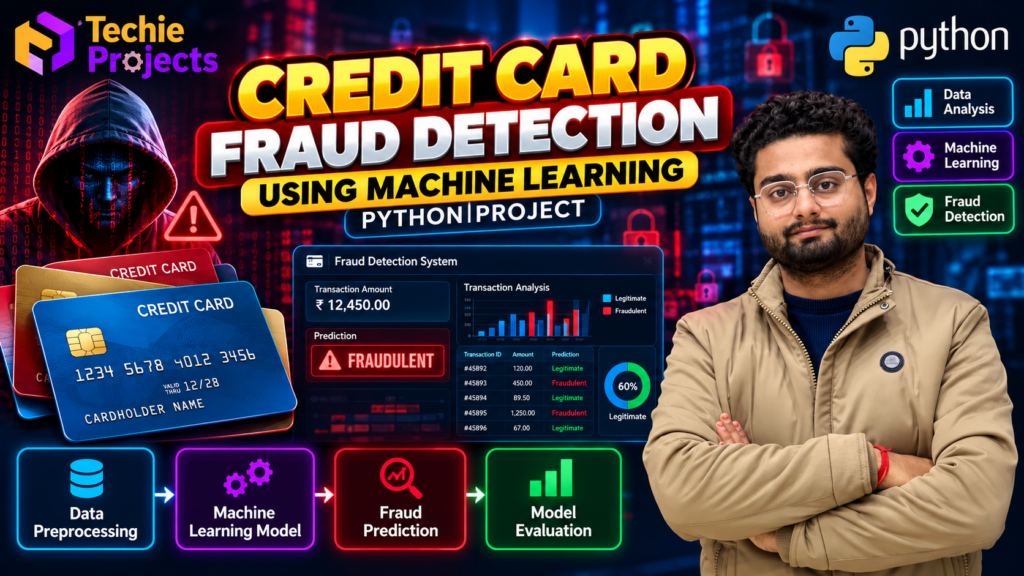
Credit Card Fraud Detection Using Machine Learning is a Python-based machine learning project designed to analyze financial transaction data and identify potentially fraudulent transactions. This project demonstrates how data preprocessing, feature selection, and classification algorithms can help distinguish suspicious transactions from legitimate ones.
As digital payments and online shopping continue to grow, detecting unusual transaction patterns has become an important application of artificial intelligence. The Credit Card Fraud Detection Using Machine Learning project provides an opportunity for B.Tech, BCA, MCA, computer science, and final-year engineering students to understand how machine learning can be applied to a real-world financial security problem.
Techie Projects offers project-related support for students who want to explore this implementation, understand its workflow, and develop their machine learning skills. Students can contact us to enquire about project availability, source code, implementation details, and customization options.
🎬 Credit Card Fraud Detection Using Machine Learning – Project Demo Video
Watch the project demonstration to understand how the Credit Card Fraud Detection System processes transaction data and produces a prediction. The demo helps students explore the application’s interface, workflow, and main features before enquiring about the project.
The demonstration illustrates the project implementation; actual functionality and prediction performance depend on the dataset, trained model, and software version provided.
🎓 Credit Card Fraud Detection Project Overview
The Credit Card Fraud Detection Using Machine Learning system uses transaction data to train a classification model. After preprocessing the data, the model learns patterns that may help distinguish fraudulent transactions from legitimate transactions.
The system can be developed as a Python application with a user interface that accepts transaction-related inputs and displays a model prediction. Depending on the implementation, it may also include dataset analysis, model evaluation, and visualizations.
This project is suitable for students interested in machine learning, Python programming, data analytics, and financial fraud detection.
🎯 Objectives of the Project
The primary objectives of the Credit Card Fraud Detection Using Machine Learning project are:
- To understand the application of machine learning in financial transaction analysis.
- To preprocess and prepare transaction datasets for model training.
- To explore classification algorithms for identifying potentially fraudulent transactions.
- To evaluate model performance using appropriate classification metrics.
- To display prediction results through a user-friendly interface, if included in the implementation.
- To demonstrate a practical machine learning workflow for an academic project.
⚙️ How Does the System Work?
The system generally follows these steps:
1. Transaction Dataset Collection
A suitable transaction dataset is collected for training and testing. The dataset may contain transaction features and labels indicating whether a transaction is fraudulent or legitimate.
2. Data Preprocessing
The data is checked for missing values, inconsistent formats, and other quality issues. Features are transformed or scaled when required by the selected model.
3. Feature Selection and Preparation
Relevant transaction attributes are prepared for model training. The dataset is divided into training and testing sets using an appropriate strategy to reduce data leakage.
4. Machine Learning Model Training
A suitable classification algorithm is trained on the prepared dataset. Depending on the implementation, possible algorithms include Logistic Regression, Decision Tree, Random Forest, or other classification models.
5. Fraud Prediction
The trained model receives transaction features and generates a prediction. The application may display the output as a potentially fraudulent or legitimate transaction according to the model’s classification.
6. Model Evaluation
The model is evaluated using suitable metrics such as precision, recall, F1-score, confusion matrix, and precision-recall analysis. These metrics are particularly important because fraudulent transactions are often much less common than legitimate ones.
✨ Key Features of the Project
The features available depend on the selected project version and implementation. Common features may include:
- Transaction Data Analysis: Explore the structure and distribution of transaction data.
- Data Preprocessing: Prepare data for machine learning.
- Classification Model: Train a model to classify transactions.
- Fraud Prediction: Generate predictions for supported transaction inputs.
- Performance Evaluation: Review classification metrics and prediction errors.
- Data Visualization: Display charts and graphs when included.
- Python Implementation: Demonstrate a practical machine learning workflow.
- User Interface: Provide a simple interface if the selected version includes one.
🧠 Technologies Used
The project can use the following technologies, depending on the implementation:
- Programming Language: Python
- Data Processing: Pandas and NumPy
- Machine Learning: Scikit-learn
- Data Visualization: Matplotlib or Seaborn
- User Interface: Streamlit, Flask, or another supported framework, if included
- Development Environment: Jupyter Notebook, VS Code, or another Python-compatible IDE
Confirm the exact libraries and frameworks included in your selected version before purchase.
💻 Software and Hardware Requirements
Software Requirements
- Python installed on the computer
- Required Python libraries for the selected implementation
- A compatible code editor or IDE
- A supported transaction dataset
- Compatible operating system and dependency versions
Hardware Requirements
- A computer or laptop capable of running Python
- Sufficient memory and storage for the dataset and project dependencies
- Internet access for downloading dependencies, if required
A dedicated GPU is generally not necessary for a basic tabular-data classification project.
📊 Applications of Credit Card Fraud Detection
Credit card fraud detection techniques can be explored in several areas:
Digital Banking and Payments
Machine learning can help analyze payment patterns and identify transactions that require further review.
E-commerce Transactions
Online shopping platforms can study transaction characteristics to help identify suspicious payment activity.
Financial Data Analytics
Analysts can use transaction datasets to study fraud patterns, class imbalance, and classification performance.
Academic and Research Projects
Students can use this project to demonstrate data preprocessing, model training, evaluation, and application development.
Important: This academic project is a demonstration of machine learning concepts, not a production-ready banking security system. Its predictions should not be used as the sole basis for real financial decisions.
✅ Advantages of the Project
- Demonstrates a practical application of Python and machine learning.
- Helps students understand classification algorithms and data preparation.
- Introduces evaluation metrics for imbalanced datasets.
- Can be extended with additional models and visualization features.
- Provides a foundation for further research in financial data analytics.
- Can support academic presentations and project demonstrations when used according to institutional requirements.
⚠️ Limitations and Challenges
Fraud detection is a challenging classification problem. Students should consider the following limitations:
- Class Imbalance: Fraudulent transactions may represent only a small proportion of the dataset.
- False Positives: Legitimate transactions may be incorrectly flagged as suspicious.
- False Negatives: Some fraudulent transactions may not be detected.
- Changing Fraud Patterns: Models may become less effective when transaction behavior changes.
- Dataset Quality: Incomplete, outdated, or unrepresentative data can affect results.
- Privacy and Security: Real financial data must be handled securely and lawfully.
The project should report measured evaluation results rather than claim guaranteed fraud detection accuracy.
🚀 Future Enhancements
The Credit Card Fraud Detection Using Machine Learning project can be extended with additional features, such as:
- Comparing multiple classification algorithms.
- Improving evaluation for imbalanced datasets.
- Adding precision-recall curves and confusion matrix visualizations.
- Developing an interactive dashboard for transaction analysis.
- Integrating additional validation and monitoring features.
- Exploring anomaly detection techniques.
- Designing a more comprehensive interface for demonstration purposes.
These enhancements depend on the available dataset, project scope, and development requirements.
🛒 Purchase the Credit Card Fraud Detection Project from Techie Projects
Are you looking for a Credit Card Fraud Detection Using Machine Learning project in Python for your final-year engineering project, academic demonstration, or machine learning practice?
Techie Projects can help you enquire about project availability and suitable implementation options. Contact us to confirm the source code package, software requirements, included features, documentation, and customization support before placing your order.
This project may be relevant to:
- B.Tech and BE Computer Science students
- BCA and MCA students
- Students learning Python and machine learning
- Final-year project teams exploring financial data analytics
- Learners looking for a practical classification project
What Should You Confirm Before Ordering?
Before purchasing, ask us about:
- The available project version and its features
- Source code and setup instructions
- Dataset availability and usage permissions
- Project documentation and report availability
- Installation and implementation support
- Customization options and applicable charges
- Delivery format, payment terms, and support conditions
Ready to enquire?
- 📲 Call/WhatsApp: +91-9460060699
- 🌎 Website: www.techieprojects.com
- 📺 Instagram: @pythonprojects_
Send a message mentioning “Credit Card Fraud Detection Using Machine Learning” to discuss availability and your project requirements.
🎓 Explore Related Projects
Explore these related project areas on Techie Projects:
- Machine Learning Projects
- Deep Learning Projects
- Data Science Projects
- Artificial Intelligence Projects
- Python Projects
- Final Year Engineering Projects
Browse the website to find relevant project ideas and enquire about specific implementations.
❓ Frequently Asked Questions
1. What is Credit Card Fraud Detection Using Machine Learning?
It is a machine learning application that analyzes transaction features to classify transactions as potentially fraudulent or legitimate.
2. Which programming language is used in this project?
Python is commonly used because it provides libraries for data processing, classification, visualization, and model evaluation.
3. Which machine learning algorithms can be used?
Depending on the implementation, algorithms may include Logistic Regression, Decision Tree, Random Forest, and other suitable classifiers.
4. Is this project suitable for final-year engineering students?
Yes. It can be a useful academic project for students studying computer science, information technology, data science, or machine learning, subject to their institution’s project requirements.
5. Can I customize the project?
Customization may be available depending on the selected version and requirements. Contact Techie Projects to confirm feasibility, pricing, and delivery details.
6. How can I purchase this project?
Contact Techie Projects through WhatsApp and mention the project name. Confirm the deliverables and terms before making a payment.
7. Does the project guarantee accurate fraud detection?
No. Performance depends on dataset quality, feature engineering, model selection, evaluation methodology, and changes in transaction patterns. Academic results do not guarantee real-world performance.
📝 Conclusion
The Credit Card Fraud Detection Using Machine Learning project provides a practical way to explore Python programming, transaction data preprocessing, classification algorithms, and model evaluation. It can help students understand how machine learning techniques are applied to financial fraud analysis while developing skills in data science and software implementation.
If you want to explore this project for your academic work, contact Techie Projects to discuss availability, source code, documentation, and customization options. Confirm the included deliverables and support terms before ordering.
Build your machine learning skills with a project that connects Python programming to a real-world data analysis challenge.