
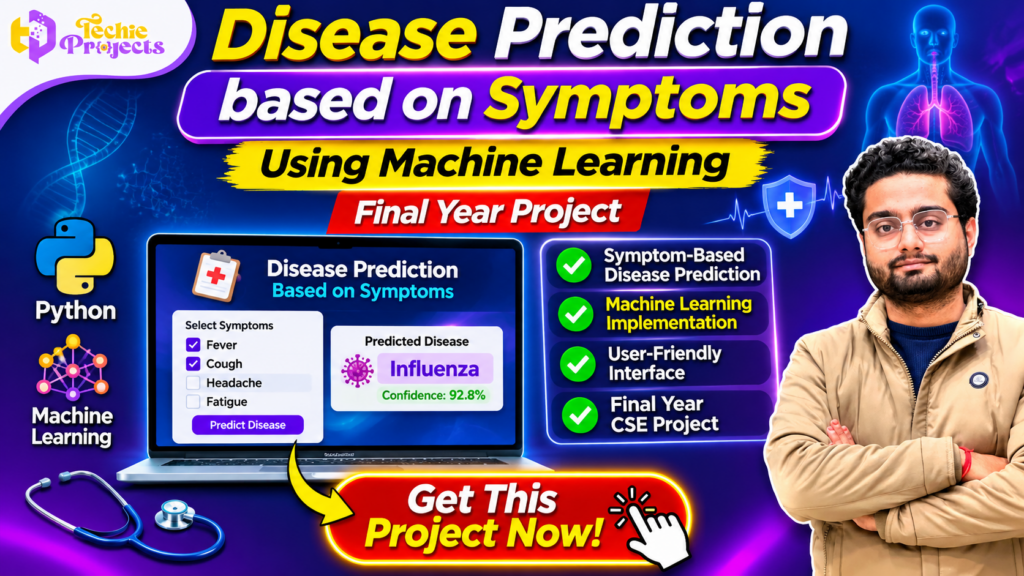
Are you looking for a practical Disease Prediction Based on Symptoms Using Machine Learning project for your final-year submission? Get a ready-to-explore Python-based machine learning project from Techie Projects, designed to help students understand how artificial intelligence can analyse symptoms and predict possible diseases.
This project is a valuable choice for B.Tech, BCA, MCA, M.Tech, and Computer Science Engineering students who want to demonstrate machine learning, Python programming, data preprocessing, classification algorithms, and healthcare-related applications of AI.
Instead of spending weeks building every component from scratch, you can enquire about the project package from Techie Projects and get details about the available source code, project documentation, implementation guidance, and technical support. It provides an opportunity to study a complete academic project and understand how machine learning can be applied to a real-world problem.
The Disease Prediction Based on Symptoms Using Machine Learning project is developed as an educational prototype. It demonstrates possible predictions from user-selected symptoms and should not be considered a medical diagnosis or a replacement for professional healthcare advice.
📞 Contact Techie Projects for Project Enquiries
Want to purchase the Disease Prediction Based on Symptoms Using Machine Learning project? Contact Techie Projects to enquire about pricing, availability, project files, and technical support.
- 📲 Call/WhatsApp: +91-9460060699
- 🌎 Website: www.techieprojects.com
- 📺 Instagram: @pythonprojects_
Get this project now! Contact our team to discuss the available project package and take the next step towards your final-year project.
🎬 Disease Prediction Based on Symptoms Using Machine Learning – Project Demo
The project demonstration presents the working concept of a Python-based disease prediction application. It explains how users can select symptoms, how the application processes the selected inputs, and how a trained machine learning model generates a possible prediction.
The demonstration helps students understand the project interface, input process, prediction workflow, and practical implementation of machine learning in a healthcare-related academic application.
🩺 What Is Disease Prediction Based on Symptoms Using Machine Learning?
Disease prediction based on symptoms is an application of machine learning in which a computer model analyses symptom-related inputs and predicts a possible disease category based on patterns learned from training data.
In a traditional healthcare process, medical professionals evaluate symptoms, medical history, physical examination results, and other relevant information before making a diagnosis. A machine learning project can demonstrate how data-driven algorithms identify patterns between symptoms and disease labels.
The Disease Prediction Based on Symptoms Using Machine Learning project uses a structured dataset containing symptom information and corresponding disease categories. The dataset is processed and used to train a classification model.
When a user selects symptoms through the application, the input is converted into a format that the trained model can understand. The model then produces a predicted category based on the patterns learned during training.
This project is intended for academic learning and software demonstration. Its output is not clinically validated and must not be used to diagnose, treat, or rule out any medical condition.
🎯 Main Objectives of the Project
The primary objective is to develop an educational application that demonstrates the use of machine learning algorithms for symptom-based classification.
Important objectives include:
- Understand how machine learning can be applied to healthcare-related datasets.
- Collect and prepare structured symptom and disease data.
- Perform data preprocessing and feature selection.
- Train a machine learning classification model.
- Accept multiple symptoms as user inputs.
- Generate a possible disease-category prediction.
- Develop a user-friendly interface for interacting with the model.
- Understand the limitations of machine learning predictions.
⚙️ Key Features of the Disease Prediction Project
The following features explain the main capabilities that can be demonstrated in this academic project.
1. 👨💻 User-Friendly Interface
The application provides an interface where users can select or enter symptoms. A simple interface makes it easier to understand the prediction process without requiring users to interact directly with Python code.
2. 🩺 Multiple Symptom Selection
Users can provide multiple symptom inputs depending on the available dataset and application design. The selected symptoms are converted into model-compatible features before prediction.
3. 🤖 Machine Learning-Based Prediction
The trained classification model analyses the symptom inputs and generates a possible disease-category prediction. This demonstrates how machine learning can identify patterns in structured data.
4. 📊 Dataset-Based Analysis
The application uses a structured dataset containing symptom features and disease labels. The dataset provides the information required to train and evaluate the machine learning model.
5. 🔍 Data Preprocessing
Data preprocessing prepares the dataset for machine learning. It may include handling missing values, converting categorical information, checking duplicate records, and preparing input features.
6. 📈 Model Training and Evaluation
The training process helps students understand how a classification algorithm learns patterns from the dataset. Evaluation metrics can be used to examine model performance on test data.
7. 🖥️ Prediction Results
After receiving the input symptoms, the application displays the model’s predicted category. The result is intended for educational demonstration, not medical decision-making.
🧠 Technologies Used in the Project
The Disease Prediction Based on Symptoms Using Machine Learning project combines Python programming, data processing, machine learning, and application development.
🐍 Python
Python is the primary programming language used for developing the project. It provides a simple syntax and a large ecosystem of libraries for data science and machine learning.
📚 Pandas
Pandas is used to load, organise, manipulate, and analyse structured datasets. It helps prepare symptom-related data for model development.
🔢 NumPy
NumPy supports numerical operations and array processing. It is useful for preparing data and performing mathematical computations.
🤖 Scikit-learn
Scikit-learn provides machine learning tools for data preprocessing, classification, model training, and evaluation. The specific algorithm depends on the implementation.
📊 Matplotlib and Seaborn
These libraries can be used to visualise dataset information, feature distributions, and model evaluation results.
🌐 Streamlit or Flask
A web framework such as Streamlit or Flask can be used to create an interactive interface for accepting symptom inputs and displaying prediction results, depending on the project implementation.
🔄 How Does the Project Work?
The workflow explains how the application processes symptom inputs and generates a prediction.
Step 1: Dataset Collection
A structured dataset containing symptom-related features and disease labels is collected for academic model development. The quality, completeness, and suitability of the dataset are important for meaningful results.
Step 2: Data Preprocessing
The dataset is examined and prepared for training. Missing values, inconsistent entries, duplicate records, and categorical variables are handled as required.
Step 3: Feature Preparation
The symptom columns are converted into a numerical representation that the machine learning algorithm can process. The input format used during prediction must match the format used during model training.
Step 4: Model Selection
A suitable classification algorithm is selected according to the dataset and project requirements. Possible algorithms for educational experimentation include:
- Decision Tree
- Random Forest
- Support Vector Machine
- Naive Bayes
- K-Nearest Neighbours
The final algorithm should be selected and evaluated based on the actual dataset rather than assuming that one algorithm is always the most accurate.
Step 5: Model Training
The prepared dataset is divided into training and testing portions. The model learns patterns from the training data and is evaluated using data that was not used for training.
Step 6: User Input
The application allows users to select symptoms through its interface. These inputs are transformed into the same feature structure expected by the trained model.
Step 7: Prediction Generation
The trained model processes the selected symptoms and returns a predicted disease category based on its learned patterns.
Step 8: Display Results
The application displays the prediction result. The interface should clearly explain that the output is experimental and is not a substitute for medical evaluation.
💻 Example of a Symptom-Based Prediction Workflow
Consider an educational example in which a user selects several symptoms from the available options.
The application follows this process:
- The user selects symptoms.
- The application converts the selections into numerical features.
- The prepared input is passed to the trained model.
- The model processes the input.
- The application displays the predicted category.
The example demonstrates the basic relationship between user input, feature processing, machine learning classification, and output generation.
Actual prediction results depend on the dataset, selected symptoms, training procedure, and model performance. A prediction should never be interpreted as confirmation that a person has a particular disease.
🎓 Benefits of Disease Prediction Based on Symptoms Using Machine Learning for Students
The Disease Prediction Based on Symptoms Using Machine Learning project offers students an opportunity to explore multiple areas of computer science through one practical implementation.
1. Practical Machine Learning Experience
Students can understand how a classification model is trained, tested, and used to process new inputs.
2. Python Programming Skills
The project provides practical exposure to Python libraries such as Pandas, NumPy, and Scikit-learn.
3. Understanding Data Preprocessing
Students learn why data cleaning, feature preparation, and consistent input formatting are important in machine learning applications.
4. Healthcare Technology Exploration
The project introduces students to an educational application of AI in healthcare-related data analysis.
5. Academic Demonstration
Students can use the project to explain dataset preparation, algorithm selection, model training, prediction, and evaluation during an academic demonstration.
6. Project Development Knowledge
Working through the implementation helps students understand how individual components are connected to create a complete software application.
📂 Project Modules
The project can be understood through the following development modules.
1. Dataset Module: Manages the symptom and disease dataset used for training and testing.
2. Data Preprocessing Module: Cleans and prepares the dataset for machine learning.
3. Feature Processing Module: Converts symptom information into the format expected by the model.
4. Model Training Module: Trains the selected classification algorithm.
5. Prediction Module: Processes new symptom inputs and generates the predicted category.
6. User Interface Module: Provides an interface for entering symptoms and viewing results.
7. Evaluation Module: Examines model performance using appropriate evaluation metrics.
The exact modules and their implementation depend on the project version and package supplied.
📊 Machine Learning Algorithms Used for Disease Prediction
Different classification algorithms can be explored in this project. Each algorithm has different strengths and limitations.
Decision Tree
A Decision Tree uses a tree-like structure to make predictions based on feature conditions. It is relatively easy to understand and can help students learn classification logic.
Random Forest
Random Forest combines predictions from multiple decision trees. It can be useful for experimenting with structured datasets and comparing classification performance.
Support Vector Machine
Support Vector Machine attempts to identify a decision boundary that separates different classes. It can be explored for classification problems with suitable feature representations.
Naive Bayes
Naive Bayes uses probability-based classification and can be useful as a baseline model for structured data.
K-Nearest Neighbours
K-Nearest Neighbours predicts a class based on the labels of nearby data points. Its performance depends on feature scaling, distance measures, and dataset characteristics.
The most suitable algorithm should be selected after comparing results using a proper evaluation process. Accuracy alone is not sufficient to establish clinical usefulness.
📈 Model Evaluation and Performance
Model evaluation is an important part of the Disease Prediction Based on Symptoms Using Machine Learning project. It helps students understand whether a trained model performs well on unseen test data.
Common evaluation metrics include:
- Accuracy: The proportion of correct predictions among all predictions.
- Precision: The proportion of positive predictions that are correct for a particular class.
- Recall: The proportion of actual instances of a class that the model correctly identifies.
- F1-score: A combined measure of precision and recall.
- Confusion Matrix: A table showing correct and incorrect predictions across classes.
For a multi-class classification problem, evaluation should examine individual class performance as well as overall results. Dataset imbalance and possible data leakage should also be considered.
A high test accuracy does not automatically mean that a model is suitable for real-world medical use. Clinical validation, representative data, privacy safeguards, and expert assessment would be required for any healthcare deployment.
🚀 Applications of the Project
This project demonstrates concepts that are relevant to several areas of technology and research.
- Academic Learning: Demonstrates machine learning classification using structured data.
- Healthcare Technology Research: Provides an educational example for exploring data-driven healthcare applications.
- Python Development: Demonstrates the use of Python libraries in an integrated application.
- Data Science Practice: Helps students understand data cleaning, feature preparation, and model evaluation.
- AI Demonstrations: Can be used to explain how classification algorithms process input features.
The application is a learning prototype and must not be used for medical diagnosis, treatment decisions, emergency assessment, or self-medication.
🛠️ Software and Hardware Requirements
The following are typical development requirements. Actual requirements may vary according to the implementation.
Software Requirements
- Programming Language: Python
- Operating System: Windows 10 or Windows 11
- Development Environment: VS Code, PyCharm, or Jupyter Notebook
- Data Processing: Pandas and NumPy
- Machine Learning: Scikit-learn
- Visualisation: Matplotlib and Seaborn
- User Interface: Streamlit or Flask, if included in the implementation
Hardware Requirements
- Processor: Intel or AMD processor
- RAM: 4 GB minimum; 8 GB recommended
- Storage: Sufficient free space for Python, libraries, and project files
- Input Devices: Keyboard and mouse
- Display: Standard computer monitor
A GPU is generally not necessary for a small, structured-data classification project.
🛒 Why Choose Techie Projects for This Project?
Choosing a suitable academic project is an important step for students preparing for final-year submissions and technical demonstrations.
At Techie Projects, students can enquire about engineering and computer science project packages across areas such as Artificial Intelligence, Machine Learning, Deep Learning, Python, Data Science, Internet of Things, and Computer Vision.
When you enquire about the Disease Prediction Based on Symptoms Using Machine Learning project, our team can provide information about the available package, deliverables, pricing, and support options.
What Can You Enquire About?
Depending on the selected package and availability, you can ask about:
- Python project source code
- Dataset and related files
- Project documentation
- Installation and execution instructions
- Implementation explanation
- Technical support options
- Project demonstration and workflow
- Guidance for understanding the project
Please confirm the exact deliverables and support included in your package before purchasing.
💡 Who Can Purchase This Project?
This project may be suitable for:
- B.Tech Computer Science Engineering students
- BCA students
- MCA students
- M.Tech students
- Artificial Intelligence students
- Machine Learning learners
- Python programming learners
- Students exploring healthcare-related data science applications
Students should review their institution’s academic rules and use the project responsibly. Understand the implementation and follow your college’s requirements for disclosure, modification, and submission.
📞 Get This Project Now – Contact Techie Projects
Ready to explore the Disease Prediction Based on Symptoms Using Machine Learning project?
Get in touch with Techie Projects to enquire about the available project package, source code, documentation, pricing, and technical support.
👉 GET THIS PROJECT NOW!
📲 WhatsApp: https://wa.me/919460060699
☎️ Call: +91 94600 60699
🌐 Website: https://techieprojects.com/
📸 Instagram: https://www.instagram.com/pythonprojects_/
Contact us today to discuss your requirements and check the available project options.
❓ Frequently Asked Questions (FAQs)
1. What is Disease Prediction Based on Symptoms Using Machine Learning?
It is an educational machine learning project that processes selected symptom features and predicts a possible disease category using a trained classification model.
2. Which programming language is used in this project?
Python is used as the primary programming language. Libraries such as Pandas, NumPy, and Scikit-learn can support data processing and model development.
3. Which machine learning algorithms can be used?
Decision Tree, Random Forest, Support Vector Machine, Naive Bayes, and K-Nearest Neighbours are possible algorithms for experimentation, depending on the dataset.
4. Is this project suitable for final-year students?
Yes. It can be considered by B.Tech, BCA, MCA, and other computer science students interested in machine learning and Python-based applications, subject to their academic requirements.
5. Does the project provide medical diagnosis?
No. It is an educational prototype that demonstrates machine learning classification. Its predictions are not medically validated and must not be used for diagnosis or treatment.
6. Can I get the source code?
You can contact Techie Projects to enquire about the availability of the Python source code and the deliverables included in the selected package.
7. Is documentation available?
You can ask our team about project documentation, installation instructions, and other available learning resources before purchasing.
8. How can I purchase this project?
Contact Techie Projects through WhatsApp at +91 94600 60699 or visit https://techieprojects.com/ to enquire about pricing and availability.
🔗 Explore Related Python and Machine Learning Projects
Explore more academic project ideas and development resources from Techie Projects:
- Artificial Intelligence Projects
- Machine Learning Projects
- Deep Learning Projects
- Python Projects
- Data Science Projects
- Computer Vision Projects
- Healthcare Projects
- Final Year Engineering Projects
Visit https://techieprojects.com/ to explore more project options.
🎯 Conclusion
The Disease Prediction Based on Symptoms Using Machine Learning project is an educational example of how Python and machine learning can be combined to process structured symptom data and generate classification predictions.
It introduces important concepts such as dataset preparation, feature processing, classification algorithms, model training, evaluation metrics, and application development. These concepts make it a useful topic for students who want practical exposure to machine learning and healthcare-related technology.
If you are looking for a Python-based machine learning project for your academic work, contact Techie Projects to enquire about the available source code, documentation, pricing, and technical support.
🚀 Get your Disease Prediction Based on Symptoms Using Machine Learning project now!