
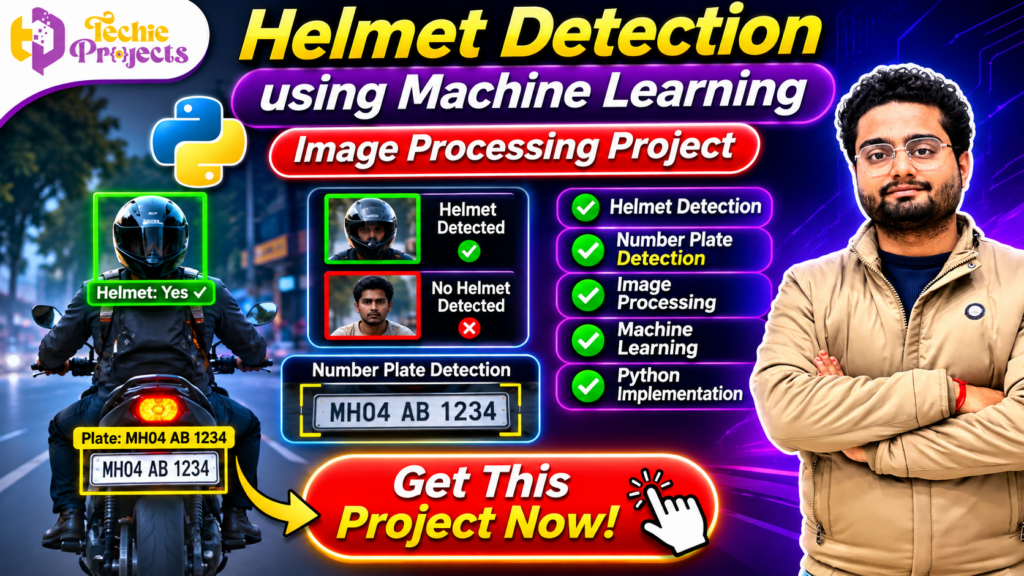
Helmet Detection Using Machine Learning | Python Image Processing Project
🚀 Looking for a practical final-year engineering project that combines Python, Artificial Intelligence, Machine Learning, and Computer Vision? Get the Helmet Detection Using Machine Learning project from Techie Projects!
The Helmet Detection Using Machine Learning project demonstrates how computer vision can identify motorcycle riders wearing helmets and distinguish them from riders without helmets. It also introduces number plate detection, image processing, and automated traffic monitoring concepts in a practical application.
Instead of spending weeks struggling with project development, installation errors, model configuration, and implementation, you can enquire about the complete project package from Techie Projects. Get access to project resources, source code options, documentation, and technical guidance to help you understand and demonstrate your final-year project.
Whether you are a B.Tech, BCA, MCA, M.Tech, or Computer Science Engineering student, this project offers an opportunity to explore real-world applications of intelligent traffic monitoring.
📞 Contact Techie Projects for Project Enquiries
Want to purchase the Helmet Detection Using Machine Learning project? Contact Techie Projects to check availability, pricing, project resources, and technical support.
- 📲 WhatsApp: https://wa.me/919460060699
- ☎️ Contact Number: +91 94600 60699
- 🌐 Website: https://techieprojects.com/
- 📸 Instagram: https://www.instagram.com/pythonprojects_/
🎬 Watch the Helmet Detection Using Machine Learning Project Demo
Explore the Helmet Detection Using Machine Learning project demonstration to understand its working process, detection interface, and practical computer vision application.
The demonstration explains how the system processes visual input, identifies helmet-related objects, and presents detection results. It also introduces the number plate detection functionality and the overall project workflow.
🔍 What Is Helmet Detection Using Machine Learning?
Helmet Detection Using Machine Learning is a computer vision application designed to identify whether motorcycle riders are wearing helmets. The system analyses images or video frames and uses trained detection techniques to recognise relevant objects.
Road safety is an important concern in modern transportation systems. Traditional traffic monitoring often depends on manual observation, which can be time-consuming and difficult to scale. Computer vision provides an alternative approach by helping analyse traffic images and identify specific road-safety conditions.
A Helmet Detection Using Machine Learning system can be developed to recognise categories such as:
- Helmet-wearing motorcycle riders.
- Motorcycle riders without helmets.
- Motorcycles and related objects.
- Number plates, when the additional detection module is implemented.
The project provides students with practical exposure to image processing, object detection, Python programming, and machine learning concepts.
🎯 Main Objectives of the Project
The primary objective of Helmet Detection Using Machine Learning is to demonstrate how intelligent visual analysis can support automated helmet monitoring.
The major objectives include:
- Helmet Identification: Detect helmets in images or video frames.
- Rider Analysis: Identify motorcycle riders and analyse helmet-related conditions.
- Object Detection: Apply computer vision techniques to recognise relevant objects.
- Number Plate Detection: Demonstrate an additional vehicle identification feature where supported.
- Image Processing: Process visual input for improved detection and analysis.
- Automated Monitoring: Explore how computer vision can assist traffic monitoring applications.
- Practical Learning: Help students understand the development and working principles of an AI-based application.
⚙️ How Does the Helmet Detection System Work?
The Helmet Detection Using Machine Learning project follows a series of image-processing and detection steps.
1. 📷 Image or Video Input
The system receives visual input through an image, recorded video, or supported camera source. This input contains road scenes, motorcycles, riders, and other objects.
2. 🖥️ Image Preprocessing
The input is prepared for analysis. Depending on the implementation, preprocessing may include resizing, colour conversion, frame extraction, and other image-processing operations.
3. 🤖 Object Detection
A trained machine learning or deep learning detection model analyses the input and identifies objects belonging to its trained classes.
4. 🪖 Helmet Classification
The system uses the detected objects and class predictions to identify helmet-related categories. The results depend on the training data, model configuration, image quality, and implementation.
5. 🔢 Number Plate Detection
An additional number plate detection module can identify the number plate region in a vehicle image. Optical Character Recognition (OCR) may be used to extract text when included in the implementation.
6. 📊 Result Display
The application displays the detection results, which may include bounding boxes, class labels, confidence scores, or processed images.
This workflow demonstrates how Helmet Detection Using Machine Learning combines multiple computer vision concepts in one practical project.
🧠 Technologies Used in Helmet Detection Using Machine Learning
The project introduces several important technologies used in modern computer vision applications.
🐍 Python Programming
Python is widely used for machine learning, artificial intelligence, and image-processing development. Its libraries make it suitable for building computer vision applications and experimenting with detection models.
👁️ OpenCV
OpenCV is an open-source computer vision library. It supports image loading, video processing, frame extraction, resizing, colour conversion, and visual output.
🤖 Machine Learning and Deep Learning
Machine learning techniques allow a computer system to learn patterns from training data. Deep learning-based object detection models can identify multiple objects and predict their locations in an image.
🎯 YOLO Object Detection
YOLO (You Only Look Once) is a family of real-time object detection models. It can be used in helmet detection applications when the project implementation is configured with a suitable YOLO model and trained classes.
🔤 Optical Character Recognition
OCR technology can convert text visible in an image into machine-readable characters. It is useful for number plate recognition when supported by the project.
⭐ Key Features of the Project
The Helmet Detection Using Machine Learning project demonstrates important features of an intelligent traffic monitoring application.
🪖 Helmet Detection
The system identifies helmet-related objects using its configured detection model. This is the central feature of the project.
🚫 No-Helmet Identification
The application can identify riders classified as not wearing helmets when the model has been trained and configured for that class.
🔢 Number Plate Detection
The additional number plate module demonstrates how vehicle registration plate regions can be located in an image.
🎥 Video-Based Analysis
Where video input is supported, the application can analyse video frames and display detection results.
📦 Bounding Box Visualisation
Object detection results can be represented through bounding boxes and class labels, making it easier to understand which objects have been identified.
🖥️ Visual Output
The system presents processed images or detection results through its supported interface.
🧩 Practical Computer Vision Workflow
The project brings together input processing, object detection, classification, and result visualisation in one application.
🎓 Benefits of Helmet Detection Using Machine Learning for Final-Year Students
Choosing a practical project can help students connect theoretical knowledge with software development skills. Helmet Detection Using Machine Learning provides an opportunity to explore multiple areas of computer science.
1. 💻 Learn Practical Python Programming
Students can understand how Python is used to develop real-world computer vision applications. Working with image input, model execution, and detection output improves practical programming knowledge.
2. 🤖 Understand Artificial Intelligence
The project introduces AI-based object detection and demonstrates how trained models recognise objects in visual data.
3. 👁️ Explore Computer Vision
Students gain exposure to image processing, video frames, object localisation, and detection visualisation.
4. 📚 Improve Final-Year Project Understanding
The project provides a practical subject for academic demonstrations, project presentations, and technical discussions.
5. 🧪 Gain Testing Experience
Students can explore how different lighting conditions, camera angles, image quality, and object sizes influence detection results.
6. 📄 Support Project Documentation
Project documentation can help students understand the problem statement, objectives, methodology, system requirements, and implementation workflow.
7. 💼 Strengthen Technical Knowledge
The concepts covered in this project are relevant to computer vision, AI development, machine learning, and intelligent transportation applications.
🏗️ Applications of Helmet Detection Using Machine Learning
Computer vision-based helmet monitoring can be explored in several application areas.
🚦 Traffic Monitoring Systems
Traffic monitoring applications can use visual detection to analyse road scenes and identify helmet-related conditions.
🛣️ Road Safety Research
Researchers and students can explore how automated visual analysis may support road-safety studies.
🏙️ Smart City Applications
Intelligent transportation is an important part of smart city development. Computer vision can support traffic analysis and monitoring applications.
🚔 Intelligent Surveillance
Video analytics can be used to study traffic scenes and detect selected objects in supported surveillance environments.
🎓 Academic Research
Students can extend the project by experimenting with different datasets, detection models, and image-processing techniques.
Important: This project is an academic and technical demonstration. Its predictions should not be treated as verified evidence of a traffic violation or as a replacement for authorised enforcement procedures.
🖥️ Software and Hardware Requirements
The following are typical development requirements. Actual requirements may vary depending on the selected model, project version, and implementation.
Software Requirements
- Programming Language: Python
- Operating System: Windows or another supported Python environment
- Image Processing: OpenCV
- Machine Learning: Supported machine learning or deep learning framework
- Object Detection: Configured detection model, such as YOLO where included
- Development Environment: VS Code, PyCharm, or another compatible IDE
Hardware Requirements
- Processor: Modern Intel or AMD processor
- RAM: 8 GB recommended for a comfortable development environment
- Storage: Sufficient space for Python packages, model weights, datasets, and project files
- Input Devices: Keyboard and mouse
- GPU: Optional; a compatible GPU may improve performance for supported models
🛒 Why Choose Techie Projects for This Project?
Finding a suitable final-year engineering project is not only about selecting an interesting topic. Students also need to understand the implementation, prepare documentation, configure the development environment, and demonstrate the application.
Techie Projects helps students explore practical engineering and computer science project topics.
When enquiring about Helmet Detection Using Machine Learning, you can discuss the following package details:
- Project Source Code: Ask about the available source code and project version.
- Project Documentation: Check the availability of project reports and supporting documents.
- Installation Guidance: Get information about the setup and installation process.
- Implementation Explanation: Understand the project’s workflow and major components.
- Demo Reference: Review the available project demonstration.
- Technical Support: Ask about the support available for installation and understanding the project.
Package contents, availability, and support depend on the selected project option. Contact Techie Projects before purchasing to confirm the exact inclusions.
💰 Get Helmet Detection Using Machine Learning Project Now!
Ready to work on an AI-based final-year engineering project?
Get in touch with Techie Projects to enquire about the Helmet Detection Using Machine Learning project package. Discuss the source code, documentation, implementation requirements, pricing, and available technical support before placing your order.
Whether you need a project for B.Tech, BCA, MCA, M.Tech, or another computer science course, our team can help you understand the available project options.
👉 Get This Project Now!
📲 WhatsApp: https://wa.me/919460060699
☎️ Call: +91 94600 60699
🌐 Website: https://techieprojects.com/
📸 Instagram: https://www.instagram.com/pythonprojects_/
Choose your project, understand its implementation, and take the next step towards your final-year engineering project with Techie Projects!
🔮 Future Scope of Helmet Detection Using Machine Learning
The project can be extended with additional features to explore more advanced computer vision applications.
1. 📹 Real-Time Camera Integration
A supported camera can be integrated to analyse live video frames and display detection results.
2. 🚗 Improved Vehicle Detection
The application can be extended to identify different vehicle categories, depending on the available training data.
3. 🔤 Advanced Number Plate Recognition
An OCR-based module can be developed to improve number plate text extraction under different image conditions.
4. ☁️ Cloud-Based Monitoring
A future version could store selected detection results on a cloud platform for authorised monitoring and analysis.
5. 📊 Detection Analytics Dashboard
A dashboard could present detection counts, time-based summaries, and other project statistics.
6. 🧠 Model Performance Improvement
Students can experiment with different training datasets, model configurations, and evaluation methods to study detection performance.
❓ Frequently Asked Questions (FAQs)
1. What is Helmet Detection Using Machine Learning?
Helmet Detection Using Machine Learning is a computer vision application that analyses images or videos to identify motorcycle riders wearing helmets and riders classified as not wearing helmets.
2. Which programming language is used in this project?
Python is commonly used for developing this type of project because it provides libraries and frameworks for image processing, machine learning, and object detection.
3. Is this project suitable for B.Tech final-year students?
Yes. It is a relevant academic project topic for students interested in Artificial Intelligence, Machine Learning, Computer Vision, and Image Processing.
4. Does the project include number plate detection?
The number plate detection feature can be included as an additional module. Confirm the exact features available in the project package with Techie Projects before purchasing.
5. Can this project process video?
Video processing can be supported through frame extraction and object detection, depending on the selected implementation.
6. Is YOLO used in helmet detection?
YOLO can be used for helmet detection when the implementation includes a compatible YOLO model and suitable trained classes. The exact model depends on the project version.
7. Can beginners understand this project?
Students with basic Python knowledge can begin exploring the project. Understanding OpenCV, object detection, and machine learning concepts will make implementation easier.
8. Can I purchase the project source code?
You can contact Techie Projects to check the available source code package, pricing, documentation, and technical support options.
9. Is a GPU compulsory?
A GPU is not always compulsory. Requirements depend on the selected model, framework, and whether training or inference is being performed.
10. How can I contact Techie Projects?
You can contact Techie Projects through WhatsApp at +91 94600 60699 or visit https://techieprojects.com/ for project enquiries.
🔗 Explore Related Python and AI Projects
Explore more practical engineering project topics from Techie Projects:
- Artificial Intelligence Projects
- Machine Learning Projects
- Python Projects
- Computer Vision Projects
- Image Processing Projects
- Deep Learning Projects
- YOLO Object Detection Projects
- Data Science Projects
- Final-Year Engineering Projects
Visit https://techieprojects.com/ to explore additional project options.
🏁 Conclusion
Helmet Detection Using Machine Learning is an interesting computer vision project that demonstrates how Python, image processing, and object detection can be applied to traffic monitoring concepts. It combines helmet identification with the possibility of additional vehicle and number plate analysis, giving students an opportunity to explore multiple technical areas.
For students preparing a final-year engineering project, this topic offers practical learning opportunities in Python programming, Artificial Intelligence, Machine Learning, and Computer Vision.
If you are interested in purchasing the Helmet Detection Using Machine Learning project, contact Techie Projects to discuss the available package, source code, documentation, and technical support.
🚀 Get This Project Now from Techie Projects!