
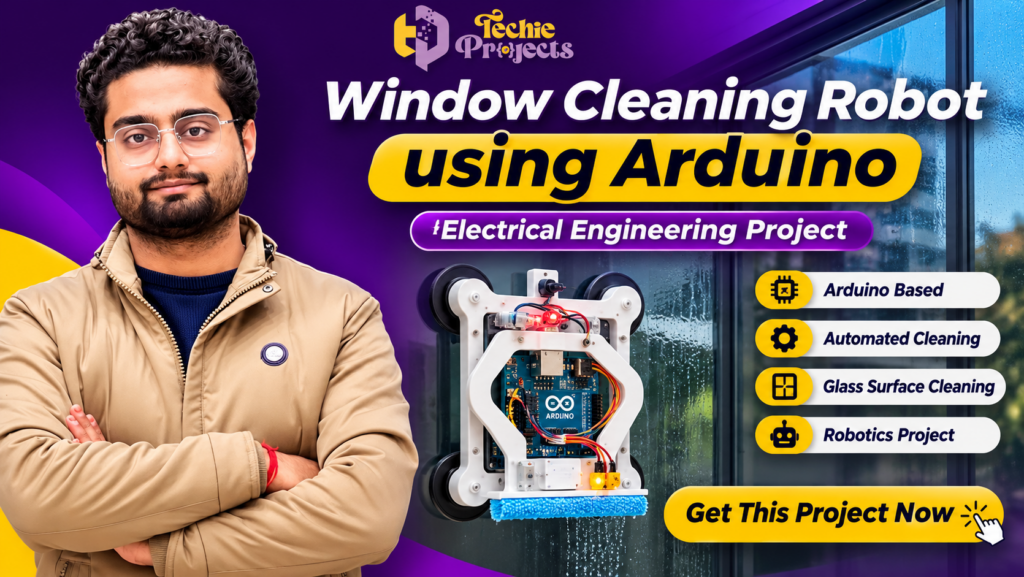
🚀 Looking for an innovative Arduino robotics project for your final-year engineering submission? Purchase the Window Cleaning Robot Using Arduino project from Techie Projects!
Cleaning large glass windows, office buildings, and glass surfaces can be difficult, time-consuming, and sometimes risky when performed manually. With advancements in robotics and automation, automated window cleaning systems offer an interesting solution for reducing repetitive cleaning efforts.
The Window Cleaning Robot Using Arduino is an innovative electrical engineering and robotics project that demonstrates how a microcontroller, motors, and a robotic cleaning mechanism can be combined to develop an automated glass-cleaning system.
🎓 Are you a B.Tech, M.Tech, Diploma, BCA, or MCA student searching for a practical engineering project? This project provides an opportunity to explore Arduino programming, embedded systems, motor control, robotics, and automation.
Get this project from Techie Projects! We provide engineering project solutions across Arduino, Robotics, IoT, Artificial Intelligence, Machine Learning, Python, and Image Processing. Contact our team to enquire about project availability, pricing, source code, hardware requirements, documentation, and customization options.
Whether you are preparing a final-year project, working on an academic prototype, or exploring robotics technology, this project can be an interesting addition to your engineering portfolio.
📞 Contact Techie Projects for Project Enquiries
📱 Contact / WhatsApp: +91 94600 60699
🌐 Website: www.techieprojects.com
📸 Instagram: @pythonprojects_
Contact us today to discuss your project requirements and purchasing options.
🎬 Watch the Window Cleaning Robot Using Arduino Project Demo
Want to see how an Arduino-based window cleaning robot works?
Watch the project demonstration to understand the robotic mechanism, electronic components, and automated cleaning operation.
Project Name: Window Cleaning Robot Using Arduino
Domain: Robotics | Arduino | Electrical Engineering
Technology: Arduino and Embedded Systems
🪟 Introduction to Window Cleaning Robot Using Arduino
Glass windows are widely used in residential buildings, commercial offices, shopping malls, hospitals, and modern architectural structures. Although glass surfaces provide an attractive appearance, maintaining their cleanliness can require regular effort.
Traditional window cleaning generally involves manual labour, cleaning equipment, and sometimes specialized arrangements for reaching elevated glass surfaces.
This creates several challenges, especially when cleaning large windows or glass structures.
Robotics provides an opportunity to automate certain cleaning operations. By combining electronic components, motors, sensors, and mechanical cleaning mechanisms, engineers can develop robotic systems that perform repetitive cleaning tasks.
The Window Cleaning Robot Using Arduino project demonstrates the application of embedded systems and robotics in automated glass cleaning.
Arduino acts as the main controller and manages the connected components according to the programmed instructions. The robotic mechanism moves across the glass surface while the cleaning attachment assists with removing dirt and dust.
The project introduces students to practical automation concepts and demonstrates how electronic and mechanical technologies can work together.
🤖 What Is a Window Cleaning Robot?
A window cleaning robot is an automated robotic device designed to clean glass surfaces with minimal manual intervention.
These robots generally use motors, cleaning pads, suction mechanisms, sensors, and electronic controllers to perform cleaning operations.
Depending on the design, a window cleaning robot may include:
- Microcontroller-based control systems.
- DC motors or geared motors.
- Cleaning pads or microfiber attachments.
- Suction or adhesion mechanisms.
- Movement control components.
- Sensors for detecting edges and obstacles.
- Power supply and electronic circuits.
The main purpose is to automate repetitive glass-cleaning activities and reduce the need for continuous manual operation.
Different window cleaning robots use different movement and adhesion mechanisms. The exact functionality depends on the mechanical design and hardware implementation.
🎯 Objectives of the Project
The main objective of the Window Cleaning Robot Using Arduino project is to demonstrate automated glass cleaning through an Arduino-controlled robotic mechanism.
The important objectives include:
- To develop an Arduino-based robotic window cleaning system.
- To understand the working principles of robotic cleaning mechanisms.
- To control motor movements using a microcontroller.
- To explore automated movement across glass surfaces.
- To understand embedded programming and electronic circuit integration.
- To reduce repetitive manual effort in supported cleaning operations.
- To demonstrate practical applications of robotics in everyday activities.
This project helps students understand how automation can be applied to common cleaning challenges.
⚙️ How Does the Window Cleaning Robot Using Arduino Work?
The working principle involves a combination of electronic control, mechanical movement, and a cleaning mechanism.
The general workflow can be understood through the following stages.
1. Power Supply and System Initialization
Initially, the robotic system receives power through its designated power supply.
The Arduino controller starts executing the programmed instructions and initializes the connected electronic components.
2. Motor Control
The motors are responsible for controlling the movement of the robotic platform.
Arduino sends the required control signals to the motor driver or motor control circuit, depending on the implementation.
This allows the robot to move in the desired direction.
3. Glass Surface Attachment
The robot needs a suitable mechanism to remain attached to the glass surface while performing its cleaning operation.
Depending on the prototype design, this may involve suction-based or another mechanical attachment arrangement.
A reliable attachment mechanism is particularly important for safe operation.
4. Robotic Movement
After establishing the required attachment, the robot moves across the glass surface.
The movement mechanism allows it to cover different sections of the cleaning area.
5. Cleaning Operation
The cleaning attachment comes into contact with the glass surface.
A cleaning pad or similar mechanism helps remove dust and dirt during movement.
6. Movement and Direction Control
The controller manages the movement sequence according to the programmed instructions.
Depending on the implementation, the robot may use predefined movement patterns or additional sensors for movement control.
7. Completion of Cleaning
Once the cleaning operation is completed, the robot can be stopped or returned to its designated position.
The actual cleaning coverage and performance depend on the prototype’s design, motor configuration, attachment mechanism, and cleaning material.
🔩 Hardware Components Required
The Window Cleaning Robot Using Arduino project combines electronic and mechanical components.
The following components are commonly relevant to an Arduino-based robotic cleaning prototype.
1. Arduino Uno
Arduino Uno is the main microcontroller board used to control the robotic system.
It executes the program and sends control signals to connected components.
2. DC Motors
DC motors are used to provide mechanical movement to the robot.
They help move the robotic platform across the glass surface.
3. Motor Driver
A motor driver provides an interface between the Arduino controller and motors.
It allows the controller to manage motor direction and operation.
4. Cleaning Pad
The cleaning pad comes into contact with the glass surface and helps remove dust and dirt.
Suitable cleaning materials should be selected according to the surface and cleaning requirements.
5. Suction Mechanism
A suction mechanism may be used to help the robot remain attached to the glass surface.
Its design and capacity must be suitable for the robot’s weight and operating conditions.
6. Wheels or Movement Mechanism
The movement mechanism helps the robot travel across the glass surface.
Its design depends on the prototype’s mechanical arrangement.
7. Power Supply
The power supply provides electrical energy to the controller, motors, and other connected components.
8. Connecting Wires and Electronic Components
Wires and supporting electronic components establish the required circuit connections.
The exact hardware specifications may vary according to the project implementation.
💻 Software Requirements
The project introduces students to embedded programming and microcontroller development.
The main software requirements include:
- Arduino IDE: Used to write, compile, and upload programs to the Arduino board.
- Embedded C/C++: Used for programming the microcontroller.
- Arduino Libraries: Used when additional supported hardware modules require library functions.
- Serial Monitor: Useful for debugging and monitoring controller communication.
Additional software tools may be required depending on the selected hardware and project configuration.
⭐ Key Features of the Window Cleaning Robot Using Arduino
The project demonstrates several important robotics and automation concepts.
Major Project Features
- Arduino-based control system.
- Automated robotic movement.
- Motor control functionality.
- Glass surface cleaning mechanism.
- Embedded programming.
- Electronic and mechanical integration.
- Robotic cleaning demonstration.
- Practical electrical engineering application.
These features make the project useful for understanding the relationship between microcontrollers, mechanical systems, and automation.
🌍 Applications of Automatic Window Cleaning Robots
Automated glass cleaning systems have several potential applications.
1. Residential Buildings
Window cleaning robots can be explored for cleaning suitable glass windows in residential environments.
They can help demonstrate how repetitive household cleaning tasks may be automated.
2. Commercial Buildings
Office buildings frequently contain large glass windows and partitions.
Automated cleaning technology can be explored for suitable commercial glass-cleaning applications.
3. Shopping Malls
Shopping malls often have extensive glass surfaces that require regular maintenance.
Robotic cleaning systems offer opportunities for studying automated maintenance solutions.
4. Hospitals
Hospitals contain glass partitions and windows that require regular cleaning.
Automation can be explored for suitable cleaning tasks while maintaining appropriate hygiene and safety procedures.
5. Educational Institutions
Engineering laboratories and educational institutions can use robotic window cleaning prototypes to demonstrate embedded systems, automation, and robotics.
6. Industrial Applications
Automated cleaning technology can be studied for suitable industrial glass surfaces and controlled cleaning environments.
📈 Advantages of Window Cleaning Robots
Window cleaning robots offer several potential benefits.
1. Reduced Manual Effort
Automated systems can assist with repetitive cleaning operations and reduce the amount of continuous manual work required.
2. Automation
The robotic system can perform programmed movements, demonstrating how electronic controllers manage mechanical operations.
3. Practical Engineering Learning
Students gain exposure to Arduino programming, motor control, electronic circuits, and mechanical design.
4. Repetitive Operation
A programmed robotic mechanism can repeat predefined cleaning movements under suitable operating conditions.
5. Innovation in Robotics
The project introduces students to an interesting application of robotics in everyday life.
6. Future Development Opportunities
The system can be extended with advanced sensors, wireless communication, obstacle detection, and intelligent control mechanisms.
🔬 Future Scope of the Window Cleaning Robot Using Arduino
The project can be enhanced with additional technologies to develop a more advanced robotic cleaning system.
1. IoT-Based Remote Monitoring
Internet of Things technology can be integrated to monitor robot operation through a connected platform.
Users could explore remote status monitoring and operational control.
2. Smartphone Application Control
A mobile application can be developed to control the robot through a compatible wireless communication module.
3. Automatic Obstacle Detection
Sensors can be integrated to identify obstacles and help prevent unwanted movement.
4. AI-Based Cleaning Optimization
Artificial intelligence can be explored to optimize cleaning paths and improve movement decisions.
5. Advanced Suction Mechanism
An improved suction arrangement can be investigated to provide more reliable attachment to suitable glass surfaces.
6. Edge Detection
Edge detection sensors can help the robot identify the boundaries of the glass surface.
This is an important area to explore for controlled movement.
7. Automatic Cleaning Path Planning
Path-planning techniques can be implemented to help the robot cover the target cleaning area more systematically.
These improvements can transform a basic prototype into a more advanced robotics research project.
🎓 Why Choose This Project for Your Final-Year Engineering Submission?
Selecting an appropriate engineering project is an important part of academic development.
A good project should demonstrate practical implementation, technical knowledge, and the ability to apply engineering concepts to real-world problems.
The Window Cleaning Robot Using Arduino combines multiple technical domains in one project.
It is particularly relevant for students from:
- Electrical Engineering.
- Electronics and Communication Engineering.
- Computer Science Engineering.
- Mechanical Engineering.
- Robotics and Automation.
- Mechatronics Engineering.
- Internet of Things.
Students can explore microcontroller programming, electronic circuit design, motor control, and robotic mechanisms.
It also provides an opportunity to develop additional features as part of an academic project.
🛒 Purchase Window Cleaning Robot Using Arduino from Techie Projects
Are you looking for a practical robotics project for your final-year engineering submission?
Get the Window Cleaning Robot Using Arduino project from Techie Projects!
Techie Projects provides engineering project solutions for students who want to explore practical implementations across different technology domains.
Instead of spending unnecessary time searching for suitable project ideas, you can contact our team to discuss this project and its available deliverables.
What Can You Enquire About?
When contacting our team, you can ask about:
- Arduino project source code availability.
- Hardware component requirements.
- Circuit connections and implementation details.
- Project demonstration video.
- Project documentation availability.
- Software installation and execution guidance.
- Customization according to academic requirements.
- Technical support availability.
The exact project package, pricing, hardware availability, and support arrangements can be confirmed before purchasing.
Why Choose Techie Projects?
1. Multiple Technology Domains
Explore engineering projects across Arduino, Python, Artificial Intelligence, Machine Learning, Robotics, IoT, and Image Processing.
2. Practical Project Solutions
Find project ideas that demonstrate real-world applications of engineering and technology.
3. Project Demonstrations
Watch available project demonstrations to understand the working concept before making a purchase decision.
4. Academic Project Options
Explore solutions suitable for B.Tech, M.Tech, Diploma, MCA, BCA, and other technical courses.
5. Direct Project Enquiries
Discuss your technical requirements, project availability, and customization directly with our team.
🚀 Get This Project Now!
Don’t wait until your final-year project submission deadline approaches.
Contact Techie Projects today to enquire about the Window Cleaning Robot Using Arduino project.
📞 Contact / WhatsApp: +91 94600 60699
🌐 Website: www.techieprojects.com
📸 Instagram: @pythonprojects_
Techie Projects – Your Destination for Engineering Projects and Innovative Technology Solutions!
💡 Recommended Projects from Techie Projects
Interested in exploring more robotics and Arduino projects?
Check out these related engineering project ideas:
- Automatic Fruit Picking Robot Using Arduino – Explore robotic fruit harvesting and smart agriculture.
- Obstacle Avoidance Robot Using Arduino – Develop a robot that detects and avoids obstacles.
- Line Following Robot Using Arduino – Build a robot that follows a predefined path.
- Pick and Place Robotic Arm – Develop a robotic arm for automated object handling.
- Smart Home Automation Using Arduino – Control household appliances through an embedded system.
- Automatic Plant Watering System Using Arduino – Automate plant watering using sensor-based control.
- IoT-Based Smart Monitoring System – Monitor connected devices and sensor information remotely.
Explore more engineering projects at www.techieprojects.com.
❓ Frequently Asked Questions (FAQs)
1. What is a Window Cleaning Robot Using Arduino?
It is an Arduino-based robotic system designed to demonstrate automated cleaning of glass surfaces using a robotic movement and cleaning mechanism.
2. Which microcontroller is used in this project?
Arduino Uno is used as the primary microcontroller in the project.
3. Which programming language is used?
Embedded C/C++ is generally used for Arduino programming through the Arduino IDE.
4. Is this project suitable for B.Tech students?
Yes. It is relevant to Electrical, Electronics, Mechanical, Computer Science, and Robotics engineering students.
5. Can I purchase this project from Techie Projects?
Yes. Contact Techie Projects to enquire about pricing, availability, source code, hardware requirements, and documentation.
6. Does the robot work automatically?
The project demonstrates automated robotic movement and cleaning functionality according to its programmed control mechanism. The actual level of automation depends on the implemented hardware and software.
7. Can IoT functionality be added?
Yes. IoT modules and wireless communication technologies can be explored for remote monitoring and control.
8. What are the main applications of window cleaning robots?
Potential applications include suitable residential windows, commercial glass surfaces, educational demonstrations, and controlled industrial cleaning environments.
9. Can this project be improved using artificial intelligence?
Yes. AI-based path planning, intelligent obstacle detection, and automated cleaning optimization can be explored as future enhancements.
10. How can I get the project demonstration?
Contact Techie Projects through WhatsApp or visit our website to enquire about the available project demonstration.
🏁 Conclusion
The Window Cleaning Robot Using Arduino is an interesting electrical engineering and robotics project that demonstrates how microcontrollers, motors, and mechanical cleaning systems can work together to automate glass cleaning operations.
By integrating Arduino programming, motor control, and robotic mechanisms, students can explore practical applications of embedded systems and automation.
The project is suitable for engineering students interested in robotics, electrical systems, electronics, and smart automation.
It also provides opportunities for future improvements through IoT, wireless control, obstacle detection, edge sensing, and intelligent cleaning algorithms.
🎓 Ready to start your engineering project?
Get in touch with Techie Projects to enquire about purchasing the Window Cleaning Robot Using Arduino project.
🚀 Learn Robotics. Build Innovation. Develop Your Future with Techie Projects!
📞 Contact / WhatsApp: +91 94600 60699