
Introduction
Breast cancer detection using thermal images is an emerging research application that explores how artificial intelligence and deep learning can analyze thermal patterns in breast images. This project demonstrates how computer vision techniques can be applied to thermal image processing and classification for an academic machine learning project.
For B.Tech, BCA, MCA, and final-year engineering students, this project offers an opportunity to explore image preprocessing, feature extraction, model training, and AI-based image classification using Python.
🎬 Project Working Demo
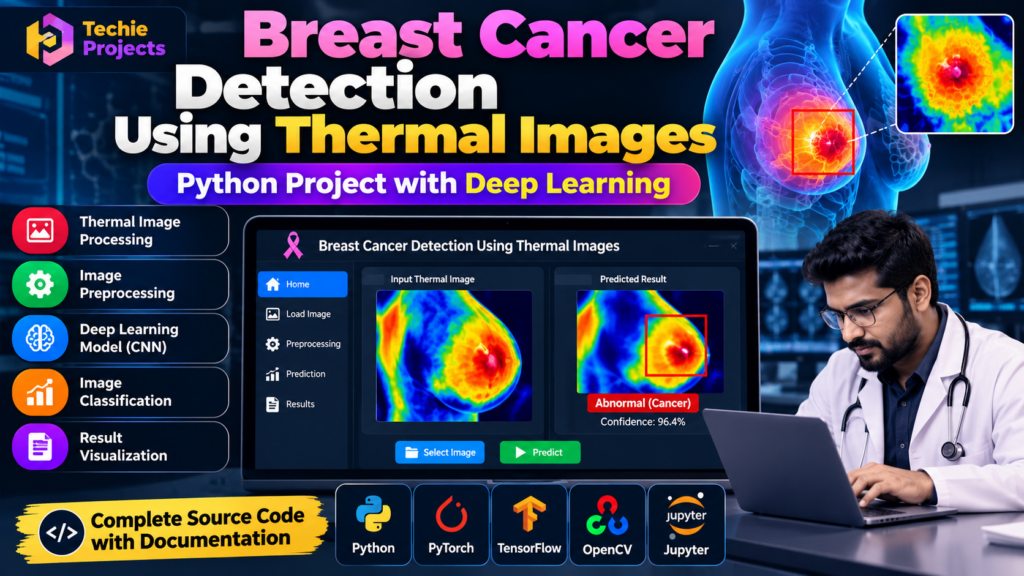
Watch the project demonstration to understand the interface, thermal image processing workflow, and how the breast cancer detection model presents its results.
📌 Overview of Breast Cancer Detection Using Thermal Images
Thermal imaging captures infrared radiation emitted by the body and represents temperature variations as an image. Researchers investigate whether these thermal patterns can provide useful information for studying breast abnormalities.
In this project, thermal images are processed and analyzed using machine learning or deep learning techniques. Depending on the implementation, the system may classify images into predefined categories based on patterns learned from a labeled dataset.
The project is designed for educational and research purposes. Its performance depends on dataset quality, preprocessing methods, model selection, and evaluation.
🎯 Objectives of the Project
The main objectives of this project are:
- Process and analyze breast thermal images using Python.
- Apply image preprocessing techniques.
- Extract relevant features from thermal images.
- Train a machine learning or deep learning classification model.
- Evaluate model performance using appropriate metrics.
- Demonstrate an AI-based thermal image classification workflow.
⭐ Key Features of the Project
1. Thermal Image Upload
Allow users to select thermal images for analysis, depending on the application’s interface.
2. Image Preprocessing
Prepare images for model input using techniques such as resizing, normalization, noise reduction, and format conversion where appropriate.
3. Feature Extraction
Identify useful image characteristics, which may include temperature distribution, texture, and spatial patterns.
4. Deep Learning Model
Use a suitable model, such as a convolutional neural network (CNN), if supported by the project’s implementation.
5. Image Classification
Generate a model prediction based on the categories used during training.
6. Result Visualization
Display the predicted class and relevant output in a clear interface, depending on the implemented features.
🛠️ Technologies Used
Python: Main programming language for image processing and model development.
OpenCV: Can be used for image loading, resizing, and preprocessing.
NumPy: Supports numerical operations and image-array processing.
TensorFlow or PyTorch: Can be used to build and train deep learning models.
Matplotlib: Useful for visualizing images, training curves, and evaluation results.
Scikit-learn: Can support dataset splitting and evaluation metrics.
The exact libraries depend on the implementation of the project you choose.
⚙️ How Does the System Work?
Step 1: Dataset Collection
Collect a suitable, ethically sourced and labeled thermal image dataset for research.
Step 2: Image Preprocessing
Prepare the images by applying appropriate resizing, normalization, and preprocessing methods.
Step 3: Dataset Preparation
Separate the dataset into training, validation, and test sets. Avoid placing duplicate or closely related images across these sets, as this can lead to misleading evaluation results.
Step 4: Model Training
Train the selected machine learning or deep learning model using the training data.
Step 5: Model Evaluation
Evaluate performance on held-out data using suitable metrics such as accuracy, precision, recall, F1-score, sensitivity, and specificity.
Step 6: Prediction and Results
Provide a thermal image to the trained model and display its predicted category and relevant output.
🧠 Deep Learning Models Used
Depending on the project implementation, suitable approaches may include:
- Convolutional Neural Network (CNN)
- ResNet
- VGG
- MobileNet
- Transfer learning with pretrained image models
Model selection should be based on the dataset, available computing resources, and validation results rather than model complexity alone.
💻 Software Requirements
- Operating System: Windows 10 or Windows 11
- Programming Language: Python
- Image Processing: OpenCV
- Numerical Computing: NumPy
- Machine Learning: Scikit-learn
- Deep Learning: TensorFlow or PyTorch, depending on implementation
- Code Editor: Visual Studio Code, PyCharm, or Jupyter Notebook
🖥️ Hardware Requirements
- Computer or laptop
- Sufficient RAM to process the selected dataset
- Adequate storage for images, models, and project files
- GPU support where available for faster model training
📊 Advantages of the Project
- Demonstrates practical applications of AI in medical-image research.
- Provides experience with image processing and deep learning.
- Helps students understand classification workflows.
- Introduces model evaluation and performance analysis.
- Can be extended for research and educational demonstrations.
⚠️ Limitations and Challenges
Thermal image analysis can be affected by image quality, acquisition conditions, dataset size, and differences between subjects. Models trained on small or unrepresentative datasets may not generalize well to new data.
Thermal imaging classification is not a substitute for established breast cancer screening or diagnostic procedures. A student project must not be presented as a clinically validated diagnostic tool unless appropriate clinical validation and regulatory requirements have been met.
🚀 Future Scope
Potential research extensions include:
- Evaluating additional deep learning architectures.
- Improving image preprocessing and quality control.
- Using larger and more diverse datasets.
- Adding explainability visualizations.
- Comparing thermal imaging models with other research approaches.
- Developing a more accessible demonstration interface.
- Conducting rigorous external validation with qualified clinical researchers.
❓ Frequently Asked Questions
1. What is breast cancer detection using thermal images?
It is a research approach that investigates thermal image patterns using image processing and machine learning or deep learning techniques.
2. Which programming language is used?
Python is commonly used because it supports image processing, numerical computing, and deep learning libraries.
3. Is this project suitable for final-year students?
Yes. It can be suitable for students studying computer science, artificial intelligence, machine learning, or image processing, subject to their academic requirements.
4. Can deep learning be used for thermal image classification?
Yes. CNNs and transfer-learning models can be explored when suitable labeled data and a sound evaluation methodology are available.
5. Can this project diagnose breast cancer?
No. An academic model is not a medical diagnostic tool. Its predictions should not be used to diagnose, exclude, or make treatment decisions about breast cancer.
🛒 Get the Breast Cancer Detection Project
Looking for a Breast Cancer Detection Using Thermal Images project with Python source code for your final-year engineering project?
Techie Projects helps students explore Python, machine learning, deep learning, and computer vision projects for academic learning and demonstrations.
Contact us to confirm source-code availability, included files, documentation, installation requirements, demonstration details, and pricing before purchasing.
📲 WhatsApp for Project Enquiries: +91-9460060699
🌐 Website: www.techieprojects.com
📸 Instagram: @pythonprojects_
Share your course, submission deadline, and required features so we can discuss a suitable project option.
🔗 Recommended Projects
- Skin Cancer Detection Using Machine Learning
- Brain Tumor Detection Using Deep Learning
- Brain Stroke Detection Using Machine Learning
- Pneumonia Detection Using Deep Learning
- Diabetic Retinopathy Detection Using Deep Learning
- Dental Caries Detection Using Deep Learning
- Medical Image Classification Using CNN
Conclusion
Breast cancer detection using thermal images is an educational project that combines Python, image processing, and deep learning to explore thermal image classification. It offers students practical experience with dataset preparation, model development, evaluation, and result visualization.
For academic use, choose a project version that matches your course requirements and verify its implemented features before purchasing. Any medical claims should remain within the evidence supported by the dataset and validation results.