
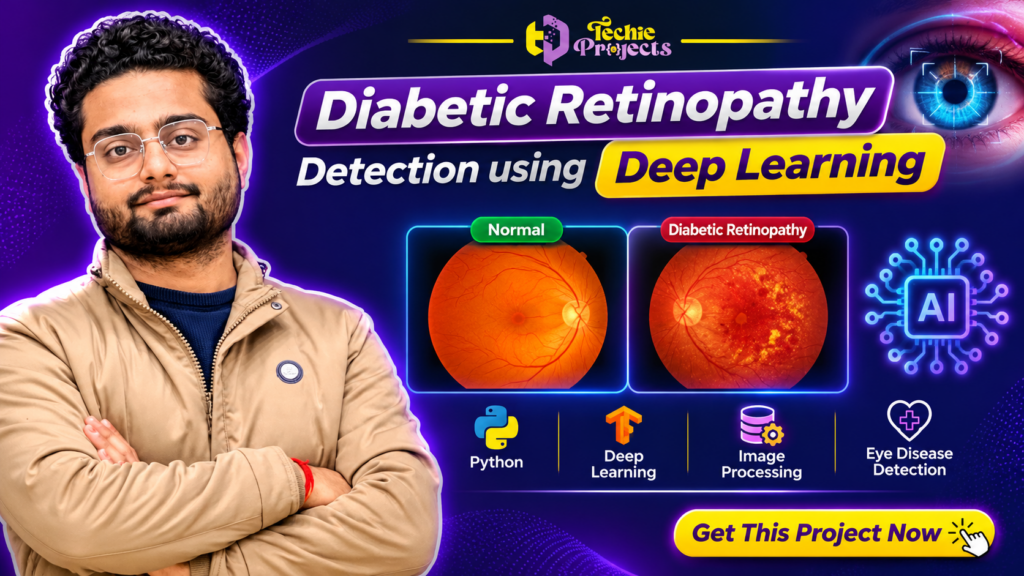
Diabetic Retinopathy Detection using Deep Learning is an excellent choice for students interested in combining Python programming, Artificial Intelligence, and healthcare technology. This project demonstrates how modern deep learning techniques can be explored for retinal image classification.
Are you looking for an innovative Artificial Intelligence project for your final-year engineering submission? 🚀 Want to develop a healthcare-based AI application that combines Python, Deep Learning, and Medical Image Processing?
Get the Diabetic Retinopathy Detection using Deep Learning project from Techie Projects!
This project demonstrates how Artificial Intelligence and deep learning techniques can be applied to retinal image analysis to identify patterns associated with diabetic retinopathy. It is an excellent choice for B.Tech, M.Tech, Computer Science, Information Technology, and AI & Data Science students who want to explore real-world applications of machine learning.
🎓 Instead of spending weeks developing everything from scratch, explore our ready-developed project solution, understand its implementation, and prepare your academic demonstration with technical assistance from Techie Projects.
📞 Contact Techie Projects for Project Enquiries
Interested in purchasing the Diabetic Retinopathy Detection using Deep Learning Project? Contact us to enquire about package availability, pricing, source code, documentation, installation guidance, and technical support options.
💬 WhatsApp Enquiry: Chat with Techie Projects
📱 Contact Number: +91 94600 60699
🌐 Official Website: www.techieprojects.com
📸 Instagram: Follow Techie Projects
🎓 Project Areas: Robotics, Machine Learning, Arduino, Deep Learning, Artificial Intelligence, and Android App.
✅ Request Project Details: Share your engineering branch, preferred features, and technical requirements to enquire about the most suitable available package.
🚀 Ready to get started? Click here to enquire on WhatsApp and mention Diabetic Retinopathy Detection using Deep Learning Project.
Package contents, prices, hardware availability, and support options should be confirmed before purchase.
🎬 Watch the Diabetic Retinopathy Detection Project Demo
Watch the project demonstration to understand the concept, interface, and working approach of this AI-based eye disease detection system.
The demonstration helps students understand how retinal images can be processed and analyzed using Python and deep learning techniques.
Interested in the complete implementation? Contact Techie Projects for purchasing details.
🔍 What Is Diabetic Retinopathy Detection?
Diabetic retinopathy is an eye condition associated with diabetes that affects the blood vessels in the retina. It can cause vision-related complications if it progresses without appropriate medical attention.
Retinal fundus photography is commonly used to capture images of the retina. These images contain important visual information that can be studied to identify changes associated with diabetic retinopathy.
Traditional retinal image examination requires trained healthcare professionals to evaluate the images. Artificial Intelligence offers additional research opportunities by helping analyze large collections of retinal images.
The Diabetic Retinopathy Detection using Deep Learning project demonstrates how computer vision and deep learning can be used to study retinal images and identify patterns associated with the condition.
The main objective is to develop an AI-based application that accepts retinal images, processes the input, and produces a model-generated classification result.
This project is particularly useful for students interested in Artificial Intelligence, healthcare technology, computer vision, and medical image analysis.
Important: This is an academic demonstration project, not a clinically validated diagnostic system. Its output should not be used for medical diagnosis or treatment decisions.
🎯 Objectives of the Project
The main goal of Diabetic Retinopathy Detection using Deep Learning is to demonstrate an intelligent image classification workflow using retinal fundus images. Students can explore image preprocessing, model training, and prediction techniques.
The primary objective is to demonstrate the application of deep learning in retinal image classification.
The major objectives include:
- To understand diabetic retinopathy and its impact on retinal health.
- To explore retinal fundus image processing.
- To implement deep learning techniques for image classification.
- To understand the application of Python in healthcare-related AI projects.
- To develop an interface for interacting with the image classification system.
- To study the potential of Artificial Intelligence in medical image analysis.
- To understand the complete workflow of an image-based machine learning application.
By implementing these objectives, students can gain practical exposure to AI-based healthcare applications.
💡 Why Choose Diabetic Retinopathy Detection using Deep Learning?
If you want a project that combines practical implementation with an important real-world application, this project is worth considering.
Here are some reasons to choose it:
1. Artificial Intelligence Application
The project introduces students to the use of Artificial Intelligence in healthcare research and medical image analysis.
2. Deep Learning Implementation
Students can understand how deep learning models learn visual patterns from image datasets and generate classification results.
3. Python-Based Development
Python provides a flexible environment for implementing machine learning, image processing, and deep learning applications.
4. Medical Image Processing
The project provides practical exposure to retinal fundus images and the challenges associated with processing medical images.
5. Suitable for Engineering Students
It is relevant to students pursuing Computer Science, Information Technology, Artificial Intelligence, Data Science, and related engineering disciplines.
6. Demonstration-Oriented Learning
Students can demonstrate the image input, processing workflow, and classification output during their academic presentation.
⚙️ Technologies Used in the Project
Python plays an important role in Diabetic Retinopathy Detection using Deep Learning because it provides powerful libraries for developing image processing and machine learning applications.
The implementation combines different technologies used in Artificial Intelligence and image processing.
Python
Python is the primary programming language used for implementing the project. It provides libraries and frameworks for image processing, data handling, and machine learning.
Deep Learning
Deep learning techniques are used to learn visual patterns from retinal image data and perform image classification.
TensorFlow / Keras
TensorFlow and Keras can be used for developing, training, and evaluating deep learning models, depending on the implementation.
Image Processing
Image processing techniques help prepare retinal images for model input. This may include resizing, normalization, and other preprocessing operations.
Machine Learning
Machine learning concepts are useful for understanding training data, validation, testing, and model performance.
Graphical User Interface
A graphical interface can allow users to upload retinal images and view the corresponding model output.
The exact framework, model architecture, and dataset depend on the delivered project implementation. Contact our team for the confirmed technical specifications.
🧠 How Does the Project Work?
The Diabetic Retinopathy Detection using Deep Learning system processes retinal images through a predefined workflow. The input image is prepared and passed to a trained model to generate a classification result.
The Diabetic Retinopathy Detection using Deep Learning project follows an image-based processing and classification workflow.
Step 1: Input Retinal Image
The user provides a retinal fundus image through the application interface.
The image acts as the input for the classification process.
Step 2: Image Preprocessing
The input image is prepared for analysis.
Depending on the implementation, preprocessing may include:
- Image resizing.
- Pixel normalization.
- Image format conversion.
- Image quality preparation.
- Dataset preprocessing.
These operations help prepare the image for the deep learning model.
Step 3: Deep Learning Model
The prepared image is passed to a trained deep learning model.
The model learns visual features from training images and uses the learned patterns to generate predictions for new input images.
Step 4: Image Classification
The model processes the input and generates a classification result based on the categories used during training.
The output depends on the model architecture, training dataset, and implementation.
Step 5: Display Results
The application displays the model-generated output through its interface.
This allows users to understand the basic working process of an AI-based retinal image classification application.
📊 Importance of Deep Learning in Retinal Image Analysis
Deep learning is an important area of Artificial Intelligence that focuses on learning complex patterns from data.
One of the important aspects of Diabetic Retinopathy Detection using Deep Learning is its ability to demonstrate how neural networks learn visual features from retinal image datasets.
In computer vision, deep learning models can automatically learn useful visual representations from images.
Retinal fundus images contain structures such as blood vessels, optic discs, and other retinal features. Studying these structures can help researchers investigate image patterns associated with different retinal conditions.
Deep learning provides a useful framework for conducting this type of research.
The Diabetic Retinopathy Detection using Deep Learning project helps students understand the relationship between image data, model training, feature learning, and classification.
Students can also explore how changes in image quality, dataset size, and model selection may affect classification performance.
🏥 Real-World Applications
Researchers and engineering students can use Diabetic Retinopathy Detection using Deep Learning as an educational example to understand AI-based medical image analysis and explore computer vision applications.
AI-based retinal image analysis has several research and development applications.
1. Healthcare Research
Researchers can investigate how AI models identify visual patterns in retinal fundus images.
2. Medical Image Classification
Image classification techniques can be studied for categorizing retinal images according to predefined dataset labels.
3. AI-Based Healthcare Applications
Developers can explore intelligent healthcare software that supports medical image analysis research.
4. Educational Demonstrations
Engineering students can demonstrate the application of computer vision and deep learning in healthcare.
5. Medical Imaging Research
The project can provide a starting point for exploring image preprocessing, model evaluation, and classification techniques.
📚 What Will Students Learn?
Working with this project provides opportunities to understand several technical concepts.
Students can explore:
- Python programming.
- Artificial Intelligence fundamentals.
- Deep learning concepts.
- Image preprocessing.
- Computer vision.
- Retinal fundus image analysis.
- Image classification.
- Model training and testing.
- Dataset management.
- Graphical user interface development.
- Model evaluation.
These concepts are valuable for students planning to build careers in AI, machine learning, data science, and software development.
💻 Software Requirements
The project can be explored in a Python development environment.
Typical software requirements include:
- Programming Language: Python.
- Operating System: Windows 10 / Windows 11.
- Development Environment: VS Code, PyCharm, or compatible Python IDE.
- Deep Learning Framework: As specified in the project implementation.
- Image Processing: Compatible Python image processing libraries.
- User Interface: As provided in the project.
🖥️ Hardware Requirements
The typical development environment may include:
- Processor: Intel Core i3 or above.
- RAM: 4 GB minimum; 8 GB or more recommended.
- Storage: Sufficient space for datasets and project files.
- Display: Standard monitor.
- Input Devices: Keyboard and mouse.
The actual requirements depend on the selected model, dataset size, and training configuration. A GPU may be useful for faster model training.
🎓 Why Is This Project Suitable for Final-Year Engineering Students?
Diabetic Retinopathy Detection using Deep Learning is suitable for final-year engineering students who want practical exposure to Python, deep learning, and healthcare-related Artificial Intelligence applications.
Final-year engineering projects should demonstrate practical technical knowledge and the ability to apply concepts to real-world problems.
The Diabetic Retinopathy Detection using Deep Learning project combines multiple technical domains in one application.
It is suitable for:
- B.Tech Computer Science students.
- B.Tech Information Technology students.
- Artificial Intelligence students.
- Data Science students.
- M.Tech Computer Science students.
- Machine Learning enthusiasts.
- Computer Vision learners.
Students can use the project to understand the implementation, study its technical concepts, and prepare their academic demonstrations according to their college requirements.
🚀 Get the Diabetic Retinopathy Detection Project from Techie Projects
Looking for a ready-developed AI project with implementation support?
Techie Projects provides engineering project solutions across Artificial Intelligence, Machine Learning, Python, Deep Learning, Computer Vision, Data Science, and other technology domains.
Our objective is to help students explore practical technology projects and understand their implementation.
What Can You Enquire About?
When contacting Techie Projects, you can discuss:
- Project source code availability.
- Python implementation.
- Project execution guidance.
- Technical documentation availability.
- Demonstration and implementation details.
- Installation assistance.
- Customization requirements.
- Additional technical support.
The exact deliverables and support arrangements will be confirmed before purchase.
💰 Why Purchase from Techie Projects?
Looking for a complete Diabetic Retinopathy Detection using Deep Learning project? Contact Techie Projects to enquire about source code availability, implementation details, documentation, pricing, and technical assistance.
Developing an entire deep learning project independently can require significant time for understanding datasets, preprocessing images, implementing models, and resolving technical issues.
By choosing an available project solution from Techie Projects, students can get a structured starting point for their learning and academic preparation.
Our project offerings cover multiple engineering domains, allowing students to explore different technologies according to their interests.
Don’t wait until your submission deadline! Contact us to check availability, pricing, and delivery details.
📲 Get This Project Now!
Diabetic Retinopathy Detection using Deep Learning – Python AI Project
📞 Contact / WhatsApp: +91 94600 60699
🌐 Website: www.techieprojects.com
📸 Instagram: Techie Projects
Send us a WhatsApp message with the project name to enquire about purchasing.
🔥 💡 Recommended Projects
Looking for more interesting final-year engineering projects? Explore these related project ideas:
- Brain Tumor Detection using Deep Learning.
- Skin Cancer Detection using Machine Learning.
- Pneumonia Detection using CNN.
- Breast Cancer Prediction using Machine Learning.
- Lung Cancer Detection using Deep Learning.
- Plant Leaf Disease Detection using CNN.
- Face Mask Detection using Computer Vision.
- Blood Cell Classification using Deep Learning.
- Heart Disease Prediction using Machine Learning.
- COVID-19 Detection using Medical Image Processing.
These projects provide additional opportunities to explore Artificial Intelligence, Python programming, machine learning, and deep learning.
🔗 Explore Related Python Projects
Discover more practical engineering projects and development solutions from Techie Projects:
- Artificial Intelligence Projects.
- Machine Learning Projects.
- Deep Learning Projects.
- Python Projects.
- Data Science Projects.
- Computer Vision Projects.
- Image Processing Projects.
- Final Year Engineering Projects.
Visit www.techieprojects.com to explore more project ideas and available solutions.
❓ Frequently Asked Questions
1. What is Diabetic Retinopathy Detection using Deep Learning?
It is an AI-based image classification project that demonstrates how deep learning techniques can be used to analyze retinal fundus images and identify patterns associated with diabetic retinopathy.
2. Which programming language is used?
Python is the primary programming language used for developing this type of application.
3. Is this project suitable for B.Tech students?
Yes. It is relevant to Computer Science, Information Technology, AI, and Data Science students.
4. Which technologies are used?
The project may involve Python, deep learning frameworks, image processing libraries, and machine learning techniques. The exact implementation details should be confirmed before purchase.
5. Can beginners understand this project?
Students with basic Python programming knowledge can use it as a learning opportunity. Understanding deep learning and image classification concepts will also be helpful.
6. Can I purchase this project from Techie Projects?
Yes. Contact Techie Projects to check the current project availability, pricing, deliverables, and technical support.
7. Does the project provide medical diagnosis?
No. This is an educational and research-oriented project. Its model-generated output is not a substitute for professional medical examination or diagnosis.
Choose Diabetic Retinopathy Detection using Deep Learning from Techie Projects to explore an interesting AI-based healthcare application and strengthen your practical understanding of deep learning.
🎯 Conclusion
Artificial Intelligence is creating new opportunities in healthcare research, computer vision, and medical image processing. Deep learning techniques provide useful approaches for studying complex visual information and developing image classification applications.
The Diabetic Retinopathy Detection using Deep Learning project gives engineering students an opportunity to explore these technologies through a practical Python-based implementation.
From understanding retinal fundus images to learning about preprocessing, model training, and classification, this project covers important concepts in modern AI development.
If you are planning your final-year engineering project and want to explore an AI-based healthcare application, this project is worth considering.
🚀 Purchase your Diabetic Retinopathy Detection project from Techie Projects and start exploring practical Artificial Intelligence development!
📞 Contact / WhatsApp: +91 94600 60699
Techie Projects – Building Practical Technology Projects for Students!

