
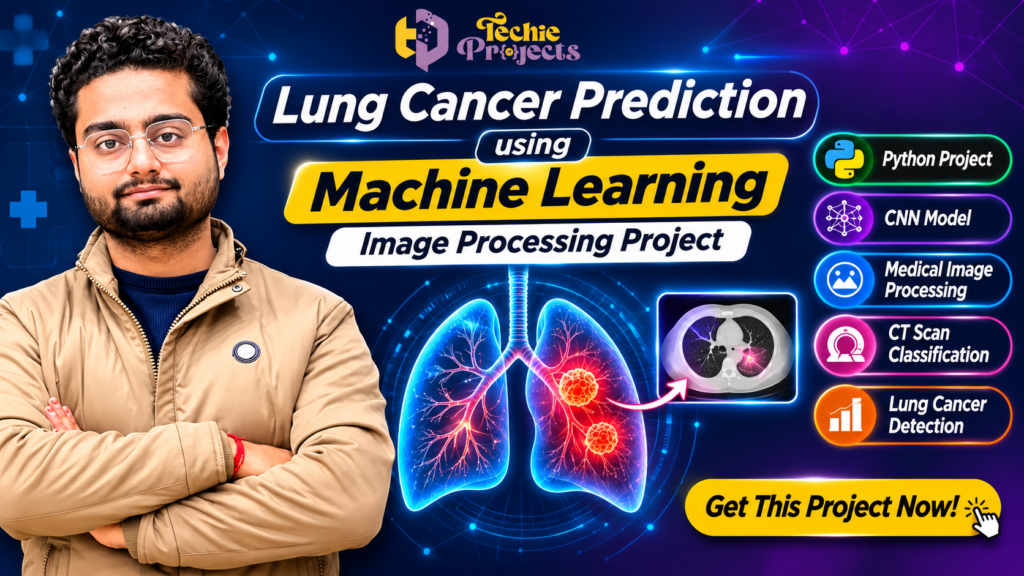
Are you looking for a ready-to-implement Lung Cancer Detection using Python project for your final-year engineering submission, B.Tech, M.Tech, MCA, or computer science academic project? 🚀 Get a practical AI-based healthcare project from Techie Projects and make your academic portfolio stand out with machine learning, deep learning, Python programming, and medical image processing.
Instead of spending weeks searching for incomplete tutorials, troubleshooting Python libraries, or developing an entire project from scratch, you can contact Techie Projects to purchase this project and get assistance with project implementation, demonstration, and academic preparation.
Our Lung Cancer Detection Project demonstrates how artificial intelligence and deep learning techniques can be applied to CT scan image analysis and classification. It is an excellent opportunity for students interested in healthcare technology, artificial intelligence, computer vision, and machine learning.
🎓 Get your project from Techie Projects and start preparing your final-year submission with a practical AI-based implementation!
📞 Contact Techie Projects for Project Enquiries
Interested in purchasing the Lung Cancer Detection using Python Project? Contact us to enquire about package availability, pricing, source code, documentation, installation guidance, and technical support options.
💬 WhatsApp Enquiry: Chat with Techie Projects
📱 Contact Number: +91 94600 60699
🌐 Official Website: www.techieprojects.com
📸 Instagram: Follow Techie Projects
🎓 Project Areas: Robotics, Machine Learning, Arduino, Deep Learning, Artificial Intelligence, and Android App.
✅ Request Project Details: Share your engineering branch, preferred features, and technical requirements to enquire about the most suitable available package.
🚀 Ready to get started? Click here to enquire on WhatsApp and mention Lung Cancer Detection using Python Project.
Package contents, prices, hardware availability, and support options should be confirmed before purchase.
🎬 Watch the Lung Cancer Detection Project Demo
Explore the project demonstration to understand its concept, image-processing workflow, and expected application.
Project Demo: Lung Cancer Prediction using Machine Learning
You can watch the project demonstration on the Techie Projects YouTube channel to understand how the application works before making a purchase enquiry.
🔬 What Is Lung Cancer Detection using Python?
Lung Cancer Detection using Python is an artificial intelligence-based project that demonstrates how machine learning and deep learning techniques can analyze medical images to identify patterns associated with lung abnormalities.
The project focuses on processing CT scan images and applying image classification techniques to categorize images according to the classes defined in the training dataset.
Python provides an extensive ecosystem of libraries for developing intelligent healthcare applications. Libraries such as TensorFlow, Keras, OpenCV, NumPy, and Matplotlib can be used for image processing, model development, visualization, and evaluation.
The main objective of this academic project is to demonstrate how computational techniques can support medical image analysis.
The system provides students with practical exposure to:
- Medical image preprocessing.
- CT scan image analysis.
- Convolutional Neural Networks (CNN).
- Deep learning model training.
- Image classification.
- Python-based application development.
- Model evaluation and visualization.
This makes the Lung Cancer Detection Project a valuable choice for students exploring artificial intelligence and healthcare applications.
Important: This is an educational prototype, not a clinically validated diagnostic system. Its predictions must not be used for medical diagnosis or treatment decisions.
🎯 Objectives of the Lung Cancer Detection Project
The primary objective is to develop a Python-based application that demonstrates the use of deep learning in medical image classification.
The major objectives include:
- To understand medical image processing techniques.
- To preprocess CT scan images for model training.
- To implement a CNN-based image classification model.
- To explore Deep Learning for Lung Cancer Detection.
- To classify images according to the available training dataset.
- To evaluate model performance using suitable metrics.
- To develop an understandable application for demonstrating the classification process.
By implementing these objectives, students can understand how AI models are developed and applied to real-world research problems.
⚙️ Technologies Used in the Project
The project uses Python and deep learning technologies to demonstrate medical image classification.
1. Python Programming
Python is the primary programming language because of its extensive machine learning and image-processing ecosystem.
2. TensorFlow and Keras
TensorFlow and Keras can be used to develop, train, and evaluate deep learning models for image classification.
3. Convolutional Neural Network (CNN)
CNN is an important deep learning architecture for extracting visual features from images. It can identify patterns such as edges, shapes, and image structures.
4. OpenCV
OpenCV supports image loading, resizing, preprocessing, and other image-processing operations.
5. NumPy
NumPy provides numerical operations and array handling for image data and model preparation.
6. Matplotlib
Matplotlib can be used to visualize images, training performance, and evaluation results.
These technologies provide a practical foundation for students interested in Machine Learning Healthcare Projects.
🫁 How Does the Lung Cancer Detection Project Work?
The working process involves several stages, starting from CT scan image input and continuing through preprocessing, feature extraction, classification, and output generation.
Step 1: CT Scan Image Input
The application accepts a CT scan image as input. The image is used to demonstrate the medical image classification workflow.
Step 2: Image Preprocessing
The input image is processed before being supplied to the deep learning model.
Typical preprocessing operations include:
- Image resizing.
- Pixel normalization.
- Image format conversion.
- Dataset preparation.
- Training and testing data separation.
Step 3: Feature Extraction
The CNN architecture learns visual features from the training images.
Different convolutional layers identify increasingly complex image patterns. Pooling layers help reduce spatial dimensions and computational requirements.
Step 4: Model Training
The prepared image dataset is supplied to the CNN model during training.
The model learns relationships between image features and the corresponding dataset labels.
Step 5: CT Scan Image Classification
After training, the model can process an input image and generate a classification result based on the learned patterns.
This stage demonstrates CT Scan Image Classification using deep learning techniques.
Step 6: Result Visualization
The application displays the classification output through its interface.
Students can use this stage to understand how the model connects image input, processing, and prediction.
🧠 Deep Learning for Lung Cancer Detection
Deep learning has become an important research area in medical image analysis because neural networks can learn complex visual patterns from large image datasets.
Deep Learning for Lung Cancer Detection focuses on applying neural network architectures to medical imaging tasks.
A Convolutional Neural Network is particularly relevant because it can automatically learn image features during training.
Unlike traditional image-processing methods that may depend heavily on manually designed features, CNN models learn useful representations directly from image data.
Some important concepts demonstrated through this project include:
- Convolution operations.
- Pooling layers.
- Feature extraction.
- Activation functions.
- Fully connected layers.
- Classification output.
- Model training and evaluation.
The project provides an opportunity to understand how deep learning techniques can be explored in healthcare-related academic research.
🖥️ Features of the Lung Cancer Detection Project
The project demonstrates several useful functionalities related to medical image classification.
1. Image Upload: Provides an input mechanism for selecting a CT scan image.
2. Image Preprocessing: Prepares images according to the model’s expected input requirements.
3. CNN-Based Classification: Demonstrates the use of convolutional neural networks for image classification.
4. Prediction Display: Presents the model’s classification output through the application interface.
5. Python Implementation: Provides practical exposure to Python-based AI development.
6. Image Processing: Demonstrates medical image preprocessing and analysis concepts.
7. Academic Demonstration: Helps students explain the complete workflow during project presentations and viva examinations.
Actual functionality and deliverables should be confirmed with Techie Projects before purchasing.
🎓 Benefits of the Lung Cancer Detection Project for Final-Year Students
Choosing an appropriate final-year project is important for engineering students because it provides an opportunity to apply theoretical knowledge to practical problems.
The Lung Cancer Detection Project combines Python programming, machine learning, deep learning, and image processing into one academic implementation.
1. Practical AI and Machine Learning Experience
Students gain exposure to how machine learning models can be developed and applied to image classification problems.
2. Understanding Deep Learning Architecture
The project helps students understand CNN architecture, convolutional operations, pooling, feature extraction, and classification.
3. Healthcare Technology Knowledge
Students can explore how artificial intelligence is being researched for medical image analysis.
4. Useful for Academic Presentations
The project offers a practical topic for explaining artificial intelligence concepts, model training, image preprocessing, and classification.
5. Resume and Portfolio Development
Working with Python, TensorFlow, Keras, and OpenCV can help students demonstrate technical knowledge in AI and computer vision.
6. Suitable for Multiple Academic Programs
This project can be considered by students pursuing:
- B.Tech Computer Science Engineering.
- B.Tech Information Technology.
- M.Tech Computer Science.
- MCA.
- BCA.
- Artificial Intelligence and Data Science.
- Related computer science programs.
7. Exposure to Real-World Research Areas
Medical image analysis is an important research area where computer vision and artificial intelligence techniques are actively explored.
🫁 Why Choose Lung Cancer Detection using Python?
Lung Cancer Detection using Python is an interesting artificial intelligence project for students who want to explore healthcare applications using machine learning and deep learning. The project demonstrates how CT scan images can be processed and classified using Python-based technologies.
By developing a Lung Cancer Detection Project, students can understand image preprocessing, feature extraction, CNN architecture, and classification techniques. It also provides practical exposure to Medical Image Processing using Python.
The Lung Cancer Detection using Python implementation combines computer vision and deep learning concepts to demonstrate an image classification workflow. Students can explore how trained models learn visual patterns from labeled medical image datasets.
🔍 Applications of Lung Cancer Detection using Python
The Lung Cancer Detection using Python project demonstrates several educational applications of artificial intelligence in healthcare research.
- Medical Image Classification: Demonstrates how CT scan images can be classified using trained machine learning models.
- CNN-Based Analysis: Explores convolutional neural networks for extracting image features.
- Healthcare Research: Introduces students to AI-based medical image analysis.
- Image Processing: Demonstrates image resizing, normalization, and preprocessing.
- Deep Learning: Provides practical exposure to neural network training and evaluation.
The Lung Cancer Detection using Python project is designed for academic learning and experimentation. It should not be considered a clinically validated diagnostic solution.
🧠 Understanding CNN in Lung Cancer Detection using Python
Convolutional Neural Networks are widely used in computer vision applications. In this project, CNN architecture can be used to learn features from CT scan images and classify them according to predefined dataset labels.
The Lung Cancer Detection using Python workflow demonstrates how convolutional layers, pooling layers, and fully connected layers work together.
Important CNN concepts include:
- Convolutional layers for feature extraction.
- ReLU activation for introducing non-linearity.
- Pooling layers for reducing feature dimensions.
- Flattening for converting feature maps into vectors.
- Dense layers for classification.
- Output layers for generating class predictions.
Students implementing Lung Cancer Detection using Python can experiment with different model configurations and compare their evaluation results.
📊 Importance of Dataset and Model Evaluation
Dataset quality plays an important role in machine learning applications. For the Lung Cancer Detection using Python project, CT scan images should be appropriately labeled, organized, and divided into training, validation, and testing datasets.
Model evaluation can include:
- Accuracy
- Precision
- Recall
- F1-score
- Confusion matrix
These metrics help students understand how a classification model performs on unseen test data. They should also consider class imbalance, data leakage, and overfitting when interpreting results.
🔄 Working Methodology of the Project
The methodology explains the sequence of operations involved in developing and executing the application.
The Lung Cancer Detection using Python workflow can be divided into the following stages:
Stage 1: Dataset Collection
Collect and organize suitable CT scan images with appropriate labels for academic model development.
Stage 2: Dataset Preprocessing
Prepare the images by resizing, normalization, and other necessary preprocessing operations.
Stage 3: CNN Architecture Development
Create a Convolutional Neural Network architecture suitable for the image classification task.
Stage 4: Model Training
Train the CNN model using the prepared training dataset.
Stage 5: Model Evaluation
Evaluate the trained model using appropriate testing data and metrics such as accuracy, precision, recall, F1-score, and a confusion matrix.
Stage 6: Application Integration
Connect the trained model with the Python application interface.
Stage 7: Prediction and Result Display
Provide an input image and display the resulting classification output.
This methodology gives students a clear understanding of the complete development lifecycle, from dataset preparation to application demonstration.
💻 Software and Hardware Requirements
Software Requirements
- Programming Language: Python.
- Deep Learning Framework: TensorFlow / Keras.
- Image Processing: OpenCV.
- Numerical Computing: NumPy.
- Visualization: Matplotlib.
- Development Environment: VS Code / PyCharm / Jupyter Notebook.
- Operating System: Windows or Linux.
Hardware Requirements
- Processor: Intel Core i3 or higher.
- RAM: Minimum 8 GB recommended.
- Storage: 500 GB HDD or SSD.
- Graphics: GPU recommended for faster deep learning training.
Actual requirements depend on the model architecture, dataset size, and implementation.
🎓 Purchase Lung Cancer Detection using Python Project from Techie Projects
Are you searching for a practical Lung Cancer Detection using Python project for your B.Tech, MCA, M.Tech, or final-year engineering submission?
Techie Projects provides project solutions across artificial intelligence, machine learning, deep learning, Python development, and image processing.
You can contact our team to enquire about the complete project package, source code availability, project demonstration, documentation, and implementation assistance.
The Lung Cancer Detection using Python project is a suitable academic topic for students interested in developing practical knowledge of CNN models and healthcare-related machine learning applications.
Developing an AI-based project from scratch can require considerable time for dataset preparation, coding, debugging, model training, and interface development.
Techie Projects provides engineering project solutions across multiple technical domains to help students explore practical implementations.
When you enquire about this project, you can discuss:
- Project source code availability.
- Project demonstration.
- Software installation requirements.
- Project documentation availability.
- Implementation guidance.
- Customization requirements.
- Academic presentation assistance.
Our objective is to help students understand their projects rather than simply provide a project title or theoretical explanation.
Whether you are looking for a Lung Cancer Detection Project, an image-processing application, or another AI-based academic implementation, our team can help you explore suitable options.
🚀 Who Should Purchase This Project?
This project may be suitable for:
- Final-year B.Tech students.
- Computer Science Engineering students.
- Artificial Intelligence students.
- Data Science students.
- MCA and M.Tech students.
- Students interested in Python development.
- Students exploring deep learning and computer vision.
- Students interested in healthcare AI research.
If you want to demonstrate the practical application of Python and deep learning in healthcare research, this project is worth exploring.
💡 Recommended Projects from Techie Projects
Looking for more artificial intelligence and machine learning projects?
Explore these related project ideas:
- Brain Tumor Detection using Deep Learning.
- Skin Cancer Detection using Machine Learning.
- Breast Cancer Prediction using Machine Learning.
- Pneumonia Detection using CNN.
- Heart Disease Prediction using Machine Learning.
- Diabetic Retinopathy Detection using Deep Learning.
- Medical Image Classification using Python.
These projects provide additional opportunities to explore computer vision, medical image processing, and AI-based healthcare applications.
📚 Explore Related Python Projects
Techie Projects offers project ideas and development solutions across several domains:
- Artificial Intelligence and Machine Learning.
- Deep Learning.
- Python Development.
- Computer Vision.
- Image Processing.
- Natural Language Processing.
- Data Science and Analytics.
- Web Development.
- Internet of Things (IoT).
Visit www.techieprojects.com to explore more engineering projects and find an implementation that matches your academic requirements.
❓ Frequently Asked Questions (FAQs)
1. What is Lung Cancer Detection using Python?
It is an academic AI project that demonstrates how Python and deep learning techniques can be used to process and classify CT scan images according to predefined dataset categories.
2. Which algorithm is used in the project?
A Convolutional Neural Network (CNN) can be used for image feature extraction and classification.
3. Is this project suitable for final-year B.Tech students?
Yes. It is a relevant academic topic for students studying computer science, artificial intelligence, information technology, and data science.
4. Which programming language is used?
Python is the primary programming language used for the implementation.
5. What is CT Scan Image Classification?
It is the process of assigning predefined categories to CT scan images using image-processing and machine learning techniques.
6. Can I purchase the complete project from Techie Projects?
You can contact Techie Projects to discuss source code availability, project demonstrations, documentation, pricing, and other deliverables.
7. Does the project include a demonstration?
A project demonstration is available through the Techie Projects YouTube channel. Contact our team to confirm the available demonstration and project package.
8. Is this project a real medical diagnostic tool?
No. It is an educational prototype designed to demonstrate image classification techniques. It is not a clinically validated medical diagnostic system.
🔥 Purchase Lung Cancer Detection Project Today!
Still searching for a practical AI-based final-year engineering project?
Get started with the Lung Cancer Detection using Python project from Techie Projects.
Explore how Python programming, CNN architecture, deep learning, and medical image processing come together in an academic healthcare application.
Don’t waste valuable project-development time searching for incomplete code or disconnected tutorials. Contact our team to discuss the available project package, pricing, source code, demonstration, documentation, and implementation assistance.
🎯 GET THIS PROJECT NOW!
Make your final-year engineering project more practical with AI, Python, and deep learning!
📞 Contact / WhatsApp: +91 94600 60699
🌐 Website: www.techieprojects.com
📸 Instagram: @pythonprojects_
Techie Projects – Your Destination for Engineering Projects, AI Solutions, and Python-Based Development.

