
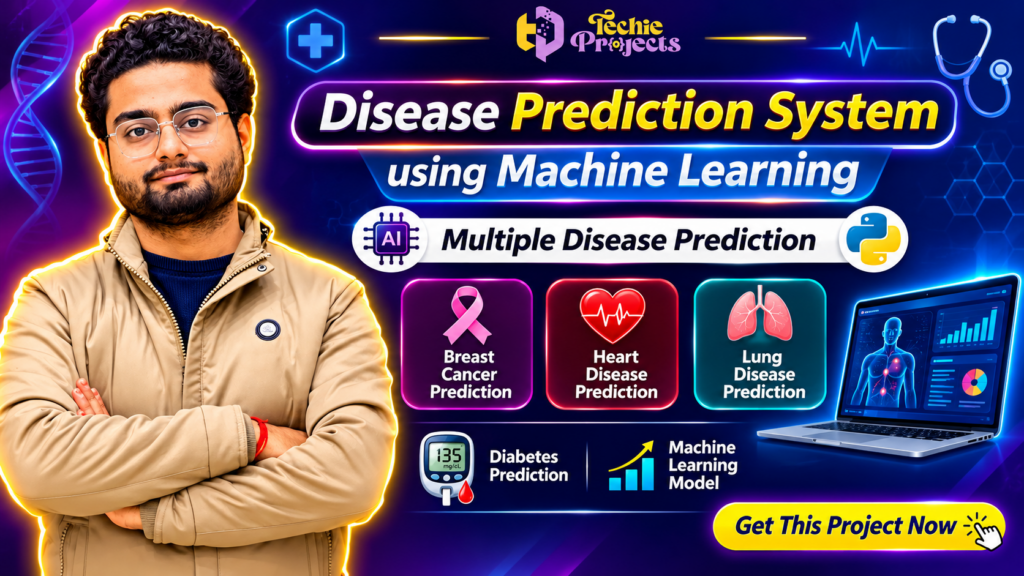
🚀 Get Your Disease Prediction System Project Today!
The Disease Prediction System using Machine Learning is designed to demonstrate how Artificial Intelligence can support healthcare-related data analysis through trained predictive models. It provides students with practical exposure to Python programming and machine learning implementation.
Looking for a ready-to-use Disease Prediction System using Machine Learning for your final-year engineering project, college submission, or academic demonstration? Get this project from Techie Projects and explore how Python and Machine Learning can be used to develop an intelligent healthcare prediction application.
Instead of spending weeks searching for datasets, implementing machine learning algorithms, designing interfaces, and resolving programming errors, you can purchase our project solution and get a practical implementation to study, run, customize, and demonstrate.
🎓 Perfect for B.Tech, M.Tech, MCA, BCA, Computer Science, Artificial Intelligence, and Data Science students.
Our Disease Prediction System demonstrates how machine learning techniques can process medical-related input parameters and generate prediction results for selected disease categories, including breast cancer, heart disease, and diabetes.
Why wait? Get your Machine Learning project from Techie Projects today!
📞 Contact / WhatsApp: +91 94600 60699
🌐 Website: www.techieprojects.com
🎬 Watch the Disease Prediction System Project Demo
Explore the working demonstration of the Disease Prediction System using Machine Learning and understand its interface, prediction workflow, and major functionalities.
The project demonstration helps students understand how users interact with the application, enter relevant input parameters, and view the generated prediction results.
Watch the project demo: Disease Prediction System – Techie Projects
Interested in purchasing the complete project with source code?
👉 Get This Project Now – Contact Techie Projects
🧠 What Is a Disease Prediction System Using Machine Learning?
A Disease Prediction System using Machine Learning is a software application designed to demonstrate how machine learning algorithms can analyze structured input data and generate predictions related to selected diseases.
Healthcare data analysis is an important application area of Artificial Intelligence. Machine learning techniques can identify patterns in datasets and use those patterns to develop predictive models.
Traditional software applications generally depend on predefined conditions and rules. Machine learning applications, on the other hand, can learn patterns from historical datasets and use trained models to generate predictions for new input records.
This project focuses on developing a Python-based application that demonstrates multiple disease prediction functionalities through a graphical user interface.
The application includes different prediction modules, allowing users to explore disease-related input parameters and understand how trained machine learning models produce results.
The main objective of this project is to demonstrate the practical implementation of Python programming, data preprocessing, machine learning algorithms, and GUI development in a healthcare-related academic application.
This Disease Prediction System using Machine Learning combines data preprocessing, classification algorithms, and Python application development to generate disease-related prediction results from structured datasets.
Important: This project is intended for educational and demonstration purposes. Its predictions are not medical diagnoses and must not be used to make healthcare decisions.
🎯 Main Objectives of the Project
The major objectives of developing this Disease Prediction System using Machine Learning include:
- To develop a Python-based healthcare prediction application.
- To demonstrate machine learning techniques using medical datasets.
- To implement multiple disease prediction modules.
- To provide a graphical interface for entering input information.
- To understand data preprocessing and model training.
- To demonstrate how trained models generate prediction results.
- To develop practical knowledge of Artificial Intelligence applications.
- To create an academic project suitable for engineering demonstrations.
⭐ Key Features of the Disease Prediction System
The application demonstrates multiple functionalities related to healthcare data analysis and machine learning.
1. ❤️ Heart Disease Prediction
The heart disease prediction module demonstrates how machine learning can analyze selected health-related parameters to estimate whether an input record matches patterns associated with heart disease in the training dataset.
The heart disease module is an important component of the Disease Prediction System using Machine Learning, demonstrating how trained classification models process health-related input parameters.
Depending on the implemented dataset and model, input parameters may include:
- Age
- Gender
- Blood pressure
- Cholesterol level
- Blood sugar
- Maximum heart rate
- Other relevant clinical attributes
The application processes the entered information and displays the model’s prediction result.
This module helps students understand how classification algorithms can be applied to structured healthcare datasets.
2. 🎀 Breast Cancer Prediction
Breast cancer prediction is another important module of the application. Using the Disease Prediction System using Machine Learning, students can explore how numerical dataset features are processed to demonstrate breast cancer classification.
Machine learning models can be trained using structured datasets containing tumor-related numerical characteristics.
Depending on the selected dataset, parameters may include:
- Radius
- Texture
- Perimeter
- Area
- Smoothness
- Compactness
- Concavity
- Symmetry
The trained model processes the input features and generates a classification result.
Students can use this module to understand how machine learning classification techniques work with medical datasets.
3. 🩸 Diabetes Prediction
The diabetes prediction module demonstrates how machine learning algorithms can analyze numerical health-related parameters.
The Disease Prediction System using Machine Learning also demonstrates diabetes prediction using selected numerical attributes and a trained machine learning model.
Common dataset attributes may include:
- Glucose level
- Blood pressure
- Insulin
- BMI
- Age
- Diabetes pedigree function
- Number of pregnancies
The model processes the selected input values and generates a prediction based on patterns learned during training.
This functionality demonstrates the practical application of data preprocessing and classification techniques.
4. 🫁 Additional Disease Prediction Module
The project can also be extended with additional disease-related prediction modules, depending on the available datasets and implementation.
For example, a lung disease prediction module can be incorporated using an appropriate dataset and a separately trained model.
Such extensions make the application useful for exploring different machine learning approaches.
5. 🖥️ Graphical User Interface
The application provides a graphical interface through which users can navigate between available modules and enter relevant input parameters.
The interface helps demonstrate the complete prediction workflow without requiring users to interact directly with Python code.
6. 📊 Machine Learning-Based Prediction
The core functionality uses trained machine learning models to generate prediction outputs.
The prediction process demonstrates the relationship between input data, preprocessing, model training, and classification.
⚙️ Technologies Used in the Project
The Disease Prediction System using Machine Learning combines several technologies from Python development, data science, and Artificial Intelligence. Python plays an important role in developing the Disease Prediction System using Machine Learning, connecting datasets, trained models, preprocessing operations, and the graphical interface.
| Technology | Purpose |
|---|---|
| Python | Main programming language |
| Machine Learning | Prediction and classification |
| Pandas | Dataset manipulation |
| NumPy | Numerical operations |
| Scikit-learn | Model training and evaluation |
| Tkinter | Graphical user interface |
| Matplotlib | Data visualization, where implemented |
| Pickle | Saving and loading trained models, where implemented |
The exact libraries and versions depend on the delivered source code.
Why Python?
Python is widely used in machine learning and data science because it provides a large ecosystem of libraries for data processing, model development, and application building.
Students can use Python to understand the complete development lifecycle of an AI-based application.
🔄 Working Process of the Disease Prediction System
The system follows a machine learning workflow that converts input information into prediction results.
Step 1: Dataset Collection
The first step involves collecting suitable datasets for the selected disease categories.
Datasets should contain relevant attributes and corresponding target labels.
Step 2: Data Preprocessing
Raw datasets may contain missing values, inconsistent records, or numerical features with different scales.
Preprocessing prepares the dataset for machine learning.
Common preprocessing operations include:
- Handling missing values
- Removing duplicate records
- Feature selection
- Data normalization
- Encoding categorical variables
- Splitting datasets into training and testing sets
Step 3: Model Training
After preprocessing, the selected dataset is used to train the machine learning model.
Depending on the dataset and implementation, algorithms may include:
- Logistic Regression
- Decision Tree
- Random Forest
- Support Vector Machine
- K-Nearest Neighbors
- Naive Bayes
The choice of algorithm depends on the dataset and the objective of each prediction module.
Step 4: Model Evaluation
The trained model can be evaluated using testing data.
Common evaluation measures include:
- Accuracy
- Precision
- Recall
- F1-score
- Confusion Matrix
These measures help students understand the performance of classification models.
Step 5: Model Integration
The trained models are integrated into the Python application.
The GUI provides an interface for entering input values and accessing the prediction functionality.
Step 6: Prediction Generation
After receiving input values, the application applies the required preprocessing and passes the prepared data to the corresponding trained model.
The model generates a prediction result that is displayed through the application interface.
💡 Advantages of the Disease Prediction System
Developing this project provides several academic and technical benefits.
1. Multiple Prediction Modules: Students can explore different disease-related machine learning applications in one software project.
2. Practical Python Development: The project demonstrates how Python can be used to develop a complete desktop application.
3. Understanding Machine Learning: Students can learn about classification, training datasets, preprocessing, and prediction.
4. GUI-Based Application: The graphical interface makes the project easier to demonstrate.
5. Customization Opportunities: Students can explore additional datasets, algorithms, and features.
6. Academic Demonstration: The project provides a practical example of applying Artificial Intelligence to a healthcare-related problem.
7. Learning Data Science: Students can understand how numerical datasets are processed and used for predictive modeling.
🏗️ How to Develop a Disease Prediction System Using Machine Learning
Students interested in developing their own Disease Prediction System using Machine Learning can follow a structured development process.
First, identify the disease categories that the application will support. Select appropriate datasets for each category and understand the attributes included in those datasets.
Next, install Python and the required machine learning libraries. Prepare the datasets using Pandas and NumPy.
After preprocessing, divide the data into training and testing sets. Select suitable classification algorithms and train individual models for the selected prediction tasks.
Evaluate each model using appropriate performance metrics. Save the trained models so that they can be integrated into the application.
Develop a graphical interface using Tkinter. Create separate sections for each prediction module and design input fields for the relevant attributes.
Finally, connect the interface with the trained models, test the application, and verify that the prediction workflow operates correctly.
This development process provides valuable practical experience in Python programming, machine learning, and application development.
💻 Software and Hardware Requirements
The following are the basic requirements listed for the project environment. Actual requirements may vary depending on the supplied implementation.
Software Requirements
- Programming Language: Python
- Operating System: Windows 10 / Windows 11
- GUI Framework: Tkinter
- Machine Learning Libraries: Scikit-learn and other required Python packages
- Development Environment: Python IDE or Visual Studio Code
Hardware Requirements
- Processor: Intel Pentium or equivalent
- RAM: 4 GB minimum
- Hard Disk: 500 GB recommended system storage
- Input Devices: Keyboard and Mouse
- Display: Standard computer monitor
A modern computer is recommended for a smoother development and testing experience.
🎓 Who Should Purchase This Project?
This project is suitable for students and learners interested in Artificial Intelligence, machine learning, and healthcare-related applications. Students searching for a Disease Prediction System using Machine Learning for B.Tech, MCA, M.Tech, or final-year academic demonstrations can contact Techie Projects for project purchasing enquiries.
It can be useful for:
- B.Tech Computer Science Engineering students
- B.Tech Artificial Intelligence students
- B.Tech Data Science students
- M.Tech students
- MCA students
- BCA students
- Diploma engineering students
- Machine Learning beginners
- Python developers
- Academic project demonstrations
Whether you are exploring machine learning for the first time or preparing a final-year project demonstration, this application provides a practical learning opportunity.
💰 Why Purchase from Techie Projects?
Choosing the right project development provider can save valuable time during academic project preparation.
Techie Projects provides project solutions across multiple technology domains, including Artificial Intelligence, Machine Learning, Python, Data Science, Computer Vision, IoT, Web Development, and Deep Learning.
When you purchase the Disease Prediction System using Machine Learning from Techie Projects, you can discuss your requirements and available project deliverables directly with our team.
What Can You Request?
Depending on the selected project package, you can enquire about:
- Python source code
- Project execution support
- Required libraries and dependencies
- Project documentation
- Project report
- Installation guidance
- Working demonstration
- Customization requirements
- Additional features
Please confirm the exact deliverables and support included in your selected package before purchasing.
Why Choose Techie Projects?
- Multiple engineering project domains
- Python and Machine Learning solutions
- Academic project assistance
- Practical project demonstrations
- Custom project development enquiries
- Direct communication through WhatsApp
Our objective is to help students explore practical technology solutions and understand how software applications are developed.
🚀 Get This Disease Prediction System Project Now!
Are you looking for a ready-to-use Machine Learning project for your final-year engineering submission?
Don’t waste your valuable time searching for incomplete project examples. Contact Techie Projects to discuss purchasing the Disease Prediction System with its available source code and project support.
Get your project requirements discussed today!
📞 Contact / WhatsApp: +91 94600 60699
🌐 Website: www.techieprojects.com
📸 Instagram: @pythonprojects_
🔗 Explore Related Python and Machine Learning Projects
Looking for more final-year engineering projects? Explore other project categories available at Techie Projects.
- Artificial Intelligence Projects
- Machine Learning Projects
- Deep Learning Projects
- Python Projects
- Data Science Projects
- Data Analytics Projects
- Computer Vision Projects
- Natural Language Processing Projects
- Image Processing Projects
- Healthcare Prediction Projects
- Web Development Projects
- Android Application Projects
Explore more project ideas and solutions at www.techieprojects.com.
❓ Frequently Asked Questions (FAQs)
1. What is a Disease Prediction System using Machine Learning?
It is a Python-based application that demonstrates how trained machine learning models can analyze structured input data and generate predictions related to selected disease categories.
2. Which diseases are included in this project?
The demonstrated project includes breast cancer, heart disease, and diabetes prediction modules. Additional modules depend on the available implementation.
3. Which programming language is used?
Python is used as the primary programming language.
4. Which machine learning algorithms are used?
Algorithms can include Logistic Regression, Random Forest, Decision Tree, Support Vector Machine, and other classification techniques, depending on the individual model implementation.
5. Is source code available?
You can contact Techie Projects to enquire about purchasing the project with its available Python source code.
6. Can I customize the project?
Yes, customization requirements can be discussed with Techie Projects. Additional features and modules depend on technical feasibility.
7. Is this project suitable for final-year engineering students?
Yes. It is relevant to Computer Science, Artificial Intelligence, Machine Learning, and Data Science academic project demonstrations.
8. Can this system diagnose diseases?
No. The project is an educational machine learning demonstration, not a clinically validated medical diagnostic tool. Its predictions should not replace professional medical evaluation.
9. How can I purchase this project?
Contact Techie Projects through WhatsApp at +91 94600 60699 to discuss project availability, pricing, deliverables, and customization.
10. Does the project require internet access?
The core desktop application may operate locally after the required software, datasets, libraries, and trained models have been installed. Requirements depend on the supplied implementation.
If you want to understand practical healthcare applications of Artificial Intelligence, the Disease Prediction System using Machine Learning from Techie Projects is an excellent academic project to explore.
🎯 Conclusion
The Disease Prediction System using Machine Learning is an interesting academic project that demonstrates the combination of Python programming, data science, machine learning, and healthcare-related applications.
By implementing multiple prediction modules, students can explore how structured datasets are processed, how classification models are trained, and how prediction functionality can be integrated into a graphical application.
This project offers a practical opportunity to understand Artificial Intelligence concepts while developing software engineering skills.
If you are searching for a Disease Prediction System using Machine Learning project with source code for your academic requirements, contact Techie Projects today.
🚀 Purchase your project and start exploring the practical world of Machine Learning!
📞 Contact / WhatsApp: +91 94600 60699
🌐Website: www.techieprojects.com
📸 Instagram: @pythonprojects_