
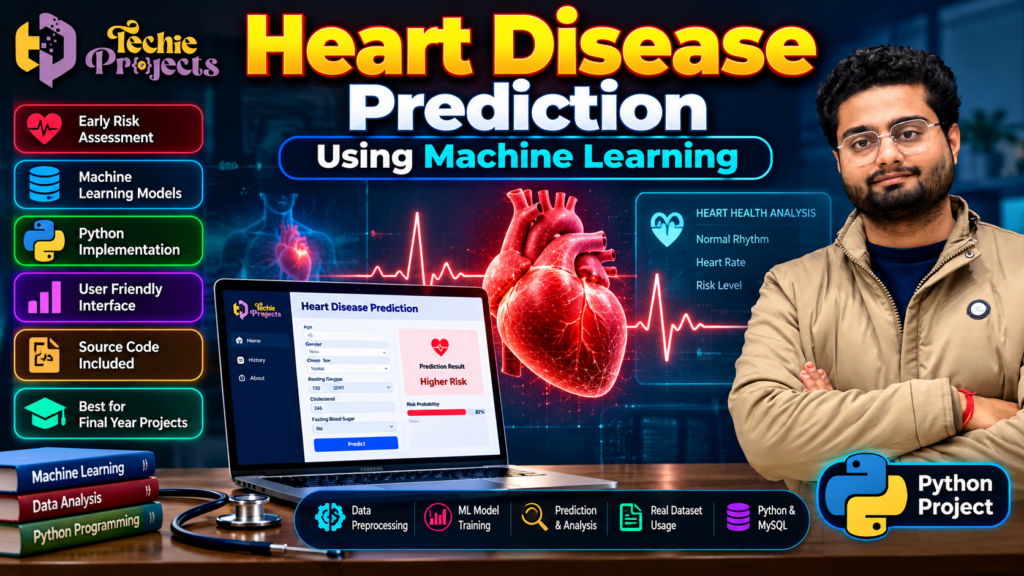
Looking for a practical machine learning project that combines Python programming, healthcare technology, and predictive analytics? The Heart Disease Prediction Using Machine Learning project from Techie Projects is an excellent option for engineering students who want to explore how artificial intelligence can analyze health-related data and generate prediction results. Instead of spending excessive time searching for a suitable project topic, you can enquire about this project and explore its implementation, technical requirements, and available deliverables.
Designed as an academic project concept, this system demonstrates how machine learning techniques can be applied to structured medical datasets to estimate the likelihood of heart disease. It is relevant to B.Tech, BCA, MCA, computer science, information technology, and data science students interested in machine learning and healthcare applications.
Planning your final-year or minor project? Explore the Heart Disease Prediction Using Machine Learning project from Techie Projects and contact us to confirm the available source code, documentation, installation requirements, and project support before purchasing.
🎬 Heart Disease Prediction Project Demo
The project demonstration showcases the concept of predicting heart disease using machine learning and Python. It highlights the type of interface and prediction workflow associated with this academic project.
Watch the demonstration to understand the project’s presentation and how a user may interact with a prediction system.
🫀 What Is Heart Disease Prediction Using Machine Learning?
Heart disease prediction using machine learning is an application of data science in which algorithms learn patterns from a dataset and use those patterns to estimate a target outcome. In an academic implementation, the target may represent whether a record belongs to a heart-disease or non-heart-disease category.
The system typically works with structured information such as age, sex, resting blood pressure, cholesterol measurements, and other variables, depending on the dataset selected for the project. These attributes are processed and supplied to a trained model to generate a prediction.
Python is commonly used for this type of application because it supports data processing, machine learning, model evaluation, and application development through a broad ecosystem of libraries.
The purpose of this project is educational. Its output should not be treated as a medical diagnosis or a substitute for consultation with a qualified healthcare professional.
🎯 Objectives of the Project
The main objective is to demonstrate the practical use of machine learning for a healthcare-related classification problem.
Key objectives include:
- Understanding how healthcare datasets can be used in machine learning.
- Learning the process of data cleaning and preprocessing.
- Exploring how classification algorithms learn from historical examples.
- Developing a workflow that accepts input features and generates a model prediction.
- Understanding how model performance can be evaluated.
- Exploring the potential role of predictive analytics in healthcare research.
These objectives make the project suitable for students who want to connect programming concepts with a real-world application area.
⚙️ How the Heart Disease Prediction System Works
A typical implementation follows several stages, from preparing the dataset to displaying the prediction result. The exact workflow depends on the source code and model used in the selected version.
1. Dataset Collection
The process begins with a suitable dataset containing health-related attributes and a target label. Dataset quality is important because incomplete, inconsistent, or unrepresentative records can affect the model’s performance.
For academic purposes, publicly available datasets may be used subject to their licensing and usage conditions.
2. Data Preprocessing
The dataset is examined for missing values, duplicate records, inconsistent formats, and unsuitable features. Numerical and categorical variables may require different preprocessing methods.
Preprocessing helps prepare the data for model training and reduces problems caused by inconsistent inputs.
3. Feature Selection
Relevant attributes are selected for model development. Depending on the dataset, these may include age, cholesterol, blood pressure, and other recorded variables.
Feature selection should be based on the dataset and a defensible methodology rather than assumptions about which factors are medically decisive.
4. Model Training
A classification algorithm learns patterns from the training data. Algorithms commonly explored in academic classification projects include Logistic Regression, Decision Trees, Random Forest, and Support Vector Machines.
The algorithm actually implemented in the project should be confirmed before describing it as a supported feature.
5. Prediction Generation
After training, the model can receive a compatible set of input values and generate an output according to its learned patterns. Depending on the implementation, the output may be a class label or a probability score.
A prediction is an estimate produced by the model. It does not confirm whether a person has a medical condition.
6. Result Presentation
The application can display the output through a suitable interface. A simple interface may make the project easier to demonstrate during an academic presentation or viva.
The specific interface, visualizations, and reporting features depend on the implementation included in the selected project package.
💻 Technologies Used in the Project
The following technologies are commonly relevant to a Python-based machine learning implementation. The exact libraries and versions should be verified against the project package.
- Python: Main programming language for data processing and model development.
- Pandas: Useful for loading, organizing, and analyzing tabular datasets.
- NumPy: Supports numerical operations and array processing.
- Scikit-learn: Provides classification algorithms, preprocessing utilities, and model evaluation tools.
- Matplotlib or Seaborn: May be used to visualize dataset patterns and evaluation results.
- Streamlit, Flask, or another interface framework: May be used if the implementation includes a web-based interface.
Not every implementation uses all these libraries. Compatibility depends on the actual source code, environment, and dependency versions.
📊 Important Features of a Heart Disease Prediction Project
A well-structured academic implementation can demonstrate several important machine learning concepts.
Data Handling
Students can learn how structured datasets are loaded, inspected, cleaned, and prepared for model training.
Classification Workflow
The project illustrates the relationship between input features, training data, a classification model, and generated predictions.
Prediction Interface
Where included, an interface allows users to enter relevant values and view the model’s output without manually running each processing step.
Model Evaluation
Evaluation can include metrics such as accuracy, precision, recall, F1-score, and a confusion matrix. For healthcare-related classification, examining recall, false negatives, class imbalance, and validation methodology is particularly important.
A high accuracy score alone does not establish that a model is clinically reliable.
Academic Demonstration
The project provides a practical topic for explaining data preprocessing, model training, classification, evaluation, and the limitations of machine learning.
📚 Why Choose This Project for Engineering Students?
The Heart Disease Prediction Using Machine Learning project connects multiple areas of computer science within one application. It can help students explore how programming, data analysis, and machine learning work together.
For computer science students: The project offers an opportunity to study algorithms, data structures used in processing, classification, and application workflows.
For data science students: It introduces dataset preparation, feature selection, model evaluation, and interpretation of prediction results.
For information technology students: It can demonstrate how a machine learning model may be integrated into an application interface.
For final-year students: It offers a healthcare-oriented topic that can be explained through a problem statement, methodology, implementation, testing, and limitations.
The educational value depends on understanding the implementation rather than simply presenting a prediction screen. Students should be able to explain the dataset, algorithm, evaluation method, and reasons for selecting the approach.
🧪 Software and Hardware Requirements
A typical Python machine learning project can run on a standard laptop or desktop, depending on the size of the dataset and the software dependencies.
Software Requirements
- Operating system: Windows, Linux, or another supported environment.
- Python version compatible with the project’s dependencies.
- Required Python libraries and packages.
- A code editor or Python IDE.
- Dataset files used by the implementation.
- A supported browser if the project includes a web interface.
Hardware Requirements
- A computer with a compatible processor.
- Sufficient RAM for the selected dataset and libraries.
- Storage space for the source code, environment, and data files.
- Internet access when needed for installation or downloading permitted resources.
A dedicated GPU is generally unnecessary for many small, tabular classification projects, although the actual requirements depend on the implementation.
🫀 Benefits of Heart Disease Prediction Using Machine Learning
Heart Disease Prediction Using Machine Learning helps students understand how Python and predictive analytics can be applied to healthcare-related datasets. This project demonstrates important concepts such as data preprocessing, feature selection, classification algorithms, and model evaluation. It is a useful academic topic for students exploring artificial intelligence, data science, and healthcare technology.
⚙️ Applications of Heart Disease Prediction Using Machine Learning
The Heart Disease Prediction Using Machine Learning project illustrates how a trained classification model can analyze selected health-related attributes and produce an estimated prediction. Similar approaches are studied in healthcare research, clinical decision-support research, and health-data analytics. The project’s educational value lies in understanding the model workflow, evaluating its limitations, and learning how data-driven applications are developed.
🛒 Purchase the Heart Disease Prediction Using Machine Learning Project
Looking for a practical Python project for your academic requirements? Enquire about the Heart Disease Prediction Using Machine Learning project from Techie Projects to confirm its current availability, source code, dataset, documentation, installation requirements, and pricing before purchase.
The Heart Disease Prediction Using Machine Learning project is worth exploring if you want to study how a classification model can be used in a healthcare-related application.
Before purchasing, confirm the exact package details, including:
- Whether Python source code is included.
- Which machine learning algorithm and dataset are used.
- Whether a project report or documentation is available.
- Which software versions and dependencies are required.
- Whether installation assistance or project-related support is included.
- The price, delivery method, and applicable terms.
These details should be confirmed before payment so you know exactly what is included.
📲 Enquire About the Project
Contact Techie Projects to ask about the current availability and deliverables for this project.
- 📲 Call/WhatsApp: +91-9460060699
- 🌎 Website: www.techieprojects.com
- 📺 Instagram: @pythonprojects_
Share your course, project requirements, and preferred technologies when enquiring so the available package can be checked against your academic needs.
🚀 Real-World Relevance of Machine Learning in Healthcare
Machine learning is studied in healthcare research for tasks such as risk estimation, medical image analysis, patient-data analysis, and decision-support research.
A heart disease classification project provides an introductory way to examine this field. It can demonstrate how algorithms identify statistical patterns in a dataset and how evaluation methods help measure their performance.
However, real-world healthcare deployment requires much more than a working academic application. Models must be tested on appropriate populations, validated independently, assessed for bias, protected against privacy risks, and evaluated by qualified experts. An educational prototype should not be presented as a clinically approved diagnostic tool.
⚠️ Limitations of the Project
Understanding limitations is an important part of a strong technical presentation.
- Dataset dependency: Results depend on the quality, size, and representativeness of the data.
- Generalization: A model trained on one dataset may not perform equally well on different populations.
- Prediction errors: False-positive and false-negative results are possible.
- Evaluation quality: Poor data splitting or data leakage can make performance appear better than it really is.
- Clinical limitations: An academic prediction is not equivalent to a medical diagnosis.
Explaining these limitations demonstrates a more responsible and technically informed understanding of machine learning.
🎓 Explore Related Python Projects
Explore more project categories from Techie Projects to find an option aligned with your interests:
- Machine Learning Projects – Classification, regression, and predictive analytics applications.
- Artificial Intelligence Projects – Applications involving intelligent systems and automated analysis.
- Data Science Projects – Data cleaning, exploration, visualization, and statistical analysis.
- Deep Learning Projects – Neural network applications for suitable datasets and tasks.
- Image Processing Projects – Image enhancement, segmentation, and visual analysis.
- Python Projects – Programming applications for different academic levels.
- Healthcare AI Projects – Educational applications involving healthcare data and analytical methods.
Visit TechieProjects.com to explore available project options and enquire about relevant packages.
❓ Frequently Asked Questions
1. What is a Heart Disease Prediction Using Machine Learning project?
It is an academic application that demonstrates how a classification model can analyze selected health-related data and estimate a target outcome associated with heart disease.
2. Which programming language is used?
Python is commonly used because it supports data processing, model training, and evaluation through libraries such as Pandas, NumPy, and Scikit-learn. Confirm the actual dependencies of the available implementation.
3. Is this project suitable for final-year engineering students?
It can be suitable for computer science, information technology, and data science students, depending on their syllabus, project scope, and institutional requirements.
4. Does the system provide an accurate medical diagnosis?
No academic machine learning project should be assumed to provide a reliable medical diagnosis. Its predictions depend on the dataset and model, and clinical use requires appropriate validation and professional oversight.
5. Can I purchase this project from Techie Projects?
You can enquire through WhatsApp or visit Techie Projects to confirm current availability, pricing, included files, and delivery terms.
6. What should I verify before purchasing?
Confirm the source code, dataset, algorithm, software requirements, documentation, installation process, and support terms before placing an order.
✅ Conclusion
The Heart Disease Prediction Using Machine Learning project provides an educational introduction to Python-based classification and healthcare data analysis. It brings together data preprocessing, feature selection, model training, prediction generation, and performance evaluation in a practical project concept.
For students seeking a machine learning project for academic exploration, this topic offers opportunities to learn important technical concepts while understanding the limitations of predictive systems in healthcare.
Interested in this project? Contact Techie Projects on WhatsApp to enquire about the available package, confirm its deliverables, and decide whether it matches your project requirements.
Disclaimer: This project is intended for educational purposes. Its outputs are not medical advice and should not be used to diagnose, treat, or rule out heart disease.