
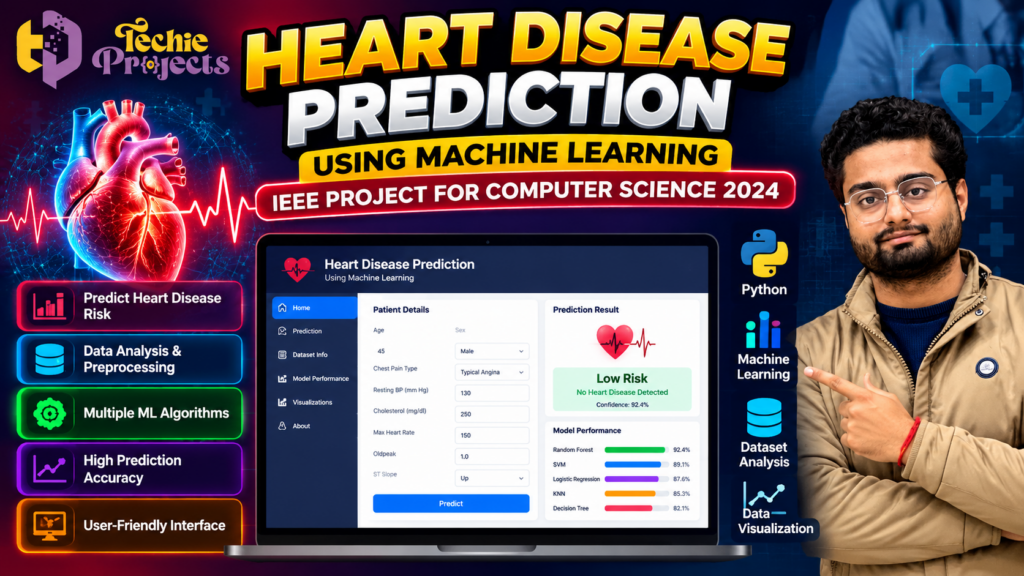
🎓 Looking for a machine learning project for your final-year engineering submission? The Heart Disease Prediction Using Machine Learning project is a practical way to explore Python, healthcare data analysis, predictive modeling, and classification algorithms in one application. If you are a Computer Science, IT, Artificial Intelligence, or Data Science student, this project can help you demonstrate your understanding of machine learning through a healthcare-focused use case.
Instead of spending weeks searching for datasets, configuring Python libraries, developing a prediction interface, and troubleshooting model code, you can enquire about the available project package from Techie Projects. Review the implementation, confirm the deliverables, and choose a package that matches your academic requirements and budget.
Whether you want to study data preprocessing, compare machine learning algorithms, understand model evaluation, or prepare a project demonstration, this topic offers several opportunities for practical learning.
Want to purchase this project? Contact Techie Projects to enquire about source code, installation instructions, project documentation, dataset availability, supported algorithms, pricing, and other deliverables before ordering.
- 🌐 Website: Techie Projects
- 📲 WhatsApp: Enquire About This Project
- 📸 Instagram: Follow Techie Projects
Important: This is an educational machine learning project, not a clinically validated diagnostic system. Its predictions should not be used to diagnose heart disease or make medical decisions.
🎬 Watch the Heart Disease Prediction Project Demo
Explore the project demonstration to understand how the application processes health-related input data and displays its prediction output.
A demonstration can help you review the interface, understand the workflow, and decide whether the project is appropriate for your academic requirements. Check which features are actually implemented before purchasing the package.
🧠 What Is Heart Disease Prediction Using Machine Learning?
Heart disease prediction using machine learning is an application of data science in which algorithms analyze selected health-related attributes to estimate a target category based on patterns learned from historical data.
A typical educational dataset may contain features such as age, blood pressure, cholesterol, resting electrocardiographic measurements, or maximum heart rate. The exact attributes depend on the dataset used.
The model learns patterns from labeled examples during training. After training, it can generate predictions for new inputs that resemble the data it was designed to process.
In this project, Python is used to prepare the data, train or load a machine learning model, and produce predictions through an application interface if one is included.
The quality of the results depends on the dataset, preprocessing, algorithm, validation method, and model limitations. A prediction is not proof that a person does or does not have heart disease.
🎯 Objectives of the Project
The main objective is to demonstrate how machine learning can be applied to a healthcare-related classification problem.
Key objectives include:
- Understanding healthcare datasets and their structure.
- Learning data cleaning and preprocessing techniques.
- Exploring supervised machine learning algorithms.
- Training or using a classification model.
- Evaluating model performance using suitable metrics.
- Developing a prediction interface, if included.
- Understanding the limitations of data-driven predictions.
- Presenting the project workflow and results clearly.
These objectives connect theoretical concepts from machine learning with a practical application that students can study and explain.
⚙️ How Does the Project Work?
The workflow depends on the supplied implementation. A typical version contains the following stages.
1. Dataset Collection
The project begins with a labeled dataset containing selected patient attributes and a target label. Public datasets are commonly used in educational machine learning demonstrations.
Students should review the dataset source, feature definitions, class distribution, and usage conditions before training a model.
2. Data Preprocessing
Raw data may contain missing values, inconsistent formats, or features measured on different scales. Preprocessing prepares the data for model training.
Common operations include handling missing values, encoding categorical variables, scaling numerical features when needed, and separating input features from the target variable.
Data leakage should be avoided by fitting preprocessing operations on the training data rather than using information from the test set.
3. Exploratory Data Analysis
Exploratory data analysis helps students understand the dataset before training the model.
It may include summary statistics, feature distributions, class counts, and visualizations showing relationships between variables. These observations can help identify data quality issues and guide model selection.
4. Model Training
A suitable classification algorithm learns patterns from the training dataset. Depending on the implementation, the project may use models such as Logistic Regression, Decision Tree, Random Forest, Support Vector Machine, or K-Nearest Neighbors.
Not every implementation includes all these algorithms. The available source code determines which models can actually be trained or compared.
5. Model Evaluation
The trained model should be evaluated using data that was not used to fit it. Common classification metrics include accuracy, precision, recall, F1-score, and the confusion matrix.
For healthcare-related applications, accuracy alone may not adequately describe performance. False negatives and false positives can have different implications, so evaluation should consider the intended use and limitations of the dataset.
6. Prediction Interface
Some implementations provide a form where users enter selected attributes and submit them to the model. The application then displays the predicted class.
The interface may use a Python framework such as Streamlit, Flask, or Tkinter, depending on the project. Confirm the actual framework and functionality before purchasing.
7. Results and Documentation
The final stage involves reviewing the model’s results, explaining the workflow, and documenting the implementation. Students should be prepared to explain the dataset, algorithm, evaluation method, and limitations during a project presentation.
❤️ Benefits of Heart Disease Prediction Using Machine Learning
The Heart Disease Prediction Using Machine Learning project helps students explore how data analysis and classification algorithms can be applied to healthcare-related datasets. It combines Python programming with practical machine learning concepts.
Key benefits include:
- Data analysis: Understand patterns and relationships in structured health-related data.
- Predictive modeling: Learn how classification algorithms generate predictions from input features.
- Algorithm comparison: Explore the performance of different models when supported by the implementation.
- Model evaluation: Understand accuracy, precision, recall, F1-score, and confusion matrices.
- Python development: Gain experience working with data processing and machine learning libraries.
- Academic presentation: Explain the workflow, testing methods, and limitations during your project demonstration.
These learning opportunities make this topic relevant to students interested in artificial intelligence, data science, and healthcare analytics.
⚙️ How Heart Disease Prediction Using Machine Learning Helps Students Learn AI
The Heart Disease Prediction Using Machine Learning workflow begins with a dataset containing selected health-related features and a target label. The data is prepared, divided into suitable training and testing sets, and used to train a classification model.
Depending on the implementation, students may explore algorithms such as Logistic Regression, Decision Tree, Random Forest, or Support Vector Machine. Model performance can then be assessed using suitable evaluation metrics.
This workflow demonstrates how data preprocessing, model training, and evaluation fit together in a machine learning application. The resulting predictions are educational outputs and must not be treated as medical diagnoses.
🎓 Who Should Choose a Heart Disease Prediction Using Machine Learning Project?
A Heart Disease Prediction Using Machine Learning project may be suitable for students pursuing Computer Science Engineering, Information Technology, Artificial Intelligence, or Data Science.
It can be particularly useful for students who want to learn about:
- Python-based machine learning applications.
- Healthcare data analysis and visualization.
- Classification algorithms and model evaluation.
- Dataset preparation and feature processing.
- Academic demonstrations involving artificial intelligence.
Before choosing a project package, confirm that its scope, implementation, and documentation meet your institution’s requirements.
🌟 Key Features to Explore
The following features are common in this project category. Confirm which ones are included in the Techie Projects package.
- Healthcare dataset analysis: Explore selected health-related attributes.
- Data preprocessing: Prepare input data for model training or prediction.
- Machine learning classification: Use a trained model to predict a target category.
- Model evaluation: Review available metrics and classification results.
- Prediction interface: Enter supported inputs if a user interface is included.
- Data visualization: Explore graphs or charts if implemented.
- Python-based workflow: Study the integration of data processing and machine learning.
- Extendable learning project: Experiment with alternative algorithms or preprocessing methods.
These are potential project capabilities, not a guarantee that every feature is included. Check the actual implementation and deliverables before placing an order.
💻 Technologies Used
A typical implementation may use the following technologies:
| Technology | Purpose |
|---|---|
| Python | Main programming language |
| Pandas | Dataset handling and data analysis |
| NumPy | Numerical operations |
| Scikit-learn | Machine learning models and evaluation |
| Matplotlib | Data visualization, if included |
| Seaborn | Statistical visualization, if included |
| Streamlit, Flask, or Tkinter | User interface, depending on implementation |
The exact dependencies vary. Confirm the Python version, library versions, and installation requirements to avoid compatibility issues.
🖥️ Software and Hardware Requirements
Software Requirements
A typical development environment may include:
- Windows or Linux operating system.
- Compatible Python installation.
- Required Python libraries.
- Visual Studio Code, PyCharm, or another code editor.
- Dataset and trained model files, if required.
- A compatible interface framework, if the application uses one.
Hardware Requirements
- A computer with sufficient RAM and storage.
- A compatible processor for data processing and model inference.
- An internet connection for initial setup or downloading dependencies, if needed.
A standard computer is generally sufficient for many traditional machine learning classification projects. Exact requirements depend on the implementation and the size of the dataset.
🎓 Why Choose This Project for Final-Year Engineering?
For Computer Science and IT Students
The project demonstrates how a Python application can process structured data, use a trained model, and display a result. It can help students practice programming, data handling, and software development.
For AI and Data Science Students
It provides an opportunity to explore supervised learning, feature preparation, classification metrics, and model comparison. Students can also investigate how dataset quality influences the results.
For Academic Demonstrations
The workflow is suitable for explaining the stages of a machine learning pipeline, from dataset preparation to model evaluation. A working interface, if included, can make the demonstration easier to follow.
For Resume and Portfolio Development
Students can use the project as a learning example when discussing data analysis and machine learning skills. Any resume claims should reflect the work they actually completed and understand.
If you purchase a project package, follow your institution’s academic integrity rules and ensure that you can independently explain and demonstrate the implementation.
🌍 Applications and Learning Opportunities
Healthcare machine learning is an important research area, and educational projects can help students understand its basic methods.
Possible learning applications include:
- Studying classification of structured health datasets.
- Comparing machine learning algorithms.
- Investigating feature importance and model behavior.
- Visualizing data distributions and prediction results.
- Exploring model evaluation and error analysis.
- Learning about responsible use of healthcare-related data.
A classroom model should not be represented as suitable for real clinical use without appropriate clinical validation, regulatory review, and professional oversight.
⚠️ Challenges and Limitations
Understanding limitations is essential to a responsible machine learning project.
- Dataset quality: Inaccurate or incomplete data can affect model performance.
- Class imbalance: Unequal numbers of examples can distort some evaluation metrics.
- Overfitting: A model may perform well on training data but poorly on new examples.
- Feature limitations: Selected variables may not capture all relevant medical factors.
- Generalization: Results on one dataset may not transfer to other populations.
- Prediction uncertainty: Model outputs can be wrong and should not be treated as medical conclusions.
- Privacy: Real patient data requires careful handling and appropriate permissions.
Discussing these limitations strengthens the technical explanation and helps demonstrate a clear understanding of the project.
🚀 Future Scope
The project can be extended as an academic exercise by comparing additional algorithms, improving data preprocessing, evaluating cross-validation results, or creating clearer visualizations.
Other potential extensions include feature-importance analysis, model explainability methods, a more accessible interface, and testing on additional suitable datasets.
Any improvements should be evaluated carefully. Higher accuracy on one test set does not automatically mean that a model is reliable in real healthcare settings.
🛒 Purchase the Heart Disease Prediction Using Machine Learning Project
Need a Heart Disease Prediction Using Machine Learning project for your final-year submission? Techie Projects can help you enquire about the available package so you can review the implementation and check whether it fits your requirements before ordering.
Before purchasing, confirm the following details:
- Source code availability and programming language.
- Dataset source and usage conditions.
- Machine learning algorithms included.
- Trained model files, if applicable.
- Prediction interface and supported inputs, if included.
- Installation guide and dependency requirements.
- Project report and documentation availability.
- Demonstration video or screenshots, if available.
- Pricing, delivery time, and support or customization terms.
Deliverables vary by package, so verify these details directly rather than assuming every feature is included.
📲 Contact Techie Projects
- 📲 Call/WhatsApp: +91-9460060699
- 🌎 Website: www.techieprojects.com
- 📺 Instagram: @pythonprojects_
Send your academic requirements through WhatsApp to ask about current availability, price, and technical specifications.
🔗 Explore Related Python Projects
Interested in other project topics? Visit Techie Projects to explore available machine learning, Python, data science, and final-year engineering projects.
You can also explore related areas such as:
- Machine Learning Projects
- Python Projects
- Data Science Projects
- Artificial Intelligence Projects
- Healthcare Analytics Projects
- Data Visualization Projects
Choose a project that matches your course requirements and confirm the available deliverables before making a purchase.
❓ Frequently Asked Questions
1. What is Heart Disease Prediction Using Machine Learning?
It is an educational classification project that uses selected health-related data to generate predictions based on patterns learned from a dataset.
2. Which programming language is used?
Python is commonly used, with libraries such as Pandas, NumPy, and Scikit-learn, depending on the implementation.
3. Which algorithms can be used?
Possible algorithms include Logistic Regression, Decision Tree, Random Forest, Support Vector Machine, and K-Nearest Neighbors. The supplied implementation determines which are available.
4. Is this project suitable for final-year engineering students?
It may be suitable for Computer Science, IT, AI, and Data Science students, subject to institutional requirements and the actual project scope.
5. Does the project include source code and a report?
This depends on the package. Contact Techie Projects to confirm whether source code, documentation, a dataset, trained model files, and installation instructions are included.
6. Can this project diagnose heart disease?
No. An educational machine learning model is not a substitute for a clinical assessment. Its predictions should not be used for diagnosis or treatment decisions.
7. How can I purchase the project?
Visit Techie Projects or contact us on WhatsApp to enquire about availability, pricing, and deliverables.
✅ Conclusion
The Heart Disease Prediction Using Machine Learning project offers students a practical way to explore Python, structured data analysis, classification algorithms, and model evaluation in a healthcare-related context.
If you want to study a machine learning pipeline and prepare an academic demonstration, contact Techie Projects to review the available implementation and confirm whether it matches your requirements.
🚀 Ready to enquire? Contact Techie Projects on WhatsApp or visit https://techieprojects.com/ for project details.