
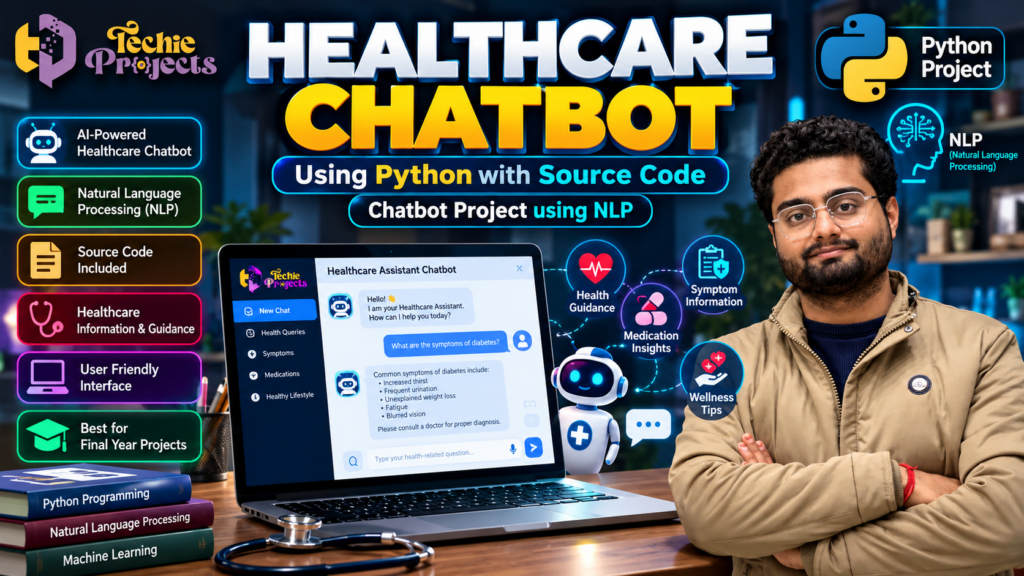
Looking for a practical Python project that combines Artificial Intelligence, Natural Language Processing (NLP), and healthcare technology? The Healthcare Chatbot Using Python with Source Code project from Techie Projects is an option for engineering students who want to explore conversational AI through an academic project. Instead of spending excessive time building an entire application from scratch, you can enquire about the available project package and its deliverables before purchasing.
This project focuses on how a chatbot can receive text-based questions and generate relevant responses using programmed logic and NLP techniques. It can be useful for B.Tech, BCA, MCA, computer science, artificial intelligence, and machine learning students looking for a practical project topic.
If you are planning a minor project, major project, or final-year engineering submission, explore the project details below and contact Techie Projects to confirm the available source code, implementation, documentation, and installation requirements.
🎬 Healthcare Chatbot Project Demonstration
The project demonstration presents the chatbot interface and illustrates how users can interact with the application. It helps visitors understand the overall appearance, conversational flow, and general purpose of the system.
The demonstration can also provide an overview of how a Python-based chatbot receives a message, processes the text, and displays a response. The exact interface and available functions depend on the implemented version.
🤖 What Is a Healthcare Chatbot Using Python?
A healthcare chatbot is a software application designed to communicate with users through a conversational interface. Users enter health-related questions, and the chatbot processes the input to provide responses based on its configured knowledge, rules, or language-processing methods.
The Healthcare Chatbot Using Python project demonstrates how Python programming can be used to build a conversational application around healthcare-related information. Depending on its implementation, it may include a chat interface, predefined responses, text processing, and organised question-and-answer handling.
For example, a user might enter a general question about common symptoms or healthy lifestyle practices. The chatbot can respond with information available in its configured knowledge base. The accuracy and usefulness of those responses depend on the quality of the information and the design of the application.
It is important to understand that an academic chatbot is not a replacement for a qualified healthcare professional. Its purpose is to demonstrate software development and conversational technology, not to provide a definitive diagnosis or prescribe treatment.
🎯 Objectives of the Healthcare Chatbot Project
The primary objective is to demonstrate how a conversational application can organise and present healthcare-related information through a simple digital interface.
Key objectives include:
- Developing a chatbot interface using Python.
- Exploring basic Natural Language Processing concepts.
- Processing user-entered text and identifying relevant information.
- Generating responses using the application’s configured logic.
- Organising healthcare-related information into a conversational format.
- Understanding the development and testing of an interactive software application.
- Exploring the potential role of chatbots in digital information services.
These objectives connect programming concepts with a practical application that students can study and explain during an academic presentation.
⚙️ How Does the Healthcare Chatbot Work?
The workflow of a Healthcare Chatbot Using Python can be divided into several stages. The precise implementation may differ according to the libraries, response system, and interface used in the project.
1. User Input
The process begins when a user enters a question or message into the chatbot interface. The input may relate to general health information, symptoms, wellness, or another topic supported by the application.
2. Text Processing
The application receives the message and processes it according to its programming logic. In an NLP-based implementation, text processing may involve cleaning text, converting text into a suitable format, or identifying keywords and patterns.
3. Query Identification
The system analyses the processed input to determine which response or information category is relevant. A rule-based chatbot may use predefined keywords and conditions, while a more advanced implementation may use an NLP model or intent classification.
4. Response Generation
After identifying a suitable match, the chatbot prepares a response using its configured rules, model, or knowledge source. The quality of the answer depends on how the response system has been designed and tested.
5. Displaying the Response
The generated response is displayed in the chat interface. The user may then enter another question and continue the interaction within the application’s supported scope.
6. Testing and Evaluation
The application should be tested with different questions, variations in wording, unexpected input, and unsupported queries. Testing helps identify incorrect responses and situations in which the chatbot should acknowledge its limitations.
🧠 Technologies Used in the Healthcare Chatbot Project
Python is a popular language for this type of application because it supports software development, data processing, and AI-related libraries.
The technologies used depend on the specific project implementation. Common possibilities include:
- Python: Core programming language for application logic.
- Natural Language Processing: Techniques for processing and interpreting text.
- Machine Learning: May be used if the implementation includes a trained prediction or classification model.
- Chat Interface: A graphical or web-based interface for entering questions and displaying responses.
- Supporting Libraries: Additional Python packages for text processing or application development, depending on the codebase.
Not every healthcare chatbot uses machine learning. Some applications rely on predefined rules and responses, while others incorporate trained models. Confirm the exact libraries, framework, and model used in the package before purchasing.
✨ Key Features of a Healthcare Chatbot
The features available depend on the actual version of the project. A healthcare chatbot may include the following capabilities:
Interactive Chat Interface
A conversational interface allows users to enter questions and view the responses generated by the application. A clear layout can make the interaction easier to understand.
Healthcare Information Responses
The chatbot may display predefined or model-generated information related to the topics included in its configured knowledge base.
Text-Based Communication
Users interact with the application by entering written messages. This makes the system suitable for demonstrating text processing and conversational logic.
Python-Based Development
The project provides an opportunity to examine how Python can be used to connect input handling, response generation, and the user interface.
NLP Concepts
Where implemented, NLP techniques can help the application process text and identify the intent or category of a question.
Academic Demonstration
The project can serve as a learning example for students studying Python programming, artificial intelligence, NLP, or chatbot development.
These are possible project capabilities rather than a guarantee that every feature is included. Check the actual demonstration and confirm the deliverables before ordering.
🎓 Why Choose This Python Project for Your Academic Work?
A well-selected project gives students an opportunity to apply programming concepts to a practical problem. The healthcare chatbot topic is particularly relevant for students interested in conversational interfaces and AI-assisted information systems.
Practical Python Learning: Study how application logic, user input, text processing, and responses work together.
Introduction to NLP: Explore how written messages can be processed and matched to relevant responses.
Software Development Experience: Understand the relationship between the user interface and the underlying program.
Project Presentation: Use the application’s workflow to explain its objectives, design, implementation, testing, and limitations.
Further Learning Opportunities: Depending on the existing code, students can study response handling, interface design, testing methods, or alternative NLP approaches.
Students should review their institution’s project rules and ensure that they understand the implementation. Any purchased material should be used in accordance with academic integrity requirements.
🏥 Applications of Healthcare Chatbots
Healthcare chatbots illustrate how conversational software can be used to present information in accessible formats. Potential application areas include:
- General Health Information: Providing access to curated educational information.
- Wellness Awareness: Sharing general information about healthy habits and preventive care.
- Frequently Asked Questions: Responding to common questions within a defined knowledge base.
- Digital Information Services: Demonstrating conversational interfaces in healthcare-related websites or applications.
- Academic Research: Exploring the strengths and limitations of NLP in a healthcare context.
Real-world use requires appropriate content review, privacy safeguards, testing, and clinical oversight where necessary. A student project should not be presented as a clinically validated diagnostic system unless it has undergone the relevant validation.
💻 Software and Hardware Requirements
The requirements depend on the framework, Python version, and libraries used by the specific project.
Software Requirements
- Python and a compatible development environment.
- Required Python libraries and dependencies.
- A compatible operating system.
- Any interface framework or supporting software included in the implementation.
Hardware Requirements
- A computer or laptop capable of running the selected Python environment.
- Sufficient memory and storage for the application and its dependencies.
- An internet connection if the particular implementation requires online services or downloads.
A lightweight rule-based chatbot may have modest hardware requirements, while a model-based version may need additional resources. Confirm the exact installation requirements before purchasing.
📚 What Students Can Learn from This Project
Working through a chatbot project can help students understand several important software concepts:
- Input and output handling: How an application accepts user messages and returns responses.
- Conditional logic: How predefined rules can direct the chatbot’s behaviour.
- Text processing: How written input can be cleaned, analysed, or categorised.
- Interface development: How users interact with the application.
- Testing: How to check responses against expected behaviour.
- Limitations and reliability: Why a chatbot may misunderstand questions or provide incomplete information.
These learning outcomes are useful when preparing a project report, demonstration, or viva. Students should be able to explain the design decisions and distinguish between the features actually implemented and possible future enhancements.
⚠️ Limitations and Responsible Use
A healthcare chatbot’s answers are only as reliable as its configured content, logic, or underlying model. It may misunderstand ambiguous questions, fail to recognise an unfamiliar phrase, or return an incomplete response.
Healthcare information also requires particular care. The chatbot should communicate its limitations clearly and direct users to qualified professionals for personal medical concerns. It should not encourage users to rely on an academic application for emergency decisions, diagnosis, or treatment.
Developers should also consider privacy when handling messages that may contain personal information. Any deployment beyond an educational demonstration requires an appropriate review of data collection, storage, security, and applicable requirements.
🩺 Benefits of Healthcare Chatbot Using Python for Students
The Healthcare Chatbot Using Python project gives students an opportunity to explore how Python programming can be applied to healthcare-related information systems. It combines application development with conversational interaction, making it a relevant topic for students interested in artificial intelligence and Natural Language Processing.
Some important learning benefits include:
- Understanding how a Python chatbot receives and processes user input.
- Exploring text-processing techniques used in conversational applications.
- Learning how predefined responses or NLP methods can generate chatbot replies.
- Understanding the connection between the chatbot interface and its underlying logic.
- Practising software testing and evaluating response accuracy.
- Learning about responsible use and limitations in healthcare applications.
This project can help students connect programming concepts with a practical application while developing their technical presentation skills.
⚙️ Features of Healthcare Chatbot Using Python
The Healthcare Chatbot Using Python application can demonstrate several features, depending on the implemented version. A conversational interface allows users to enter questions and view relevant responses from the system.
Possible features include text-based interaction, healthcare information responses, basic query processing, and a user-friendly interface. If NLP techniques are included, the application may also process text to identify keywords, patterns, or user intent.
Students should verify which features are available in the actual project before purchasing. Understanding the implemented functions is important for explaining the project accurately during a demonstration or viva.
🎓 Why Choose Healthcare Chatbot Using Python as an Academic Project?
Choosing the Healthcare Chatbot Using Python topic can help students explore a practical application of Python and conversational technology. It is relevant to coursework involving software development, artificial intelligence, NLP, and interactive applications.
Students can study the project workflow, understand how messages are handled, test different inputs, and explain the limitations of automated responses. These activities can support project learning and help students prepare for academic presentations.
If you are considering this project for your coursework, contact Techie Projects to confirm the available source code, included features, documentation, installation requirements, pricing, and support terms.
🛒 Buy Healthcare Chatbot Using Python from Techie Projects
Looking for a Python chatbot project for your college submission? Contact Techie Projects to enquire about the Healthcare Chatbot Using Python project and confirm whether the available package matches your academic requirements.
🌐 Website: https://techieprojects.com/
📲 WhatsApp: https://wa.me/919460060699
📸 Instagram: https://www.instagram.com/pythonprojects_/
Review the project details before ordering, and ensure that you understand the implementation and follow your institution’s academic guidelines.
🔗 Explore Related Python Projects
If you are exploring more project ideas, visit Techie Projects to discover related topics in:
- Python Projects
- Artificial Intelligence Projects
- Machine Learning Projects
- Natural Language Processing Projects
- Data Science Projects
- Web Development Projects
- Final Year Engineering Projects
Select a project based on your academic objectives and the technologies you want to understand in greater depth.
❓ Frequently Asked Questions
1. What is a Healthcare Chatbot Using Python?
It is a Python-based application designed to answer supported healthcare-related questions through a conversational interface. Depending on the implementation, it may use predefined rules, NLP techniques, or machine learning.
2. Is this project suitable for final-year engineering students?
It can be suitable for students studying computer science, information technology, artificial intelligence, or related disciplines, subject to their institution’s project requirements and the scope of the implementation.
3. Does the project use Natural Language Processing?
The project is presented as an NLP-related chatbot topic. The exact text-processing techniques and libraries should be confirmed from the specific implementation.
4. Can the chatbot diagnose diseases?
An academic chatbot should not be treated as a clinically validated diagnostic tool. Its responses are limited by its design and available information, and medical concerns should be discussed with qualified healthcare professionals.
5. How can I purchase the project?
Visit https://techieprojects.com/ or contact Techie Projects through https://wa.me/919460060699 to enquire about availability, pricing, source code, installation requirements, and package deliverables.
6. What should I confirm before purchasing?
Confirm the included features, source code, software dependencies, documentation, installation instructions, pricing, and support terms. Make sure the project matches your academic requirements before ordering.
✅ Conclusion
The Healthcare Chatbot Using Python with Source Code project offers an academic introduction to conversational software, Python programming, and NLP-related concepts. It can help students explore how a chatbot processes questions and presents information through an interactive interface.
For students looking for a practical project topic, the next step is to review the demonstration, understand the technical scope, and confirm the package details with Techie Projects before purchasing. A clear understanding of the implementation will also help you explain the project confidently during your academic presentation.