
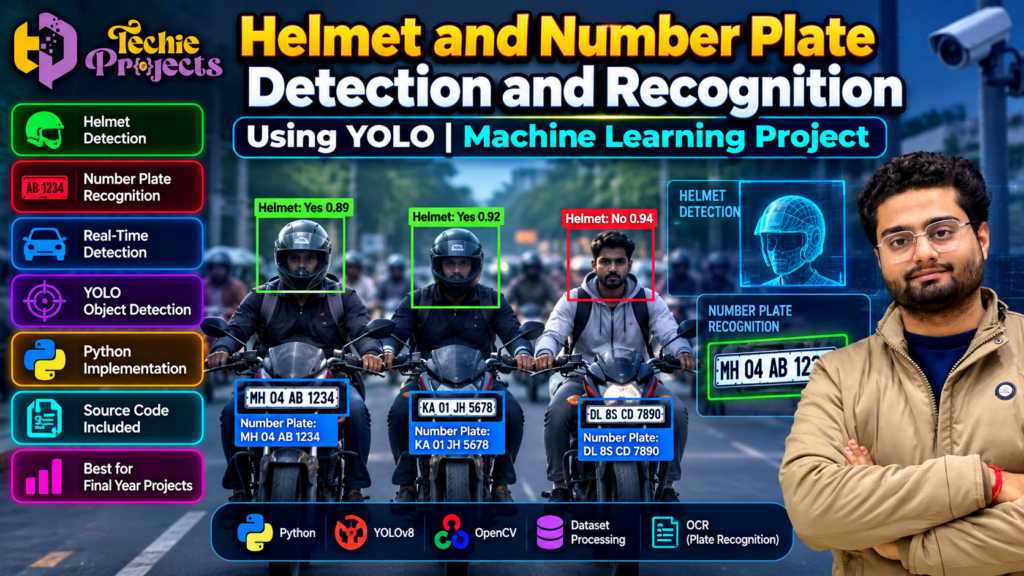
Looking for a practical machine learning project that combines real-time object detection, road safety, and number plate recognition? The Helmet and Number Plate Detection and Recognition Using YOLO project is an excellent option for engineering students who want to explore computer vision through a real-world traffic monitoring application.
At Techie Projects, we help students explore Python, artificial intelligence, machine learning, and computer vision projects for academic learning. This project demonstrates how object detection techniques can identify helmet usage and detect vehicle number plates from supported images or video input, depending on the implementation.
If you are searching for a final-year engineering project that connects AI technology with traffic management, this solution is worth exploring. Contact Techie Projects to enquire about the project package, available source code, installation requirements, and deliverables before purchasing.
🎬 Watch the Helmet and Number Plate Detection Project Demo
Explore the Helmet and Number Plate Detection and Recognition project in action to understand how YOLO-based object detection can identify helmet-related objects and detect vehicle number plates. The demonstration showcases the project’s visual workflow and illustrates how computer vision techniques can be applied to traffic monitoring and road safety applications.
🎓 What Is Helmet and Number Plate Detection Using YOLO?
Helmet and number plate detection is a computer vision application designed to analyse traffic-related images or video frames. It uses object detection techniques to identify relevant objects, such as motorcycles, riders, helmets, and vehicle number plates.
YOLO, short for You Only Look Once, is a family of object detection models designed to locate and classify objects in images efficiently. A suitable YOLO model can be trained or configured to recognise specific classes, depending on the dataset and implementation.
The number plate recognition component focuses on locating a vehicle’s registration plate and extracting its characters. This process may use optical character recognition (OCR) after the plate has been detected.
Combining these components creates an educational project that introduces students to multiple computer vision tasks within one application.
🚦 Why Choose This Machine Learning Project?
Many students want a project that goes beyond basic classification and demonstrates how AI techniques can be applied to practical problems. This project combines several relevant concepts in a single workflow.
Key learning areas include:
- Helmet detection: Understanding how a trained model identifies helmet-related objects or classes.
- Vehicle number plate detection: Locating number plates in supported images or video frames.
- Object detection with YOLO: Exploring bounding boxes, class labels, and confidence scores.
- Image processing: Learning how images and video frames are prepared for model inference.
- OCR integration: Understanding how detected number plates can be converted into text.
- Python development: Exploring how machine learning components are connected in an application.
For students working on computer science, information technology, AI, or data science projects, these concepts can provide a useful foundation for further experimentation.
🚦 Benefits of Helmet and Number Plate Detection and Recognition Using YOLO
⚙️ How the Project Works
The overall workflow depends on the model, dataset, and implementation used. A typical system can be organised into the following stages.
1. Input Image or Video
The application receives an image, video file, or supported camera stream. The input provides the visual information that the system will analyse.
2. Image Preprocessing
The input frames may be resized, converted into the required format, or otherwise prepared before being passed to the detection model. Appropriate preprocessing helps maintain compatibility with the selected model.
3. Helmet Detection
A trained object detection model analyses the frame and predicts the classes it has learned to recognise. If helmet-related classes are included in the training data, the model can identify corresponding objects and display bounding boxes with confidence scores.
Detection quality depends on the dataset, training process, camera angle, lighting, image quality, and model configuration.
4. Number Plate Detection
The system locates vehicle registration plates in the input frame. The detected region can then be cropped for further processing.
5. Character Recognition
If OCR is integrated, the cropped plate image can be processed to extract its visible characters. Recognition accuracy can vary because of blur, glare, plate damage, unusual fonts, or poor image resolution.
6. Displaying Results
The application may display the processed frame with detection boxes, class labels, confidence values, or recognised plate text, depending on the available features.
This workflow gives students an opportunity to understand how different computer vision components work together.
🔍 Features of Helmet and Number Plate Detection and Recognition Using YOLO
The Helmet and Number Plate Detection and Recognition Using YOLO project demonstrates how computer vision can analyse traffic-related images and identify objects supported by a trained model. It combines useful concepts for students interested in Python, machine learning, and intelligent traffic monitoring.
Key features may include:
- Helmet detection: Identify helmet-related classes in supported images or video.
- Number plate detection: Locate vehicle registration plates for further processing.
- YOLO object detection: Display detected objects with bounding boxes and confidence scores.
- OCR integration: Extract number plate characters when an OCR component is included.
- Visual output: Display annotated frames or detection results, depending on the application.
- Python implementation: Explore how model inference and image processing are connected.
The exact features depend on the project version, model, and available components.
💻 Technologies Used
The technologies used depend on the actual source code and project configuration. A typical implementation may involve the following tools.
- Python: Main programming language for application development.
- YOLO: Object detection model for identifying trained object classes.
- OpenCV: Image and video processing operations.
- OCR library: A compatible OCR tool, if number plate character recognition is implemented.
- Machine learning libraries: Supporting packages required by the selected model.
- Development environment: A compatible Python IDE or code editor.
Before purchasing, confirm the exact model version, Python version, libraries, and other dependencies provided with the project.
🖥️ Software and Hardware Requirements
The required system configuration depends on the model size, input resolution, and processing method.
Software Requirements
A typical setup may require:
- Windows or another operating system supported by the project
- Python version compatible with the dependencies
- A code editor or Python IDE
- OpenCV and the required machine learning libraries
- Model weights and configuration files, where applicable
- An OCR package, if used by the implementation
Hardware Requirements
A standard computer may be sufficient for basic testing with images or smaller models. Video processing and larger models may benefit from more processing power.
- A compatible desktop or laptop
- Adequate RAM and storage
- A CPU supported by the required libraries
- A compatible GPU, if GPU acceleration is required or available
- A camera, only if live video input is part of the implementation
Check the actual project requirements before making a purchase, especially if your computer has limited memory or does not include a dedicated GPU.
🎯 Applications of Helmet and Number Plate Recognition
This project demonstrates concepts that are relevant to several potential applications. A student prototype should not be treated as a certified enforcement or surveillance system without appropriate validation.
1. Road Safety Research
Computer vision can be studied as a way to analyse helmet usage in traffic images and evaluate the performance of detection models.
2. Smart Traffic Monitoring
Traffic monitoring systems can use object detection to analyse road scenes. A project prototype can help students understand how such systems process visual data.
3. Parking Management
Number plate recognition techniques can be explored in controlled parking environments to identify registration text from suitable images.
4. Vehicle Access Systems
Plate recognition can be investigated for entry and exit workflows, subject to accuracy, privacy, and security requirements.
5. Academic Research
Students can experiment with different datasets, lighting conditions, model settings, and image resolutions to study their impact on detection performance.
6. Computer Vision Demonstrations
The project can serve as a practical demonstration of object detection and OCR integration during academic presentations, where permitted by the institution.
📊 Advantages of the Project
There are several educational benefits to studying this system.
- Combines multiple computer vision concepts.
- Introduces students to object detection models.
- Demonstrates a potential use case for image and video analysis.
- Provides opportunities to evaluate model performance.
- Encourages experimentation with datasets and preprocessing.
- Can support discussions about AI applications, limitations, and responsible deployment.
The project also helps students explore the difference between detecting an object and recognising text. These are related but separate technical tasks, each with its own performance challenges.
⚠️ Limitations and Important Considerations
Real-world traffic scenes are challenging. A helmet may be partly hidden, a number plate may be blurred, or lighting may make characters difficult to read. Model predictions can also be incorrect.
Detection accuracy depends on the training data, model quality, camera position, image resolution, and environmental conditions. A prototype may require additional training, testing, or configuration before it performs reliably in a new environment.
Number plate data can contain personally identifiable information. Any real-world testing should follow applicable privacy rules, institutional policies, and local laws. The system should not be relied upon as the sole basis for issuing penalties or making other consequential decisions without independent verification.
These limitations provide useful discussion points for a project report and presentation.
🎓 What Students Can Learn
Working with this project can help students understand:
- How object detection models make predictions.
- How bounding boxes and confidence scores are interpreted.
- How images and video frames are processed.
- How OCR can extract text from an image region.
- Why datasets and testing conditions affect model performance.
- How to identify and explain technical limitations.
- How multiple software components can be integrated into a computer vision workflow.
Students should review the implementation and understand its actual behaviour before presenting results or making performance claims.
The Helmet and Number Plate Detection and Recognition Using YOLO project combines object detection and number plate analysis in a practical computer vision application. It helps students explore how machine learning models can identify helmet-related objects, locate vehicle registration plates, and process visual information.
Key benefits include:
- YOLO object detection: Learn how models identify and locate objects in images or video frames.
- Helmet detection: Explore computer vision techniques for analysing helmet usage.
- Number plate recognition: Understand how detected plate images can be processed using OCR.
- Python integration: Study how image processing and machine learning components work together.
- Academic learning: Explore model predictions, testing methods, and limitations for project presentations.
Actual results depend on the model, dataset, and features available in the implementation.
🧠 How Helmet and Number Plate Detection Using YOLO Works
The Helmet and Number Plate Detection Using YOLO workflow typically begins with an image or video frame. The detection model analyses the input and identifies objects represented in its training classes. When a number plate is detected, the system may crop the plate region and use an OCR tool to extract characters.
This combination gives students an opportunity to understand object detection, image preprocessing, and text recognition within one project. Detection and OCR results should be tested under different lighting conditions and image qualities because accuracy can vary.
🛒 Get the Helmet and Number Plate Detection Project from Techie Projects
Interested in learning computer vision through a practical engineering project? Contact Techie Projects to enquire about the Helmet and Number Plate Detection and Recognition Using YOLO package.
The Helmet and Number Plate Detection and Recognition project is relevant to students interested in YOLO, traffic monitoring, and OCR-based applications.
Before confirming your order, enquire about the exact package and verify which items are included. Ask about source code availability, installation instructions, model files, documentation, supported Python versions, and any demonstration or explanation support. Availability can vary by project package.
Contact Techie Projects:
- 📲 Call/WhatsApp: +91-9460060699
- 🌎 Website: www.techieprojects.com
- 📺 Instagram: @pythonprojects_
Share your requirements and ask for the current price, package details, and compatibility information before purchasing.
🔗 Explore Related Python Projects
Students interested in computer vision and machine learning can also explore related project categories on Techie Projects:
- Image Processing Projects
- Machine Learning Projects
- Artificial Intelligence Projects
- Deep Learning Projects
- Python Projects
- Data Science Projects
- Computer Vision Projects
Choose a project that matches your academic requirements, available hardware, and current technical knowledge.
❓ Frequently Asked Questions
What is Helmet and Number Plate Detection Using YOLO?
It is a computer vision project that uses object detection techniques to identify helmet-related objects and locate vehicle number plates. An OCR component may be used to extract text from detected plates.
Which programming language is used?
Python is commonly used for this type of project because it supports machine learning, image processing, and OCR libraries. Confirm the exact language and dependencies of the package before purchasing.
Is YOLO used for number plate text recognition?
YOLO is generally used to detect and locate objects, such as number plates. Reading the characters usually requires a separate OCR step or another recognition model.
Can the project process live video?
That depends on the implementation. Some versions may support live camera input, while others may process only images or saved videos. Confirm this feature before ordering.
Is a GPU required?
Not necessarily for every implementation. Basic testing may work on a compatible CPU, although processing speed depends on the model and input. GPU support depends on the selected software stack and hardware.
Who can study this project?
It may be useful for students studying computer science, information technology, artificial intelligence, data science, or related engineering subjects.
How can I purchase this project?
Contact Techie Projects through WhatsApp or visit techieprojects.com. Ask for current pricing, available deliverables, system requirements, and package details before confirming your order.
🚀 Start Your Computer Vision Project Journey
The Helmet and Number Plate Detection and Recognition project brings together object detection, image processing, and potential OCR integration in one practical learning topic. It can help students explore how computer vision models analyse traffic-related images and understand the challenges of applying AI to real-world scenes.
If this project matches your academic interests, contact Techie Projects to enquire about the available package and confirm its deliverables.
📲 Call/WhatsApp: +91-9460060699
🌎 Website: www.techieprojects.com
📺 Instagram: @pythonprojects_