
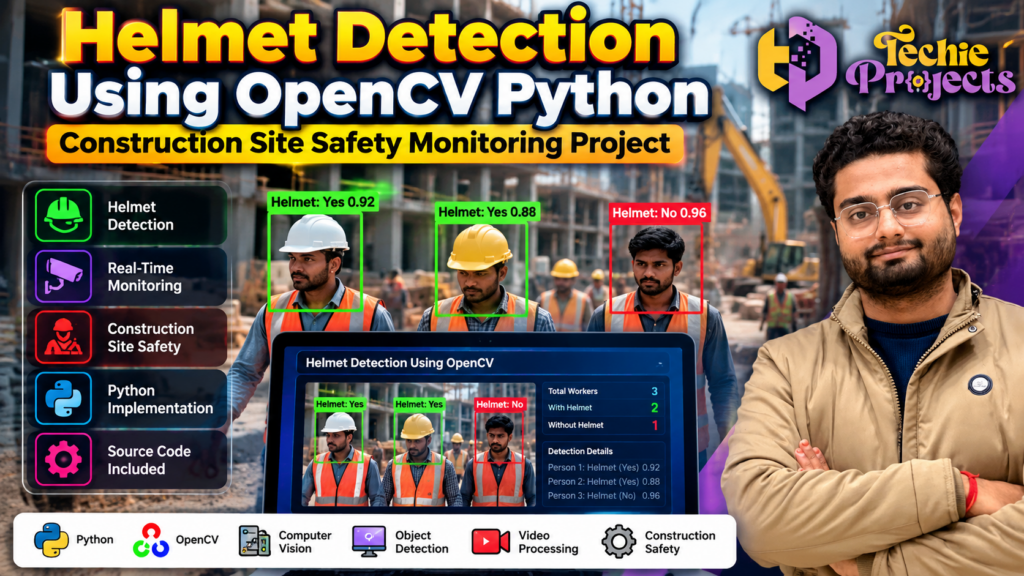
Are you looking for a practical computer vision project for your final-year engineering submission, machine learning portfolio, or academic demonstration? The Helmet Detection Using OpenCV Python project is an excellent option to explore how artificial intelligence and image processing can be applied to construction-site safety and worker monitoring.
Instead of spending valuable time searching for a suitable project idea and building everything from scratch, explore this project from Techie Projects. It demonstrates a real-world computer vision application that can help you understand object detection, image processing, video analysis, and Python programming. If you need a project for your academic work, contact our team to enquire about the available project package, source code, installation requirements, and other deliverables before purchasing.
Whether you are a computer science student, an AI and machine learning learner, or an engineering student interested in practical Python applications, this project can help you connect theoretical concepts with a meaningful real-world problem.
🎬 Watch the Helmet Detection Using OpenCV Python Project Demo
See the Helmet Detection Using OpenCV Python project in action and explore how computer vision can identify helmet-related safety conditions in construction-site footage. The demonstration helps you understand the project’s interface, detection workflow, and potential applications before making a purchase enquiry.
🚀 What Is Helmet Detection Using OpenCV Python?
Helmet detection is a computer vision application designed to identify whether people in an image or video appear to be wearing safety helmets. Construction sites, industrial facilities, and other workplaces can benefit from technologies that assist with safety monitoring.
The Helmet Detection Using OpenCV Python project uses Python-based computer vision techniques to process visual information and demonstrate helmet detection. Depending on the model and implementation, the system may identify people, locate helmets, and classify detected cases into categories such as helmet and no helmet.
OpenCV is a popular computer vision library used for reading images, processing video frames, displaying results, and supporting real-time vision applications. When combined with a suitable detection model, it can help developers build practical visual monitoring systems.
For students, this project offers an opportunity to explore how computer vision transforms image and video data into meaningful detection results.
🔍 Key Features of Helmet Detection Using OpenCV Python
The Helmet Detection Using OpenCV Python project demonstrates how computer vision can be used to analyse images or video footage for helmet-related safety conditions. Depending on the implementation, its features may include:
- Helmet detection: Identify helmets using the detection model included in the project.
- Visual detection results: Display detected objects with labels or bounding boxes when supported.
- Video processing: Analyse video frames using Python and OpenCV if video input is included.
- Detection confidence: Show model confidence values if the selected implementation provides them.
- Safety-monitoring demonstration: Explore how visual detection can support the review of helmet compliance.
These features make the project useful for learning about Python programming, image processing, and object detection. Confirm the actual features available in the package before purchasing.
🎯 Why Choose This Computer Vision Project?
Choosing the right engineering project can make a difference to your learning experience and project presentation. A practical application is often easier to explain when you can connect its technical workflow to a real-world problem.
Here are some reasons to consider this project:
- Practical application: Explore how computer vision can support workplace safety monitoring.
- Python programming: Learn about Python-based image and video processing.
- Visual output: Understand detection results through bounding boxes, labels, or other outputs supported by the implementation.
- Technical learning: Explore object detection, image analysis, and model inference.
- Academic presentation: Use the project’s workflow to explain the problem statement, proposed solution, methodology, and limitations.
- Portfolio development: Gain experience with a computer vision application relevant to AI and machine learning.
If you need a ready-made project to study and demonstrate, contact Techie Projects to confirm the current package details and suitability for your academic requirements.
⚙️ How the Helmet Detection System Works
The general workflow of a helmet detection application consists of several stages. The exact steps depend on the detection model and implementation used in the selected project.
1. Image or Video Input
The system receives visual input from an image, a recorded video, or a camera feed if live-camera functionality is supported. Video input is processed as a sequence of frames.
2. Frame Processing with OpenCV
OpenCV can read video frames, resize images, convert colour formats, and prepare visual data for further processing. These operations help create a consistent input pipeline for the detection model.
3. Object Detection
A trained or configured detection model analyses the image to identify relevant objects. Depending on the implementation, these objects may include people, helmets, or other classes needed for helmet-related classification.
4. Helmet Status Classification
The detection results can be used to distinguish between people wearing helmets and people who may not be wearing them. Classification accuracy depends on the model, training data, lighting, camera angle, and image quality.
5. Displaying the Results
The application can display processed frames with bounding boxes, labels, or confidence scores when these features are implemented. This makes the system’s output easier to interpret during a demonstration.
6. Reviewing Detection Performance
Students can examine successful detections and incorrect predictions to understand the limitations of computer vision. This provides a useful opportunity to discuss accuracy, false positives, false negatives, and possible improvements.
🧠 Technologies Used in Helmet Detection
The technologies required depend on the particular version of the project. Common components in a Python-based helmet detection application include:
Python: The primary programming language for implementing the application logic and connecting computer vision components.
OpenCV: A computer vision library used for reading images and videos, processing frames, and displaying visual results.
Object Detection Model: A suitable trained model is required to detect helmets or related objects. The model architecture and supported classes should be confirmed for the specific project package.
NumPy: May be used for numerical operations and image-array processing.
Development Environment: Python can be used with an editor or IDE such as Visual Studio Code or PyCharm.
Before installing the project, verify its actual library versions and dependencies. Different model architectures may require additional packages or specific Python and framework versions.
💻 Software and Hardware Requirements
A typical Python computer vision project can run on a compatible laptop or desktop, although the exact requirements depend on the model and video-processing workload.
Software Requirements
- Python version compatible with the project dependencies
- OpenCV
- Required model and supporting libraries
- Visual Studio Code, PyCharm, or another compatible editor
- Windows, Linux, or another operating system supported by the implementation
Hardware Requirements
- A laptop or desktop computer
- Adequate RAM and storage for the model and project files
- A compatible processor
- A webcam or sample video if required by the project
A dedicated GPU may improve performance for some detection models, but it is not mandatory for every implementation. Check the package’s installation instructions before purchasing to ensure compatibility with your computer.
🏗️ Real-World Applications of Helmet Detection
Helmet detection has potential applications in environments where protective headgear is required. The technology can assist with monitoring, but it should not replace appropriate workplace safety procedures or professional supervision.
Construction Site Monitoring
A computer vision system can help identify possible helmet non-compliance in construction-site footage. This may support safety teams in reviewing visual information.
Industrial Safety
Factories and industrial workplaces can explore object detection to monitor protective equipment in selected areas.
Smart Surveillance
Computer vision can be integrated into broader video analytics systems to identify events or conditions that require human review.
Academic Research
Students can investigate model accuracy, lighting conditions, detection speed, and the challenges of identifying helmets in crowded scenes.
AI and Machine Learning Demonstrations
The project provides an example of how a trained detection model can be integrated into a Python application to solve a visual classification problem.
Actual deployment requires appropriate testing, privacy safeguards, and evaluation under the conditions in which the system will operate.
📚 What Can Students Learn from This Project?
The project can help students explore several concepts relevant to computer science and engineering:
- Python programming and project structure
- Image processing and video-frame analysis
- Object detection and classification
- Computer vision libraries and model integration
- Detection confidence and prediction errors
- Software installation and dependency management
- Testing, debugging, and performance evaluation
- Technical documentation and project presentation
During your project presentation, explain the problem statement, system architecture, input data, detection process, output, and limitations. Understanding these areas is more valuable than simply demonstrating that the application runs.
Students should also review their institution’s rules regarding external project assistance and ensure they can explain the implementation and their own learning.
✅ Advantages and Limitations
Advantages
- Demonstrates a meaningful computer vision use case.
- Connects Python programming with image and video processing.
- Can provide visual outputs that are useful for demonstrations.
- Offers opportunities to study object detection and model performance.
- Can be extended as a learning exercise, subject to the code and model architecture.
Limitations
- Performance may vary with lighting, camera angle, distance, and occlusion.
- Incorrect detections can occur when the model encounters unfamiliar conditions.
- Real-time processing speed depends on hardware and model complexity.
- A demonstration project should not be assumed to be production-ready safety equipment.
- Model accuracy and supported features must be verified against the actual implementation.
Understanding these limitations will help you present the project realistically and discuss possible future improvements.
🧪 How to Improve Helmet Detection Using OpenCV Python
Students can explore several improvements to understand the performance of a computer vision system. For example, testing different lighting conditions, camera angles, and image resolutions can reveal situations in which detection becomes less reliable.
The Helmet Detection Using OpenCV Python application can also be evaluated using test images or videos. Where suitable labelled data is available, students can measure precision, recall, and other relevant evaluation metrics. The results can help identify false detections and areas for improvement.
Possible future enhancements include optimising processing speed, testing additional datasets, improving detection under partial occlusion, and creating a more informative results interface. The feasibility of each enhancement depends on the model, source code, and available resources.
🛒 Purchase the Helmet Detection Using OpenCV Python
Looking for a practical computer vision project for your engineering course? Contact Techie Projects to enquire about the Helmet Detection Using OpenCV Python package.
Before ordering, confirm the current price, source-code availability, supported Python version, installation requirements, and included documentation. You can discuss your system specifications and academic requirements with our team.
Contact Techie Projects through the following channels:
- 📲 Call/WhatsApp: +91-9460060699
- 🌎 Website: www.techieprojects.com
- 📺 Instagram: @pythonprojects_
Share your course, project requirements, operating system, and submission deadline when enquiring. Our team can clarify the available options so you can make an informed purchase decision.
🔗 Explore Related Python Projects
If you are interested in computer vision and artificial intelligence, explore other project categories on Techie Projects:
- Python Projects
- Machine Learning Projects
- Artificial Intelligence Projects
- Image Processing Projects
- Deep Learning Projects
- Data Science Projects
- Computer Vision Projects
Choose a project that matches your learning objectives and academic requirements. Confirm the available features and deliverables before making your final selection.
❓ Frequently Asked Questions
1. What is Helmet Detection Using OpenCV Python?
It is a computer vision application that uses Python and suitable detection techniques to identify helmet-related conditions in images or video footage.
2. Is this project suitable for final-year engineering students?
It may be suitable for students interested in Python, image processing, artificial intelligence, or machine learning. Confirm your institution’s requirements and the project’s scope before purchasing.
3. Does the project support real-time detection?
Real-time detection depends on the particular implementation, model, and hardware. Contact Techie Projects to confirm whether live-camera input is included in the available package.
4. Which technologies are used in this project?
Python and OpenCV are relevant technologies for this type of application. Additional libraries and the object detection model depend on the specific implementation.
5. Can I install the project on my laptop?
Installation depends on your operating system, Python version, hardware, and project dependencies. Verify the supported environment and installation instructions before purchasing.
6. How can I purchase the project?
Visit https://techieprojects.com/ or contact Techie Projects on WhatsApp at https://wa.me/919460060699 to enquire about pricing, availability, and package details.
7. Can helmet detection be used as a complete workplace safety solution?
No. A detection system may assist with visual monitoring, but it can make mistakes and should not replace workplace safety policies, inspections, or qualified human oversight.
🎓 Conclusion
The Helmet Detection Using OpenCV Python project demonstrates how computer vision can be applied to a practical safety-monitoring problem. By exploring image processing, object detection, Python programming, and model evaluation, students can develop a better understanding of how AI-based visual applications work.
If you are searching for a project for your academic work, portfolio, or technical demonstration, contact Techie Projects to enquire about the available package. Confirm the price, installation requirements, supported features, and deliverables before ordering.
Ready to explore this project? Visit Techie Projects or send your enquiry on WhatsApp to discuss your requirements.