
Introduction
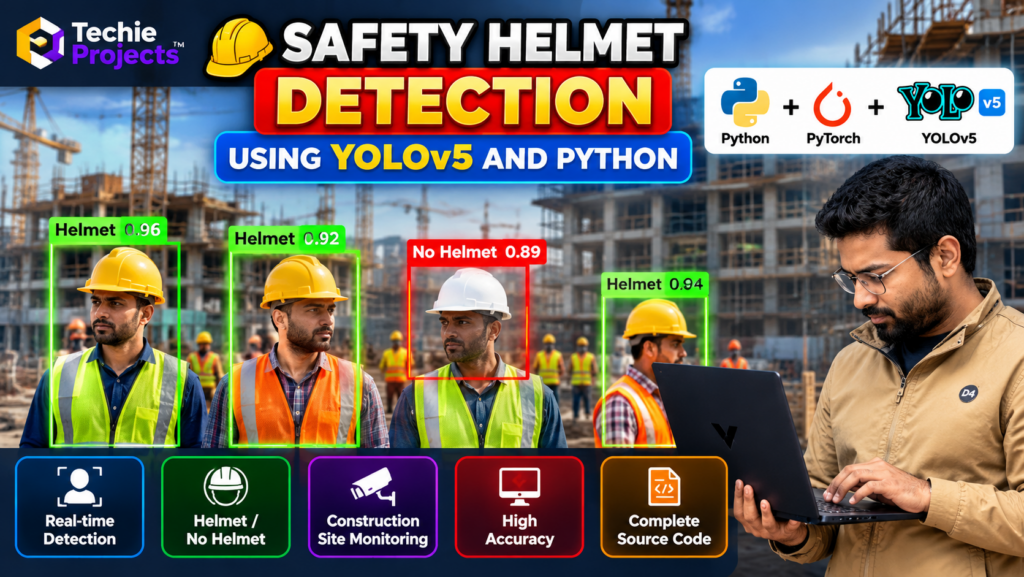
Safety helmet detection using YOLOv5 and Python is a computer vision project designed to identify workers wearing safety helmets and detect workers without helmets in images or video footage. By using object detection techniques, this project demonstrates how AI-based systems can support construction-site safety monitoring.
Construction sites contain potential hazards, making personal protective equipment (PPE) an important part of workplace safety. A helmet detection system can help monitor helmet usage and highlight cases that may require human review.
This project is suitable for B.Tech, B.E., BCA, MCA, and computer science students interested in Python, machine learning, deep learning, and real-time object detection.
If you are looking for a safety helmet detection project with Python source code, Techie Projects can help you enquire about available project packages, documentation, implementation details, and pricing.
Safety helmet detection using YOLOv5 helps demonstrate how a trained object detection model can identify helmet-related objects in construction-site images. This Python project introduces students to deep learning, image processing, and workplace safety monitoring.
🎬 Project Demo: Safety Helmet Detection Using YOLOv5
Explore the project demonstration to understand how the application processes images or video frames and identifies helmet-related detections. The demo can help students understand the interface, detection workflow, and expected output of the implementation.
🎯 Objectives of the Project
The main objectives of the safety helmet detection project are:
- Detect workers and safety helmets in images or video.
- Classify helmet and no-helmet cases when supported by the trained model.
- Explore YOLOv5-based object detection.
- Use Python to build a computer vision application.
- Display detection results using bounding boxes and confidence scores.
- Explore how automated visual monitoring can support workplace safety procedures.
🚀 Key Features of Safety Helmet Detection Using YOLOv5
1. Helmet Detection
The system analyzes images or video frames to locate safety helmets using a suitable trained object detection model.
2. Helmet and No-Helmet Classification
When the model is trained with appropriate classes, it can identify detected cases as helmet or no-helmet. The results depend on the dataset, training quality, and implementation.
3. Object Detection with YOLOv5
YOLOv5 is an object detection model family that can predict object locations and class labels. In this project, a suitable trained model can be used to detect helmets and related objects.
4. Image and Video Processing
Python and OpenCV can be used to load images, process video frames, and display the model’s predictions.
5. Detection Visualization
Bounding boxes, class labels, and confidence scores can help users review the model’s output.
6. Potential Real-Time Monitoring
With compatible camera input and adequate processing performance, the system can be adapted for live video detection. Real-time performance depends on the hardware, model, and application configuration.
⚙️ How Does the Project Work?
In safety helmet detection using YOLOv5, the model analyzes each input image or video frame and predicts the locations and classes of objects it has learned to detect. The application can then display helmet detection results using bounding boxes and class labels.
Step 1: Collect Input Images or Video
The application receives construction-site images, recorded video, or a live camera feed if supported.
Step 2: Prepare the Input
The image or video frame is prepared in the format expected by the detection model.
Step 3: Run YOLOv5 Detection
The trained model processes the input and predicts the locations and classes of objects it has learned to recognize.
Step 4: Identify Helmet Status
If helmet and no-helmet classes are included in the trained model, the application uses these predictions to classify detected cases.
Step 5: Display Detection Results
The system can display bounding boxes, labels, and confidence scores on the processed image or video.
Step 6: Evaluate the Results
Test the system with different lighting conditions, camera angles, distances, and worker positions to understand its strengths and limitations.
🛠️ Technologies Used
The exact technologies depend on the supplied implementation. A typical version may use:
- Python: Main programming language.
- YOLOv5: Object detection model.
- PyTorch: Deep learning framework used by YOLOv5.
- OpenCV: Image and video processing.
- NumPy: Numerical operations.
- Visual Studio Code or PyCharm: Development environment.
The exact model files, package versions, and installation requirements should be confirmed before running the project.
💻 Software Requirements
Typical software requirements include:
- Python 3.x compatible with the selected dependencies
- PyTorch
- OpenCV
- NumPy
- YOLOv5 code and model weights
- A compatible Python IDE
- Sample images or video footage for testing
GPU acceleration may be helpful for faster inference, but whether it is required depends on the model and performance goals.
🖥️ Hardware Requirements
A computer with a modern processor and sufficient memory can run basic detection workloads. Recommended resources depend on the model and input resolution.
- Processor: Modern dual-core processor or better
- RAM: 8 GB recommended for a more comfortable development experience
- Storage: Enough space for dependencies, model weights, datasets, and output files
- GPU: Optional for many basic experiments, but potentially useful for faster inference
- Camera: Required only if live video input is part of the implementation
🏗️ Applications of Safety Helmet Detection
Construction-Site Monitoring
The system can help identify visual cases where workers may not be wearing helmets, allowing a supervisor to review the results.
Industrial Safety
Similar detection approaches can be adapted to suitable industrial environments after testing with representative data.
Workplace Compliance Support
Helmet detection can support safety observation workflows, but automated predictions should not be treated as a substitute for human judgment or formal safety inspections.
Research and Education
Students can use this project to learn about object detection, model evaluation, computer vision, and the practical limitations of AI systems.
✅ Advantages of the Project
- Demonstrates a practical computer vision application.
- Introduces object detection using YOLOv5.
- Provides experience with Python and deep learning tools.
- Supports experimentation with different images and video inputs.
- Can be extended with dashboards, logging, or compatible camera input.
- Offers a practical topic for final-year engineering demonstrations.
⚠️ Limitations
- Poor lighting and low-resolution footage may reduce detection quality.
- Occlusion can make helmets difficult to identify.
- Detection accuracy depends on the training dataset and model.
- Similar-colored objects or unusual helmet designs may cause errors.
- Live monitoring performance depends on hardware and model configuration.
- Predictions should be reviewed before being used in real workplace safety decisions.
🔮 Future Scope
Safety helmet detection using YOLOv5 can be extended with live camera input, detection logging, and dashboard integration, depending on the available implementation and project requirements.
Safety helmet detection using YOLOv5 can be extended with additional functionality, depending on the project requirements.
- Live Camera Integration: Process compatible camera streams.
- Detection Logging: Store detection events for later review.
- Dashboard Integration: Display detection results and summary statistics.
- Email or Alert Integration: Add notifications when supported by a suitable application workflow.
- Dataset Improvement: Train and evaluate the model on more diverse images.
- PPE Detection: Extend the model to identify additional equipment, such as safety vests, if suitable training data and classes are available.
- Performance Evaluation: Measure precision, recall, and inference speed under different conditions.
These enhancements may require additional development beyond the existing project.
🎓 Why Choose This Project for Your Final Year?
This project combines Python programming, deep learning, and computer vision in a practical workplace-safety application. It can help students demonstrate their understanding of object detection and model evaluation.
It is especially relevant for students interested in:
- Artificial intelligence and machine learning
- Deep learning using PyTorch
- YOLO-based object detection
- Image and video processing
- Industrial safety applications
- Final-year computer science projects
🛒 Get the Safety Helmet Detection Project
Are you searching for a safety helmet detection project using YOLOv5 and Python for your B.Tech, B.E., BCA, MCA, or final-year engineering submission?
Techie Projects helps students explore project options and enquire about available implementations.
Before purchasing, contact us to confirm whether the package includes:
- Python source code
- YOLOv5 model files and required dependencies
- Installation and execution instructions
- Sample input images or videos
- Project report or documentation, if available
- Helmet and no-helmet classification
- Customization or implementation support, if available
Package contents, functionality, documentation, pricing, and support options should be confirmed before placing an order.
📲 Enquire on WhatsApp
Tell us your course, submission deadline, and required features so we can discuss the available project package.
👉 Enquire About Safety Helmet Detection on WhatsApp
📲 Call/WhatsApp: +91-9460060699
🌎 Website: www.techieprojects.com
📺 Instagram: @pythonprojects_
🌐 Visit Techie Projects to explore more engineering and Python projects.
🎓 Recommended Projects
Explore these related project topics and link each title to its corresponding published page.
- Vehicle Detection and Counting Using Python — analyze vehicle presence and traffic flow.
- Car Number Plate Detection Using Python — locate vehicle license plates in images.
- Intrusion Detection System Using Machine Learning — explore network security analysis.
- Parking Slot Detection Using OpenCV — identify available and occupied parking spaces.
- Smart Traffic Management System Using Artificial Intelligence — explore intelligent traffic monitoring.
❓ Frequently Asked Questions
1. What is safety helmet detection using YOLOv5?
It is a computer vision application that uses a suitable trained YOLOv5 model to detect helmets and, when supported by the model, classify helmet and no-helmet cases.
2. Which programming language is used?
Python is commonly used, along with supporting libraries such as PyTorch and OpenCV.
3. Can the project work with live video?
Live video may be supported if camera integration is implemented and the computer can process frames at the required speed.
4. Is this project suitable for final-year engineering students?
It can be a suitable topic for students studying computer science, information technology, artificial intelligence, or related disciplines, subject to their institution’s project requirements.
5. Can I purchase the source code?
Contact Techie Projects to confirm current availability, included files, documentation, and pricing.
6. Can additional features be added?
Possible extensions include live camera input, detection logging, dashboards, and additional PPE classes. Confirm the scope and feasibility before purchasing.
Conclusion
Safety helmet detection using YOLOv5 and Python is a practical computer vision project that demonstrates how AI-based object detection can support construction-site safety monitoring. It provides an opportunity to learn about model predictions, image processing, classification, and real-world deployment considerations.
If you need this project for your academic submission, contact Techie Projects to discuss the available implementation, source code, documentation, and pricing.
📲 Contact Techie Projects on WhatsApp