
Introduction
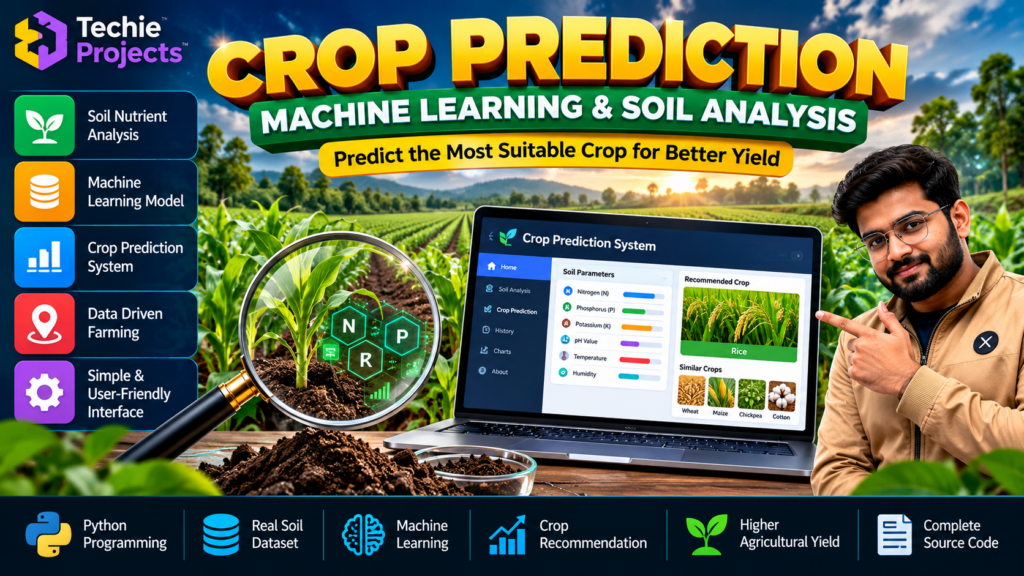
Crop prediction using machine learning is an agricultural technology project that demonstrates how machine learning algorithms can analyze soil and environmental data to recommend a suitable crop from a predefined set of options. This project combines Python programming, data preprocessing, model training, and prediction in an agriculture-related application.
If you are a B.Tech, B.E., BCA, MCA, Computer Science, Artificial Intelligence, or Data Science student looking for a final-year project, this topic offers an opportunity to explore how data-driven methods can support agricultural research.
Techie Projects provides engineering project options for students interested in practical software development. Contact us to confirm the available source code, dataset, model, documentation, installation requirements, and pricing.
🎬 Project Demo: Crop Prediction Using Machine Learning
Watch the project demonstration to understand the application’s interface and prediction workflow. Review the inputs, outputs, and features shown in the demonstration before purchasing.
The exact prediction method depends on the supplied implementation. A project that predicts crops from structured soil data may differ from a separate soil-image-processing application.
🎯 What Is Crop Prediction Using Machine Learning?
Crop prediction using machine learning is a data-driven approach that uses patterns in a dataset to recommend a crop for a given set of input conditions.
A typical project may use soil nutrients such as nitrogen, phosphorus, and potassium, along with other variables such as temperature, humidity, pH, or rainfall. A trained classification model processes the available inputs and predicts one of the crop labels represented in its training data.
The recommendation depends on the dataset and model. It should be treated as an educational prediction rather than a guaranteed agricultural outcome.
✨ Key Features of the Crop Prediction Project
The following features may be included, depending on the supplied version.
- Soil parameter input: Enter supported soil or environmental values.
- Crop recommendation: Predict a crop from the classes supported by the trained model.
- Machine learning integration: Use a trained model to process input data.
- Input processing: Validate or prepare values before prediction where implemented.
- Prediction interface: Display the predicted crop through the application’s interface.
- Data visualization: Display charts or summaries if included.
- Image processing: Include soil-image analysis only if it is genuinely implemented in the supplied project.
- Python implementation: Connect the data processing, model, and application logic using Python.
Confirm the exact functionality before purchasing. Soil-image processing, fertilizer recommendations, automated sensor integration, and live agricultural data are not guaranteed unless included in the actual implementation.
🎓 Objectives of Crop Prediction Using Machine Learning
The main objectives of this project are:
- To understand how machine learning can be applied to agriculture-related datasets.
- To prepare and process soil or environmental data.
- To train or use a suitable classification model.
- To predict a crop from supported input features.
- To display prediction results through a software interface.
- To evaluate the model using suitable metrics.
- To understand the limitations of data-driven crop recommendations.
⚙️ How Does the Crop Prediction System Work?
1. Dataset Collection
The project begins with a dataset containing input features and crop labels. The quality, coverage, and source of the dataset influence the model’s usefulness.
2. Data Preprocessing
The data is inspected and prepared for machine learning. This may include handling missing values, checking data types, and preparing features for the selected algorithm.
3. Feature Selection
The model uses the features supported by its training data. Depending on the dataset, these may include soil nutrients, pH, temperature, humidity, or rainfall.
4. Model Training
A classification algorithm is trained using labelled examples. The algorithm learns relationships between the input features and the crop labels.
5. Model Evaluation
The model should be evaluated on data that was not used to train it. Suitable metrics may include accuracy, precision, recall, F1-score, and a confusion matrix.
6. User Input
The user enters the required values into the application. The system should validate inputs and use the same feature order and preprocessing steps expected by the model.
7. Crop Prediction
The trained model generates a prediction based on the input values and displays the result.
8. Result Interpretation
The predicted crop represents the model’s output, not a guarantee of crop suitability, yield, or profitability. Real farming decisions require additional local knowledge and agricultural assessment.
🧰 Technologies Used
Python
Python is used to implement data processing, model integration, and application logic.
Pandas
Pandas can be used to load, inspect, and manipulate tabular agricultural datasets.
NumPy
NumPy supports numerical operations and array processing.
Scikit-learn
Scikit-learn provides tools for training classification models, preprocessing data, and evaluating predictions.
Matplotlib or Seaborn
These libraries may be used to visualize data and model results if visualization is part of the implementation.
Streamlit, Tkinter, or Another Interface
The application may use a web-based or desktop interface, depending on the supplied project.
The exact libraries and versions depend on the implementation. Confirm the actual technology stack before purchasing.
💻 Software and Hardware Requirements
Software Requirements
- Windows, Linux, or another compatible operating system
- Python
- Required machine learning libraries
- Dataset and model files
- Compatible code editor, such as VS Code or PyCharm
- Additional dependencies specified by the project
Hardware Requirements
- Laptop or desktop computer
- Compatible processor
- Sufficient RAM for the dataset and model
- Storage for project files and datasets
A GPU is generally not necessary for many conventional tabular crop-classification models, although requirements depend on the implementation.
🌱 Advantages of the Crop Prediction Project
- Demonstrates a practical machine learning workflow.
- Introduces agricultural data analysis.
- Combines Python programming with classification.
- Helps students understand feature selection and model evaluation.
- Can be extended with additional datasets or models.
- Provides an academic example of data-driven agricultural decision support.
🌾 Applications of Crop Prediction
Crop prediction techniques can be explored in areas such as:
- Agricultural data analysis
- Crop suitability research
- Soil and environmental data studies
- Smart farming prototypes
- Agricultural decision-support demonstrations
- Machine learning research and education
The usefulness of any recommendation depends on the data and conditions represented by the model.
⚠️ Limitations and Important Considerations
Crop prediction using machine learning has several limitations:
- A model may perform poorly on data that differs from its training dataset.
- Missing or inaccurate input values can affect predictions.
- A predicted crop does not guarantee high yield or profitability.
- Actual crop suitability depends on local climate, soil properties, irrigation, pests, seed variety, and farming practices.
- Dataset imbalance can affect performance for less-represented crop classes.
- Evaluation metrics should be reported honestly using suitable test data.
Farmers should not rely solely on a student project for real agricultural decisions. Local soil testing and advice from qualified agricultural experts remain important.
🚀 Future Scope
Possible improvements to the crop prediction project include:
- Adding more region-specific agricultural data.
- Comparing multiple machine learning algorithms.
- Improving input validation and error handling.
- Adding visualizations of model results.
- Integrating weather data where appropriate.
- Exploring soil sensor integration.
- Developing a mobile or web interface.
- Evaluating the model on independent regional datasets.
These are potential extensions and may require additional development beyond the existing implementation.
🎓 Why Choose This Project for Your Final Year?
Crop prediction using machine learning may be suitable for students interested in Artificial Intelligence, Data Science, Python, and agricultural technology.
The project provides an opportunity to learn:
- Data preprocessing
- Feature engineering
- Classification algorithms
- Model evaluation
- Python application development
- Agricultural data analysis
- Technical documentation and presentation
Before selecting the project, confirm that its implementation and complexity meet your institution’s requirements.
📦 What Is Included When You Purchase the Project?
Package contents depend on the available version. Contact Techie Projects to confirm whether it includes:
- Python source code
- Dataset or dataset instructions
- Trained model files, if applicable
- Required libraries and installation instructions
- Project documentation or report
- Instructions for running the application
- Available setup guidance or technical support options
Confirm the exact deliverables, model type, dataset, and price before placing an order.
📲 Purchase the Crop Prediction Using Machine Learning Project
Looking for a crop prediction using machine learning project for your college assignment or final-year submission? Contact Techie Projects to enquire about the available implementation, source code, documentation, and pricing.
We can help you confirm the project’s features and technical requirements before you purchase.
Get Project Details and Pricing on WhatsApp
📲 Call/WhatsApp: +91-9460060699
🌎 Website: www.techieprojects.com
📺 Instagram: @pythonprojects_
Contact us to confirm current pricing, source code availability, dataset requirements, documentation, and setup options before purchasing.
🔗 Explore Related Projects
Explore these related project topics on Techie Projects:
- Plant Leaf Disease Detection Using Deep Learning
- Soil Detection Using Image Processing
- Fertilizer Recommendation System Using Machine Learning
- Crop Yield Prediction based on Indian Agriculture using Machine Learning
- Smart Agriculture Using IoT
Link each title to its relevant published article on your website when available.
❓ Frequently Asked Questions
1. What is crop prediction using machine learning?
It is a machine learning application that uses patterns in agricultural data to predict a crop label from supported input features.
2. Which programming language is used?
Python is commonly used for data processing, model training, and application development.
3. Which inputs are required for crop prediction?
Depending on the dataset, inputs may include nitrogen, phosphorus, potassium, soil pH, temperature, humidity, and rainfall. The required features vary by implementation.
4. Does the project guarantee better crop yield?
No. A model prediction does not guarantee crop suitability, yield, or profitability. Real outcomes depend on many local and environmental factors.
5. Does this project include soil image processing?
That depends on the supplied version. Confirm whether it uses structured soil data, image processing, or both before purchasing.
6. Is the project suitable for final-year students?
It may be suitable for students studying Computer Science, Artificial Intelligence, Data Science, or related fields, subject to their college requirements.
7. How can I purchase the project?
You can contact Techie Projects on WhatsApp to enquire about pricing and availability.
📝 Conclusion
Crop prediction using machine learning is a useful academic project topic for learning Python, agricultural data processing, classification models, and prediction workflows.
It provides students with a practical way to explore how data-driven methods can support agricultural research while understanding the importance of reliable data and careful model evaluation.
If you want to purchase this project for learning or academic purposes, contact Techie Projects to confirm the current implementation, included deliverables, and price.
👉 Contact Techie Projects on WhatsApp to get started.