
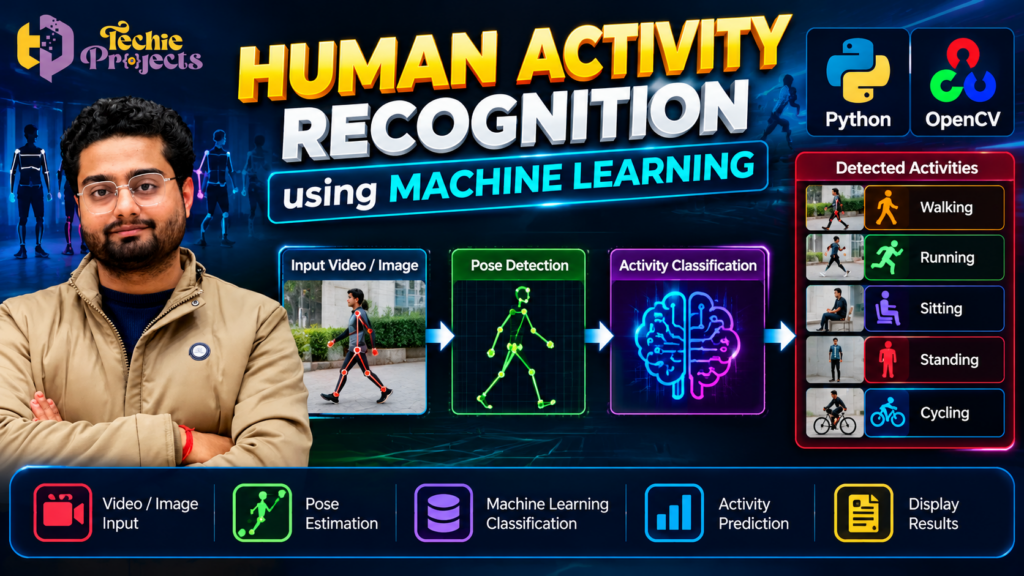
Are you looking for a practical machine learning project that demonstrates computer vision, Python programming, and intelligent activity analysis? Human Activity Recognition Using Machine Learning is an excellent project idea for computer science students who want to explore how computers can identify human movements from video or image data.
At Techie Projects, we help engineering students explore practical project ideas for minor projects, major projects, final-year submissions, and technical demonstrations. If you want to develop your understanding of machine learning through a real-world application, this project can be a valuable addition to your academic portfolio.
Instead of spending excessive time searching for a suitable project topic and planning the complete implementation from scratch, you can contact Techie Projects to discuss the available project package, implementation details, software requirements, and deliverables. This can help you choose a project that fits your syllabus, experience level, and submission timeline.
Interested in getting this project? Visit Techie Projects or contact us directly on WhatsApp to enquire about availability, pricing, and project deliverables.
🎬 Human Activity Recognition Project Demo
The Human Activity Recognition project demonstrates how computer vision and machine learning techniques can be used to analyse human movement. Depending on the implementation, the system may process video footage, extract movement-related information, and classify activities into predefined categories.
Watching a working demonstration can help you understand the relationship between input data, activity analysis, classification, and output results. It can also give you a practical starting point for discussing the project’s workflow during a college presentation or technical review.
For students evaluating this project, review the available demonstration and confirm which activities, input formats, algorithms, and output features are supported by the actual implementation.
📌 What Is Human Activity Recognition Using Machine Learning?
Human Activity Recognition (HAR) is a computer vision and machine learning task that identifies activities performed by people. These activities may include walking, running, sitting, standing, jumping, or other movements, depending on the dataset and model.
Human Activity Recognition Using Machine Learning combines data processing and classification techniques to identify patterns associated with different activities. A system may analyse individual video frames, human body poses, movement features, or sequences of observations to make a prediction.
For example, a model trained to distinguish walking from running may learn patterns related to body posture, limb movement, and changes between consecutive frames. The system then uses these learned patterns to classify new inputs.
The exact approach depends on the project design. Some implementations use traditional machine learning with extracted features, while others use deep learning models, pose estimation, or neural networks that process image or video data.
For engineering students, this topic connects several important areas:
- Python programming
- Machine learning and deep learning
- Computer vision
- Image and video processing
- Data preparation and classification
- Model evaluation and result visualisation
These connections make the project suitable for exploring how multiple technical components work together in an intelligent application.
🎓 Why Choose This Project for Your Final Year?
Selecting a final-year project involves more than finding an interesting title. Students also need to consider technical complexity, implementation requirements, demonstration quality, and the ability to explain the system during evaluation.
Human activity recognition provides an opportunity to study a practical problem while learning about the development of intelligent software.
1. Practical application of machine learning
The project introduces the process of using data to identify patterns and predict activity categories. Students can explore how training data, model selection, and preprocessing affect the results.
2. Computer vision experience
Video-based implementations introduce image frames, visual features, frame processing, and the challenges of interpreting human movement. This is useful for students interested in computer vision and AI development.
3. Suitable for technical demonstrations
A working system can provide a visual demonstration of how input data is processed and how predictions are produced. The exact demonstration depends on the available implementation and supported activities.
4. Opportunities for further development
Students can investigate extensions such as additional activity categories, improved visualisation, performance evaluation, or a different classification approach, subject to the project’s architecture and available data.
5. Relevant to computer science coursework
The project connects programming, algorithms, data analysis, and intelligent systems. Students can use these connections to structure their learning and explain the technical decisions behind the implementation.
If you want to explore this topic without choosing an unsuitable package, contact Techie Projects first and confirm the available version, features, and requirements.
🎓 Benefits of Human Activity Recognition Using Machine Learning for Students
Human Activity Recognition Using Machine Learning is a useful academic project for students who want to explore practical applications of artificial intelligence. It combines programming, data processing, computer vision, and activity classification in one project.
By studying this application, students can understand how a machine learning model analyses input data and predicts an activity category. They can also learn about preprocessing, model evaluation, classification errors, and the importance of suitable training data.
For computer science and engineering students, Human Activity Recognition Using Machine Learning can provide a foundation for exploring related areas such as pose estimation, intelligent video analysis, and deep learning. The project also offers opportunities to discuss technical limitations and possible improvements during a project presentation.
⚙️ How Does the System Work?
The workflow of a human activity recognition system varies according to the algorithm and input data. A typical video-based implementation may include the following stages.
Step 1: Input video or image data
The system receives an input such as a video file, webcam stream, or image sequence. The supported input method depends on the implementation.
Step 2: Data preprocessing
The input may be resized, converted into the required format, or divided into frames. Preprocessing helps prepare the data for the selected model.
Step 3: Feature extraction or pose estimation
Some systems identify visual patterns directly from image frames. Others estimate body landmarks or extract movement-related features before classification.
Pose estimation can represent parts of the body as key points, such as shoulders, elbows, hips, knees, and ankles. These points may help describe a person’s posture and movement.
Step 4: Activity classification
The system uses a trained model or classification method to assign an activity label to the processed input. The supported labels depend on the training dataset and model configuration.
Step 5: Prediction display
The predicted activity may be shown as text, a label on the video, or another visual output. Some implementations may also display confidence scores or additional information.
Step 6: Testing and evaluation
The model should be tested using suitable data to examine whether it recognises activities correctly. Students can investigate misclassifications and discuss limitations during their project evaluation.
Understanding these stages helps students explain the complete workflow instead of describing the project only as an application that predicts activities.
⚙️ How Human Activity Recognition Using Machine Learning Processes Activities
The workflow of Human Activity Recognition Using Machine Learning depends on the implementation, but a typical video-based system begins by receiving video or image data. The input is then prepared for analysis using suitable preprocessing techniques.
Depending on the selected approach, the system may extract visual features, estimate human body poses, or process frames through a trained model. The classification component uses the learned patterns to predict an activity supported by the model.
The predicted result can then be displayed for inspection. Testing the application with different examples helps students understand how lighting, camera angles, movement patterns, and training data can influence performance.
This workflow makes Human Activity Recognition Using Machine Learning a practical topic for understanding how data moves through a computer vision application.
🧠 Technologies Used in Human Activity Recognition
The technologies depend on the specific version of the project. Common tools in this area include the following.
Python
Python is widely used for machine learning, data preparation, computer vision, and application development. Its ecosystem makes it possible to connect multiple processing and classification components.
OpenCV
OpenCV is a computer vision library that can be used to read video streams, process image frames, resize images, and display results. Its use depends on the project’s implementation.
Machine learning libraries
Libraries such as scikit-learn may support preprocessing, classification, and evaluation for traditional machine learning workflows.
Deep learning frameworks
TensorFlow or PyTorch may be used when the implementation relies on neural networks. Not every human activity recognition project requires both frameworks, so confirm which tools are included in the available package.
Pose estimation tools
A pose estimation library or pretrained model may be used to extract human body landmarks. This component is optional and depends on the chosen architecture.
Before purchasing a project, ask Techie Projects which programming language, libraries, model, dataset, and interface are included. Do not assume that every possible tool listed above is part of the same implementation.
💻 Software and Hardware Requirements
The resources needed to run this application depend on the selected model and the size of the input data.
Software requirements
A typical Python-based setup may include:
- Python installed in a compatible version
- Required computer vision or machine learning libraries
- A code editor or Python development environment
- Compatible operating system
- Project-specific model files and dependencies, if required
Hardware requirements
A computer with sufficient RAM, storage, and processing capability is generally needed. CPU-based execution may be suitable for some implementations, while larger deep learning models may benefit from a compatible GPU.
The exact requirements depend on the model architecture, image resolution, processing speed, and whether inference is performed in real time. Confirm the minimum specifications before purchasing or installing the project.
✨ Important Features to Explore
The following are common features that may be relevant to a human activity recognition application. Verify which ones are included in the specific package before relying on them.
- Activity classification: Predicts a category from the supported activity labels.
- Video processing: Processes video input when supported by the implementation.
- Visual output: Displays predicted activity labels or other results.
- Machine learning workflow: Demonstrates how input data is processed and classified.
- Model testing: Allows predictions to be examined against suitable test examples.
- Potential for customisation: May provide a basis for experimenting with supported datasets, labels, or models.
The final feature list should reflect the actual project. Real-time webcam detection, multiple-person tracking, confidence scores, report generation, and a graphical interface should only be advertised if they are genuinely available.
🌍 Real-World Applications of Human Activity Recognition
Human activity recognition is an active area of research with possible applications across several fields. The suitability of a system depends on its accuracy, data quality, privacy safeguards, and operating environment.
1. Smart surveillance research
Activity classification can help researchers investigate movement patterns in video. Real-world surveillance use requires careful consideration of privacy, consent, and the risk of incorrect predictions.
2. Healthcare and assisted living research
Activity recognition can be studied for movement monitoring and assistance applications. A student prototype should not be treated as a validated medical or safety device.
3. Fitness and sports analysis
Movement classification may support research into exercise patterns and physical activity. Reliable use requires appropriate data and evaluation.
4. Smart environments
Researchers can investigate activity-aware systems that respond to observed movement. Any automated action should be designed with safeguards and suitable testing.
5. Academic research
The project can help students study classification methods, feature extraction, model performance, and the limitations of machine learning when processing complex visual information.
📊 Advantages and Limitations
Advantages
- Combines programming, computer vision, and machine learning concepts.
- Offers a visual way to demonstrate predictions.
- Supports discussion of data preparation and model evaluation.
- Provides opportunities to compare different classification techniques.
- Can be extended for learning and research when the code and data permit.
Limitations
- Prediction accuracy depends on training data and the chosen model.
- Poor lighting, camera angles, occlusion, and unusual movements can affect results.
- Similar activities may be difficult to distinguish.
- Processing video continuously may require additional computing resources.
- A model may perform poorly on people, environments, or camera conditions that differ from its training data.
Discussing these limitations in your report demonstrates that you understand the project critically rather than presenting machine learning as a perfect solution.
🎯 What Can Students Learn from This Project?
A well-understood implementation can help students develop practical knowledge in several areas.
Programming: Learn how Python components are organised and how input data moves through the application.
Data processing: Understand the importance of preparing data in a format compatible with the selected model.
Model evaluation: Explore test data, prediction errors, accuracy metrics, and the difference between successful demonstrations and reliable performance.
Debugging: Learn to investigate dependency problems, incompatible library versions, missing files, and unexpected predictions.
Technical communication: Practise explaining the problem statement, objectives, system architecture, workflow, results, and limitations.
Students should also follow their institution’s rules for project assistance, source-code use, citations, and individual assessment. Make sure you understand the implementation and can explain your own work.
🛒 Purchase Human Activity Recognition Using Machine Learning Project
Looking for a practical project for your final-year engineering submission? Human Activity Recognition Using Machine Learning is a topic worth considering if your academic interests include Python, artificial intelligence, and computer vision.
Techie Projects can help you enquire about the available project package, pricing, implementation details, and deliverables. Before purchasing, confirm the supported activity categories, installation requirements, source-code availability, and any documentation or assistance you need.
Why enquire before purchasing?
- Check project suitability: Compare the implementation with your syllabus and project objectives.
- Confirm compatibility: Discuss your operating system, Python version, and hardware.
- Understand the deliverables: Verify exactly what is included in the package.
- Clarify pricing: Request the current price and payment details directly.
- Plan your timeline: Share your submission date so you can check availability before ordering.
Contact Techie Projects
Ready to enquire about this project?
- 📲 Call/WhatsApp: +91-9460060699
- 🌎 Website: www.techieprojects.com
- 📺 Instagram: @pythonprojects_
Send a message mentioning Human Activity Recognition Using Machine Learning and your course or project requirements. The team can clarify availability and the deliverables offered for the selected package.
🔗 Explore Related Python Projects
If you are comparing project ideas, you can also explore related areas on Techie Projects:
- Human Pose Estimation
- Real-Time Object Detection
- Face Recognition Attendance System
- AI-Based Exam Proctoring
- Vehicle Detection and Counting
- Gesture Recognition Using Computer Vision
- Image Classification Using Deep Learning
These are related project topics, not a guarantee that every title is currently available as a ready-to-run package. Check the website or contact the team for current options.
❓ Frequently Asked Questions
What is Human Activity Recognition Using Machine Learning?
It is a computer vision and machine learning task that classifies human activities from data such as images, video frames, or movement-related features. The exact method depends on the model and implementation.
Which programming language is commonly used?
Python is widely used because it supports computer vision, machine learning, and deep learning libraries. Confirm the programming language used in the specific project package.
Is this project suitable for final-year engineering students?
It can be suitable for students studying computer science, artificial intelligence, data science, or related fields. Suitability depends on the institution’s requirements and the technical depth of the implementation.
Does the project work in real time?
Some implementations process webcam input in real time, while others analyse saved videos or images. Ask Techie Projects to confirm the supported input mode before purchasing.
Can I customise the activities?
Customisation may be possible if the model, code, and training data support it. Adding new activity categories may require suitable data, retraining, and additional testing.
What should I confirm before buying?
Ask about the current price, supported features, source-code availability, software requirements, installation assistance, documentation, and any other deliverables you need. Obtain confirmation before payment.
How can I enquire about the project?
Visit Techie Projects or message Techie Projects on WhatsApp. Mention the project title and your academic requirements to help clarify whether the available package is appropriate.
✅ Conclusion
Human activity recognition is a useful topic for exploring the relationship between machine learning, computer vision, and human movement analysis. It offers students an opportunity to investigate data processing, classification, prediction results, and model limitations through a practical application.
If you are planning a minor project, major project, or final-year engineering submission, review the available implementation carefully and confirm that it matches your requirements.
Want to explore this project for your coursework? Contact Techie Projects on WhatsApp or visit techieprojects.com to enquire about availability, pricing, and package details before purchasing.