
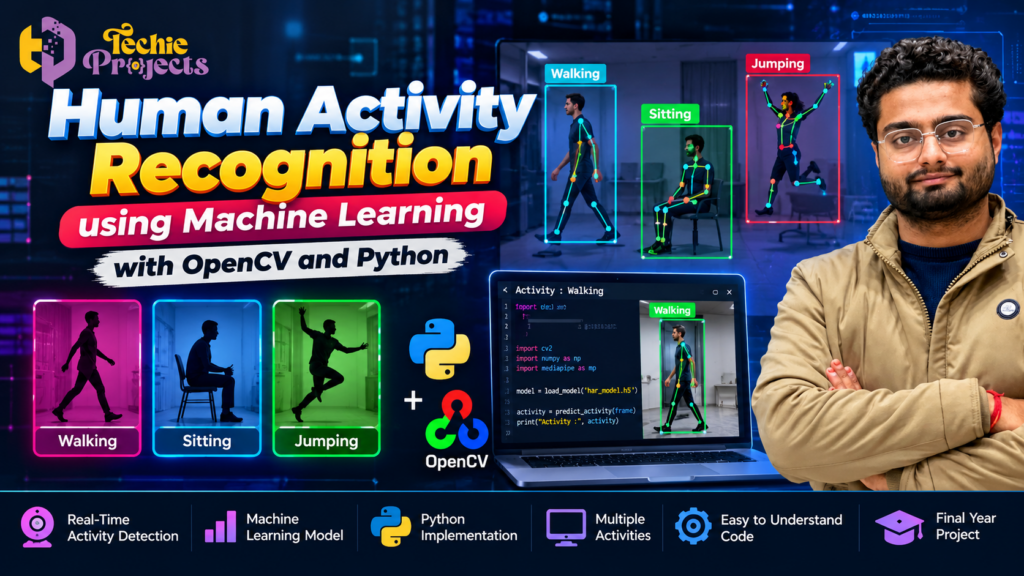
Human Activity Recognition Using Machine Learning with OpenCV and Python
Looking for a practical machine learning project that can help you demonstrate computer vision skills in your college project submission? Human Activity Recognition Using Machine Learning is a strong choice for students who want to explore how computers identify and classify human movements using video or image data. Instead of spending weeks starting from scratch, you can explore a project from Techie Projects and enquire about the available implementation, source code, installation assistance, and documentation before purchasing.
This project combines Python programming, OpenCV, and machine learning concepts to demonstrate how activities such as walking, sitting, and jumping can be recognized from visual data, depending on the model and implementation. It is suitable for students exploring artificial intelligence, computer vision, and final-year engineering projects.
At Techie Projects, our goal is to help students find practical project options that align with their academic requirements and technical interests. Contact us to discuss the available project package, supported features, software requirements, and deliverables before placing your order.
🎬 Human Activity Recognition Project Demo
Watch the Human Activity Recognition project demonstration to understand its interface, activity classification process, and overall workflow.
The demonstration can help you see how the application operates and how computer vision concepts are applied to recognize human movements. Review the actual implementation to understand which activities are supported and whether the project matches your academic requirements.
🤖 What Is Human Activity Recognition Using Machine Learning?
Human activity recognition is a computer vision and machine learning task in which a system identifies human actions from visual information, sensor readings, or other input data. In a video-based implementation, the system processes frames and uses a suitable algorithm or trained model to predict the activity represented in the input.
Human Activity Recognition Using Machine Learning demonstrates how programming and data-driven models can be combined to classify different movements. Depending on the implementation, the system may identify actions such as walking, sitting, standing, running, or jumping.
For example, a camera may capture a person walking across a room. The application processes the available visual information and produces an activity label if the trained model supports that action.
The prediction depends on the model, training data, input quality, and implementation. It should not be assumed that every version supports all activities or works reliably in every environment.
🎓 Why Choose This Machine Learning Project?
Selecting a suitable engineering project involves more than choosing an interesting title. Students need a topic that demonstrates technical concepts, supports practical learning, and can be explained during a project presentation or viva.
This project offers several learning opportunities:
- Practical computer vision: Explore how video frames or images can be processed using Python and OpenCV.
- Machine learning fundamentals: Understand how trained models classify input data.
- Real-time processing concepts: Learn how a video-based application can process frames continuously, where supported.
- Application development: Study how input processing, prediction, and output display work together.
- Project presentation: Explain the problem statement, system architecture, workflow, limitations, and possible improvements.
- Further experimentation: Investigate how different datasets, model architectures, or preprocessing methods can affect predictions.
If you need a ready-made project for academic learning, contact Techie Projects to confirm the available package and whether it meets your institution’s requirements.
🎓 Benefits of Human Activity Recognition Using Machine Learning for Students
Human Activity Recognition Using Machine Learning is a valuable topic for students interested in Python programming, artificial intelligence, and computer vision. It connects theoretical machine learning concepts with a practical application that processes visual information and predicts human activities.
By studying this project, students can understand how video frames are processed, how a trained model generates predictions, and how the results are displayed. It also provides opportunities to investigate the effect of input quality, model selection, and preprocessing on classification performance.
For engineering students, Human Activity Recognition Using Machine Learning can support practical learning, technical presentations, and discussions about the advantages and limitations of automated activity classification.
🛠️ Technologies Used in the Project
The exact technology stack depends on the version supplied. The following tools are commonly relevant to a video-based human activity recognition system.
1. Python Programming Language
Python provides the main programming environment for developing the application. Its readable syntax and extensive machine learning ecosystem make it useful for image processing, model inference, and application logic.
Students can study how input data is handled, how functions are organized, and how predictions are displayed.
2. OpenCV for Computer Vision
OpenCV is a computer vision library used for image and video processing. In a suitable implementation, it can read video streams, extract frames, resize images, and display processed output.
Learning OpenCV also introduces students to essential concepts such as frame dimensions, image channels, video capture, and image preprocessing.
3. Machine Learning Model
The recognition component uses a model or classification approach to predict an activity. The particular algorithm depends on the project’s design.
Some implementations use handcrafted features and traditional classifiers, while others rely on deep learning architectures, pose estimation, or temporal information from multiple frames. These approaches are not interchangeable, so the actual model should be verified before purchase.
4. Supporting Python Libraries
Depending on the implementation, the application may use additional libraries for numerical computation, data handling, model loading, or visualization. Confirm the exact dependency list and compatible versions before installing the project.
⚙️ How Does the System Work?
A typical video-based recognition workflow can be explained through the following stages.
Step 1: Input Collection
The application receives input from a video file, image, or camera feed, depending on the supported configuration. The input provides the visual information used for activity classification.
Step 2: Frame Processing
For video input, the system reads individual frames. Image preprocessing may resize frames or prepare them in the format expected by the recognition model.
Step 3: Feature Extraction or Model Inference
The system extracts relevant visual features or passes the prepared input to a trained model. Some approaches analyze body posture, while others learn visual patterns associated with particular activities.
Step 4: Activity Classification
The model generates a prediction based on the information it receives. The predicted label might represent an activity such as walking or sitting, provided that the model has been designed to recognize that class.
Step 5: Result Display
The application displays the predicted activity in its interface or output window. Depending on the implementation, the output may include labels, confidence scores, or visual indicators.
Step 6: Evaluation and Testing
The system should be tested with suitable examples to examine its behavior. Students can investigate how lighting, camera angle, background, movement speed, and unfamiliar actions influence prediction quality.
This workflow gives students a clear structure for explaining the project during a demonstration or technical presentation.
✨ Key Features of a Human Activity Recognition System
The features available depend on the actual project version. Common capabilities in this type of application may include:
- Activity classification: Predict supported human actions from input data.
- Video processing: Process video frames when video input is implemented.
- Visual output: Display the predicted activity in an output window or interface.
- Python-based development: Use Python for application logic and model integration.
- Computer vision integration: Apply image or video processing techniques.
- Machine learning workflow: Demonstrate how a trained model produces predictions.
- Testing and evaluation: Examine the model’s behavior across different inputs.
Before ordering, confirm which features are included in the Techie Projects version rather than assuming that every listed capability is available.
💻 Software and Hardware Requirements
A compatible computer and correctly configured Python environment are important for running a machine learning project.
Software Requirements
A typical setup may include:
- Python
- OpenCV
- The machine learning framework required by the selected model
- Additional Python packages listed in the project dependencies
- A compatible operating system, such as Windows, subject to the implementation
The required Python version and package versions should be checked against the project’s actual configuration.
Hardware Requirements
For a basic implementation, a standard laptop or desktop may be sufficient. A camera may be required if the application supports live video input.
More computationally intensive deep learning models can require additional processing power. A dedicated GPU may help with some workloads, but it is not automatically required for every implementation.
Important: Verify the project’s system requirements before purchasing to avoid compatibility issues.
🌍 Real-World Applications of Human Activity Recognition
Human activity recognition has applications across several fields. The feasibility of each use case depends on the model, data, hardware, and deployment environment.
1. Smart Surveillance Research
Activity classification can support research into video analysis, including identifying selected movement patterns in recorded footage. Real-world surveillance systems require careful testing, privacy safeguards, and appropriate human oversight.
2. Healthcare and Assisted Living
Researchers can investigate activity monitoring to understand movement patterns and support selected assisted-living applications. Systems used in healthcare require additional validation and must not be treated as medical devices without appropriate assessment.
3. Fitness and Sports Analytics
Activity recognition can be used to explore movement classification in fitness or sports settings. Depending on the implementation, a model may distinguish selected exercises or movement categories.
4. Smart Homes
Computer vision research can examine how systems identify activities in indoor environments. Any real deployment should consider consent, data security, and the limitations of visual recognition.
5. Academic Research and Learning
Students can use the project as a starting point to study computer vision, classification models, data preparation, and evaluation methods.
These are broader application areas of the technology, not a guarantee that every feature is built into the project offered for purchase.
⚙️ Applications of Human Activity Recognition Using Machine Learning
Human Activity Recognition Using Machine Learning has potential applications in research involving smart surveillance, fitness analytics, assisted living, and human movement analysis. The usefulness of a particular system depends on its training data, supported activities, and testing conditions.
In a video-based implementation, OpenCV can help process incoming frames, while a compatible trained model predicts the activity represented by the input. Students can explore how changes in lighting, camera angle, background, and movement affect the results.
These experiments make Human Activity Recognition Using Machine Learning a useful subject for understanding the practical challenges of computer vision and classification systems.
📊 Advantages and Limitations
Advantages
- Combines Python, machine learning, and computer vision concepts.
- Provides a practical topic for studying model inference.
- Can help students understand the relationship between input data and predictions.
- Offers opportunities to experiment with preprocessing and model evaluation.
- Can be extended for further learning if the implementation supports modification.
Limitations
- Accuracy depends on the quality and suitability of the trained model.
- Poor lighting, occlusion, camera position, and unusual movements may reduce performance.
- A model can struggle with activities or environments not represented in its training data.
- Processing speed depends on the model, hardware, and implementation.
- Predictions may be incorrect and should not be treated as definitive evidence of a person’s behavior.
Understanding these limitations will help you present the project realistically and answer technical questions with confidence.
🎯 Learning Outcomes for Engineering Students
Working with this topic can help students develop a better understanding of machine learning and computer vision workflows.
Students can learn how to:
- Describe a computer vision problem and its objectives.
- Understand the role of training data and a trained classification model.
- Process images or video frames using Python.
- Explain the relationship between preprocessing and model inference.
- Test predictions using different input conditions.
- Discuss model limitations and potential improvements.
- Present the system architecture and project workflow during a demonstration.
For the best academic experience, study the implementation and prepare your own explanation of its technical components. Follow your institution’s rules regarding purchased code, project assistance, and originality.
🛒 Get the Human Activity Recognition Using Machine Learning Project
Looking for a Python-based computer vision project for your academic work? Human Activity Recognition Using Machine Learning combines activity classification concepts with practical programming and model inference.
Contact Techie Projects to enquire about the available version, supported activities, source-code availability, installation instructions, documentation, and pricing before purchasing.
Why Enquire with Techie Projects?
- Explore Python and machine learning project options.
- Discuss your academic requirements before purchasing.
- Confirm software compatibility and included deliverables.
- Ask questions about the available implementation.
- Find related projects in computer vision and artificial intelligence.
Ready to enquire about this project?
- 📲 Call/WhatsApp: +91-9460060699
- 🌎 Website: www.techieprojects.com
- 📺 Instagram: @pythonprojects_
Share your course, project deadline, and required deliverables when contacting us. Our team can help clarify the available package and the next steps before you make a purchase.
🔗 Explore Related Python Projects
If you are exploring other technical topics, browse related project areas on Techie Projects:
- Machine Learning Projects
- Computer Vision Projects
- Python Projects
- Artificial Intelligence Projects
- Image Processing Projects
- Deep Learning Projects
- Final-Year Engineering Projects
Choose a project based on your learning goals, available time, technical background, and college requirements.
❓ Frequently Asked Questions
1. What is Human Activity Recognition Using Machine Learning?
It is a machine learning task that identifies human activities from data such as video frames, images, or sensor readings. The specific input and supported activities depend on the implementation.
2. Which programming language is used?
Python is commonly used for this type of project. OpenCV may be used for image or video processing, alongside the framework required by the selected model.
3. Can the system recognize activities in real time?
Some implementations support live camera input and continuous prediction. Confirm that real-time recognition is included in the version you intend to purchase.
4. Is this project suitable for final-year engineering students?
It can be a suitable learning topic for students interested in artificial intelligence, machine learning, and computer vision. Check your college’s requirements and confirm the project’s complexity and deliverables before ordering.
5. Does the project require a GPU?
Not necessarily. Requirements depend on the model and implementation. Some models can run on a CPU, while others may benefit from GPU acceleration.
6. Can I purchase this project from Techie Projects?
You can contact Techie Projects to enquire about availability, pricing, supported functionality, and included deliverables through the website or WhatsApp.
7. What should I confirm before purchasing?
Ask about the supported activities, input method, Python and library versions, source-code availability, installation process, documentation, and any support included with the purchase.
✅ Conclusion
Human Activity Recognition Using Machine Learning provides a practical introduction to the relationship between Python programming, computer vision, and activity classification. By exploring the workflow from input processing to model prediction, students can develop a clearer understanding of how visual data can be used to recognize selected human actions.
If you are looking for a project to study or adapt for your academic work, contact Techie Projects to discuss the available implementation and confirm the deliverables before purchasing.
Visit TechieProjects.com or contact us on WhatsApp to enquire about this project and explore other machine learning and computer vision solutions.