
Introduction
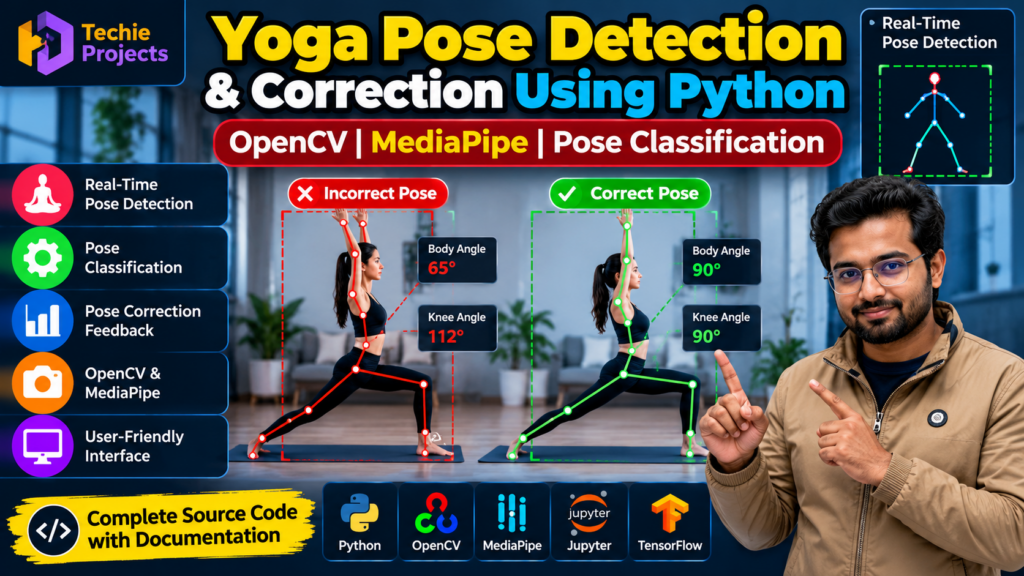
Yoga Pose Detection and Correction Using Python is a computer vision project that explores how technology can identify human body landmarks, classify yoga poses, and provide feedback about posture. Using Python, OpenCV, and MediaPipe, this project demonstrates how pose estimation can be applied to real-time yoga posture analysis.
This project is suitable for B.Tech Computer Science students, final-year engineering students, and learners interested in artificial intelligence, machine learning, image processing, and human pose estimation.
The system can analyze supported yoga poses through a webcam or video input and display visual feedback based on its implemented pose classification and correction rules.
🎬 Project Working Demo
Watch the project demonstration to see how yoga poses are detected, how body landmarks are displayed, and how the application distinguishes between supported poses.
🎯 Objectives of the Project
The main objectives of this yoga pose detection project are:
- Detect human body landmarks using computer vision.
- Recognize selected yoga poses from image or video input.
- Classify supported poses using predefined rules or a trained model.
- Display visual feedback to help users understand their posture.
- Explore real-time pose estimation using Python.
- Demonstrate practical applications of AI and computer vision.
🔍 Key Features of Yoga Pose Detection and Correction
1. Real-Time Pose Detection
The system can process webcam frames and identify supported body landmarks, depending on the implementation and device performance.
2. Body Landmark Tracking
MediaPipe Pose can help identify landmarks such as shoulders, elbows, hips, knees, and ankles. These landmarks provide useful information for analyzing body posture.
3. Yoga Pose Classification
The application can classify supported yoga poses using landmark coordinates, calculated angles, predefined conditions, or a trained machine learning model.
4. Posture Feedback
The system can display visual indicators or messages when a detected pose meets or fails to meet the configured criteria.
5. Visual Pose Display
Body landmarks and connections can be drawn over the video to make pose estimation easier to understand.
6. User-Friendly Interface
Depending on the implementation, the project can provide controls for starting the camera, viewing the detected pose, and reviewing feedback.
⚙️ Technologies Used
Python
Python is the primary programming language used for application logic, data processing, and integrating the required libraries.
OpenCV
OpenCV supports image and video processing, webcam access, frame manipulation, and visual overlays.
MediaPipe
MediaPipe provides pose-estimation capabilities for detecting body landmarks from supported image and video inputs.
NumPy
NumPy can be used for numerical calculations, including landmark-coordinate processing and joint-angle calculations.
Machine Learning (Optional)
A machine learning model may be used to classify poses if the project includes model training or inference. The exact algorithm depends on the implementation.
🔄 How Does the System Work?
The general workflow of a yoga pose detection and correction system includes the following stages:
- Video Input: Capture frames from a webcam or load a supported video.
- Frame Processing: Prepare frames for pose estimation.
- Landmark Detection: Identify body landmarks using a pose-estimation library.
- Feature Extraction: Calculate relevant distances, coordinates, or joint angles.
- Pose Classification: Compare the extracted features with supported pose definitions or model predictions.
- Feedback Generation: Display the detected pose and relevant feedback based on the implemented rules.
- Visual Output: Show the processed video with landmark overlays and classification results.
The accuracy and speed of the system depend on lighting, camera position, body visibility, pose variation, and hardware performance.
🧘 Applications of Yoga Pose Detection
Yoga pose detection using Python can be explored in several educational and practical contexts:
- Yoga posture analysis demonstrations
- Computer vision learning projects
- Human pose estimation experiments
- Fitness application prototypes
- Interactive exercise interfaces
- AI-based movement analysis research
The application should be treated as a learning or fitness-support prototype rather than a substitute for guidance from a qualified yoga instructor or healthcare professional.
🛠️ Software Requirements
Typical software requirements may include:
- Python 3
- OpenCV
- MediaPipe
- NumPy
- Visual Studio Code, PyCharm, or another compatible IDE
- A supported operating system
- A webcam, if real-time input is required
The exact package versions should be confirmed against the project’s source code and environment.
💻 Hardware Requirements
- Laptop or desktop computer
- Webcam for real-time detection
- Keyboard and mouse
- Adequate RAM and storage
- A compatible processor
Higher-performance hardware may improve processing speed, but the actual requirements depend on the selected model and implementation.
✅ Advantages of the Project
- Provides practical experience with Python and computer vision.
- Demonstrates human pose estimation and landmark tracking.
- Combines video processing with posture classification.
- Can be extended to support additional yoga poses.
- Helps students understand how real-time AI applications are developed.
- Offers opportunities to explore user interfaces and visual feedback.
⚠️ Limitations
Pose estimation can be affected by poor lighting, camera angles, occlusion, loose clothing, and partially visible body parts. A system trained or configured for a limited set of poses may not recognize unfamiliar movements correctly.
Furthermore, visual pose feedback does not guarantee that a yoga posture is safe or biomechanically correct for every individual. Any correction rules should be tested carefully and presented as educational guidance.
🚀 Future Scope
The project can be extended with features such as:
- Support for additional yoga poses
- Improved pose classification
- Custom datasets for model training
- Pose history and performance summaries
- A graphical dashboard
- Video-based posture analysis
- Personalized feedback rules
- A web or mobile application interface
These features should only be advertised as completed capabilities when they are actually implemented.
❓ Frequently Asked Questions
1. What is yoga pose detection using Python?
It is a computer vision application that identifies body landmarks and uses them to recognize or analyze supported yoga poses.
2. Which technologies are used in this project?
Python, OpenCV, MediaPipe, and NumPy are common choices. Additional machine learning libraries depend on the implementation.
3. Is this project suitable for final-year engineering students?
Yes. It can be suitable for Computer Science, Information Technology, AI, and related engineering students, subject to their academic requirements.
4. Can yoga poses be detected in real time?
Yes, real-time detection is possible when the implementation supports webcam input and the computer can process frames efficiently.
5. Can I purchase the source code for this project?
Contact Techie Projects to confirm availability, supported features, source-code delivery, documentation, installation requirements, and pricing.
🛒 Get the Yoga Pose Detection Project
Looking for a practical AI or computer vision project for your final-year engineering submission?
Techie Projects helps students explore Python, machine learning, and computer vision projects for academic learning and demonstrations.
Contact us to discuss the Yoga Pose Detection and Correction project and confirm which deliverables are available for purchase.
📲 Call/WhatsApp: +91-9460060699
🌎 Website: www.techieprojects.com
📺 Instagram: @pythonprojects_
Before purchasing, confirm the source code, implemented features, supported environment, documentation, project demonstration, and available technical support.
🔗 Explore Related Projects
- Sign Language to Text Conversion Using Machine Learning
- Face Recognition Attendance System Using Python
- Human Activity Recognition Using Machine Learning
- Hand Gesture Recognition Using OpenCV
- Brain Stroke Classification Using CT and MRI Images
Conclusion
Yoga Pose Detection and Correction Using Python is an educational computer vision project that demonstrates how body landmarks, pose estimation, and classification techniques can be combined to analyze supported yoga poses.
By exploring Python, OpenCV, and MediaPipe, students can gain practical experience in video processing, human pose estimation, and real-time application development. With suitable testing and carefully designed feedback rules, the project can also serve as a foundation for further experiments in AI-based movement analysis.